
Posts by Gershon Kogan

Reimagining the Persianate Sphere: Iran’s Response to Turkic Regional Integration
PSCRP-BESA Reports No 227 (August 31, 2026)
1. Introduction
In mid-August 2026, Iran’s First Vice President Mohammad-Reza Aref met in Tehran with Tajikistan’s Minister of Energy and Water Resources, Daler Juma. The substance of the meeting was unglamorous: oil bitumen and petrochemical exports, aviation fuel, a joint energy commission, and a first half of 2026 in which bilateral trade already ran some 15 percent ahead of the same period in 2025. Only after working through this ledger did Aref turn to something else — a proposal, in his words, to build on the “extensive cultural, civilizational, and linguistic commonalities” between the two countries by establishing a “Union of Persian-Speaking Countries and Regions,” and to pursue the idea “seriously” through further meetings and visits. (IRNA, 2026; Mehr News Agency, 2026)
It is worth being precise about what did, and did not, occur. No union was announced. Tajikistan did not agree to join one. No institution, charter, or secretariat exists. What exists is a proposal, advanced by a senior Iranian official and appended to a routine bilateral economic meeting — and, as this article will show, not for the first time.
That sequencing is itself significant. The cultural proposal did not occasion the meeting; the meeting created an opening for the cultural proposal. Understood this way, Aref’s remarks appear less as the launch of a coherent geopolitical project than as a rhetorical addition to an unrelated transaction — low-cost, low-commitment, and revealing precisely because it cost Tehran nothing to voice. The question this article poses is therefore not whether such a union will come into being; in any binding institutional form, it almost certainly will not. The more interesting question is why Iranian officials continue to reach for this particular idea, and what its persistent, low-cost recurrence suggests about a strategic problem Tehran has not yet resolved.
2. The Arithmetic of a Narrow Proposal
Taken at face value — a union defined by the Persian language — the arithmetic of Aref’s proposal is unforgiving. Its core membership would consist of Iran, Tajikistan, and Afghanistan. Iran remains a significant regional power, but one degraded by war, sanctions, and domestic economic strain. Tajikistan is culturally central to any Persian project yet lacks the economic or political weight to anchor one. Afghanistan has a large Dari-speaking population, but its government — the Taliban — has maintained a historically difficult, at times openly hostile, relationship with Tehran. Set against the Organization of Turkic States, which already links Turkey, Azerbaijan, Kazakhstan, Uzbekistan, and Kyrgyzstan through transport corridors, coordinated diplomacy, and a growing institutional apparatus, a purely linguistic Persian union resembles a three-member club, two of whose members can scarcely sustain it.
Nor is the idea new. In February 2024, at a “Night of Iranian-Tajik Cultural Heritage” held at Niavaran Palace in Tehran, Ali Darabi — then deputy minister of Iran’s Ministry of Cultural Heritage, Tourism, and Handicrafts — advanced substantially the same proposal: a union of Persian-speaking countries, grounded in shared language, culture, and civilization. Darabi went further than Aref would two years later. Addressing Tajikistan’s deputy culture minister and ambassador, he described Tajikistan as pāre-ye tan-e Irān — “a torn-off piece of Iran’s body.” (ISNA, 2024; Mehr News Agency, 2024)
The phrase merits close attention. It is not a claim about shared literature or festivals; it is a claim about territory and belonging, voiced by a sitting Iranian official at a state-adjacent cultural occasion. It illustrates a structural tendency built into the linguistic framing of a “Persian union”: once the operative criterion becomes ancestry and language rather than shared heritage, the logic drifts toward irredentism — and toward precisely the kind of claim likely to alarm Dushanbe, Tashkent, and Baku rather than draw them closer.
The difficulty with Aref’s proposal, then, is not only its narrowness. It is that its underlying logic points in a genuinely destabilizing direction.
3. The Persianate Alternative
There is an alternative available, and Iranian officials have gestured toward it without ever quite naming it. Scholars of the region have long used a different concept for a different kind of space: the Persianate world. First articulated by the historian Marshall Hodgson and subsequently elaborated by scholars such as Nile Green and Richard Eaton, the term does not describe where Persian is spoken today. It describes the far larger zone in which, for centuries, Persian functioned as a language of literature, courtly culture, administration, and elite education — irrespective of what populations spoke at home or which polity governed them. (Hodgson, 1974; Green, 2019; Eaton, 2019) Isfahan, Herat, Bukhara, Samarkand, and Delhi were, in this sense, nodes within a single cultural system, even though most of their inhabitants were never ethnically Persian.
This shift in criterion substantially alters the map. Consider Central Asia. Uzbekistan today is unambiguously a Turkic-speaking state, and no serious analysis should suggest otherwise. Yet Samarkand and Bukhara — its two most historically consequential cities — served for centuries as centers of Persian literary and scholarly production. The case for a Persianate layer there requires no claim on Uzbek political allegiance; it requires only acknowledging a stratum of shared cultural history that predates, and outlasts, the modern linguistic border.
The Caucasus offers a more consequential case. Azerbaijan’s contemporary national identity rests substantially on Turkic language and orientation toward Turkey. Yet for much of its history the territory lay within Iranian political structures, and its classical elite culture was produced largely in Persian. More broadly, several of the Turkic dynasties that ruled portions of the Iranian plateau — the Safavids prominent among them — governed as patrons of Persian court culture rather than as its rivals. Turkic political authority and Persian civilizational prestige were not historically opposed; they frequently operated through the same institutions.
This is the argument available to Tehran, and it is considerably more sophisticated than anything in Aref’s current framing: not that Azerbaijanis are covertly Persian, but that their poetry, their cities, and their historical administrative traditions took shape within a civilizational space that Iran helped construct but never owned outright.
Nowruz offers the clearest instrument for making this case without provoking the territorial anxieties that language inevitably raises. Its most recent UNESCO inscription, joined by Mongolia in 2024, now covers thirteen states: Iran, Afghanistan, Azerbaijan, India, Iraq, Kazakhstan, Kyrgyzstan, Pakistan, Tajikistan, Turkey, Turkmenistan, Uzbekistan, and Mongolia. (UNESCO, 2024) No signatory is required to concede any ethnic or political claim by joining that list — which is precisely why it functions as an effective instrument of cultural diplomacy in a way that a “union of Persian speakers” cannot. A shared spring festival demands nothing of anyone. A union defined by language asks every participant to choose a side.
4. Turkey Within the Persianate World
The most striking implication of the Persianate framing is also the one Tehran has the strongest incentive to articulate explicitly: it does not exclude Turkey.
Regional commentary has already begun reading Aref’s proposal along these lines — as a Persian-speaking counterweight to the Organization of Turkic States. (Caspian Post, 2026) That framing is not wrong, but it is incomplete. If Iran’s proposal is understood primarily as a response to Turkic integration, Ankara becomes an adversary by definition. But under a civilizational rather than a present-day political framing, Turkey turns out to occupy a position partly inside the space Iran claims to represent. Ottoman court poetry developed in sustained dialogue with the Persian literary canon; Persian served for centuries as a prestige language of Ottoman elite education, alongside Arabic and Ottoman Turkish. The single most globally recognized figure of that shared canon, Jalal ad-Din Rumi — celebrated today, with justification, as part of Turkey’s own cultural heritage and buried in Konya — composed the overwhelming majority of his work in Persian. Turkey itself continues to observe Nowruz.
None of this diminishes Turkish identity or Ankara’s Turkic-world project; that is precisely what makes it a more effective rhetorical instrument than a rival ethnic claim would be. An assertion of the form “you are not truly Turkish” invites easy and confident rejection. An assertion of the form “your civilization, like ours, took shape within a shared Persianate space, long before either of our modern states existed” cannot be dismissed the same way, because it demands nothing be relinquished. It asks only that Turkey recognize the map it has spent two decades drawing was never monochrome.
This is the argument Iran has not yet made, notwithstanding ample historical resources to make it. Aref’s proposal does the opposite: by defining the project around who speaks Persian today, it hands Ankara precisely the clean, exclusive contrast that best serves Turkish interests — a small, impoverished Persian club set against a large, confident Turkic one. The apparent irony is that Tehran’s stronger asset was never linguistic exclusivity but cultural inclusiveness, deployable at Turkey’s own expense.
5. The Ceiling of the Shi’a Model
If a more persuasive civilizational alternative is available, the question follows why Tehran has not organized its strategy around it. The answer lies in what Iran actually chose to export after 1979.
The Islamic Republic’s foreign policy toolkit since the revolution has rested overwhelmingly on religious-ideological solidarity: revolutionary Shi’ism, the “Axis of Resistance,” and a narrative of opposition to the United States and Israel. This toolkit has produced durable results — footholds in Lebanon, Iraq, Syria, and Yemen, cultivated over decades of investment in Shi’a communities and allied militias. It is not a toolkit that failed; it succeeded within a specific and bounded geography.
That geography does not extend into Central Asia. Tajikistan, Uzbekistan, Kazakhstan, Kyrgyzstan, Turkmenistan, and Afghanistan are overwhelmingly Sunni societies, as is Turkey. For these audiences, an ideology built on revolutionary Shi’a identity is not merely unpersuasive; in some contexts it is regarded with active suspicion, carrying associations with sectarian export that regional governments have every incentive to keep at arm’s length.
Analysis of the August meeting by SpecialEurasia captures this asymmetry precisely, framing Iran’s approach in Central Asia as pragmatic and non-ideological — built on trade, energy, transport, and cultural exchange — in explicit contrast to the ideological, resistance-based model Tehran pursues in the Levant. Tajikistan’s growing trade relationship with Iran — some $254.3 million in the first half of 2026 alone, up nearly 15 percent year-on-year, alongside Iranian-backed drone manufacturing on Tajik soil — illustrates a second, quieter track of Iranian influence in the region: transactional, security-oriented, and largely free of revolutionary rhetoric. (SpecialEurasia, 2026)
Cultural and civilizational appeals — Ferdowsi, Nowruz, the historical memory of Bukhara and Samarkand — carry none of the sectarian baggage attached to revolutionary Shi’ism. They ask nothing of a Sunni Central Asian state that Turkish or Turkic appeals do not equally ask.
The resulting picture is symmetrical: the identity that makes Iran a formidable actor along the Mediterranean coast is the same identity that constrains its reach across the Caspian and beyond. Tehran’s strength in the Middle East and its comparative weakness in Central Asia are not two separate phenomena; they are a single phenomenon observed from two directions.
6. Implications for Israel
For Israeli strategic analysis, this dispute over cultural framing might appear academic — a matter of competing historical claims among states over which Israel exercises no direct influence. It is not. It bears directly on how Israel ought to read the current map of regional power.
The prevailing framework has been straightforward and, for some time, serviceable: Iran constitutes the primary threat, while the Turkic world — Azerbaijan above all, and by extension a more accommodating orientation toward Ankara and Central Asia — has functioned as a natural counterweight. Baku has been a genuine security and energy partner; Turkey, notwithstanding periodic friction, has generally been treated as a state whose interests diverge sufficiently from Tehran’s to be useful. The logic of “the enemy of my enemy” performed real strategic work.
That framework is now under strain, for reasons unrelated to Iran’s cultural proposals and entirely related to Turkey’s own trajectory. Ankara is no longer simply a counterweight to Tehran; it is emerging as an independent center of regional power, with its own institutional architecture in the Organization of Turkic States, its own military reach into Syria and the South Caucasus, and its own ambitions that do not automatically align with Israeli interests merely by virtue of running contrary to Iran’s. A regional order organized around the principle that “whoever opposes Iran is aligned with us” was never a complete strategy; it functioned only so long as Iran remained the sole aspiring regional hegemon.
It no longer is. This is where Iran’s faltering attempt to construct a civilizational counter-pole — however unlikely to succeed in its present form — becomes relevant to Israeli policy in a manner its architects did not intend. A weak, contested, but genuinely existing Persianate pole of gravity, situated alongside an increasingly assertive Turkic one, does not by itself improve Iran’s record toward its adversaries. But it performs a function that unchecked Turkic ascendancy would not: it keeps the region’s cultural and political map plural rather than allowing a single project to define it.
This should not be read as an argument for rapprochement with the Islamic Republic. The regime in Tehran remains what it has been: a state sponsor of terrorism, an active threat to Israel, and a proliferation risk. The distinction that matters is between Iran as a civilization and the Islamic Republic as a regime; conflating the two, in either direction, produces poor policy. What Israeli strategy requires is not fewer adversaries but a clearer accounting of which adversary’s unconstrained rise would prove more consequential — and that calculation now requires monitoring Ankara’s civilizational ambitions as closely as Tehran’s.
7. Conclusion
Three outcomes appear plausible from this point. The most likely is that the proposal recedes quietly, as its 2024 predecessor did — a paragraph in a communiqué, a working group that never reconvenes. A second, marginally more durable possibility is a decorative institution: a cultural commission, a set of memoranda, without meaningful capacity to shape events. The third, and most consequential, is that Tehran abandons the framework of formal union-building altogether and instead invests, quietly and incrementally, in the underlying instruments — language institutes, joint heritage nominations, university exchanges, tourism — without ever declaring a union at all.
Any of these three outcomes leaves the same underlying dynamic in place. For four decades, the Islamic Republic constructed its foreign policy around what makes Iran part of a larger Islamic world. Confronted with a rising Turkic order it cannot out-compete on ideological terms, it may be discovering — tentatively, and without yet saying so plainly — what makes Iran a world of its own.
References
Caspian Post. “A Persian-Speaking Alliance Against the OTS? Why Iran is Reviving an Old Idea.” 2026.
Eaton, Richard M. India in the Persianate Age, 1000–1765. Allen Lane, 2019.
Green, Nile, ed. The Persianate World: The Frontiers of a Eurasian Lingua Franca. University of California Press, 2019.
Hodgson, Marshall G. S. The Venture of Islam: Conscience and History in a World Civilization, Vol. 2. University of Chicago Press, 1974.
IRNA. “Iran’s VP Proposes Formation of Union of Persian-Speaking Countries, Regions.” 2026.
ISNA. اتحادیه کشورهای فارسیزبان تشکیل [“Formation of the ‘Union of Persian-Speaking Countries.’”] 2024.
Mehr News Agency. ضرورت تشکیل اتحادیه کشورهای فارسیزبان [“The Necessity of Forming the ‘Union of Persian-Speaking Countries.’”] 2024.
Mehr News Agency. “Iran Calls for Setting Up Persian-Speaking Communities: VP.” 2026.
SpecialEurasia. “Iran-Tajikistan and the Persian-Speaking Union Proposal.” 2026.
UNESCO. “International Day of Nowruz.” UNESCO Intangible Cultural Heritage, Representative List, 2024.
Written Sovereignty: Turkey, Russia, and Iran in the Battle Over Post-Soviet Scripts
PSCRP-BESA Reports No 223 (August 10, 2026)
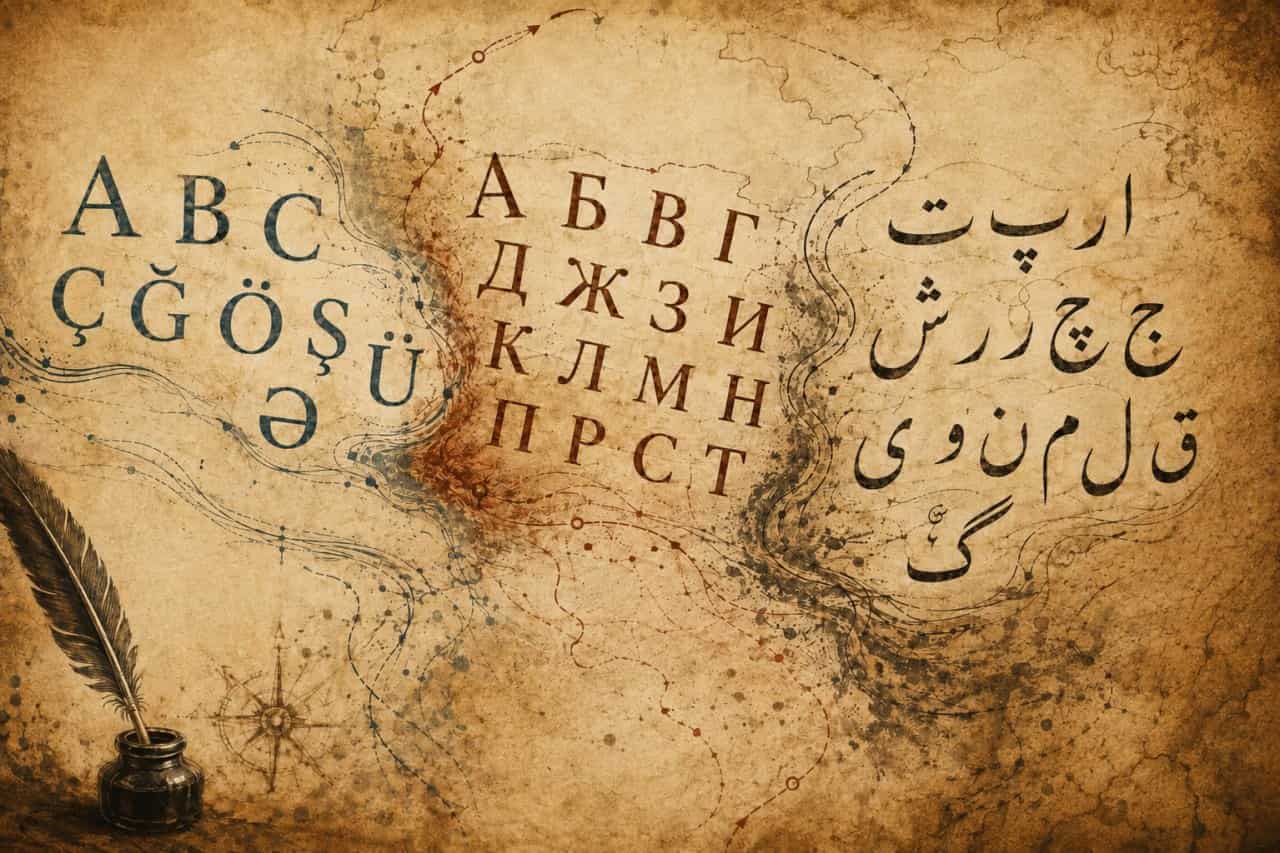
Script is rarely a neutral technical choice in this region. Which alphabet a state teaches its children is a declared vector of civilizational allegiance — a public signal of which power it expects to matter for its future. This is what “written sovereignty” means in practice: not legal independence, but the ongoing, contested right to decide whose cultural gravity a nation writes itself into. Three powers are currently making competing claims on that gravity in the post-Soviet Turkic and Persianate world — Turkey, Russia, and Iran — and they are not equally equipped to press the claim.
I. Facts on the Ground
On September 21, 2024, a commission convened in Baku under the Turkic Academy approved a Common Turkic Alphabet — a 34-letter Latin-based script intended to harmonize the writing systems of Azerbaijani, Turkish, Kazakh, Kyrgyz, Uzbek, and other Turkic languages.1 The project builds on decades of piecemeal Latinization: Azerbaijan completed its own transition from Cyrillic in the 1990s and has since positioned itself as one of the effort’s most committed sponsors, hosting the commission that produced the 2024 declaration. At the commission’s fourth meeting, held in Astana on June 15, 2026, delegates moved from declaration to implementation — endorsing practical recommendations for the alphabet’s use, reviewing proposed Kazakh and Kyrgyz variants, and citing new editions of Abai and Aitmatov printed in the common script as proof of concept.2 The recommendations remain non-binding; each state retains final authority over its own orthography, and the Academy has been explicit that adoption will proceed at each government’s own pace.
That authority has been exercised unevenly. Turkmenistan’s Latinization, begun in the 1990s, is the most institutionally complete in the region. Uzbekistan, officially Latin since 1993, still operates in practice as a digraphic society: a July 2026 reading in the lower chamber of parliament proposed bringing its script closer to the Turkish model by replacing the digraphs sh, ch, o’, g’ with dedicated letters — Ş, Ç, Ö, Ğ — though the bill has not completed the legislative process.3 Kazakhstan’s promised transition, announced in 2017, remains unfinished: as of June 2026 the Ministry of Science and Higher Education had not approved a final Latin alphabet, and its own projections anticipate only 5 percent of written communication in Latin script by 2027, rising to 15 percent by 2029 — modest targets for a reform now entering its second decade.4 Kyrgyzstan’s presidential administration has stated explicitly that the Kyrgyz alphabet — 36 Cyrillic letters — will not change, even as Bishkek continues to participate in the Turkic Academy’s alphabet commission on a symbolic and consultative basis.5
Tajikistan presents the sharpest counter-current. On July 30, 2026, its Ministry of Education confirmed the formation of a working group to strengthen instruction in the traditional Perso-Arabic script — officially termed alifboi niyogon, “the script of the ancestors” — following an instruction from President Emomali Rahmon.6 The announcement stopped short of proposing to replace Cyrillic, Tajikistan’s official script since the Soviet period; it framed the initiative as expanding, not substituting, literacy, and floated the possibility of publishing scholarly work in Persian and Arabic alongside Tajik Cyrillic. Meanwhile, in Iranian Azerbaijan, the Perso-Arabic script has never been displaced, though this continuity reflects the absence of Azerbaijani-language schooling in Iran — where the language is taught in no script at all — rather than any deliberate script policy on Tehran’s part.
A parallel but distinct trend deserves separate treatment: the expansion of Arabic-language instruction across the region under religious and cultural auspices. Between September 2025 and June 2026, ICESCO and the Sultan bin Abdulaziz Al Saud Foundation ran a six-phase teacher-training program — the Sultan bin Abdulaziz Al Saud International Language Training Program: Arabic Language in Central Asia and the Caucasus — moving through Kyrgyzstan, Kazakhstan (Almaty and Turkistan), Bashkortostan, Uzbekistan, and finally Azerbaijan, where it closed in Baku on June 22, 2026 after training more than 200 educators and postgraduate students.7 This is a substantial and well-documented initiative, but its object is modern standard Arabic as a foreign language and religious-educational tool, not the historical Perso-Arabic orthography of Uzbek, Kazakh, or Azerbaijani. Reciting Quranic Arabic, studying modern Arabic, and reading a historical text in Chaghatai or Persianate orthography are three distinct skills that do not automatically follow from one another.8 Growing Arabic literacy in the region is a measurable fact; a corresponding revival of the pre-Soviet national scripts written in Arabic characters is not — Tajikistan, discussed above, remains the only case where a state has moved to institutionalize the latter.
These developments are unfolding against a wider and more assertive Turkish security posture. On August 7, 2026, Turkey, Saudi Arabia, and Pakistan signed the Mecca Agreement, a mutual-defense pact under which an attack on any signatory is to be treated as an attack on all three — a formula Turkish Foreign Minister Hakan Fidan explicitly compared to NATO’s Article 5.9 Officials in Ankara and Riyadh describe the pact as defensive and not directed against any third state, but analysts trace its acceleration to the US-Iran war that began on February 28, 2026, and to the erosion of Gulf confidence in American security guarantees after Israel’s September 2025 strikes on Qatar.10 The Mecca Agreement is a hard-security instrument, not a cultural one, but it reflects the same underlying pattern that runs through the softer evidence collected above: Ankara is currently the most willing and best-resourced actor building new regional architecture — military, religious, and linguistic — while Tehran is largely reacting to events set by others.
II. Three Logics, Not One Contest
It is tempting to read these developments as a single contest between Latin and Cyrillic script, with Arabic-Persian writing as a marginal historical curiosity. That framing obscures more than it reveals. What is actually underway are three distinct mechanisms of influence, each rooted in a different kind of power — and, in Turkey’s case, one that carries an unresolved contradiction of its own.
Turkey: infrastructure with a contradiction at its core. The Common Turkic Alphabet is not merely a philological convenience; it is the latest instrument in a decades-long effort — through TİKA-funded schools, joint universities, satellite television, and now the Organization of Turkic States — to make Ankara the practical center of a shared Turkic communicative space. This effort has an intellectual genealogy that predates the Republic of Turkey itself. In the 1870s–80s, the Azerbaijani playwright and reformer Mirza Fatali Akhundov proposed replacing the Arabic-based script used for both Azerbaijani and Persian with a phonetic, largely Latin-based alternative, arguing that Arabic orthography obscured vowels and impeded literacy among Turkic speakers — a project he framed as part of a broader anticlerical and enlightenment agenda rather than a narrowly technical fix.11 Akhundov’s proposal failed in his own lifetime, but its logic — that the alphabet is a lever of enlightenment and modernization, not merely a technical convention — reappeared in Atatürk’s 1928 reform and again in Soviet Azerbaijan’s own Latinization, which drew on an overlapping pool of Turcological and nationalist thought even as the Soviet and Kemalist states pursued rival visions of modernity.12 What is new in the 2020s is the scale on which this old logic now operates: Turkey has the university system, media market, and diplomatic apparatus to make the same argument regionally rather than nationally, a divergence in outcome between the Turkish and Azerbaijani reforms that later comparative scholarship attributes to precisely this gap in institutional capacity.13
But this Latin-alphabet project sits awkwardly next to the other face of Erdoğan-era Turkey: a sustained ideological turn toward re-Islamization and Ottoman nostalgia, and an explicit bid for leadership of the Sunni Muslim world — a bid the Mecca Agreement itself advances. That bid is written, historically, in Arabic script; the Ottoman Empire whose legacy Ankara increasingly invokes never wrote Turkish in Latin letters at all. A state pursuing Islamic leadership while exporting a Latin alphabet is, in a specific and unresolved sense, offering the region a modernizing script attached to a re-traditionalizing politics. Whether this tension is felt as a contradiction by the governments adopting the Common Turkic Alphabet, or simply absorbed as one more inconsistency of contemporary Turkish self-presentation, is an open question — but it is a real fault line inside Ankara’s own project, not only in the region’s response to it.
Azerbaijan: agency, not submission. It would be a mistake to read Baku’s alignment with Ankara as passive absorption. Azerbaijan did not merely adopt the Common Turkic Alphabet — it hosted and chaired the 2024 commission that produced it, positioning itself as the administrative hub of Turkic script integration rather than a mere recipient of Turkish standards. Azerbaijan is Latin, has been for three decades, and is geographically the hinge between Turkey and Central Asia; hosting the institution that sets the regional standard is a way of converting proximity to Turkey into leverage over the entire Turkic space, not a symptom of losing independent standing. Baku continues to insist, in its own state rhetoric, on the distinctness of the Azerbaijani literary language from Istanbul Turkish, even as it absorbs Turkish media, vocabulary, and educational partnerships. This distinction matters beyond linguistics: a genuinely independent-minded Azerbaijan, using the Turkic-integration project for its own ends rather than simply following Ankara, is also the more useful and more predictable partner for outside actors — Israel among them — who have built a substantial relationship with Baku and have an interest in an Azerbaijan that hedges rather than one that becomes a straightforward extension of Turkish foreign policy.
Russia: inertia that is also leverage. Russia’s position rests on inertia rather than script reform — but it would understate Moscow’s hand to call this passive. An open push to entrench Cyrillic would invite immediate accusations of colonialism and empire-building, with uncertain returns; Russia has largely avoided that fight. What it has instead is the region’s principal labor market. A Tajik, Uzbek, or Kyrgyz citizen can rebrand his national identity as Turkic, adopt a Turkish-modeled alphabet, and consume Turkish television — and still find that the country where the money is earned is Russia, not Turkey. That fact requires functional Russian, and in practice Cyrillic literacy, regardless of what the state does with its own national orthography. Comparative sociolinguistic work on the post-Soviet space shows this persistence varies by domain — Russian retains particular strength in employment, higher education, and private life even where states have symbolically prioritized the titular language in law and public signage.14 Kazakhstan’s stalled transition and Kyrgyzstan’s explicit refusal to change script are not simply evidence of the cost of alphabet reform; they reflect a population for whom Cyrillic remains tied to the language of remittances.
Iran: an archive that activates itself, but not for Tehran. Iran’s position is different in kind from both. Unlike Turkey, it is not building new institutions to project script influence in the region; unlike Russia, it has no comparable economic leverage to fall back on. What it has is depth of prior text: a body of classical Persian and Persianate literature — Ferdowsi, Rudaki, Hafez, and the “Azerbaijani school” of Persian poetry produced in Ganja, Shirvan, and Tabriz — that predates the modern national borders of the region and remains, in principle, legible to anyone who can read the Perso-Arabic script. Tajikistan’s alifboi niyogon initiative draws on exactly this reservoir, and the fact that Dushanbe, not Tehran, is doing the drawing should be read carefully rather than simply as a mark of Iranian weakness. Persian literary capital appears able to activate itself transnationally precisely because it is not owned by any single state — it belongs to Tajik, Afghan, and diaspora communities as much as to Iran, and a third country can claim it without asking Tehran’s permission. That is a genuine strength of the tradition.
It is also, for Iran specifically, the source of the problem this paper is tracing: a cultural asset that does not require Iranian institutions to survive is also an asset that does not translate into Iranian diplomatic leverage over the states that draw on it. The Tajik government has taken care to frame the script as ancestral and national, not Iranian or Islamic — treating Iran’s literary heritage as a common inheritance to be claimed, not a patron relationship to be entered into. The historical record supports reading this as an Iranian institutional failure rather than a simple absence of interest: Shireen Hunter’s assessment of Iranian foreign policy in the post-Soviet space finds that Tehran’s civilizational capital has repeatedly been outweighed by sanctions, the securitized caution of secular Central Asian regimes toward a revolutionary Shia state, and competition from a more agile Turkey.15 Hamid Ahmadi’s study of Iran-Tajikistan relations is more pointed still: an earlier, more ambitious attempt to revive the Perso-Arabic script in Tajikistan stalled into what he calls a deadlock, undone not by cultural distance but by political friction between the two states.16 A separate study of Ahmadinejad-era “strategic partnership” rhetoric reaches a compatible conclusion — public amity between Tehran and Dushanbe repeatedly failed to translate into substantive cooperation, undercut by dysfunction in Iran’s own foreign-policy execution as much as by Tajik reluctance.17 The 2026 initiative is best read against this history: a second attempt, this time initiated and controlled by Dushanbe rather than proposed by Tehran, which may be precisely why it has gone further than its predecessor.
A second archive that stayed on the shelf. Iran’s position looks stronger still when set against the obvious counter-case: Uzbekistan’s own pre-Soviet literary canon, above all Alisher Navoi, who wrote in Chaghatai Turkic in Arabic script and remains a celebrated national symbol in Tashkent — a competing archive available to the Turkic side without reference to Persian sources at all. In practice, however, the Uzbek state has not developed a comparable script-literacy initiative around it. What Uzbekistan has built instead is a heritage brand: an international Uzbek-language olympiad bearing Navoi’s name for students abroad, a national theater and museum complex, and cultural showcases at events like the Bukhara Biennale.18 None of this restores the ability to read Navoi’s actual Chaghatai text in its historical orthography, in the way Tajikistan’s initiative is explicitly designed to restore Perso-Arabic reading competence. Navoi functions in today’s Uzbekistan largely as a museum exhibit and a source of national pride, not as a living, re-readable archive. This asymmetry — one tradition being reactivated for reading, the other mainly commemorated — is itself evidence for, not against, the paper’s central claim: Iran’s literary capital in the region remains comparatively the more “alive” of the two available archives, even though Iran itself is not the one reviving it.
What ordinary readers actually do. It is worth being concrete about who bears the cost of these choices. A construction laborer from Tajikistan or a cleaner from Uzbekistan working in Moscow learned one alphabet in school and knows it; repeated state-level script changes do not touch their daily literacy so much as they threaten to leave the next generation stranded between the schoolbooks their parents can read and the ones the state now prints. For this population, the practical alphabet is whichever one is tied to where the work and the money are — which is currently Cyrillic, because that is Russia’s script, not because of any residual ideological attachment to it. Emerging machine-transliteration tools for the Tajik-Persian language pair are a genuine technical development, and may eventually make cross-script reading easier for scholars, journalists, and diaspora communities with reliable internet access.19 But they are not yet, and may not soon be, part of the daily toolkit of a Tajik construction worker or an Uzbek migrant cleaner, and it would overstate the case to treat this technology as a near-term equalizer of the region’s script politics. For the population actually doing the writing and reading day to day, the practical alphabet remains the one tied to employment, not to historical depth or software.
III. Archives Are Not Instruments
None of this points toward a single alphabet’s victory. The more likely trajectory, over the next five to ten years, is a functionally stratified writing landscape: Latin script consolidating as the medium of Turkic integration and digital modernity; Cyrillic persisting wherever Russian-language labor markets and infrastructure remain more valuable than any alternative; and Perso-Arabic script surviving as a register reserved for religion, classical literature, and acts of historical reclamation rather than for everyday state communication. Kazakhstan’s stalled transition and Uzbekistan’s enduring digraphia suggest this stratification is already the default outcome even where governments have formally committed to something cleaner.
Turkey did not win its current position through cultural affinity alone; it won it through universities, broadcasters, and a diplomatic and now security apparatus willing to spend money and attention on the region for three decades — and, as of August 2026, willing to formalize that commitment into a defense pact with explicit NATO-style obligations. Russia did not preserve Cyrillic through persuasion; it preserved it by remaining the region’s most reliable source of income, which is a harder thing to dislodge than any single government’s alphabet decree. Iran’s advantage, by contrast, remains what it has been since the Qajar period: an archive without a delivery system — one that other states can and do activate for their own purposes, but which Tehran itself has repeatedly failed to convert into diplomatic or cultural leverage of its own.
This has a bearing beyond orthography. The Mecca Agreement shows Turkey building hard-security architecture around exactly the same set of states — Central Asia, the Caucasus, the wider Sunni world — where it is also setting the cultural and linguistic pace, at a moment when Iran has been substantially weakened by the war that began in February 2026. For an Israeli and Western policy audience, the interesting conclusion is not that Iran is culturally rich but strategically impotent, an observation that by itself has limited operational value. It is that the region’s cultural and linguistic vacuum left by Iran’s institutional weakness is not staying empty — it is being filled, systematically and on multiple fronts, by an assertive Ankara that is simultaneously building a Sunni-aligned military bloc, a pan-Turkic linguistic bloc, and a media and education footprint that stretches from the Caucasus to Central Asia. A Turkey that leads unopposed in all three registers — security, script, and religious authority — across this space is a materially different regional actor than a Turkey that has to share civilizational ground with a weakened but still-present Iranian archive. That may be a real, if narrow, argument for why Western and Israeli policy should not treat Iran’s cultural weakness in this region purely as good news: an Iran with zero capacity to project its literary and linguistic capital removes one of the few countervailing claims on a space Turkey is otherwise positioned to dominate outright.
This is the real fault line in Eurasia’s alphabet politics, and it will not be resolved by counting how many states use which letters. The question that will determine the region’s cultural realignment over the coming decade is not which script prevails, but which power — or which government acting on its own initiative — proves able to convert written heritage into a functioning instrument of statecraft. On present evidence, Turkey and Russia both can, in different registers. Iran, so far, cannot — and that gap is now opening at the same moment Ankara is converting the same regional relationships into a formal security bloc.
Bibliography
Academic literature
Landau, Jacob M.; Kellner-Heinkele, Barbara. Politics of Language in the Ex-Soviet Muslim States: Azerbayjan, Uzbekistan, Kazakhstan, Kyrgyzstan, Turkmenistan and Tajikistan. London: Hurst, 2001.
Landau, Jacob M.; Kellner-Heinkele, Barbara. “Alphabet Reform in the Six Independent Ex-Soviet Muslim Republics.” Journal of the Royal Asiatic Society 20, no. 1 (2010).
Algar, Hamid. “Āḵūndzāda.” Encyclopaedia Iranica.
Swietochowski, Tadeusz. Russian Azerbaijan, 1905–1920: The Shaping of National Identity in a Muslim Community. Cambridge: Cambridge University Press, 1985.
Fierman, William. Language Planning and National Development: The Uzbek Experience. Berlin/New York: Mouton de Gruyter, 1991.
Dave, Bhavna. Kazakhstan: Ethnicity, Language and Power. London: Routledge, 2007.
Kudaibergen, Diana T. The Kazakh Spring: Digital Activism and the Challenge to Dictatorship. Cambridge: Cambridge University Press, 2024. Esp. ch. 5, “Generation Q and Decolonizing Alash.”
Perry, John R. “Modern Tajiki Persian: Gharbzadagi of a Different Kind.” Nationalities Papers.
Ahmadi, Hamid. “Iran and Tajikistan: How Culture and Civilization Fade in the Shadow of Politics and the Political.” Iran and the Caucasus 23, no. 1 (2019): 105–.
Clark, B. “Ahmadinejad, Iran, and Foreign Policy Dysfunction in Tajikistan.” Asian Politics & Policy 7, no. 2 (2015): 213–244.
Hunter, Shireen T. Iran’s Foreign Policy in the Post-Soviet Era: Resisting the New International Order. Westport, CT: Praeger, 2010.
Khalid, Adeeb. Islam after Communism: Religion and Politics in Central Asia. Berkeley: University of California Press, 2007.
Güven Kılıçarslan, Zehra. “Language Policy in Turkey and Azerbaijan: A Comparative Approach to the Two Language Reforms.” Littera Turca Journal of Turkish Language and Literature 8, no. 2 (2022): 1660–.
Lummus, Wesley. “One Nation, Two Languages: Latinization and Language Reform in Turkey and Azerbaijan, 1905–1938.” PhD diss., University of Minnesota, 2021.
Pavlenko, Aneta. “Russian in post-Soviet countries.” Russian Linguistics 32, no. 1 (2008): 59–80.
Primary / official documents
Turkic Academy. “Declaration on the Common Turkic Alphabet.” Baku, September 21, 2024.
Turkic Academy. Materials of the Fourth Meeting of the Commission on the Common Turkic Alphabet. Astana, June 15, 2026.
Republic of Uzbekistan, Legislative Chamber (Oliy Majlis). First reading on alphabet amendment (introduction of Ş, Ç, Ö, Ğ), July 2026.
Republic of Kazakhstan, Ministry of Science and Higher Education. Statement on Latin alphabet implementation timeline, June 2026.
Tajikistan, Ministry of Education and Science / Asia-Plus. “This Is the Script of Our Ancestors.” July 30, 2026.
ICESCO / Sultan bin Abdulaziz Al Saud Foundation. Closing ceremony announcement, Sultan bin Abdulaziz Al Saud International Language Training Program — Arabic Language in Central Asia and the Caucasus. Baku, June 22, 2026.
APA. “Хакан Фидан: Мекканское соглашение готовилось 2 года и 8 месяцев.” August 8, 2026.
Vfokuse.mail.ru. “«Мусульманское НАТО»: что стоит за соглашением Турции, Саудовской Аравии и Пакистана.” August 2026.
Podrobno.uz. “Олимпиада имени Навои. В Узбекистане запустят международное соревнование по узбекскому языку.” May 19, 2026.
III. Preprints / technical
Arabov, Mullosharaf K. “A Systematic Benchmark of Machine Transliteration Models for the Tajik-Farsi Language Pair: A Comparative Study from Rule-Based to Transformer Architectures.” arXiv:2605.02270, 2026.
Arabov, Mullosharaf K. “TajPersLexon: A Tajik–Persian Lexical Resource and Hybrid Model for Cross-Script Low-Resource NLP.” arXiv:2605.06886, 2026. (Note: author is affiliated with Kazan Federal University, not with a Tajik or Iranian institution.)
Footnotes
Turkic Academy, “Declaration on the Common Turkic Alphabet,” Baku, September 21, 2024.
Turkic Academy, Materials of the Fourth Meeting of the Commission on the Common Turkic Alphabet, Astana, June 15, 2026.
Republic of Uzbekistan, Legislative Chamber, first reading on alphabet amendment, July 2026.
Republic of Kazakhstan, Ministry of Science and Higher Education, statement on Latin alphabet implementation timeline, June 2026.
Statement of the Kyrgyz presidential administration on the retention of the 36-letter Cyrillic alphabet, 2026.
Tajikistan Ministry of Education and Science / Asia-Plus, “This Is the Script of Our Ancestors,” July 30, 2026.
ICESCO / Sultan bin Abdulaziz Al Saud Foundation, closing ceremony announcement, Baku, June 22, 2026.
Khalid, Islam after Communism, 2007.
APA, “Хакан Фидан: Мекканское соглашение готовилось 2 года и 8 месяцев,” August 8, 2026.
Vfokuse.mail.ru, “«Мусульманское НАТО»: что стоит за соглашением Турции, Саудовской Аравии и Пакистана,” August 2026.
Algar, “Āḵūndzāda,” Encyclopaedia Iranica.
Lummus, “One Nation, Two Languages,” 2021.
Güven Kılıçarslan, “Language Policy in Turkey and Azerbaijan,” 2022.
Pavlenko, “Russian in post-Soviet countries,” Russian Linguistics 32, no. 1 (2008): 59–80.
Hunter, Iran’s Foreign Policy in the Post-Soviet Era, 2010.
Ahmadi, “Iran and Tajikistan,” Iran and the Caucasus 23, no. 1 (2019): 105–.
Clark, “Ahmadinejad, Iran, and Foreign Policy Dysfunction in Tajikistan,” Asian Politics & Policy 7, no. 2 (2015): 213–244.
Podrobno.uz, “Олимпиада имени Навои,” May 19, 2026.
Arabov, “A Systematic Benchmark of Machine Transliteration Models for the Tajik-Farsi Language Pair,” arXiv:2605.02270, 2026; Arabov, “TajPersLexon,” arXiv:2605.06886, 2026.
Tolerated Memory, Withheld Recognition: Iran, the Armenian Genocide, and the Politics of Historical Asymmetry
PSCRP-BESA Reports No 218 (July 17, 2026)
Introduction
The Israeli cabinet’s unanimous recognition of the Armenian Genocide in June 2026 generated predictable reactions: Turkish condemnation, Azerbaijani diplomatic protest, and Armenian restraint. Less predictable — and analytically more revealing — was the response from Tehran. Iranian state media framed the decision not as an act of historical justice but as an Israeli strike against Ankara, a geopolitical maneuver dressed in moral language. The irony was pointed: Iran itself has never formally recognized the Armenian Genocide, despite hosting one of the oldest Armenian communities in the Middle East and despite the fact that the term genocide — ‘naslkoši’ in Persian — was coined by a Jewish jurist, Rafael Lemkin.
This paper argues that Iran’s management of Armenian collective memory constitutes a coherent, if unacknowledged, policy of tolerated memory without formal recognition — a model in which a minority community is granted cultural, religious, and even political space to commemorate its historical trauma, while the state carefully withholds the diplomatic act that would transform private grief into public accountability. This model is not incidental. It reflects a structural logic that governs how the Islamic Republic handles historical memory more broadly: other peoples’ pain is selectively instrumentalized, one’s own geopolitical interests are protected, and — most strikingly — the Jewish Holocaust is actively denied at the highest levels of state. The result is a coherent asymmetry: Armenian memory is tolerated; Jewish memory is weaponized through denial; and Iranian state recognition of either remains diplomatically inconvenient.
A secondary argument concerns the persistent conflation, in Western analytical literature, of Azerbaijanis in Iran with the political positions of the Republic of Azerbaijan. This conflation is historically and empirically unwarranted. Iranian Azerbaijanis have been embedded in Iranian political life for centuries — constituting a substantial portion of the country’s ruling elite, from the Safavid and Qajar dynasties through to the Islamic Republic itself — and their relationship with Armenia’s memory is shaped by an Iranian historical frame rather than a Baku-directed one.
Literature Review
The Armenian community in Iran has received sustained scholarly attention, though rarely in connection with the politics of genocide recognition. Sanasarian’s foundational study of religious minorities in Iran establishes the legal and institutional framework within which Armenians operate: recognized in the constitution, granted parliamentary seats, permitted their own schools and churches, yet subject to informal pressures that constrain public political expression (Sanasarian 2000). Chaqueri’s earlier monograph, the first systematic English-language survey of Armenian-Iranian history, documents the paradoxical centrality of a community that remained politically marginal (Chaqueri 1998). A 2024 article in Iranian Studies updates this picture, tracing how the Islamic Republic’s evolving use of the term aqaliyyat (minority) has affected Armenian self-positioning within Iranian political discourse.
On the specific question of genocide recognition and its relationship to Iranian foreign policy, the most directly relevant recent contribution is Yacoubian’s analysis of Armenian advocacy under regional constraints, which introduces the concept of “muted empathy” to describe Iran’s position: acknowledgment of the Armenian tragedy in cultural and religious spaces, without any formal diplomatic declaration (Yacoubian, Armenian Weekly, 2025). This paper builds on that framework while adding two dimensions absent from Yacoubian’s analysis: the comparative dimension of Holocaust denial as the mirror image of tolerated Armenian memory, and the granular distinction between Iranian Azerbaijani identity and the pan-Turkic solidarity politics of Baku.
The Persian-language scholarship adds a layer unavailable to most Western analysts. Ismail Ra’in’s Qatl-e ʿĀm-e Armaniyan (1978), still the only comprehensive Persian-language study of the genocide, demonstrates that Iranian scholarly recognition of the events of 1915 long predates any official state position — a gap that itself constitutes the central puzzle of this paper (Ra’in 1978). The archival documentation assembled in Tarikh-e Irani (2021) further confirms that Iranian intellectuals and officials acknowledged the genocide in private discourse across the twentieth century, even as state policy maintained strategic silence.
On the theoretical level, this paper draws on constructivist approaches to memory politics, as elaborated in recent scholarship on genocide recognition as a political act distinct from historical fact (Feindt et al. 2014; International Affairs 2023). The French scholarly tradition, particularly the analysis of France’s 2001 recognition law in CEMOTI — a journal devoted precisely to the Ottoman and Iranian world — provides a useful comparative case: recognition as a parliamentary act that outpaced executive preference, driven by a combination of diaspora lobbying and bilateral political friction (Masseret 2001). Ferhadjian’s comparative study of Armenian genocide and Holocaust recognition frameworks in Revue d’Histoire de la Shoah (2003) informs the paper’s treatment of asymmetric memory politics.
For the Azerbaijani dimension, the paper relies primarily on Shaffer’s Borders and Brethren (MIT Press, 2002), the most rigorous treatment of Iranian Azerbaijani identity and its relationship to Baku’s irredentist politics, supplemented by Souleimanov’s analysis of the limits of secessionism in Iranian Azerbaijan (2011) and Atabaki’s historical study of the competition between pan-Turkism and Iranian nationalism in the region (2006).
A Note on Terminology
The term “Azerbaijani” requires clarification at the outset. In Russian and much of the Western scholarly literature, the word azerbaijanets is applied indiscriminately to both the citizens of the Republic of Azerbaijan and the Turkic-speaking population of Iran’s northwestern provinces of East and West Azerbaijan — as if these two groups constituted a single, undifferentiated ethno-political unit. This conflation is analytically misleading and underlies much of the confusion in Western assessments of Iranian domestic politics.
Persian usage draws a meaningful distinction. The term Āzari (آذری) in contemporary Iranian discourse refers primarily to the inhabitants of the Iranian provinces historically known as Azerbaijan — that is, the population of Tabriz, Urmia, and surrounding areas. The Turkic-speaking population of these provinces more commonly self-identifies, and is identified by others in Iran, as Tork (ترک) — Turks — a term that foregrounds linguistic and cultural affiliation rather than the territorial-political identity implied by “Azerbaijani.” The citizens of the Republic of Azerbaijan, by contrast, are typically referred to in Iran as Āzarbāyjāni (آذربایجانی) or simply as the northern neighbors across the Aras River.
These are not merely lexical distinctions. They reflect genuinely different historical trajectories, political loyalties, and cultural orientations. Throughout this paper, the term “Iranian Azerbaijanis” refers to the Turkic-speaking population of northwestern Iran, while “Azerbaijanis” without qualification refers to citizens of the Republic of Azerbaijan. Where the distinction is analytically significant — as it frequently is — it will be made explicit.
Tolerated Memory, Withheld Recognition: Iran’s Armenian Policy
The Armenian presence in Iran is among the oldest and most continuously documented Christian minority communities in the Islamic world. Brought to Iran in large numbers by Shah Abbas I in the early seventeenth century — relocated from Julfa in the Araxes valley to New Julfa near Isfahan in a forced but ultimately community-preserving deportation — Armenians became embedded in Iranian commercial, artistic, and diplomatic life in ways that left lasting institutional traces. By the time of the Islamic Revolution of 1979, the community numbered several hundred thousand, concentrated in Tehran, Isfahan, and the northwestern provinces. Today, reduced by emigration to an estimated 100,000–150,000, Iranian Armenians retain a constitutional status denied to most non-Muslim minorities: they are explicitly recognized in the Basic Law of the Islamic Republic, hold two reserved seats in the Majles — one for northern, one for southern Armenians — and maintain their own schools, churches, and cultural organizations under the supervision of the Khalifegari council, the community’s supreme governing body (Sanasarian 2000; Ra’in 1349/1970).
On April 24 of each year, commemorative services are held openly in Armenian churches across Iran. The Cathedral of Saint Sarkis in Tehran hosts the principal ceremony; its courtyard contains a memorial to the victims of the Genocide, inaugurated in 1973 — nearly a decade before the Islamic Revolution and maintained without interruption since. In April 2025, the Armenian embassy in Tehran reported that the ceremony proceeded as usual, with flowers laid at the memorial and prayers offered for the dead. Iranian state television did not cover the event.
This last detail is not incidental. It captures with precision the logic of what this paper terms tolerated memory: the Islamic Republic permits the Armenian community to grieve, commemorate, and transmit its historical trauma across generations, within the bounded space of communal religious life. What it does not permit — or more precisely, what it has consistently declined to perform — is the state act of formal recognition that would transform private Armenian grief into an Iranian diplomatic position.
Iran has never officially recognized the Armenian Genocide. It does not appear on any authoritative list of states that have done so. This is not, as the Persian-language scholarship makes clear, a matter of historical ignorance or scholarly dispute. Ra’in’s Qatl-e ʿĀm-e Armaniyan (1978), the only comprehensive Persian-language study of the genocide, documents the events of 1915–1923 in detail and leaves no ambiguity about their character. The historical analysis assembled in Tarikh-e Irani (2021) demonstrates that Iranian intellectuals, journalists, and politicians acknowledged the genocide across the twentieth century — from the Constitutional Revolution era through the Pahlavi period and into the Islamic Republic. The gap between private acknowledgment and official silence is not a product of uncertainty. It is a product of calculation.
The calculation is geopolitical. Turkey is Iran’s neighbor, its largest regional trade partner outside the sanctions regime, and a state with which Tehran maintains a competitive but functional relationship across multiple theaters — Syria, Iraq, the South Caucasus, Central Asia. An official Iranian recognition of the Armenian Genocide would constitute a direct challenge to the foundational narrative of the Turkish state, one Ankara would be unlikely to absorb without diplomatic consequences. The Islamic Republic, for all its ideological confrontationalism, has consistently preferred to keep its quarrel with Turkey on terrain of its own choosing. The Armenian question is not that terrain.
The logic extends to Azerbaijan. The Republic of Azerbaijan is Turkey’s closest ally, shares a border with Iran’s most restive Turkic-speaking provinces, and serves as a transit corridor of genuine strategic importance. Any Iranian move that strengthened the Armenian position in the regional memory wars would register in Baku as a hostile act — and would reverberate inside Iran among those segments of the Azerbaijani-Iranian population most receptive to pan-Turkic messaging.
The result is a stable, if morally uncomfortable, equilibrium: Armenian memory is tolerated because suppressing it would alienate a loyal and historically integrated community; Armenian genocide recognition is withheld because granting it would cost more than it would gain. The community is permitted to remember. The state declines to confirm.
This equilibrium becomes considerably more complex — and analytically more revealing — when placed alongside Iran’s position on the Holocaust. Here the Islamic Republic has not chosen strategic silence. It has chosen active denial. Holocaust denial in Iran is not a fringe phenomenon: it has been articulated from the highest levels of state, institutionalized in academic conferences, and incorporated into the ideological repertoire of the revolutionary establishment (USHMM 2016; ACIS 2019). The 2006 Tehran conference on Holocaust “revisionism,” convened under presidential auspices, was not a diplomatic miscalculation — it was a statement of position.
The juxtaposition is striking. Armenian memory: tolerated, contained, depoliticized. Jewish memory: actively negated, weaponized, deployed as an instrument of anti-Israeli and anti-Western messaging. In both cases, the Islamic Republic’s posture toward historical atrocity is determined not by the weight of evidence or the demands of moral consistency, but by the political utility of each position at any given moment. Other peoples’ pain, in this framework, is a resource to be managed — allocated, suppressed, or amplified according to the needs of the state.
This is not, it should be emphasized, a uniquely Iranian phenomenon. The politics of genocide recognition are instrumentalized across the region and beyond, as the timing of American, French, and now Israeli recognition of the Armenian Genocide amply demonstrates. What makes the Iranian case analytically distinctive is the simultaneity of the three positions — tolerated Armenian memory, withheld Armenian recognition, active Holocaust denial — within a single state apparatus, and the coherence with which all three serve the same underlying strategic logic.
Tabriz Is Not Baku: Iranian Azerbaijanis and the Limits of Pan-Turkic Solidarity
The Azerbaijani diplomatic protest against Israel’s recognition of the Armenian Genocide — a formal note from the Ministry of Foreign Affairs demanding reconsideration of a decision made by a sovereign state regarding events in which Azerbaijan had no historical part — requires explanation. The Republic of Azerbaijan was never a constituent territory of the Ottoman Empire. Its population played no role at all in the deportations and massacres of 1915–1923. By any conventional standard of diplomatic logic, the recognition of the Armenian Genocide by a third party is not Azerbaijan’s affair.
The explanation lies not in history but in bloc politics. Baku’s reaction was a reflex of pan-Turkic solidarity: an attack on the Turkish historical narrative is perceived, in the political culture of the Republic of Azerbaijan, as an attack on the Turkic world as a whole. The Armenian question is furthermore inseparable, in Azerbaijani domestic politics, from the legacy of the Karabakh conflict — three decades of war, ethnic cleansing of over 800 thousand Azerbaijanis, tragedy of Khojaly, and Armenian narratives of victimhood that have made any Armenian claim to historical justice politically toxic in Baku. For a significant portion of the Azerbaijani information space, the logic is nearly automatic: if Armenians are speaking, one must deny; if Turkey is under pressure, one must defend. The diplomatic note was less a considered foreign policy position than a conditioned response.
What makes this response analytically significant is what it reveals about the assumed unity of the “Azerbaijani” world — an assumption that Western analysts have been too quick to make and too slow to interrogate. The conflation of the Republic of Azerbaijan with the Turkic-speaking population of northwestern Iran is not merely a terminological imprecision, as noted above. It is a substantive analytical error with real consequences for the assessment of Iranian domestic stability, minority politics, and the reach of pan-Turkic ideology inside the Islamic Republic.
The Turkic-speaking population of Iran’s East and West Azerbaijan provinces inhabit a historical frame that is Iranian before it is Turkic. The provinces of Azerbaijan have been part of the Iranian political and cultural space, under various dynasties and designations, for centuries. The Safavid dynasty, which established Twelver Shi’ism as the state religion and laid the foundations of modern Iran, was itself of Turkic-speaking Azerbaijani origin and conducted its court in both Persian and Azeri Turkish. The Qajars, who ruled Iran from the late eighteenth century until 1925, were likewise of Turkic origin. In the Islamic Republic, the pattern continues: the late Supreme Leader Ali Khamenei was an ethnic Azerbaijani from Tabriz; his son Mojtaba Khamenei, widely discussed as a potential successor, is Azerbaijani by descent; the current President Masoud Pezeshkian was born in Mahabad and identifies as Azerbaijani. Far from being a marginalized periphery, Iranian Azerbaijanis have been, and remain, among the most politically integrated communities in the country.
This integration shapes, in fundamental ways, how Iranian Azerbaijanis relate to the Armenian community — and to the Armenian historical narrative. For much of the population of Tabriz, Urmia, and Julfa, Armenians are not the enemy constructed by Karabakh wars. They are old neighbors. The concentration of Armenian churches, monasteries, and historically Armenian neighborhoods across East and West Azerbaijan is not incidental: it reflects centuries of coexistence in a shared provincial space. The monastery of Saint Stepanos near Julfa, the Church of Saint Mary in Urmia, the Armenian quarter of Tabriz — these are not foreign implants but local landmarks, integrated into the fabric of regional life (Ra’in 1349/1970).
This is not to suggest that pan-Turkic sentiment is absent among Iranian Azerbaijanis. It exists, it has organizational expression, and it is attentive to signals from Ankara and Baku. Atabaki’s historical analysis documents the long competition between pan-Turkist and Iranian nationalist currents within Azerbaijani political identity, a competition that has never been fully resolved (Atabaki 2006). Shaffer’s more recent and more provocative account argues that the potential for Azerbaijani separatism in Iran is systematically underestimated by analysts who take Iranian state claims of minority integration at face value (Shaffer 2002). These are legitimate scholarly positions that cannot be dismissed.
What they do not establish, however, is that the pan-Turkic tendency is dominant, or that Iranian Azerbaijanis as a whole share Baku’s reflexive anti-Armenian posture. Souleimanov’s careful empirical analysis of secessionist sentiment in Iranian Azerbaijan concludes that pan-ethnic solidarity with the Republic of Azerbaijan, while present, does not translate into political mobilization at a level that threatens Iranian territorial integrity — and that the reasons for this lie precisely in the depth of Azerbaijani integration into Iranian institutions (Souleimanov 2011). Grebennikov’s analysis of why Azerbaijanis support the Iranian state reaches a similar conclusion through a different methodological route (Grebennikov 2010).
The implications for the present argument are direct. When Israel recognized the Armenian Genocide, the Azerbaijani state responded with a diplomatic protest rooted in the story of Karabakh and pan-Turkic bloc solidarity. But that protest does not speak for the Turkic-speaking population of northwestern Iran. Tabriz is not Baku. It does not share Baku’s historical grievances or its political allegiance to the Turkish alliance. For many of its inhabitants, the recognition of the Armenian Genocide is not an attack on their identity — it is, at most, a distant diplomatic event involving a community they have lived alongside for centuries.
The Western analytical tendency to treat “Azerbaijanis” as a unified transnational actor — with Tabriz as a southern extension of Baku’s political will — misreads the evidence and, more consequentially, misframes the political dynamics of one of Iran’s most strategically important regions.
Conclusion: The Politics of Selective Memory and the Limits of Moral Consistency
The Israeli recognition of the Armenian Genocide has been analyzed, in most Western commentary, as a bilateral event: a decision about Israel’s relationship with Turkey, freighted with the history of a once-functional alliance and the bitterness of its collapse. This paper has argued that the more revealing story lies elsewhere — in the responses of actors whose reactions were, in different ways, more structurally significant than Ankara’s predictable outrage.
Iran’s response — sardonic commentary from state media, framed around Israeli hypocrisy — was analytically coherent but self-undermining. It drew attention, whether intentionally or not, to a contradiction at the heart of Iranian memory politics: a state that tolerates Armenian commemoration within its borders, actively denies the Holocaust at the highest levels of its government, and withholds formal recognition of the Armenian Genocide as a matter of geopolitical convenience. These three positions are not contradictions. They are, as this paper has argued, expressions of a single underlying logic: historical memory is a resource to be managed, not a moral obligation to be discharged. Armenian grief is useful as a marker of communal loyalty and religious pluralism; Armenian recognition would be costly in Ankara and Baku. Jewish memory is useful as an instrument of anti-Israeli mobilization; its affirmation would undermine the ideological foundations of the revolutionary state. The asymmetry is not accidental. It is policy.
Azerbaijan’s response — a formal diplomatic protest against a decision about events in which Azerbaijan had no historical part — illustrates a different view: own local grievances from over three decades long conflict with memories of Khojaly atrocities, and the subordination of historical judgment to bloc solidarity.
What it is not is a position grounded in historical engagement with the events of 1915. And it is emphatically not a position that can be attributed, without serious analytical distortion, to the Turkic-speaking population of northwestern Iran, whose historical relationship with the Armenian community is shaped by centuries of coexistence.
These findings carry implications beyond the specific case of Armenian genocide recognition. They suggest, first, that the politics of historical memory in the Middle East and the South Caucasus cannot be adequately analyzed through the lens of bilateral relationships alone. The recognition or non-recognition of historical atrocities is embedded in regional alliance structures, domestic minority management strategies, and long-term ideological investments that cut across conventional diplomatic categories. Iran’s Armenian policy makes no sense as an isolated decision; it makes complete sense as one element of a coherent, if unstated, framework for managing historical truth as a political instrument.
They suggest, second, that the category “Azerbaijani” requires disaggregation in any serious analytical treatment of the region. The Republic of Azerbaijan and the Turkic-speaking population of northwestern Iran share a language and elements of a cultural heritage. They do not share a political identity, a historical memory, or a relationship to the Armenian question that can be treated as interchangeable. Western policy analysis that conflates the two will systematically misread both Iranian domestic politics and the regional dynamics of the South Caucasus.
They suggest, third, that the moral force of genocide recognition depends, in no small part, on its independence from political convenience. The timing of Israel’s recognition — whatever the weight of moral considerations that informed it — invited precisely the kind of cynical framing that Iranian state media deployed. This is not an argument against recognition; the Armenian Genocide is a historical fact. It is an argument for the proposition that recognition has its fullest moral weight when it is demonstrably not an instrument of current policy — when it precedes, rather than follows, the diplomatic rupture that makes it convenient.
References
Persian / فارسی
رائین، اسماعیل. قتلعام ارمنیان در دوران سلاطین آل عثمان. تهران: امیرکبیر، ۱۳۵۷ [1978].
رائین، اسماعیل. ایرانیان ارمنی. تهران: امیرکبیر، ۱۳۴۹ [1970].
دولتآبادی، یحیی. تاریخ معاصر یا حیات یحیی. تهران: عطار؛ فردوسی، ۱۳۶۲ [1983]. ج ۴.
«ایرانیان و نسلکشی ارمنیان؛ از فروغی تا حسینیان.» تاریخ ایرانی [tarikhirani.ir]، ۱۴۰۰ [2021].
«نسلکشی یا تراژدی بزرگ ارامنه در سال ۱۳۳۳ق/۱۹۱۵م: استدلالهای مخالفان.» فصلنامه تاریخ ایران، دانشگاه اصفهان [jhr.ui.ac.ir].
«ارامنه ایران.» اطلس اقلیتهای دینی ایران [adyan-iran.com].
French / Français
Masseret, Olivier. “La reconnaissance du génocide arménien de 1915 par le Parlement français: Brève histoire politico-diplomatique d’une loi atypique.” CEMOTI, n° 31, 2001, pp. 113–140.
Masseret, Olivier. “La reconnaissance par le Parlement français du génocide arménien de 1915.” Vingtième Siècle. Revue d’histoire, vol. 73, n° 1, 2002, pp. 139–155.
Ferhadjian, Sophie. “Ailleurs, hier, autrement: connaissance et reconnaissance du génocide des Arméniens.” Revue d’Histoire de la Shoah, n° 177–178, janvier–août 2003.
Akcam, Taner. “Genèse d’une histoire officielle: Le tabou du génocide arménien hante la société turque.” Le Monde Diplomatique, juillet 2001, p. 20–21.
English
Sanasarian, Eliz. Religious Minorities in Iran. Cambridge University Press, 2000.
Chaqueri, Cosroe. The Armenians of Iran: The Paradoxical Role of a Minority in a Dominant Culture. Harvard Middle Eastern Monographs, 1998.
Shaffer, Brenda. Borders and Brethren: Iran and the Challenge of Azerbaijani Identity. MIT Press, 2002.
Atabaki, Touraj. “Pan-Turkism and Iranian Nationalism.” In Iran and the First World War. I.B. Tauris, 2006.
Souleimanov, Emil A. “The Evolution of Azerbaijani Identity and the Prospects of Secessionism in Iranian Azerbaijan.” Connections: The Quarterly Journal, 11(1), 2011.
Grebennikov. “Why Do Azeris Support the Iranian State?” CPSA, 2010.
Zarifian, Julien. The United States and the Armenian Genocide: History, Memory, Politics. 2024.
Resende, E. & Budryte, D. (eds.) Memory and Trauma in International Relations. Routledge, 2014.
“Constructivist memory politics: Armenian genocide recognition in Latvia.” International Affairs, Oxford Academic, 2023.
“The Armenian Community and Changing Iranian Perceptions of Minority.” Iranian Studies, Vol. 57, Issue 2, 2024.
Yacoubian. “The politics of Armenian Genocide recognition and regional constraints in the Middle East.” Armenian Weekly, 2025.
US Holocaust Memorial Museum. “Holocaust Denial and Distortion from Iranian Government and Official Media Sources, 1998–2016.” USHMM, 2016.
Alliance Center for Iranian Studies, Tel Aviv University. “What is Behind Iran’s Advocacy of Holocaust Denial?” ACIS Iran Pulse, 2019.
Renaming the Map: Turkey’s Cognitive War for Central Asia and Its Persian Dimension
PSCRP-BESA Reports No 216 (July 8, 2026)
The Provocation: When a Textbook Becomes a Map
By Gershon Kogan
In November 2025, Turkish Minister of Education Yusuf Tekin made a declaration that passed largely unnoticed in Western strategic circles but sent a quiet tremor through the Persian-speaking world. Addressing the replacement of “Central Asia” (Orta Asya) with “Turkestan” (Türkistan) in Turkey’s national history curriculum, Tekin offered an explanation that was anything but pedagogical: the term “Central Asia,” he argued, had been deliberately introduced into academic literature to divide the Turkic world. The new curriculum, he made clear, was correcting a historical injustice — not updating a geography textbook (Anadolu Agency 2025).
This was not a spontaneous ministerial improvisation. The shift had been embedded in Turkey’s Türkiye Yüzyılı Maarif Modeli — the “Turkey’s Century” education model — under President Erdoğan’s patronage since 2024. By June 2026, Tekin repeated the same formulation at a meeting of education ministers of the Organization of Turkic States in Astana, a city that itself underwent a significant renaming not long ago. The message was institutional, deliberate, and regional in scope (MEB/Astana 2026).
The term itself has a history worth examining. “Turkestan” was widely used in Russian imperial cartography for the territories conquered in the nineteenth century — roughly today’s Özbekistān, Tājīkistān, Kyrgyzstan, and parts of Qazaqstan. Soviet nationalities policy then dismantled it: the region was divided into republics along ethnic lines, and “Central Asia” became the standard Soviet — and subsequently Western — category. When Ankara now restores “Turkestan,” it is excavating a term that Russian and Soviet power had buried, and redeploying it with a pan-Turkic ideological charge its imperial-era usage did not carry (Landau 1995; Laruelle 2008).
Most analysts who noticed the story read it through a single lens: Russia. The replacement of a Soviet-era geographic category with a term carrying explicit pan-Turkic weight was interpreted as yet another move in Ankara’s long game of repositioning itself as the natural leader of the post-Soviet Turkic republics — a rival to Moscow’s waning imperial nostalgia. That reading is not wrong. It is simply incomplete.
There is a second civilization that has regarded this territory as its cultural heartland for over a millennium — and it is not Russia. Samarqand, Bukhārā, Marv, Nīshāpūr: these are not neutral points on a map awaiting a new label. They are the cardinal coordinates of Persian civilization, the cities where Rūdakī composed the first great works of classical Persian poetry at the Sāmānid court in Bukhārā, where Ibn Sīnā wrote the Canon of Medicine, where Ferdowsī’s Šāhnāme was recited not as foreign import but as the living idiom of a literate elite (Frye 1965; Narshakhī, trans. Frye). When Ankara erases “Central Asia” and writes “Turkestan” in its place, it is not writing on a blank page. It is writing over a Persian palimpsest.
That is the provocation that has gone unanalyzed in English-language strategic literature. And it arrives at a moment when the civilization most directly targeted by this semantic shift is least equipped to respond.
The Persian Palimpsest: What “Turkestan” Erases
To understand what is at stake in Ankara’s terminological intervention, one must begin not with politics but with geography. The borders of the modern Islamic Republic of Iran do not coincide with the borders of Iranian civilization. They never have.
The territory that Turkey now proposes to call “Turkestan” was, for centuries before the Turkic migrations, an Iranian world. The populations of Sogdia, Bactria, Khwārazm, and Marv spoke Iranian languages, worshipped Iranian deities, and produced Iranian art. When the Arab conquest reshaped the religious landscape of the seventh and eighth centuries, it was Persian — not Arabic, not Turkic — that emerged as the dominant literary and administrative language of the eastern Islamic world. The great cities of what is now Özbekistān and Tājīkistān were not provincial outposts of a civilization centered elsewhere. They were the civilization (Frye 1996; Peacock and Tor 2015).
Bukhārā is the most luminous example. Under the Sāmānid dynasty — the first major Persian renaissance after the Arab conquest — it became the intellectual capital of the eastern Islamic world in the ninth and tenth centuries. The historian Narshakhī, writing in Arabic and translated almost immediately into Persian, recorded a city of extraordinary sophistication: its markets, its madrasas, its court culture conducted entirely in Persian (Narshakhī, trans. Frye). It was at this court that Rūdakī — whom the Encyclopaedia Iranica calls the “archpoet” of Persian literary history, born in a village between Samarqand and Bukhārā — composed the verses that established classical Persian as a literary standard from Anatolia to India (Frye 1965).
The figures the Persian-speaking world regards as its canonical intellectuals were overwhelmingly products of this geography. Ibn Sīnā — Avicenna in the Latin tradition — was born near Bukhārā; his autobiography, preserved through his disciple al-Jūzjānī, describes a formation entirely within the Persian literary and philosophical tradition, in a city that was culturally Iranian long before it became politically contested. Niẓāmī ʿArūžī Samarqandī, author of the Čahār Maqāle, one of the great works of Persian prose, signals his origins in his very name. These are not figures whom Persian civilization exported to Central Asia; they are figures Central Asia contributed to Persian civilization, because for centuries the distinction was meaningless — the region was a single civilizational space, operating in a single literary language (Peacock and Tor 2015; Fragner 1999).
This is what the term “Persianate world” — introduced by Hodgson and refined by Fragner’s concept of Persophonie — captures: not an ethnic or political category, but a civilizational-linguistic space in which Persian functioned as the medium of high culture and intellectual life across an enormous geographic arc, regardless of the ethnic identity of rulers or populations. Turkic dynasties — the Ghaznavids, the Tīmūrids, the Özbek Šaybānids — did not displace Persian culture when they came to power in Central Asia. They adopted it, patronized it, and in many cases produced it (Frye 1996; Bregel 2003).
It is against this background that the semantic weight of “Turkestan” must be assessed. The term does not simply rename a region; it imposes a civilizational taxonomy in which the primary identity of the space is Turkic, and the Persian layer becomes, at best, a historical footnote. Frye, whose life’s work was devoted to recovering precisely this Persian layer, traced the spread of the Persian language in Central Asia as a foundational process of Islamic civilization in the East — one whose traces survived the Mongol destruction, the Tīmūrid renaissance, and the Russian imperial conquest, only to face, in the post-Soviet period, a new and subtler erasure, now accelerated and institutionalized in a school curriculum endorsed by a NATO member state (Frye 1976).
There is a word in Persian for what is being described here: ābrū — literally “face-water,” the social and cultural dignity that must be maintained at all costs. For Iran, the Persian cultural presence in Central Asia is not a foreign policy interest. It is ābrū. It is the evidence, written in the biographies of Rūdakī and Ibn Sīnā and the stones of Bukhārā, that Iranian civilization is not a regional phenomenon but a world-historical one. To allow that evidence to be relabeled — to permit “Turkestan” to stand unchallenged as the organizing concept for a region that Persian civilization built — is not a diplomatic setback. It is an existential humiliation (Ṣanʿatī 2017).
Tehran understands this. Iranian media reaction to the Turkish curriculum reform has run significantly hotter than the Islamic Republic’s public posture would suggest — a gap between official restraint and cultural alarm that is itself analytically significant (Tabnak 2025). The question is not whether Iran perceives the challenge. The question is whether it retains the capacity to meet it.
Iran’s Diminished Capacity to Respond
For most of the post-Soviet period, Iran possessed three instruments of cultural influence in Central Asia, deployed with varying effectiveness.
The first was institutional: the Saʿdī Foundation, Iran’s primary vehicle for Persian-language promotion abroad, operated teaching centers and translation projects across Tājīkistān, Özbekistān, and beyond, with the Persian-heritage world as a stated priority zone (Bonyād-e Saʿdī 2016). The second was diplomatic-ceremonial: Nowrūz gave Tehran an annual ritual of civilizational solidarity transcending political borders, functioning as what Iranian analysts called the foundation of a jahān-e īrānī — an Iranian world (IPIS 2025). The third was religious — Shia networks Tehran cultivated across the region, though with limited reach in the predominantly Sunni republics.
None of these instruments has disappeared entirely. But each has been significantly degraded, and their aggregate effect has shifted from a coherent cultural strategy into a fragmented, defensive posture.
The military and political consequences of the February–March 2026 war have accelerated a process already underway. Association with Tehran was becoming a reputational liability for Central Asian elites before the conflict; after the killing of Supreme Leader Ali Khamenei in the joint US-Israeli strikes, the liability became acute. Mirziyoyev sent condolences in carefully cautious terms, avoiding any criticism of Washington or Jerusalem; Rahmon, the first regional leader to do so, likewise avoided direct censure of the United States or Israel — a performance that communicated, with precision, the limits of regional alignment with a weakened Tehran (Kazantsev-Vaisman 2026). For governments navigating Russian pressure, Chinese investment, Turkish overtures, and American interest, visible proximity to a defeated Tehran carries costs that Persian literary heritage cannot offset.
The Saʿdī Foundation’s operational capacity has contracted. Iranian cultural diplomacy — never fully separated in regional perception from the political project of the Islamic Republic — now carries the added weight of military defeat and internal repression. The IRGC’s increasingly autonomous behavior has further blurred the line between Iranian soft and hard power in regional eyes (Kogan 2026a). When the same state that funds Persian-language teaching is also the state whose missile forces struck civilian infrastructure, the cultural message becomes difficult to disentangle from the strategic one.
Iranian analysts have been unusually candid about this weakness — at least in Persian-language publications not intended for international consumption. A 2025 Tabnak analysis asked directly why Turkey had succeeded in Central Asia where Iran had not, and offered a damning answer: Iran’s cultural diplomacy rested on shared heritage, language, and religion, but was consistently perceived through the lens of political Islam — a framing that alienated the secular, modernizing elites whose support would have mattered most (Tabnak 2025). An earlier IPSC assessment reached a similar conclusion: Iran had failed to capitalize on the window of opportunity that opened with Soviet dissolution, leaving the field to competitors with fewer cultural assets but greater institutional discipline (ʿĀbedīnī 2018).
Turkey arrived with exactly that discipline. From the early 1990s, Ankara built educational infrastructure across the Turkic republics — schools, scholarships, media presence — that created generational loyalty rather than episodic affinity (Balci 2018). The Organization of Turkic States gave Turkey an institutional framework that Iran has never matched with comparable Persian-world architecture. The Saʿdī Foundation is not the OTS. A poetry recitation is not a summit communiqué.
What makes the current moment structurally distinctive is the simultaneity of pressures. Iran is not simply facing Turkish cultural competition — it faced that throughout the post-Soviet period. It is facing that competition precisely when its own instruments of response are most degraded and its regional reputation most damaged. The Persian palimpsest is being written over, and the hand that might have smudged the ink is occupied elsewhere.
The Cognitive Battlefield: Karpman’s Triangle and the Limits of Iran’s Options
What options remain available to Tehran? In principle, three: appeal through international cultural institutions such as UNESCO, intensification of Persian-language content distributed through diaspora and non-state channels, and reliance on organic regional resistance — the hope that Central Asian societies will reject an imposed Turkic framework on their own initiative, without requiring Iranian intervention at all (CMESS 2022).
None of these is symmetrical to Ankara’s move. A UNESCO appeal operates on a timescale of years, addressing a curriculum that will have already shaped a school generation. Diaspora content-production lacks the institutional backing of a Ministry of Education and a head of state’s patronage. And organic resistance is, by definition, not a strategy — it is a hope dressed as a policy.
There is a more useful way to understand why Iran’s position is structurally weak, and it comes not from international relations theory but from psychology. Stephen Karpman’s drama triangle — developed to describe dysfunctional roles in interpersonal conflict — maps with unsettling precision onto the current configuration of cognitive warfare in the post-Soviet Persianate space. In Karpman’s model, three roles structure a conflict: the Victim, the Persecutor, and the Rescuer. Crucially, these roles are not fixed; actors compete for them, because the role of Rescuer — the party offering protection and meaning — commands the most durable form of allegiance.
For decades, Iran’s regional narrative implicitly cast Tehran as Rescuer: protector of Persian heritage, guardian of Shia minorities, custodian of a civilizational inheritance under pressure from Russian assimilation and, more recently, Western cultural homogenization. Turkey’s curriculum reform is a direct contest for that role. By recasting “Central Asia” as “Turkestan” — a term explicitly framed by Minister Tekin as correcting historical division — Ankara positions itself as Rescuer of a Turkic world that Persian and Russian cartography allegedly fragmented (Anadolu Agency 2025). Iran, weakened and war-scarred, risks being pushed into the Victim position: a civilization whose contribution to the region is acknowledged, if at all, in the past tense.
This is the mechanism that makes the curriculum reform a textbook case of cognitive warfare rather than ordinary cultural diplomacy. It does not argue with Iran’s historical claims. It simply reallocates the roles in the regional drama, leaving Tehran to either accept a diminished part or escalate into the Persecutor role — the aggrieved former power contesting a neighbor’s institutional choices, a framing Ankara would welcome, since it confirms the very narrative of Persian “division” that Tekin invoked to begin with.
Iran’s own strategic commentary shows awareness of this trap, even if it lacks the vocabulary to name it. Analysts have warned of fārsī-setīzī — hostility toward the Persian language — as a creeping phenomenon across the region, and have noted Tehran’s structural inability to compete with the institutional discipline of Turkish cultural diplomacy (Ṣanʿatī 2017; Baṣīrī 2020). What remains absent is a Rescuer narrative that does not depend on grievance — one that reasserts the Persianate world as a living inheritance rather than a wounded one.
Conclusion: The Map as a Weapon
A school curriculum is not a battlefield in the conventional sense. No territory changes hands, no casualties are recorded. But the absence of violence does not mean the absence of consequence. What Turkey’s Ministry of Education has accomplished, quietly and through entirely legal institutional means, is the redirection of historical memory for an entire generation of Central Asian schoolchildren — both those educated in Turkey’s own system and those reached through the Organization of Turkic States’ growing coordination of curricula.
The timing transforms a semantic adjustment into a strategic event. Turkey is not renaming Central Asia into a vacuum. It is doing so at the precise moment when Iran — the civilization with the deepest claim to the region’s intellectual and literary heritage — has been militarily defeated, internally fractured, and stripped of the reputational capital needed to contest the new framing. A decade ago, Tehran might have absorbed this provocation as one irritant among many. Today, it lacks the institutional bandwidth even to formulate a coherent response.
This asymmetry will not correct itself. Absent a deliberate Iranian counter-narrative — built not on grievance but on the living continuity of the Persianate world, from Rūdakī’s Bukhārā to the Tājīk and Özbek Persian-speaking communities of today — “Turkestan” will likely consolidate as the default term across Turkic-coordinated educational systems within the next decade. Once embedded in textbooks, such terminology proves durable; it survives the leaders who introduced it.
Russia, the term’s original imperial target, faces its own complications in mounting a response: Moscow’s historical relationship with Central Asia is itself contested terrain. That leaves the Persianate counter-narrative almost entirely unclaimed — a vacancy that, if Iran cannot fill it, no other actor is positioned to fill either.
For Israeli and Western strategic audiences, the relevance extends beyond educational policy. Cognitive warfare conducted through the rewriting of historical vocabulary is cheaper and more durable than any conventional instrument of influence — and harder to counter once the terminology has settled into common use. Ankara’s textbook revision is a case study in exactly this kind of warfare: the contest for Central Asia’s strategic future is being fought, in no small part, in the footnotes of children’s history books.
The question this leaves for Tehran is not whether the Islamic Republic recognizes the stakes — Iranian commentary suggests that it does. The question is whether a state currently absorbed in survival can still find the ābrū — the dignity and the will — to reclaim a name.
How Iranian Narrative Operations Are Quietly Reshaping the Post-Soviet Information Space
PSCRP-BESA Reports No 208 (June 6, 2026)
Western strategic analysis of Iran follows a well-established perimeter: the nuclear file, ballistic missile development, proxy networks across the Middle East. This perimeter is not wrong — but it is incomplete. It systematically excludes a vector that is already operational: Iran’s engagement with the political imagination of post-Soviet societies.
The evidence is visible in open sources. A consistent pattern emerges from monitoring comment sections and audience responses across major outlets covering the Iran–US standoff — including TRT, Yeni Şafak, Al Jazeera, and BBC Arabic — as well as Telegram channels oriented toward Central Asian audiences. Across these platforms, Tehran is framed overwhelmingly as the aggrieved party. More significantly, internal Iranian dissent is systematically recast as externally sponsored provocation. Criticism of the Islamic Republic originating from within Iran is not engaged; it is immunized against. This is not spontaneous sentiment. It is the signature of a narrative that has already found its audience and shaped its cognitive filters. (Author’s monitoring, 2025–2026.)
The post-Soviet space is not a passive recipient of Middle Eastern security dynamics. It is a contested informational environment in which Iranian narrative operations, transit dependencies, and identity fault lines interact to produce strategic consequences that neither Iran specialists nor post-Soviet analysts are adequately tracking. This paper argues that the gap between these two analytical communities is itself a vulnerability — and that closing it is a prerequisite for understanding what is already unfolding across the Eurasian arc.
Why the Post-Soviet Space Is Not Peripheral to Tehran
For much of the 1990s and 2000s, Iranian strategic thinking treated the post-Soviet space as a secondary environment — fragmented, inward-looking, and largely insulated from Tehran’s core security concerns. (Keddie, 2006; Vakil, 2020) This perception has changed, driven by the structural transformation of Eurasian connectivity over the past decade. Two channels account for Tehran’s growing stake in the region.
Transit and economic interdependence. Iran is a critical node in Eurasian overland logistics, including the North-South International Transport Corridor. Central Asian states — Kazakhstan, Uzbekistan, Turkmenistan — depend on Iranian territory for the viability of trade routes that bypass both Russia and China. This dependency creates a structural asymmetry: Central Asian governments have limited incentive to align publicly with Western pressure on Tehran. Economic interdependence generates political deference — and political deference creates informational receptivity. (Al-Monitor, 2021; International Crisis Group, 2024)
Islamic networks and cultural proximity. Across Central Asia, Islamic institutions maintain connections — historical, financial, and personal — to Iranian religious infrastructure. These networks do not function primarily as ideological transmission belts; their influence is ambient and durable. Collectively, they produce a baseline interpretive disposition toward Iranian narratives: a vocabulary, a set of implicit assumptions about religious authority and its relationship to political legitimacy. (Pew Research Center, 2017)
Central Asian states are not neutral observers of the Iranian crisis. They are embedded in it — through corridors, through networks, through the quiet calculus of governments that cannot afford to be seen choosing sides.
The Mechanics of Iranian Narrative Reach
Iranian narrative reach in Central Asia does not operate through direct consumption of Persian- or Arabic-language state media. The linguistic reality makes this implausible: Kazakhs, Uzbeks, Kyrgyz, and Turkmen neither speak nor read Persian, and Arabic-language broadcasting faces an identical barrier. The partial exception is Tajikistan — where Tajik, classified by Soviet and Russian linguistic tradition as a distinct language from Iranian Persian and Afghan Dari, nonetheless shares sufficient spoken intelligibility that Tajik audiences can follow Iranian audio and video. What Soviet-era alphabet reform foreclosed is not comprehension but literacy: the Arabic script was replaced by Cyrillic in 1940 and never restored at the popular level. Iranian narrative reach therefore operates almost entirely through intermediaries.
Indirect media amplification. The most consequential intermediaries are Turkish-language outlets — TRT and Yeni Şafak — which embed Iranian framing within a broader Islamic solidarity narrative resonant across Turkic-speaking societies. Russian-language aggregators and Telegram channels constitute a second amplification chain: for educated Central Asian audiences, Russian remains the primary language of international news, and Iranian framing circulates through this ecosystem within a wider anti-Western narrative architecture sustained since 2014. Neither channel requires Iranian editorial direction — structural alignment of interests between Iranian, Turkish Islamist, and Russian anti-Western framings ensures consistent amplification without coordination. (Author’s monitoring, 2025–2026.)
The transit dependency effect. Central Asian governments’ transit dependencies generate editorial self-restraint: government-aligned media in Kazakhstan, Uzbekistan, and Turkmenistan consistently avoids framing requiring a public position against Tehran. The absence of critical coverage is not silence — it is a signal. In an environment where state media remains dominant, governmental restraint functions as implicit endorsement, shaping audience priors before any explicit Iranian narrative reaches them.
The inoculation effect. These mechanisms converge to produce narrative inoculation: Central Asian audiences develop resistance to counter-narratives. The testimony of Iranian protesters, the documentation of IRGC repression — all arrives pre-labelled as Western-sponsored disinformation. This is the signature of a mature narrative operation: not persuasion requiring ongoing reinforcement, but the restructuring of interpretive filters so that counter-evidence is automatically discredited at the point of reception. (Author’s monitoring, 2025–2026.)
Azerbaijan as the Cognitive Fault Line
Of all the post-Soviet states, Azerbaijan occupies the most structurally complex position in Iran’s narrative calculus. It is simultaneously the primary target of Iranian narrative operations in the South Caucasus, the principal transit node connecting Central Asia to European markets, and a secular Turkic state rooted in a historically Shi’ite cultural space that maintains documented security cooperation with Israel.
The narrative target. Iranian state-aligned media has constructed a consistent picture of Azerbaijan: a secular state captured by Israeli and American influence, functioning as a forward platform for hostile operations against Iran’s northern frontier. (Tasnim, 2026; Fars News, 2026; Mashregh News, 2022) This framing serves a precise domestic function — externalising internal instability by anchoring it to a culturally familiar enemy. What makes it analytically significant is not its accuracy but its operational consequences: Iranian security institutions act on this picture. Military exercises near the Azerbaijani border, diplomatic protests over Israeli defense presence, and encirclement rhetoric are behavioural outputs of a threat perception that the narrative both reflects and reinforces. (Reuters, 2021) Perception here is not a soft variable — it is a driver of robust security decisions.
The structurally inconvenient reference point. Azerbaijan generates a deeper Iranian anxiety that is ideological in character. The Islamic Republic’s legitimizing narrative rests on the presumed inseparability of Shi’ite identity from Islamic governance. (Keddie, 2006; Vakil, 2020) Azerbaijan disrupts this claim structurally, not intentionally: decades of Soviet secularisation have produced a society in which Shi’ite cultural heritage coexists with secular governance and stable cooperation with Israel. Baku does not export this model — the disruption is a byproduct of proximity and divergent historical trajectories, not a strategic objective. (Cornell, 2017) An ideological rival can be debated; a structural alternative can only be denied — and denial requires sustained narrative effort. As Iran’s internal crisis deepens, the narrative labour required intensifies. (Brookings Institution, 2023)
Where the two vectors converge. Azerbaijan is the point at which Iranian narrative operations and Central Asian transit dependencies become one strategic problem. If Iranian framing of Baku as a hostile, Israeli-controlled platform gains traction — in Central Asian public opinion, in Turkish media, in Russian-language aggregators — it introduces friction into the transit relationships that post-Soviet states depend on. It does not need to be believed universally; it needs only to raise the political cost of visible alignment with Baku. The resilience of Israeli–Azerbaijani cooperation cannot be assessed in isolation from this informational environment. That environment is being actively shaped in ways that increase the political cost of the partnership and reduce its legibility to outside observers. (Inbar, 2018; Rubin, 2022)
The Analytical Gap and Its Strategic Consequences
The phenomenon mapped in this paper has attracted little systematic attention in Western analytical communities—not1 for absence of evidence, but because of how analytical institutions are structured. Western expertise on Iran and on the post-Soviet space has developed as separate intellectual communities with distinct language requirements, publication venues, and policy interlocutors. Iran’s engagement with the post-Soviet space falls precisely into the gap between them: too peripheral to the Middle Eastern security agenda for Iran specialists, too remote from Russian and Chinese competition narratives for post-Soviet analysts.
Three consequences follow. First, the inoculation effect goes unmonitored until it has already structured audience priors across an entire region — early warning requires tracking the ambient informational environment, not merely specific campaigns. Second, the strategic value of Israeli–Azerbaijani cooperation is assessed against an assumption of informational neutrality that does not exist. Third, Central Asian governments’ editorial self-restraint on Iranian matters is consistently misread as geopolitical neutrality, distorting expectations in Western diplomatic engagement with Astana, Tashkent, and Ashgabat.
Framing Iran as a Middle Eastern problem, and the post-Soviet space as a separate file, is not a neutral analytical choice — it reproduces the geographical error that Iranian narrative operations exploit. Closing the gap requires institutional mechanisms that reward cross-community collaboration and build monitoring capacity for the indirect amplification chains through which Iranian framing enters regional information ecosystems.
Conclusion: The Invisible Front and What It Demands
Iran is already operating across the post-Soviet information space — not through overt propaganda campaigns, but through structural dependencies, ambient cultural connectivity, and indirect amplification chains that function below the threshold of conventional influence-operation monitoring. The post-Soviet space is not a passive recipient of Middle Eastern security dynamics. It is an active front.
Three conclusions emerge. The first is structural: Iranian narrative reach is a function not of messaging capability but of a pre-existing informational environment shaped by transit dependencies, religious networks, and indirect media amplification. Instability and influence travel through networks, not along administrative boundaries — and monitoring frameworks need to reflect that logic. The second concerns Azerbaijan: Baku sits at the intersection of Iranian narrative targeting and Central Asian transit dependence, making it the single most consequential node in this dynamic. The operating conditions of Israeli–Azerbaijani cooperation demand considerably more sophisticated monitoring than is currently applied. The third is institutional: the analytical gap between Iran specialists and post-Soviet analysts is a structural vulnerability. Closing it requires not individual initiative but institutional design.
The invisible front is invisible not because it is hidden — it is visible in open-source monitoring, in comment sections, in editorial patterns, in the self-restraint of governments that depend on Iranian transit. It is invisible because the analytical communities tasked with seeing it are looking in the wrong direction. And cognitive fragmentation — the quiet restructuring of how regional audiences read political reality — does not wait for political fragmentation to become strategically consequential. It precedes it. Reorienting that gaze is the prerequisite for everything else.
Bibliography
Academic and Scholarly Sources
Cornell, Svante E. Azerbaijan Since Independence. London: Routledge, 2017.
Keddie, Nikki R. Modern Iran: Roots and Results of Revolution. New Haven: Yale University Press, 2006.
Vakil, Sanam. Iran and the Global Order: Aspiration and Constraints. London: Chatham House, 2020.
Asgarov, Shahin. “Azerbaijan–Israel Relations and Regional Security Dynamics.” Journal of Eurasian Studies, 2024.
Think Tanks and Policy Research
Brookings Institution. Iran Protests and the Crisis of Regime Legitimacy. Washington, DC, 2023.
International Crisis Group. Iran’s Domestic Unrest and Regional Implications. Brussels, 2024.
Inbar, Efraim. Israel–Azerbaijan Relations and the Iranian Factor. BESA Center, 2018.
Rubin, Uzi. Missiles, Drones, and Deterrence: Israel’s Strategic Environment Beyond the Middle East. INSS Strategic Assessment, 2022.
Media Sources
Al-Monitor (Turkey Desk). “Turkey, Azerbaijan, and the Changing Security Architecture of the South Caucasus.” 2021.
BBC Persian. “Iran’s Protests and the Limits of Repression.” 2026.
Reuters. “Iran Warns Against Israeli Presence Near Its Borders.” 2021.
Iranian Sources (cited as narrative illustration)
فارس (Fars News Agency). «نقش اسرائیل در بیثباتسازی پیرامون ایران» [The Role of Israel in Destabilising Iran’s Periphery]. Tehran, 2026.
مشرق نیوز (Mashregh News). «آذربایجان، اسرائیل و معادلات جدید امنیتی در شمال ایران» [Azerbaijan, Israel, and the New Security Equations on Iran’s Northern Frontier]. Tehran, 2022.
تسنیم (Tasnim News Agency). «چاлшهای امنیتی ایران در مرزهای شمالی» [Iran’s Security Challenges on Its Northern Borders]. Tehran, 2026.
Demographic and Social Data
Pew Research Center. Religious Belief and National Identity in Central and Eastern Europe. Washington, DC, 2017.
Primary Empirical Source
Kogan, Gershon. Monitoring of open-source social media, comment sections, and regional media ecosystems — including TRT, Yeni Şafak, Al Jazeera, BBC Arabic, and Russian-language Telegram channels oriented toward Central Asian audiences. 2025–2026.