
Posts by Dr. Velvl Chernin
On the Potential of the Kazakh Irredenta in the Russian Federation
PSCRP-BESA Reports No 224 (August 14, 2026)
Kazakhstan is the second-largest state by area (after the Russian Federation) to have emerged as a result of the collapse of the USSR. At the time it gained independence, it was also the only post-Soviet state in which the titular nation constituted a minority. As a result of the large-scale colonization of its territory by non-indigenous populations, predominantly Russians, under the Russian Empire and subsequently the USSR, the share of Kazakhs declined from 81.8% to 30% between the censuses of 1897 and 1959. Thereafter, the proportion of Kazakhs in the population of the Kazakh SSR began to increase slowly, primarily due to higher birth rates among the indigenous population. However, according to the last Soviet census of 1989, Kazakhs still accounted for only 39.7% of the population, while Russians constituted 37.8%. Together with other European, predominantly Russian-speaking ethnic groups—above all Germans (5.82%), Ukrainians (5.4%), Belarusians (1.8%), and Poles (0.36%)—Russians formed a numerical majority. In urban areas, Russians alone, even without counting other Russian-speaking groups, constituted an absolute majority (50.8%), while Kazakhs—who had to a significant extent been Russified linguistically and culturally—accounted for only 21.1%. This ethnic situation contributed to the marginalization of the Kazakh language, which the Russian-speaking population generally did not know, while for the overwhelming majority of Kazakhs Russian was a second language and, in many cases, even their first language. In a number of northern and eastern regions of Kazakhstan, Russians and Russian speakers formed a numerical majority, giving Russian nationalists grounds to advance ideas about incorporating these territories into the Russian Federation.
Nevertheless, the Kazakh elites chose the path of building a Kazakh nation-state and rapidly transforming the country’s ethnic composition. Against this background, Russian nationalists have, not without reason, accused the Kazakh authorities of regarding ethnic Russians as a potential Russian “fifth column” and of building an “ethnocracy”. After three decades of independence, according to the 2021 census, Kazakhs already accounted for 70.35% of the country’s population and, together with related Turkic peoples—Uzbeks (3.2%), Uyghurs (1.51%), Tatars (1.14%), and others—made up more than three-quarters of the population. The share of Russians had fallen to 15.54%, and together with Ukrainians, Germans, Belarusians, and Poles, to no more than 20%. At the same time, the status of the Kazakh language rose significantly, although Russian remains widely spoken in Kazakhstan.
Three main factors contributed to this radical transformation of the ethnic situation:
Higher birth rates among Kazakhs and other indigenous ethnic groups.
The emigration of a significant proportion of the Russian-speaking population to the Russian Federation, and of Kazakhstan’s Germans to Germany.
The arrival of substantial numbers of ethnic Kazakh repatriates from abroad.
The last factor merits particular attention because the repatriation of Kazakhs from abroad was carried out as part of a deliberate state policy and served as an instrument for changing both the ethnic and linguistic situation, since Kazakhs arriving from outside the former USSR generally did not speak Russian. According to official data, from the time Kazakhstan gained independence in 1991 through June 1, 2024, 1,135,700 repatriates arrived in the country (as of July 1, 2026, Kazakhstan’s population was 20,590,589). In addition to post-Soviet states such as Uzbekistan, the Russian Federation, and Turkmenistan, Kazakh repatriates also arrive from China, Mongolia, and elsewhere. At the same time, the Kazakh authorities deliberately resettle repatriates in the country’s northern and eastern regions, where the proportion of the Russian-speaking population is high.
The relocation of the country’s capital in 1997 from Almaty to Tselinograd, renamed Astana (it was called Akmola from 1992 to 1998), can be regarded as a measure aimed at de-Russifying northern Kazakhstan and preventing pro-Russian separatism in the region. According to the 1989 census, Kazakhs accounted for only 25.7% of the population of Tselinograd Region, while Russians accounted for 43.16%, Germans for 13.06%, Ukrainians for 8.75%, Belarusians for 2.66%, and Poles for 1.32% (68.95% combined). According to 2025 data, the share of Kazakhs in the region, now called Akmola Region, had risen to 56.77%, while the Russian share had fallen to 26.31% (37.55% together with Germans, Ukrainians, Belarusians, and Poles). As for Kazakhstan’s capital itself, which is now administratively separate from the region, Kazakhs accounted for only 17.71% of its population in 1989, while Russians made up 54.1% (73.98% together with Ukrainians, Germans, Belarusians, and Poles). By 2025, the city’s ethnic composition had changed fundamentally: Kazakhs accounted for 82.3%, while Russians made up only 8.61% (11.56% together with Ukrainians, Germans, Belarusians, and Poles).
At the same time, Kazakhstan’s elites have not remained silent in response to territorial claims voiced against their country by Russian politicians. Moreover, from time to time they make statements that can be interpreted as counterclaims against the Russian Federation. Particularly indicative in this regard was Kazakh President Kassym-Jomart Tokayev’s public reminder that Orenburg, now a Russian regional capital, once served as the capital of the Kazakh autonomy within the RSFSR from 1919 to 1925.
The success of Kazakhstan’s nation-building policy is evident. It is no coincidence that the country has become a model for the national movements of the Turkic peoples of the Russian Federation, as clearly demonstrated by the programmatic document of the Bashkir national movement drawn up by one of its leaders, Ruslan Gabbasov, who was forced to leave Russia because of persecution by the authorities. The particular interest that Kazakhstan attracts among activists of the Bashkir national movement is due not only to the ethnic affinity between Bashkirs and Kazakhs, but also to the fact that Kazakhstan is the foreign state closest to the Republic of Bashkortostan. The two are separated only by the so-called “Kuvandyk Corridor,” several dozen kilometers wide, which forms part of Russia’s Orenburg Region but is populated almost half by Turkic peoples—Bashkirs, Kazakhs, and Tatars.
In this context, it is appropriate to recall that this is far from the only part of the Russian Federation with a substantial Kazakh population. According to the 2021 census, the number of ethnic Kazakhs in Russia stands at 591,970. They are the tenth-largest ethnic group in the Russian Federation, yet they have no territorial autonomy of their own and are generally regarded by the Russian authorities as a “diaspora.” However, these are not migrants, but a long-established population of regions bordering the Republic of Kazakhstan. It is therefore appropriate to speak of a Kazakh irredenta in the Russian Federation—not yet in the political sense of the term, but rather in the sense of the continuation of the Kazakh ethnic territory beyond the borders of the Kazakh nation-state. According to the same census, the overwhelming majority of Russia’s Kazakhs live precisely in regions bordering Kazakhstan: 149,415 in Astrakhan Region, 120,262 in Orenburg Region, 78,303 in Omsk Region, 76,007 in Saratov Region, 39,000 in Tyumen Region, 37,576 in Volgograd Region, 27,057 in Chelyabinsk Region, and so on.
At the same time, a more detailed analysis of the data at the district level reveals the presence of territories directly bordering the Republic of Kazakhstan in which Kazakhs, either alone or together with other closely related Turkic peoples, constitute an absolute or relative majority. Several examples may be cited: Volodarsky District of Astrakhan Region—68.05% Kazakh + 1.54% Tatar (here and below, figures are from the 2010 census); Yasnensky District of Orenburg Region—56.1% Kazakh + 2.5% Tatar; Alexandrov-Gaysky District of Saratov Region—54.1% Kazakh + 2.2% Tatar; Krasnoyarsky District of Astrakhan Region—47.65% Kazakh + 5.6% closely related Nogais + 4.16% Tatar; Dombarovsky District of Orenburg Region—43.4% Kazakh + 2.3% Tatar; Pallasovsky District of Volgograd Region—43.9% Kazakh + 2% Tatar.
Linguistically, the assimilation of Russia’s Kazakhs has progressed quite far. According to the 2002 census, virtually all of them (98.3%) were fluent in Russian, while only 72% spoke Kazakh. Since then, the linguistic situation of Russia’s Kazakhs has only deteriorated, because even in districts where Kazakhs form a majority, school instruction is conducted in Russian, while Kazakh is taught, at best, as an optional subject. At the same time, there are two factors that impede the complete assimilation of Kazakhs into the Russian ethnic environment even when they lose their ethnic language:
The practice of Islam, even if only at a symbolic level, which is reflected, among other things, in the giving of children names that sound foreign to Russians.
Racial differences. Belonging to the South Siberian racial type, transitional between Caucasoid and Mongoloid populations, Kazakhs constitute a “visible minority” in the Russian Federation, where citizens with a “non-Slavic appearance” also frequently become victims of xenophobia.
Thousands of Russian Kazakhs have repatriated to the Republic of Kazakhstan during the years of independence. In the early years, there was also migration of Kazakhs from Kazakhstan to the Russian Federation, albeit on a smaller scale. This phenomenon was particularly noticeable in the early 2000s, when the economic situation in Russia was better than in Kazakhstan. In recent years, however, this is no longer relevant. Kazakhstan’s economy has been developing successfully, while Russia’s full-scale aggression against Ukraine has led to a sharp deterioration in the economic situation in the Russian Federation and the elimination of even the appearance of democracy. Under these circumstances, the possibility of relocating from Russia to Kazakhstan has become attractive not only to ethnic Kazakhs but also to Russians of other ethnic backgrounds who cannot qualify for repatriate status. In the autumn of 2022, up to half a million Russians arrived in Kazakhstan, several tens of thousands of whom settled there.
Today, the Republic of Kazakhstan is an established nation-state that maintains ties with Kazakhs abroad. Until now, these ties have primarily taken the form of repatriation programs for overseas Kazakhs, which have helped alter the country’s ethnic composition in favor of the titular nation. Russia’s Kazakhs remain a significant potential source of repatriation. As the economic and political crisis in the Russian Federation is expected to deepen, an increase in the flow of repatriates to Kazakhstan appears likely, and the Russian authorities—already considering the introduction of exit visas for the country’s citizens—will probably attempt to obstruct it. However, another trajectory is also possible: against the backdrop of a dramatic weakening of Russia’s federal center and the de facto disintegration of the Russian Federation, the Republic of Kazakhstan may, in one form or another, have to take under its protection the Russian Kazakhs compactly settled along its borders. In that event, the expression “Kazakh irredenta” in the Russian Federation would acquire a different meaning.
The Jews of Ukraine Between Two Narratives
PSCRP-BESA Reports No 217 (July 15, 2026)
In late June, the most hotly debated issue concerning the Jews of Ukraine was the meeting between Dmytro Korchynskyi, leader of the radical nationalist Ukrainian party Bratstvo (“Brotherhood”), and Chief Rabbi of Ukraine Moshe Asman, who holds both Ukrainian and Israeli citizenship. Following the meeting, Rabbi Asman issued a statement asserting that Bratstvo had no connection to the Nazi slogans and salutes displayed during a public rally held on Kyiv’s Independence Square on June 21. A photograph showing Dmytro Korchynskyi and Moshe Asman shaking hands was subsequently published.
Because the Embassy of the State of Israel had previously issued an official statement regarding the Independence Square event—expressing its “deep concern over actions that desecrate the memory of the victims of Nazism” and calling upon the Ukrainian authorities to respond—Rabbi Moshe Asman stated that he had spoken with Israeli Ambassador Michael Brodsky in order to convey the position of the Ukrainian radicals to the head of Israel’s diplomatic mission. However, even if such a conversation did take place, it did not affect Israel’s position. It is noteworthy that while Dmytro Korchynskyi considered it necessary to meet with the rabbi to discuss Israel’s criticism of his party, the Ukrainian authorities refrained from issuing any response whatsoever to the Israeli embassy’s statement.
Regardless of whose interpretation of the events on Independence Square on June 21, 2026, proves to be accurate, the intense controversy that unfolded on social media over those events—as well as over the Israeli embassy’s statement and Korchynskyi’s subsequent meeting with Rabbi Asman—is itself highly revealing. On the one hand, the Jewish state became the target of a wave of criticism ranging from openly antisemitic and anti-Zionist attacks to comparatively moderate calls urging Israel “not to interfere in Ukraine’s internal affairs and to mind its own business.” As is often the case in online debates, comments directed against Israel and the Jews were considerably harsher than those typically voiced in face-to-face interactions. During my repeated visits to Ukraine following the start of Russia’s full-scale invasion, I never encountered anything comparable—not in university lecture halls, nor on the streets, nor at railway stations.
It is worth recalling that a similar reaction emerged on Ukrainian social media following the Israeli Foreign Ministry’s statement of May 25 expressing its “regret over the decision to hold an official state reburial ceremony for OUN leader Andriy Melnyk, who collaborated with the Nazis.” As might be expected, Russian-speaking Israeli social media users—including many who were born in Ukraine—actively supported Israel’s position in both instances. Numerous commentators also questioned the sincerity of Rabbi Moshe Asman’s statement.
Even a superficial examination of the authors of antisemitic and anti-Israeli comments in such online debates reveals that many—though by no means all—appear to be bots. It is reasonable to assume that this constitutes part of the hybrid warfare Russia is waging against both Ukraine and Israel, since Russia is the clear beneficiary of any deterioration in relations between the two countries, both at the governmental level and among ordinary citizens. Given the persistence of latent antisemitic attitudes among segments of Ukrainian society, combined with the heightened sense of national identity produced by the ongoing war, Russian efforts in this direction have yielded tangible results. At the same time, the collective historical memory of the Jews regarding Ukrainian antisemitism also provides fertile ground for fueling anti-Ukrainian sentiment, even among those who unequivocally support Ukraine in its struggle against Russian aggression. Since worsening relations between Ukraine and Israel clearly serves Russia’s interests, it is worth recalling that Ukrainian journalists have repeatedly accused Dmytro Korchynskyi in the past of having projects “financed by Moscow,” although he himself has consistently denied these allegations.
Be that as it may, the underlying cause of these recurring disputes—which have already arisen repeatedly in recent years and are likely to arise again—is a profound conflict of historical narratives. In this context, one should also mention the growing dispute between Ukraine and Poland triggered by President Volodymyr Zelenskyy’s decision in May to grant one of Ukraine’s elite military units the honorary title “Heroes of the UPA” (the Ukrainian Insurgent Army, the military wing of the Organization of Ukrainian Nationalists). Zelenskyy’s Jewish background is not without relevance in this particular context. Faced with an existential threat to its independence and even its survival, Ukraine is actively constructing its own national narrative, paying little attention to how the heroes of that narrative are perceived by Poles and, even less so, by Jews. This is especially true given that, at present, Ukraine’s relationship with Poland is immeasurably more important than its ties with the Jewish state or the Jewish Diaspora.
In addition to the glorification of such historical figures as Ivan Gonta, Symon Petliura, Andriy Melnyk, and others—figures viewed extremely negatively within the Jewish national narrative—the Ukrainian national narrative also contains another potentially contentious element: the Holodomor, officially recognized by the Verkhovna Rada in 2006, during Viktor Yushchenko’s presidency, as the genocide of the Ukrainian people. Since the famine of 1932–1933 affected not only Ukraine but also Kazakhstan and several regions of the Russian Soviet Federative Socialist Republic—particularly areas populated largely by ethnic Ukrainians, such as the Kuban—and since its victims within the Ukrainian SSR included not only Ukrainians but also members of other ethnic groups, including Jews, defining the Holodomor exclusively as the genocide of the Ukrainian people has generated certain objections. In 2010, then-President Viktor Yanukovych unequivocally opposed such a definition.
However, given that Yanukovych was convicted of high treason by a Ukrainian court in 2019, while Russia’s State Duma had already officially rejected the characterization of the Holodomor as genocide back in 2008, denying the Holodomor this status is now widely perceived in Ukraine as an expression of “Ukrainophobia” and an endorsement of Russian propaganda.
To date, thirty-two states have officially recognized the Holodomor as the genocide of the Ukrainian people. Israel is not among them. This has become a source of criticism directed at the Jewish state not only by radical Ukrainian nationalist politicians but also by ordinary Ukrainian social media users. Many ask, “Why should we recognize your Holocaust if you refuse to recognize our Holodomor?” In this way, the Ukrainian national narrative that has emerged in recent years appropriates the image of a victimized nation, a perception that naturally resonates with the profound trauma inflicted upon Ukrainian society by the prolonged war unleashed by Russia.
In 2006, the Security Service of Ukraine (SBU) published a list of individuals whom it identified as responsible for organizing the Holodomor. In 2010, the Kyiv Court of Appeal endorsed the SBU’s conclusions. Among the officials listed by the SBU, the number of Jews exceeded that of ethnic Ukrainians. In response, the Ukrainian Jewish Committee, headed at the time by billionaire businessman and Member of Parliament Oleksandr Feldman, issued a statement declaring that “the first list of Communist Party and Soviet leaders, senior OGPU and GPU officials of the Ukrainian SSR, and documents that served as the organizational and legal basis for implementing the policy of the Holodomor-Genocide and repressions in Ukraine, published by the SBU on the basis of archival materials, effectively assigns ethnic responsibility for the tragedy of the Holodomor to Jews and Latvians.” According to Feldman, the lists had been compiled in a tendentious manner in order to shield the actual perpetrators of the Holodomor—ethnic Ukrainians such as Hryhoriy Petrovskyi, Chairman of the Presidium of the Supreme Soviet of the Ukrainian SSR; Vlas Chubar, Chairman of the Council of People’s Commissars of the Ukrainian SSR; Prosecutor General Anton Prykhodko; and others.
These lists remain publicly accessible online and, in the eyes of many ordinary Ukrainians, serve as evidence of Jewish “guilt” toward the Ukrainian people, supposedly nullifying Jewish claims regarding the participation of Ukrainian collaborators in the destruction of the Jewish population during the Holocaust. At times, such attitudes are expressed through ostensibly conciliatory proposals that “everyone should repent and everyone should forgive.”
This is the political and psychological backdrop against which relations between the Ukrainian state and its Jewish ethnic minority are currently evolving. Although the Jewish community has become numerically very small—fewer than 40,000 Jews are believed to remain in Ukraine—it is still perceived by Ukrainian society as an important factor in many respects. At the same time, contemporary Ukrainian Jewry lacks any universally recognized representative body. Moreover, there are currently no influential secular Jewish organizations operating in the country. Major Ukrainian businessmen of Jewish origin who had previously been active in Jewish communal life now reside outside Ukraine, where criminal proceedings have been initiated against them. In the cases of Vadym Rabinovych and Ihor Kolomoisky, one of the grounds cited for the prosecution was their possession of Israeli citizenship. On June 18, 2025, the Verkhovna Rada adopted a law on multiple citizenship that includes a list of countries whose passports Ukrainian citizens may legally hold; Israel is not among them. Jewish communal life in present-day Ukraine is therefore concentrated almost entirely around religious communities affiliated with international Jewish organizations.
At the same time, against the backdrop of four and a half years of full-scale war, a distinct Ukrainian Jewish identity is rapidly taking shape—one that differs from other Russian-speaking Jewish communities and constitutes an integral part of the Ukrainian civic nation. This is the picture promoted by certain Ukrainian public figures of Jewish origin, most notably Josef Zissels, Executive Vice President of the Congress of National Communities of Ukraine and Executive Co-President of the Vaad of Ukraine. Zissels and his supporters do not consider the hundreds of thousands of Ukrainian-born Jews now living in Israel and Western countries to be part of “Ukrainian Jewry.” Within this ideological framework, the Jewish narrative is entirely subordinated to the Ukrainian one. This tendency became especially evident in the debate over how Babyn Yar should be commemorated.
The actual picture, however, is considerably more complex than a simple confrontation between competing narratives. On the one hand, Russia’s bloody aggression has led the average resident of Ukraine—including Ukrainian Jews—to develop hostility toward Russians regardless of their ethnic background. On the other hand, in Israel and throughout the West, Jews born in Ukraine generally belong to the same communal and social structures as Jews born in Russia. Russian has been eliminated from official use within Ukraine’s Jewish communities. Ukrainian is now expected to be the language of all public speeches, all publications—including translations of Jewish sacred texts—and instruction in Jewish schools. Even Ukraine’s only Jewish literary almanac, Yegupets, is now published exclusively in Ukrainian. At the same time, Russian remains the principal language of informal communication among Ukrainian Jews, whose largest communities continue to be located in traditionally Russian-speaking cities such as Dnipro, Kyiv, Kharkiv, and Odesa. It also remains the primary language of communication with the transnational Russian-speaking Jewish world in Israel, the West, and those post-Soviet states with which ties have been maintained, above all Moldova. The continued existence of Jews in contemporary Ukraine requires, at least outwardly, acceptance of the Ukrainian national narrative in order to avoid conflict with both the authorities and the ethnic majority. This, however, does not necessarily mean that most Ukrainian Jews genuinely regard that narrative as fully their own, nor is it certain that, when confronted with a clash of narratives, they sincerely choose the Ukrainian national narrative over the Jewish one.
Ukraine In The Fifth Year Of The War: Social Challenges
PSCRP-BESA Reports No 214 (June 29, 2026)
From March 2022 through November 2025, I visited Ukraine many times. Combined with maintaining constant contact with people living there and regularly following the Ukrainian media, this has enabled me to form my own understanding of a country that has, over the past several years, become Europe’s true shield.
Now, at the beginning of the summer of 2026, there is hope that the long war may come to an end—or at least be frozen—on terms acceptable to Ukraine. Moreover, given the Ukrainian Armed Forces’ establishment of fire control over the land corridor to Crimea created by Russia, the severe fuel crisis in Crimea, and Russia’s deepening economic crisis, even the liberation of at least part of Ukraine’s Russian-occupied territories appears realistic.
This naturally raises the question of “the Day After”—that is, the problems post-war Ukraine will face. Ukrainian statehood has demonstrated remarkable resilience to the world. The Ukrainian Armed Forces have arguably become the strongest army in Europe. The Ukrainian national idea, strengthened through resistance to Russia’s brutal and unprovoked aggression, has become embraced by millions of Ukrainian citizens of diverse ethnic backgrounds, a process reflected in the rapid displacement of the Russian language from the country’s public sphere.
However, the return to peaceful life will inevitably bring new challenges, some of them extremely serious. I will attempt to describe them based on my own observations of the current situation in Ukraine.
1. Under the Constitution of Ukraine, presidential elections that were due to take place in 2024 were postponed until the end of the full-scale war—that is, indefinitely.
Although Volodymyr Zelensky proved himself during the most critical period for Ukraine’s independence as an outstanding military and political leader and a man of great personal courage, one frequently hears sharp criticism of him in Ukraine today. In the first round of the 2019 presidential election, he received 30.24% of the vote; in the second round, 73.22%. It is difficult to imagine that he would receive such support if elections were held today.
Besides the understandable public fatigue and frustration caused by years of extraordinary hardship while Zelensky has remained in office, his declining popularity has also been significantly affected by corruption scandals involving members of his administration.
It should be recalled that both during his election campaign and after taking office, Zelensky promised voters that an uncompromising fight against corruption would be one of his highest priorities. It must be acknowledged that despite a number of highly publicized efforts, corruption in Ukraine has by no means been eradicated.
During wartime, when the overwhelming majority of the population has experienced a dramatic decline in living standards, corruption among the highest levels of government generates particularly strong public resentment. Several high-profile corruption scandals have implicated individuals from the president’s inner circle. Suffice it to mention Andriy Yermak, the long-serving head of the Presidential Office, who was arrested on May 14 on charges related to laundering 460 million hryvnias through a large-scale construction project.
When discussing Ukrainian society’s attitude toward President Volodymyr Zelensky, one should also take into account the latent antisemitism that exists among part of the population, intensified by heightened national sentiment at a time when Ukrainians are fighting not only for their independent statehood but also for their distinct national identity—an identity denied by Russian propaganda and systematically suppressed by Russian occupation authorities in occupied territories.
In addition to President Zelensky himself being of Jewish origin, former Presidential Office head Andriy Yermak is also Jewish. The president’s close friend and business partner, businessman Timur Mindich, has been named in corruption investigations involving Ukraine’s energy and defense sectors. He left Ukraine last November and currently resides in Israel. On December 1, 2025, Ukraine’s High Anti-Corruption Court ordered Mindich’s arrest in absentia. Another businessman of Jewish origin holding Israeli citizenship, Oleksandr Tsukerman, is also implicated in the same case.
2. While the president and his entourage may ultimately be removed from power through elections, the relationship between Ukrainians who served at the front—whether as volunteers or through mobilization—and those who remained in the rear by exploiting various loopholes, including administrative influence and corrupt schemes (the so-called ukhylianty, or draft evaders), appears to be a far more enduring and complex problem.
This issue overlaps with the accumulated public resentment toward the Territorial Recruitment Centers (TCCs), whose mobilization practices have repeatedly provoked violent confrontations. In many cases, attacks against TCC personnel have been reactions to excessive violence allegedly committed by the recruiters themselves.
The contrast between the self-sacrifice of one part of society and the passivity—or even profiteering—of another is striking even to outside observers who spend considerable time in wartime Ukraine. Even Ukrainians striving to speak exclusively Ukrainian can sometimes be heard repeating the old Russian proverb: “For some, war is misery; for others, it is a mother of profit.”
Given that virtually all Ukrainian society—and especially those who have fought—is suffering from collective post-traumatic stress, it is reasonable to expect that after the active phase of hostilities ends and hundreds of thousands of soldiers return home, these tensions could result in numerous serious incidents involving violence.
3. Another social challenge created by the prolonged war concerns relations between Ukrainians who remained in the country (including internally displaced persons) and refugee emigrants who relocated primarily to EU countries and have, over the years, established new lives there.
This involves millions of people.
According to 2023 data covering only officially registered refugees, Poland hosted more than 1.6 million Ukrainians, Germany nearly one million, the Czech Republic over half a million, Spain and Italy nearly 200,000 each, over 100,000 each in Bulgaria, Romania, Slovakia, and Austria, nearly 100,000 each in the Netherlands and Ireland, more than 70,000 in Switzerland, Lithuania, France, and Belgium, and more than 50,000 each in Finland, Sweden, Portugal, and Norway.
Many families were separated and, in numerous cases, ultimately broken apart, as women and children settled in EU countries while men remained in Ukraine.
At the same time, many Ukrainian refugees are men of military age who neither fought for Ukraine nor work or pay taxes there. Some of these individuals will never return, but others eventually will—whether for family reunification, patriotic reasons, or because European host countries revoke their refugee status and require them to return.
Ukraine needs these people, having suffered enormous demographic losses. However, their years of life in the European Union will have given them experiences fundamentally different from those of fellow citizens who remained in wartime Ukraine.
It is difficult to predict how severe the resulting tensions will become, but their emergence appears inevitable.
4. An even more acute issue will inevitably be society’s attitude toward the population of the deoccupied territories.
It should be remembered that while some territories came under Russian control only after 2022, others—notably Crimea—have remained under occupation since 2014.
In practical terms, this means that an entire generation has grown up for whom Russian is the only language they know, while no educational institutions in government-controlled Ukraine now operate in Russian. (Several tens of thousands of Ukrainian children in occupied territories have nevertheless continued studying online through Ukrainian schools since 2022.)
Residents of occupied territories have spent years under the influence of Russian propaganda. Tens, if not hundreds, of thousands actively collaborated with occupation authorities and even served in the Russian Armed Forces, directly participating in the war against Ukraine. Many were killed in combat, but their parents, widows, and children continue living in occupied areas.
Meanwhile, government-controlled Ukraine is home to vast numbers of internally displaced persons forced to flee Crimea, Donbas, and the occupied parts of Zaporizhzhia and Kherson regions because of Russian aggression. Some of them are currently fighting in the Ukrainian Armed Forces, including the renowned Azov Regiment.
Their eventual encounter with former neighbors who remained under occupation is unlikely to be easy.
In Crimea, this tension will inevitably be compounded by relations between the Crimean Tatars—most of whom sympathized with or actively supported Ukraine (one need only recall the Atesh partisan movement)—and the predominantly Slavic population, namely ethnic Russians and Russified Ukrainians, most of whom supported the Russian occupation.
In private conversations, I have repeatedly heard Ukrainians say that it would be better if a significant share of the residents of the self-proclaimed DPR, LPR, and Crimea were to leave Ukraine together with the retreating Russian forces.
Against the backdrop of such sentiments, Ukrainian demographers have urged society to adopt a more constructive attitude toward residents of the occupied territories, guided by Ukraine’s own national interests. Whether Ukrainian society will be able to follow this recommendation in practice remains uncertain.
In conclusion, it seems to me that 2026 will, one way or another, break the routine reality of the prolonged war between Russia and Ukraine. Consequently, both Russia and Ukraine will enter fundamentally new phases of development.
Whereas Russia’s future appears unequivocally bleak, Ukraine’s future seems extraordinarily difficult—but nevertheless full of promise.
Decolonization Movements of the Peoples of the Russian Federation and Israel’s Interests
PSCRP-BESA Reports No 209 (June 9, 2026)
The largest Ukrainian drone attack on Moscow since the beginning of the Russian-Ukrainian war, which took place in mid-May, became, in a certain sense, a symbolic event, demonstrating the Russian Army’s inability to fully protect even the capital and its immediate surroundings. Powerful Ukrainian attacks on Russian targets in the Volga region, the Urals, and the North Caucasus—not to mention the Russian regions directly bordering Ukraine and the temporarily occupied Ukrainian territories—have become commonplace in recent months. On the morning of June 3, the opening day of the St. Petersburg International Economic Forum, the Ukrainian Armed Forces demonstratively launched a drone attack on St. Petersburg and set fire to the city’s oil terminal, officially classified as a strategically important facility.
Against this backdrop, statements about the inevitability of Russia’s defeat and possible disintegration as one of the consequences of such a defeat have become increasingly frequent. One of the prominent Russian opposition figures in exile, Garry Kasparov, co-founder of the Free Russia Forum, has repeatedly spoken about this possibility. Discussing the centrifugal forces that could cause the Russian Federation, in the event of a weakening central government, to lose some of the territories currently within its borders, the former world chess champion emphasized the civilizational differences between various parts of the Russian Federation. He reduced this idea to the formula: “Chechnya and Ingermanland (i.e., the Leningrad Region – V.C.) do not belong in the same state.”
Garry Kasparov views the possibility of Russia’s disintegration calmly. He has repeatedly urged European politicians to stop being frightened by such a prospect and to free themselves from the concept whose grip, in his view, they still remain under. In this respect, he is much closer than some of his colleagues in the PACE Platform of Russian Democratic Forces, such as Vladimir Kara-Murza and Mikhail Khodorkovsky, to the Free Nations League, which unites a number of national and regionalist movements advocating the disintegration—or, as they prefer to call it, the decolonization—of the Russian Federation.
The fact that most Western and Israeli politicians still tend to regard the possibility of Russia’s disintegration as highly unlikely, and the political movements seeking to establish new states on the territory of the Russian Federation as marginal, is not a sufficient reason to avoid understanding what exactly is at stake. In recent years, we have witnessed rapid and dangerous changes taking place not only in the post-Soviet space but also in other parts of the world, with Russia’s direct or indirect involvement. Some of these developments have already resulted in open military conflicts; in other cases, they manifest themselves as local episodes of a broader hybrid war.
The notion that the Russian Federation is experiencing a steadily deepening crisis from which there are no good exits has already become almost axiomatic. Yet serious attempts to imagine “the day after” are, in essence, not being made either in the West or in Israel, whose interests do not always fully coincide with those of the broader Western world.
The divergence between Israel’s interests and those of the broader West became particularly evident after the large-scale terrorist attack of October 7, 2023, which drew the Jewish state into a multi-front war that continues to this day. Against this backdrop, Western countries experienced an unprecedented wave of antisemitism, while most EU states adopted openly anti-Israeli positions, effectively denying our country’s right to self-defense. Practice has shown that even the administration of President Donald Trump—the most pro-Israel U.S. president to date and likely in the foreseeable future—openly disregards Israel’s security interests when they conflict with American interests. Therefore, it seems appropriate to analyze the hypothetical prospect of the Russian Federation’s disintegration strictly from the standpoint of Israeli interests.
The aforementioned Free Nations League (FNL) is currently the only serious coalition of separatist movements whose objective is the creation of new independent states on the territory of today’s Russian Federation, although not all such movements belong to it. An important event demonstrating the FNL’s growing influence and the success of the Ukrainian diplomacy supporting it was the accession of the organization Tatar Shurasy (“Council of Tatars of the World”). On April 10 of this year, this organization was added to Russia’s “Foreign Agents Register.”
The accession of Tatar Shurasy to the Free Nations League was officially announced at the end of May. The announcement was accompanied by the following statement: “While Moscow continues to extract resources from the regions to finance its geopolitical adventures, national movements are beginning to unite their efforts in the struggle for real sovereignty and decolonization.”
Ruslan Aysin, a fairly well-known activist in the Tatar national movement, announced Tatar Shurasy’s accession to the FNL on behalf of the organization. Given the context of Israeli interests, it is worth examining his figure more closely.
Born in 1980 in Ulyanovsk and a graduate of the History Department of Kazan University, Ruslan Aysin joined the Tatar national movement in his youth. Initially, it was a legal movement. From 2008 to 2012, he held a prominent position as chairman of the World Forum of Tatar Youth, the youth wing of the officially recognized and still legally operating World Congress of Tatars.
Afterward, Ruslan Aysin moved to Moscow, where he became a personal assistant to the founder and chairman of the Islamic Committee of Russia, philosopher Geidar Dzhemal (1947–2016), who had no connection to the Tatars (his father was Azerbaijani and his mother Russian). In the context of attitudes toward Jews and Israel, it should be noted that during Perestroika, in 1988, Geidar Dzhemal joined the antisemitic organization Pamyat together with the Russian imperialist philosopher Alexander Dugin and, for some time, served on its coordinating council.
After Geidar Dzhemal’s death, Ruslan Aysin became known as a publicist on issues related to the Tatar national movement and Islam, including through cooperation with Idel.Realii, the Russian-language online publication of Radio Liberty’s Tatar-Bashkir service. In 2022, he openly condemned Russia’s full-scale invasion of Ukraine and emigrated to Turkey. In 2023, Russian authorities designated him as a foreign agent.
While in Turkey, Ruslan Aysin began running a regular Russian-language YouTube blog characterized by uncompromising support for Islamist movements and undisguised hostility toward the Jewish state. Moreover, this Tatar propagandist does not hesitate to engage in outright falsehoods, often presenting wishful thinking as reality in order to maintain the morale of his openly antisemitic audience.
A few of the titles of his broadcasts are sufficient illustration: “The Israeli Project Is Doomed“, “Putinyahu on the Brink of Failure“, “The U.S. and Israel Are Exhausting Themselves“, “Iran and the Vatican Outplayed Trump and Netanyahu“, “Netanyahu in the UAE: The Myth of Losers“, “Will There Be a War Between Turkey and Israel?“, “Netanyahu Has Disappeared“.
It is this individual who now represents Tatar Shurasy, and it is he who was photographed shaking hands with Syres Boleyen (Alexander Bolkin), leader of the Erzya national movement and one of the founders of the Free Nations League.
The accession of Tatar Shurasy to the FNL is undoubtedly, as already noted, a success for the organization, significantly enhancing its prestige and potentially serving as a trigger for other national and regionalist movements that support the idea of dismantling the Russian Federation to join it. The Tatars are Russia’s largest ethnic minority, possessing their own state tradition and a long history of national movements.
Today, the FNL includes, in addition to the Erzya national movement and Tatar Shurasy, the government-in-exile of the Chechen Republic of Ichkeria headed by Akhmed Zakayev, who served as Minister of Culture during the years of Ichkeria’s de facto independence; the Committee of the Bashkir National Movement Abroad led by Ruslan Gabbasov the Congress of the Oirat-Kalmyk People, headed by Arslang Sandzhiyev and operating legally within Russia from 2015 to 2022; the Ingush Independence Committee established in Istanbul in 2023 and led by Islamist Ingush activist Ansar Garkho (one of the co-founders of the Russian-language Islamist YouTube channel Voice of Truth); and the regionalist movement Free Ingria, which advocates self-determination for St. Petersburg and the Leningrad Region (not to be confused with the national movement of the Ingrian Finns).
The predominance of national movements representing traditionally Muslim peoples within the FNL is already noticeable. Moreover, these include the largest ethnic minorities in the Russian Federation—Tatars, Chechens, and Bashkirs—with populations of 4,713,669, 1,674,854, and 1,571,879 respectively, according to the 2020 census, which is widely suspected of deliberately undercounting the non-Russian population. For comparison, the Erzya together with the closely related Moksha numbered only 484,450 according to the same census.
One should not automatically regard all national movements of traditionally Muslim peoples as hostile to Israel. Israel maintains fairly close relations with such post-Soviet states as Azerbaijan, Uzbekistan, Kazakhstan, and Kyrgyzstan. Moreover, it would be naïve to expect that, in the event of the Russian Federation’s disintegration, the leaders of the national movements currently in exile would necessarily come to power in the new states that emerge on its territory, rather than representatives of local elites currently cooperating with Moscow.
However, in order to construct a local ethnopolitical narrative and legitimize their authority, such elites would, one way or another, need the support of those national movements.
Ruslan Aysin is by no means the only influential activist in movements seeking independence from Russia whose views raise concerns from an Israeli perspective. The President of the Assembly of the Peoples of the Caucasus and former Deputy Prime Minister of the Chechen Republic of Ichkeria, Ruslan Kutayev, is hardly more favorably disposed toward the Jewish state.
On January 26 of this year, Kutayev was included in the PACE Platform of Russian Democratic Forces as one of the representatives of national movements. Shortly thereafter, he sparked controversy through statements concerning the LGBT community and “honor killings” that were at odds with European norms. His membership in the Platform was even temporarily suspended.
However, even before joining the PACE Platform of Russian Democratic Forces, Ruslan Kutayev had publicly attacked Israel and openly supported Hamas. Since these statements did not contradict current European norms, they did not in any way prevent his inclusion in the Platform.
“The Path to Freedom”: Program Of The Bashkir National Movement
PSCRP-BESA Reports No 198 (April 27, 2026)
A book by one of the leaders of the Bashkir national movement, Ruslan Gabbasov (b. 1979), “The Path to Freedom” has been published. It is stated that it was published in Ufa, the capital of the Republic of Bashkortostan, but this is undoubtedly nothing more than a declarative gesture, given that the author received political asylum in Lithuania in the summer of 2022, while in the Russian Federation he is officially listed as a foreign agent and an extremist. In 2011, Gabbasov joined the Bashkir youth movement “Kuk Bure,” and in 2014 became one of the leaders of the nationalist organization “Bashkort,” created on its basis, which was banned in the Russian Federation in 2020.
The book “The Path to Freedom,” like Gabbasov’s previous book, is written in Russian (with the exception of quotations from Bashkir authors used as epigraphs to the chapters). This circumstance is due not only to the fact that for a significant portion of young Bashkirs their ethnic language is no longer their primary reading language (if it is at all), but also to the role of the Russian language as a means of interethnic communication among representatives of various national movements struggling for the liberation of their peoples from Russian rule.
Gabbasov’s new book is an extensive programmatic document compiled by a recognized leader of the national movement of one of the largest peoples of the Russian Federation, which has been among the most active in confronting the authorities. Suffice it to recall the mass protests in the Bashkir district center of Baymak on January 15–17, 2024, in connection with the sentencing of the leader of the banned organization “Bashkort,” Fail Alsynov (born in 1986), for his role in organizing environmental protests in Bashkortostan in April 2023 (Fail Alsynov is currently serving a four-year sentence in a penal colony and has been officially recognized by the Memorial society as a political prisoner).
The book formulates the goals and objectives of the Bashkir national movement—namely, the preservation of the Bashkir ethnos through the creation of an independent Bashkir state—but, most importantly, it outlines the methods that, in the author’s view, are appropriate for achieving these goals under various possible scenarios of the development of the current political situation in the Russian Federation as a whole and in the Republic of Bashkortostan in particular. Given the importance of “The Path to Freedom,” it is appropriate to briefly outline its main theses.
In the introduction, Ruslan Gabbasov, based on concrete examples, states that the Bashkir people, like other national minorities of the Russian Federation, are victims of a deliberate policy of forced assimilation and linguicide, the ultimate goal of which is to turn all residents of Russia into Russians and Russia into a Russian national state, despite the fact that it nominally remains a federation. He emphasizes that the number of Bashkirs has been declining from census to census over the past 30 years, and at the same time the proportion of Bashkirs who know their native language has also been decreasing, and that “if such a policy continues, then within 50 years the Bashkirs will cross that existential threshold beyond which it will no longer be possible to recover and exist as a distinct people with their own unique language and culture.”
As the only path to saving the Bashkir ethnos, the author of “The Path to Freedom” sees the creation of an independent Bashkir state. This goal appears to him achievable in principle: “It is necessary to realize that it is our generation that has a unique chance, for the first time in many centuries, to make our Bashkir people independent. And we have no right to miss such a chance.” Ruslan Gabbasov sees this chance in the political crisis into which the continuation of the full-scale war launched by Russia against Ukraine will plunge the Russian Federation.
At the same time, the author notes that the majority of Bashkirs today are, to one degree or another, under the influence of Russian propaganda and do not aspire to independence. He formulates this idea as follows: “Half of the population has been brainwashed by Russian propaganda, while the other part, due to learned helplessness instilled by the colonizers, does not believe that the independence of Bashkortostan is possible.”
In this regard, Ruslan Gabbasov considers it necessary to rely in the struggle for independence primarily on a relatively small ideological and active elite of Bashkir society that adheres to the ideology of Bashkir nationalism. Detailed explanations of the ideology of nationalism, with examples from world history, are, in his opinion, necessary because “in the Russian political tradition the word ‘nationalism’ has an extremely negative connotation” and therefore its use automatically alienates people raised in this tradition, including Bashkirs. Ruslan Gabbasov emphasizes that “nationalism is one of the most influential political ideologies of modern times” and insists that “in the second decade of the 21st century there has been another rise of nationalism as an ideology throughout the world.” According to his definition, “Bashkir nationalism is the ideology of a politicized Bashkir identity.”
Despite the fact that at this stage the Bashkir national movement is built on an ethnic basis, he declares that, in principle, “a Bashkir nationalist is not necessarily an ethnic Bashkir. It can also be a Tatar, a Russian, or a representative of any other nationality. The main thing is that he is devoted to the idea of building an independent Bashkir state with a single state Bashkir language and to the construction of a Bashkir political nation within its territory.”
As a model, Ruslan Gabbasov primarily looks to the Turkic post-Soviet states—Kazakhstan, Kyrgyzstan, Uzbekistan, and Azerbaijan—which, in his opinion, “can confidently be classified as successfully constructed states. The economies of these countries are developing, the size of the indigenous population has increased several times, and native languages are reclaiming their dominant place in all spheres of the state.” He is particularly impressed by the example of Kazakhstan, where at the time of the collapse of the USSR the titular nation was, as in the present-day Republic of Bashkortostan, a minority: “According to the last Soviet census of 1989, the number of Kazakhs was 6 million 496 thousand people, which amounted to 39.6% of the total population of the Kazakh SSR. As of 2024, the number of the Kazakh population has grown to 14 million 220 thousand people. As of the beginning of 2024, the share of Kazakhs in Kazakhstan was about 71.3% of the country’s total population.”
To achieve such impressive results, according to the ideologue of Bashkir nationalism, at a certain stage of development of a national state, autocracy is necessary in a form that could be described as ethnocracy (although Ruslan Gabbasov himself does not use this term).
“Many will say that in Kazakhstan, Uzbekistan, Kyrgyzstan, and Azerbaijan there is no democracy, that there is authoritarian rule, but in my opinion this is the correct policy of the state in the conditions of modern geopolitics,” he writes. “(…) Being in a geographical position between such giant states as China and Russia, which have strong influence over them, it was necessary to build a balanced policy, where on the one hand one could not quarrel, and on the other, fall into complete dependence. In such a situation, one has to rely not on democratic institutions, but on authoritarian rule within one’s country. (…) If in Kazakhstan, immediately after gaining independence, a parliamentary system had been established, where the party that gained the majority of votes (…) governed the country, (…) Moscow would constantly interfere in Kazakhstan’s internal politics through its influence on pro-Russian politicians (…), and a strong pro-Russian party would have been created, given the size of the Russian population.”
The ideal model of a Bashkir national state ultimately appears to Ruslan Gabbasov to be Western-style democracy, the construction of which, according to his logic, will become possible only after Bashkirs become the majority in that state. “In Kazakhstan, the consolidation of society strengthened after the share of Kazakhs reached about 70%. When the number of other groups exceeds the number of the titular people, the likelihood of competition for influence and special rights increases,” he writes.
At the same time, being aware of the imbalance of forces between the Moscow imperial center and the Bashkir national movement, Ruslan Gabbasov emphasizes that the only chance to achieve independence for Bashkiria lies in close cooperation with the national movements of other non-Russian peoples, as well as with regionalist (ethnically Russian) movements of the Russian Federation.
The book examines four possible scenarios for the development of events in the Russian Federation after Vladimir Putin leaves power for one reason or another:
The security-service elite regime remains in power.
“Under such a scenario, it will be difficult for the Bashkirs to break away from Russia. Most likely, they will have to wait until the regime reaches its logical end,” Ruslan Gabbasov states.The return of liberals.
According to Ruslan Gabbasov, “there is a possibility that they will let Chechnya, Ingushetia, Dagestan, and Tuva go, as regions inhabited by populations hostile to them, which they have failed to assimilate over many years within the empire. (…) But they will cling with a death grip to Bashkortostan, Tatarstan, Sakha-Yakutia, Buryatia, and other national republics.”
He allows that both systemic and non-systemic Moscow liberals, having come to power, may grant national republics real autonomy and freedoms, as was the case in the early 1990s, but he is convinced that sooner or later Russia will again become imperial, and therefore independence must be pursued at the moment when it is weak.“Great Turmoil.”
By this term, Ruslan Gabbasov refers to a situation “when, in Moscow, as a result of Putin’s departure, a complete absence of power, a collapse of governance, and a subsequent struggle for power among various clans and groups from today’s силовики, Kremlin officials, and oligarchs will occur.”
It is precisely such a situation that, in his opinion, will become the “moment of truth” for the Bashkir national movement and for the national movements of other peoples of the Russian Federation seeking to leave it.Civil war.
Ruslan Gabbasov considers this “a scenario that no one needs, but a very possible one for the post-Putin regime in our republic,” if the “Great Turmoil” in Moscow develops into direct armed clashes, which will lead to the complete collapse of central authority. He analyzes in detail the balance of forces in the Republic of Bashkortostan and the actions that Bashkir nationalists should take in the event of such a war.
Regarding the territorial claims of Bashkir nationalism, it can be said that Ruslan Gabbasov presents both a maximum plan and a minimum plan. The maximum plan can be understood as establishing control by the future Bashkir state over all territories where, in the historical past—prior to Russian and Tatar colonization—a Bashkir majority existed.
“All of Chelyabinsk Oblast, parts of Orenburg, Kurgan, Sverdlovsk oblasts, Perm Krai, and the Republic of Tatarstan are historical Bashkir lands,” the book “The Path to Freedom” states. However, the author immediately rejects maximalist demands, noting that “today it is unrealistic to reclaim these lands. There are neither the opportunities, nor the strength, nor the demographic advantage for this.”
Ruslan Gabbasov considers it necessary to concentrate main efforts on establishing control over the territory of the Republic of Bashkortostan within its current borders. At the same time, he allows for the possibility that at the initial stage the Bashkir national movement may fail to achieve this due to the fact that in the western districts of the republic Bashkirs are a minority. In that case, in his opinion, Bashkir nationalists will have to limit themselves to implementing the minimum plan: creating an independent Bashkir state only in the Trans-Ural, eastern part of the Republic of Bashkortostan, where Bashkirs constitute the majority population.
“Such a republic will consist mainly of a mono-ethnic Bashkir population, and the territory itself will be more than 100 thousand square kilometers, where there will be cities, infrastructure, and rich natural resources,” Ruslan Gabbasov reassures Bashkir nationalists. At the same time, he emphasizes that it was precisely on this territory that in November 1917, under the leadership of the then leader of the Bashkir national movement, Akhmet-Zaki Validi (1890–1970), the “First Bashkir Republic,” also known as the Republic of Bashkurdistan, was created.
Special attention is paid by Ruslan Gabbasov to Bashkirs living in the Chelyabinsk region located east of the Republic of Bashkortostan, specifically the Argayashsky and Kunashaksky districts, the overwhelming majority of whose population consists of Bashkirs and closely related Tatars.
“Representatives of these districts constantly ask questions about their future in an independent Bashkortostan,” he writes. “I will say right away that the issue is very complex and will largely depend on the situation at that moment. It is complex because today these two districts are separated from the territory of Bashkortostan by a large number of other districts of the Chelyabinsk region, where the Bashkir population is clearly in the minority.” In other words, if an independent Bashkortostan has sufficient strength to establish control over a corridor connecting its main territory with these two districts, the issue may gain practical meaning; otherwise, Bashkir nationalists will have to abandon them.
Ambivalent relations connect the Bashkir national movement with the Tatar one. The chapter devoted to these relations opens with the words: “Tatars are our closest and main allies in the cause of gaining independence. Among Bashkirs there are some hotheads who consider Tatars to be enemies.”
This seeming paradox is explained by several factors: the Tatar and Bashkir languages are mutually intelligible without any prior preparation. Essentially, literary Tatar and literary Bashkir can be considered two literary variants of the same literary language. Until the 1920s, the Bashkirs had no written tradition of their own and used Tatar as their literary language. After the emergence of Bashkir literature in the Soviet period, Tatars—who often wrote in both Bashkir and Tatar—played a very prominent role in it. Even today, the Tatar language often appears more prestigious than Bashkir for many Bashkirs.
From census to census, a significant percentage of Bashkirs who identify Tatar as their native language is recorded. The population of the Republic of Bashkortostan is about 4 million people, of whom, according to official data (considered by Tatar activists to be inflated in favor of the titular nation), 29.49% are Bashkirs, 25.39% Tatars, 36.05% Russians, 2.7% Chuvash, 2.61% Mari, and more than 1% Udmurts and Erzya. Tatars numerically dominate in the western districts of the Republic of Bashkortostan adjacent to the Republic of Tatarstan. Among local Tatars and many representatives of the Tatar national movement, the idea of annexing these districts to Tatarstan is popular, which irritates Bashkir nationalists, who regard them as “originally Bashkir,” and the local Tatars as descendants of migrants from Tatarstan or assimilated Bashkirs. In addition, in the capital of the Republic of Bashkortostan, Ufa—where half of the population is Russian—there are more Tatars than Bashkirs.
“Moscow has always understood that the unification of the Tatar and Bashkir peoples in defending their rights poses a political threat to it; therefore, it has always tried to drive a wedge between us, skillfully inciting hostility and playing on historical contradictions,” writes Ruslan Gabbasov. “For Tatars (…) there is no Bashkirization, and for Bashkirs (…) there is no Tatarization—there is only Russification. Today, Bashkir and Tatar children, even in the most remote villages, speak Russian. This leads to the realization that the Bashkir and Tatar national movements must unite simply in order to survive.” He tells Bashkir nationalists: “It is beneficial for us that the Tatar language lives and develops, because in this way a unified linguistic environment will be created in which there will be no place for the dominance of the Russian language.”
Relations with Tatars and Tatarstan are an extremely important, but not the only component of the Bashkir national movement’s relations with the Turkic world. Already today, Bashkirs together with closely related Tatars make up more than half of the population of the Republic of Bashkortostan, but the 70% threshold mentioned by Ruslan Gabbasov in connection with Kazakhstan is still far away. As one of the ways to increase the share of the titular nation in the population, he sees migration to Bashkortostan of ethnically close populations.
“It will be necessary to encourage the entry into our Bashkir state of representatives of other Turkic peoples—Kazakhs, Uzbeks, Kyrgyz, Turkmens, Azerbaijanis, Turks, Karakalpaks, Uyghurs. These are peoples closely related to us, with similar languages, culture, and a common religion, which can serve as material for the further construction of the Bashkir nation,” it is stated in his book. The future of an independent Bashkortostan is seen by Ruslan Gabbasov as part of a hypothetical Turkic interstate association—Turan.
However, on the path to pan-Turkic political unity, as well as to the real independence of Bashkortostan, there stands the problem of the absence of borders with foreign states for both Bashkortostan and Tatarstan. The Republic of Bashkortostan is separated from Kazakhstan by the Orenburg region, populated predominantly by Russians (75.9%). Activists of the Bashkir and Tatar national movements traditionally believe that it was created by the Soviet authorities in 1925 (in 1920–1925 Orenburg was the capital of Kazakhstan) specifically to break the territorial continuity of the Turkic autonomies. For Ruslan Gabbasov, this is a self-evident fact. “We all perfectly understand why the present Orenburg region was created on Bashkir-Kazakh lands,” he writes.
The narrowest point of the Orenburg region (slightly more than 50 km) is the so-called Kuvandyk corridor. Administratively, these are the Kuvandyk and Gai districts of the Orenburg region, whose population is almost half composed of Turkic peoples. In the Kuvandyk district—21.7% Bashkirs, 15.1% Tatars, and 7% Kazakhs; in the Gai district respectively—20.5%, 5.9%, and 9.4%.
Ruslan Gabbasov fully understands the critical importance of gaining control over the Kuvandyk corridor for both the Bashkir and Tatar national projects. However, he does not present in his book any convincingly articulated plans for achieving such control. He seems to place some hope on reaching certain peaceful agreements regarding this or some alternative access to the border with Kazakhstan with the government of the Orenburg region, should it suddenly become an independent state.
However, a scenario of forceful confrontation appears much more plausible. Moreover, Ruslan Gabbasov explicitly writes: “We are open to peaceful negotiations and to discussing options for recognizing our independence, but we are also ready for armed struggle and sacrifices for the sake of the freedom and independence of our people.” He describes in detail preparations for armed confrontation with the Russian authorities and with the population supporting them:
“Bashkir nationalists, in addition to an ideological foundation, must possess legal firearms and cold weapons, know how to use them, attend sports sections and martial arts clubs, regularly go on outdoor expeditions, be able to live in the forest, navigate terrain, and know their native territory in detail. Those living in cities must study all their strengths and weaknesses, know where the strongholds of the colonial administration and repressive bodies (FSB, Ministry of Internal Affairs, National Guard, OMON, Cossack and Russian nationalist organizations) are located. (…) Bashkir nationalists need to seek employment in administrative and security structures, have access to operational and classified information. If the situation requires it, they should conceal their nationalist views, pretending to be loyalists and supporters of the occupation (i.e., Russian) regime.”
After the proclamation of Bashkortostan’s independence, Ruslan Gabbasov considers one of the primary and mandatory tasks to be “the creation of armed forces of the new government, on which it must rely” (emphasis in the original).
Since the traditional religion of the Bashkirs is Sunni Islam, in the Israeli context particular interest is attached to the place assigned to Islam in the book “The Path to Freedom.” Ruslan Gabbasov considers Islam primarily as an important ethnic symbol and a barrier preventing the assimilation of Bashkirs.
“There are among the Bashkir people representatives of other religious confessions; they are few, but they are all Bashkirs. One must not exclude from the Bashkir people those who do not adhere to Islam—that is a personal choice. But Bashkirs must preserve Islam and hold on to it,” he writes, explaining: “It is precisely the religion of Islam that today helps Bashkirs not to assimilate into the surrounding Russian-speaking world. We see how many Finno-Ugric peoples, who were largely Christianized, are today disappearing at catastrophic rates.”
From this follows an ambivalent conclusion: “The Bashkir national movement seeks to build a secular state in which religion will be separated from state power, but Islam will play an important role in the life of an independent Bashkortostan and will be the official religion.” The author does not clarify what he means by the term “official religion.”
In any case, there is no trace of Islamism in this programmatic document of the Bashkir national movement. The State of Israel is mentioned in it once—as an example of a successful national state despite its small territory.
Ukraine Four Years On: An Israeli View
PSCRP-BESA Reports No 182 (February 15, 2026)
In March 2022, when endless streams of refugees were moving westward out of Ukraine, I crossed the border from Hungary into Ukraine. It was my first trip to the country since the beginning of the full-scale Russian invasion. In the nearly four years that have passed since then, I have visited Ukraine a dozen times, traveling to Kyiv and the Kyiv region, to towns and villages in Zakarpattia, and to Lviv. Since planes do not currently fly to Ukraine, I traveled there and back by train, bus, and taxi — through Poland, Hungary, and Moldova. The last time I visited Kyiv, arriving via Chișinău and Odesa, was in November 2025. In addition to traveling directly to Ukraine, as an emissary of the Jewish Agency I worked with refugees from Ukraine who arrived in Moldova and Poland in 2022. I have had occasion to speak with many Ukrainian citizens in a wide range of settings — from university lecture halls to markets and commuter trains. Because of this, and because I continuously follow Ukrainian media, although I am neither a citizen nor a resident of Ukraine, I can to a certain extent claim the role of an expert regarding the changes that have taken place in Ukrainian society over nearly four years of full-scale war — already the largest armed conflict in Europe since the Second World War.
In November 2024, I outlined some of my observations in the article “Ukraine at War: Sociological and Political Considerations”. In it, I focused primarily on the impact of the full-scale war on ethno-linguistic processes in Ukraine. Since then, I have visited the country several more times.
After my most recent trips to Ukraine — to some extent influenced by what we ourselves have been going through in Israel — I became especially acutely aware of the extent to which Ukrainian society as a whole, particularly its core — those who did not emigrate but remain in the country — is in a state of post-trauma. I would even use the literal translation of the Hebrew term “helem krav” — “combat shock.” Since the beginning of the full-scale Russian invasion, I have not visited Kharkiv, Zaporizhzhia, Kryvyi Rih, Kherson, Kramatorsk, or other Ukrainian cities located close to the front line and subjected almost literally to continuous attacks by Russian missiles, UAVs, and at times even tube artillery. However, even the situation in rear-line Kyiv remains tense in terms of shelling. And the destruction by Russia of the central heating system of the Ukrainian capital in the winter of 2025–2026 will undoubtedly have long-term consequences.
As a result of the deliberate destruction by missile strikes of the power plants and municipal facilities servicing the city, central heating pipes froze and burst in a number of places, making rapid restoration virtually impossible. There is no doubt that the destruction of civilian infrastructure was the objective of the Russian military. It is enough to look at the triumphant headlines that appeared in Russian media on January 17: “Klitschko (Mayor of Kyiv – V.C.) Urged Kyiv Residents to Leave the City Due to the Energy Crisis”, “Klitschko Urged Kyiv Residents to Leave the City Amid Energy Crisis”, “For the First Time in History Most of Kyiv Left Without Heat: Klitschko Urged Residents to Leave”, and so on.
But the issue is not limited to shelling and frequent power outages. The war occupies, in one way or another, the entire informational space of Ukraine: news from the front, acquaintances and relatives serving there, internally displaced persons from occupied and frontline territories, and so on. It is impossible to hide from a war of this magnitude. It reminds people of itself not only through air-raid sirens and explosions, but also through seemingly harmless phenomena — such as the fact that in Lviv or Mukachevo one can now more often hear Russian speech (with a characteristic Ukrainian accent) due to the arrival of numerous displaced persons from Eastern Ukraine. And since no end to the war is in sight, Ukrainian society has, in a certain way, adapted to life against the backdrop of war. Moreover, to life against the backdrop of a war with no visible end.
Under these circumstances, for many Ukrainians Israel serves as a model of a democratic state that has existed for many years under conditions of constant military tension, often escalating into large-scale armed conflicts. Israel has shown the world that even under such extreme conditions it is possible to achieve economic success and maintain a relatively high standard and quality of life. For Ukrainian attitudes toward Israel, it is also significant that for many generations Jews were, and still are, an integral part of Ukraine’s history. Israel is not some distant and exotic country like Taiwan, which is also quite successful despite constant military threats and boycott. Israel is populated by Jews who are quite familiar to Ukrainians, many of whom speak Russian or even Ukrainian. Yes, within the Ukrainian information space one can hear as a military commentator the openly antisemitic Roman Svitan; in Ukraine there are streets named after Symon Petliura, whose soldiers carried out Jewish pogroms, and after members of the OUN who collaborated with the Nazis. However, I can testify that walking through Ukrainian cities wearing a kippah today, one is far less likely to encounter manifestations of antisemitism than in Polish cities, not to mention Germany.
The idea of a shared fate between Ukrainians and Jews finds reflection in Ukrainian media. To some extent, this is also facilitated by the activities of the Embassy of the State of Israel in Kyiv, headed by a native of the USSR, Michael Brodsky. It is indicative that in an interview with the Ukrainian information outlet “24 Channel” he stated, among other things: “There are many Jews fighting in the Armed Forces of Ukraine, and there are Ukrainians in the IDF.” The Ukrainian publication emphasized in its commentary that “many ethnic Jews serve in the Ukrainian army, including Israeli citizens; the Israeli embassy provides support to families, particularly in tragic moments.”.
For their part, Russian propaganda resources use the participation of Jews in the Russian-Ukrainian war within the ranks of the Ukrainian armed forces to promote antisemitism. Illustrative in this regard is the headline “Jews from Nazi Battalions of the AFU Received Gifts for the Holiday of Purim,” under which the Russian website “Dzen” reported that “about one thousand Purim gifts were delivered to Jewish Ukrainian soldiers fighting on the front lines of the war against Russia, the Federation of Jewish Communities of Ukraine (FJCU) reported.” Such wording by ostensibly independent Russian media fully coincides, for example, with the official statement by Russian Foreign Minister Sergey Lavrov that Ukrainian President Volodymyr Zelensky is a “pure Nazi” and a “traitor to the Jewish people.”
Another factor bringing Ukraine and Israel closer is the awareness among a significant portion of Ukrainians that both states serve as shields of Western civilization, restraining a numerically superior and extremely aggressive enemy. Ukrainian society is also aware that many high-ranking representatives of Western civilization are inclined either to ignore the war imposed on Ukraine and Israel or cynically to use it for their own interests, while rhetorically rejecting it. From my own perspective: more so in the case of Israel and less so in the case of Ukraine.
In any case, one consequence of this largely unique geopolitical role is the well-understood fact within Ukrainian society that today no European state possesses an army as powerful, battle-tested, and motivated as Ukraine’s. The construction and functioning of this military machine has been made possible to a significant extent by enormous financial, military-technical, and logistical assistance from Ukraine’s Western partners; however, Ukraine has paid and continues to pay for it in blood.
It can be stated that four years after the beginning of the full-scale war, Ukrainian society is tired of it. Yet since there are no real or even minimally acceptable prospects for its conclusion, it — having no other option — demonstrates a collective readiness to continue the war. Social post-trauma manifests itself, among other things, in a sense of embitterment toward Russians (including relatives and former friends living in Russia) and in a semi-subconscious desire at any cost to achieve Russia’s defeat — a heavy and humiliating defeat. A verbal expression of this condition has been the emergence of memes meaningful precisely “here and now.” One such meme is the expression “a good Russian,” applied to Russian opposition figures and implying that, from the Ukrainian perspective, there is no essential difference between them and open supporters of Russian aggression — why this is so is a subject for a separate article. Not merely mockery but literal hatred and contempt for Russia permeate the now firmly established meme “bavovna” (which in Ukrainian literally means “cotton”), arising from the phonetic similarity between the Russian word “khlOpok” (cotton) and “khlopOk,” a term often used by official Russian media to euphemistically replace the word “explosion” when reporting strikes by the AFU and SBU on Russian rear areas — usually military, industrial, and transportation facilities. Another popular Ukrainian meme applied to Russians is “went to a concert with Kobzon” (the late famous Soviet and Russian singer of Jewish origin who publicly supported Russia’s annexation of Crimea in 2014). The list of such memes could be continued.
At the same time, even a relatively superficial acquaintance with the situation allows one to assert that within Ukrainian society there is an increasingly deepening divergence in worldview among its various segments, depending on their place in the protracted armed conflict with Russia. The first group includes those serving in military or civilian capacities at the front and in frontline areas; volunteers who regularly travel to frontline zones with various humanitarian missions; and their family members.
The second group consists of residents of the Ukrainian “rear” not directly connected to events at the front. Of course, one cannot compare the complexity of situations in cities located relatively close to the line of contact — such as Kharkiv or Kryvyi Rih — with life in cities far from the front, such as Lviv or Chernivtsi. However, periodic Russian attacks on western regions of Ukraine bordering EU countries partially blur this distinction. In an entirely different position are the numerous Ukrainian refugees — including men of conscription age — currently residing outside Ukraine.
Finally, there are Ukrainian citizens who found themselves in territories occupied by Russia and who are, for the most part, compelled to cooperate in one way or another with the occupation authorities — from accepting the Russian citizenship imposed upon them to serving in the Russian Army. Sooner or later, this seemingly endless war will end, and one can state with a high degree of confidence that the reunification of representatives of these groups will not be simple; in some cases, it may prove impossible — both at the national level and within individual families.
The Russian Opposition and the Parliamentary Assembly of the Council of Europe (PACE)
PSCRP-BESA Reports No 162 (October 28, 2025)
On October 1, 2025, during its plenary session in Strasbourg, the Parliamentary Assembly of the Council of Europe (PACE) decided to establish a platform for dialogue with Russian democratic forces. This platform is intended to serve as a forum for exchanging views and “addressing issues of mutual interest” between the Assembly and the Russian opposition. It will be personally chaired by the President of PACE. Participants in this platform will be granted certain rights — they will be able to attend meetings of committees and subcommittees, as well as events held within PACE sessions, and may address them with the President’s permission.
Given that Russia’s full-scale aggression against Ukraine — which poses a direct threat to the security of all Europe — has continued for almost four years, this long-awaited decision appears both timely and necessary.
The Russian Federation became a member of PACE in 1996, during the presidency of Boris Yeltsin. Despite criticism from other PACE members over human rights violations — particularly during the Second Chechen War — Russia remained for many years one of the organization’s five principal sponsors. In 2014, following the onset of the Russian-Ukrainian war and the annexation of Crimea by the Russian Federation, the Russian delegation to PACE was stripped of several key powers. Russian representatives were no longer allowed to hold leadership positions in PACE or participate in its monitoring committees.
After Russia’s full-scale invasion of Ukraine in 2022, its membership in PACE was first suspended and then completely terminated. Thus, the decision to establish a dialogue platform with the Russian opposition can be viewed as the creation of a kind of “alternative Russia” within PACE.
At a time when the Russian Federation has for years been waging a hybrid war against the collective West — and particularly against the European Union — through its agents of influence and active interference in European political processes, granting a form of official recognition to the anti-government Russian diaspora, even if only in the form of limited representation within PACE, amounts to a declaration of intent by collective Europe to support political change in Russia.
However, since the Russian opposition in exile — unlike, for example, the Belarusian opposition — cannot boast of any real unity, the question immediately arose as to which groups and political figures would benefit from the PACE plenary decision, and which would lose out. The PACE Special Rapporteur on relations with Russian democratic forces, Estonian MP Eerik-Niiles Kross, is well aware of the constant infighting that has long plagued the Russian opposition abroad. Therefore, the aforementioned PACE resolution includes an appeal to Russian opposition members in exile to unite in order to “defend democratic change in the Russian Federation and (…) support Ukrainians in their struggle against the aggressor state in various ways.” In this context, it is worth noting that this vague wording (“support in various ways” — what exactly does that mean?) is by no means accidental.
While the Belarusian opposition in exile openly and actively supports Ukraine in its fight against Russian aggression — and does not conceal its ties with the Belarusian Kastus Kalinouski Regiment fighting within the Ukrainian Armed Forces — the vast majority of Russian opposition activists abroad refuse to support the Ukrainian army, including the Russian Volunteer Corps “Freedom of Russia” that fights on Ukraine’s side, and generally avoid expressing strong public support for Ukraine. This is due to their fear that such support would make them appear to ordinary Russians as “traitors” or “collaborators with the enemy,” which could politically damage them in the future when attempting to lead the so-called “beautiful Russia of the future.”
Given all of the above, the PACE resolution sets out a number of requirements for potential participants in the platform — including a firm condemnation of Russian aggression against Ukraine, Georgia, Moldova, and other countries. In addition, they are required to sign the “Berlin Declaration of Russian Democratic Forces,” adopted by a large group of Russian opposition figures in April 2023. Incidentally, shortly after the adoption of the PACE resolution, the FSB announced that it had opened a criminal case against members of the “Anti-War Committee of Russia,” accusing them of preparing a “violent seizure of power and the creation of, or participation in, a terrorist organization.” It was reported that the reason for initiating this case was precisely the signing of the “Declaration of Russian Democratic Forces” in 2023.
The initiator of the Berlin congress at which the declaration was adopted was Mikhail Khodorkovsky. Thus, he and the organizations associated with him — the “Russian Action Committee,” the “Russian Anti-War Committee,” the “Free Russia Forum,” as well as politicians he supports, particularly Vladimir Kara-Murza — are the main beneficiaries of the creation of this platform. The main losers, by contrast, are Yulia Navalnaya and her team (the Anti-Corruption Foundation, FBK), who did not sign the “Berlin Declaration” at the time.
In addition, as might have been expected based on previous experience, disputes immediately arose among members of the Russian opposition in exile who had signed the “Berlin Declaration” — and who therefore met PACE’s requirement for participation in the platform — over who should lead this representation of the Russian opposition (albeit unofficially, since, as mentioned earlier, the platform itself will be chaired by the President of PACE). For now, it appears that the favorite for this informal leadership role is Vladimir Kara-Murza Jr., who called PACE’s decision to establish the platform “historic.”
According to Ilya Yashin, who was released from a Russian prison at the same time as Kara-Murza, the latter should head the platform on behalf of the Russian opposition, as he “possesses undeniable moral authority and international experience.” However, not everyone agrees with this view. In particular, Russian opposition figures Maxim Katz, who resides in Israel and holds Israeli citizenship, and Leonid Volkov, who lives in Lithuania — both of whom, unlike Kara-Murza and Yashin, have not served prison time in Russia and are therefore significantly less known in the West — spoke out against what they described as “self-appointment” and proposed holding elections among opposition-minded Russians. In their view, without such a selection procedure, the opposition’s delegation would represent no one and risk turning into “a circus with horses.” However, the precise definition of "opposition-minded Russians" and the organization of such elections among them remain unclear.
These disputes within the Russian opposition in exile once again highlight its disorganization and helplessness. If the disagreements and conflicts surrounding PACE’s decision to create the platform were limited to this internal squabbling, they would hardly merit much attention. But there is a much more serious issue connected to this decision — namely, how European policymakers envision the day after: the real, desirable outcome of efforts to end the current prolonged cycle of tension in Europe caused by Russian aggression — both the direct military aggression against Ukraine and the hybrid war against other European states.
For the day after to come, a change of political regime in Russia is essential. And judging by all indications, European policymakers already understand this. The very fact that PACE adopted a decision to establish a platform for engagement with the Russian opposition serves as indirect evidence of this understanding. However, at least theoretically, there are two basic scenarios for regime change in Russia:
Its “reset” — meaning the dismantling of Vladimir Putin’s authoritarian regime and the creation in its place of a democratic and liberal system of governance, which the late Alexei Navalny once referred to as “the beautiful Russia of the future.”
The disintegration of the Russian Federation in its current form and the emergence in its place of a number of independent states along ethnic or regional lines — what supporters of this approach call “decolonization.”
Both the supporters of Mikhail Khodorkovsky and those of Yulia Navalnaya, as well as other, less prominent influencers within the “metropolitan” mainstream of the Russian opposition in exile, see the first scenario as the desirable and, in essence, the only possible version of the day after. However, they are no longer the only players in this field.
Against the backdrop of the Kremlin’s harsh policy of forced Russification of national minorities, and as a reaction to it, the national liberation movements of Russia’s indigenous peoples have become significantly more active since the beginning of Russia’s full-scale invasion of Ukraine. This is particularly evident in the activities of their representatives in exile. In their political work, these movements receive substantial support from Ukraine, whose political leadership takes a notably critical view of the “metropolitan” Russian opposition abroad — often referred to in Ukrainian media, with a note of skepticism and disdain, as “good Russians.”
Over the past several years, the Ukrainian authorities have adopted a series of legal acts explicitly aimed at supporting the national liberation movements of Russia’s indigenous peoples seeking independence from it:
In October 2022, the Verkhovna Rada passed a law recognizing the Chechen Republic of Ichkeria as an independent state temporarily occupied by Russia. Ukraine thus became the first UN member state to officially recognize Ichkeria.
In August 2023, the Verkhovna Rada established a special commission to work with the enslaved peoples of Russia.
In January 2024, Ukrainian President Volodymyr Zelensky signed a decree “On the Territories of the Russian Federation Historically Populated by Ukrainians.” Since ethnic Ukrainians have long been native to significant areas of Russia’s Belgorod, Kursk, Voronezh, and Rostov regions, as well as the Krasnodar and Stavropol territories, they can undoubtedly also be considered one of Russia’s indigenous peoples.
In January 2025, the Verkhovna Rada adopted a resolution recognizing the genocide of the Circassian people committed by Russia during the nineteenth-century Caucasian War. A similar resolution had been passed by the Georgian parliament in 2011. The practical significance of such resolutions lies in the international legitimization of the Circassian national movement’s demands for the repatriation to the North Caucasus of millions of descendants of Circassian muhajirs currently living in Turkey, Syria, Jordan, and other countries — and for the creation of a Circassian state on the territories of Kabardino-Balkaria, Krasnodar Krai, Adygea, and Karachay-Cherkessia that are now or were historically inhabited by Circassians.
Demonstrating that it clearly favors the second basic scenario for regime change in Russia — namely, its “decolonization” — Ukraine is actively using the levers of political influence at its disposal within international organizations to bring the issue of “Russia’s decolonization” onto the global agenda. The goal is to ensure that on the day after, Russia will no longer pose a military threat to its neighbors, having lost its imperial character.
As a result of Ukrainian diplomatic efforts in this direction, the following provision appeared in the aforementioned PACE resolution: “It will be necessary to address the issue of overcoming the colonial legacy of the Russian Federation, including the problems and interests of the indigenous and colonized peoples living within the territories of the subjects of the Russian Federation. The Assembly seeks to facilitate the establishment of an appropriate format for dialogue between its members, participants of the Platform, and representatives of Russian national groups.”
According to Russian opposition politician Gennady Gudkov, who took part in the negotiations with PACE concerning the creation of the platform for contacts with the Russian opposition, “this amendment was successfully introduced by the Ukrainian delegation on the last day. PACE deputies could not resist the emotional charge of their colleagues and allies from wartime Ukraine.”
It seems that PACE has not yet made a definitive choice between the two basic day after scenarios but has already moved away from its previous, unambiguous preference for the first option — and from its near-complete disregard of the second, once considered too radical. In this context, an attempt was made to merge the two mutually exclusive narratives by allocating a certain quota of seats within the future platform to representatives of national minorities.
Undoubtedly, among supporters of the “metropolitan” mainstream of the Russian opposition in exile, there are also members of Russia’s indigenous non-Russian peoples who are either fully integrated into the broader Russian opposition narrative or willing to settle for the promise of meaningful autonomy for their peoples within “the beautiful Russia of the future.” However, these cosmetic concessions in no way satisfy the advocates of Russia’s disintegration.
In this regard, the League of Free Nations (FNL) — an alliance of national liberation movements of Russia’s indigenous peoples advocating full independence and supported by Ukraine — issued a special statement on October 17 containing seven points:
“Our peoples are not part of the so-called ‘Russian democratic opposition.’ We do not seek to be part of the ‘Russian people’ and do not link our future with the ‘Russian state’ — neither in its current form nor in any reformed version. Our political and historical goal is liberation from Moscow’s colonial control and the establishment of our own independent national states.
Russian oligarchs and former officials now in exile have neither the moral nor the political right to speak on behalf of all the peoples living within the territory of the Russian Federation. Their attempts to once again claim the right of representation are a continuation of imperial practice, in which everything ‘non-Russian’ must submit to the ‘center.’
The Tatars, Bashkirs, Chechens, Sakha, Buryats, and dozens of other peoples possess their own political subjectivity. We are not an appendage to the projects of Russian chauvinists — whether in the Kremlin or in exile. Any format of a ‘united Russian opposition’ that fails to recognize the right of our peoples to self-determination is merely a continuation of colonial logic under a new flag.
We see signs that another opportunity is being given to Russian forces to build a ‘democratic Russia,’ but this experiment could be the last for our peoples. Give us a chance. We want to, we must survive — help us. We want to be part of the free, civilized world, not Moscow’s subjects, regardless of who sits on the throne: tsar, emperor, general secretary, or president!
The League of Free Nations is ready for direct and independent dialogue with PACE, without the mediation of the Russian opposition. We insist that the voices of the indigenous peoples be heard directly and reflect the true diversity of the post-Russian space.
Ethnic Russians living in our national republics and regions are part of the future dialogue. We are open to the participation of all who recognize the right of our peoples to independence, self-determination, and peaceful development.
The League of Free Nations expects direct consultations with PACE and remains open to cooperation with other international organizations, including the Organization of Turkic States, the OSCE, and the European Parliament. We are ready for a constructive discussion on the paths to decolonization and the creation of new, independent states that threaten no one, on the territories currently under Moscow’s control.”
The statement quoted above was delivered not only by the main spokesperson of the FNL, Syres Bolyaen, leader of the Erzya national movement, but also by representatives of the Circassian (Rustam Khuazhev), Yakut (Raisa Zubareva), Buryat (Dorjo Dugarov), and Bashkir (Ruslan Gabbasov) national movements. This was intended to emphasize the unity of the peoples subjugated by Russia in their common struggle for decolonization.
It is still difficult to say whether PACE will respond to the demands of the FNL and of Ukraine, which supports it, or whether an alternative platform for contacts between PACE and the national liberation movements of Russia’s indigenous peoples will be established in the foreseeable future. However, it is already clear that, alongside the evident split within the Russian “metropolitan” opposition in exile, the sharp criticism of the PACE platform from supporters of Russia’s disintegration will serve as a powerful factor in delegitimizing both the platform itself and the Russian “metropolitan” opposition in exile as a whole.
Russian Separatism Problem: the Protest Movement in the Republic of Altai
PSCRP-BESA Reports No 158 (October 11, 2025)
On September 24, Russian security forces detained the leader of the protest movement in the Republic of Altai — 39-year-old Aruna Arna, whom her supporters call the “people’s leader of Altai.” She has been charged with “public calls for separatism”.
In 2019, she founded and headed a civic organization called the Council of Residents of the Republic of Altai, which she initiated to oppose the large-scale appropriation of the republic’s lands by wealthy investors from the federal center. These investors sought to develop elite tourist and recreational infrastructure projects.
Thanks to its unique natural and ecological conditions, tourism is one of the key sectors of the Republic of Altai’s economy. According to official data, around two million tourists visit the region annually, drawn by rafting, eco-tours, extreme attractions, and horseback excursions. Even Vladimir Putin himself has chosen Altai as a vacation destination. Since 2019, Aruna Arna has become one of the most prominent public figures in the republic.
However, what was once permissible in Russia before the full-scale invasion of Ukraine has become forbidden since then. In April 2023, Arna was issued two administrative citations for posts criticizing mobilization into the Russian army for the war in Ukraine. In November of the same year, her apartment in Gorno-Altaysk was searched for nine hours. In April 2024, a Russian court fined her 180,000 rubles over a Telegram post alleging falsification of the Russian presidential election results.
Despite this, in April 2025, Aruna Arna led protests against proposed amendments to the Constitution of the Republic of Altai, particularly the removal of a clause on territorial integrity. Protesters feared that the change was a step toward dissolving the Republic of Altai as a federal subject and merging it with the neighboring Altai Krai.
In June 2025, Arna became the leader of mass demonstrations against the abolition of local self-governance bodies — the village councils — a reform pushed by the federally appointed head of the Republic, Andrei Turchak. Protesters demanded his resignation. These demonstrations drew widespread attention, even beyond Altai.
In retaliation, the authorities added Aruna Arna to the official “register of terrorists and extremists” in August of this year. Her arrest at the end of September was, therefore, only a matter of time.
The Republic of Altai is a small and sparsely populated constituent entity of the Russian Federation. Its area is about 93,000 square kilometers (35th among Russian regions), and its population, as of 2025, is only about 210,000 people. It is located in southern Siberia, at the junction of the borders of Russia, Mongolia, China, and Kazakhstan. Outside Russia, few people are familiar with its ethno-cultural particularities and problems, which makes it appropriate to describe them in more detail — as well as the broader trend across Russia toward the elimination of rural and settlement administrations.
The indigenous people of the Republic of Altai, the Altaians (formerly known in Russian as Oirots), are a Turkic people belonging to the Mongoloid race. Among them, to some extent, an ancient tribal division persists, including such groups as the Telengits, Teleuts, Kumandins, Tubalars, and Chekans. In the late Middle Ages, the Altaians had their own state — the Telengit Ulus — which became a tributary of Russia in the 17th century and was annexed in the early 18th century.
The traditional religion of the Altaians was shamanism. In the 19th century, Russian missionaries made extensive efforts to convert the Altaians to Orthodoxy, but their success was quite limited. During the same period, Russian settlers began moving into the territory of present-day Altai. By the late 19th and early 20th centuries, the influx of Russian settlers had become massive, leading to a land crisis among the Altaians, who were traditionally pastoralists. Against this backdrop arose a religious-ethnic movement known as Burkhanism or the Altai Faith. Alongside its spiritual dimension, Burkhanism served as a nonviolent national-political movement. A direct outcome of this movement was the establishment in 1918 of the first ethno-territorial autonomy of the Altaians, called the Karakorum-Altai Regional Council, headed by the artist Grigory Choros-Gurkin. After the end of the Civil War, in 1922, the Bolsheviks created the Oirot Autonomous Region (renamed the Gorno-Altai Autonomous Region in 1948).
On October 25, 1990, the Supreme Council of the Gorno-Altai Autonomous Region, which at that time was part of Altai Krai, decided to secede and transform the autonomous region into an autonomous republic (the federal authorities officially recognized this new status of Gorny Altai in April 1992). At the same time, the Declaration of Sovereignty of the Republic of Altai was adopted.
According to the 2010 census, Russians made up 56.6% of the republic’s population, Altaians 34.4%, and Kazakhs — a people related to the Altaians but traditionally Muslim — 6.2%. Despite a relatively high degree of linguistic Russification among the indigenous population, the majority of ethnic Altaians (estimated at no less than 70%) practice Burkhanism, shamanism, and Buddhism. The rest are mainly Orthodox Christians. Religious syncretism is characteristic of the region: distinctions between adherents of different faiths are often blurred.
Given this ethno-religious context, it is important to note that in both Burkhanist and shamanic practices, sacred sites — which are often natural landmarks — hold special significance. Consequently, the struggle against the seizure or purchase of these natural sites by outside wealthy investors frequently takes on the character of an ethno-religious confrontation.
Ethnic groups are distributed unevenly across the republic: Russians form an absolute majority in six of its districts (aimaks) and in the capital; Altaians predominate in three districts; in one district, the two groups are roughly equal in number; and in another, Kazakhs form the majority (50.16%), followed by Altaians (44.48%), while Russians make up only 3.12%. Given the near total dominance of the Russian language in the capital, monoethnic villages continue to serve as the final strongholds of the national language and culture.
The law introducing a single-tier system of local self-government — effectively abolishing rural and settlement councils — was adopted by the Russian State Duma in March of this year, more than three years after it was first submitted for consideration. The law includes a clause allowing the federal subjects to decide for themselves whether or not to retain their lower-level self-governing bodies.
Given that the direct election of regional heads by citizens was legally abolished in Russia back in 2004 as part of Putin’s construction of the so-called “vertical of power,” there is no doubt that all current regional leaders are Kremlin appointees acting in strict accordance with Moscow’s directives. However, in the case of this particular law, some of these appointees dared to express open dissent. The abolition of rural and settlement councils deprives all local residents, regardless of ethnicity, of any opportunity to influence decisions that directly affect their lives.
Yet, since civil society in Russia has effectively ceased to exist and there is no organized opposition, these Moscow-appointed regional heads have no reason to take public opinion into account. The only exceptions to this rule are ethnically non-Russian regions, where — due to the factors mentioned above — local nationalism can become a trigger for protest movements. It is therefore no coincidence that the only two regional leaders who openly spoke out against the transition to a single-tier system during the law’s discussion were Rustam Minnikhanov of Tatarstan and Radiy Khabirov of Bashkortostan — two key republics with non-Russian ethnic majorities. It can be assumed that it was largely due to their criticism that the final version of the law included the clause granting regional authorities the right to decide whether or not to abolish rural and settlement councils.
However, the head of the Republic of Altai — where the titular nationality is a minority — is Andrei Turchak, an ethnic Russian born and raised in Leningrad, who arrived in Altai only a year ago. He has been implementing the federal center’s policies in the republic without any regard for local ethnic specificities or the interests of the region’s residents. The result has been powerful protests (significant given the small local population), demonstrating that the regional-ethnic factor in the Republic of Altai remains politically relevant.
The protesters’ fears that the authorities intend to merge the Republic of Altai with Altai Krai appear quite credible. Over the past 20 years, six ethnic autonomous regions with the status of federal subjects have been eliminated in Russia: the Ust-Orda Buryat Autonomous Okrug, the Agin-Buryat Autonomous Okrug, the Evenk Autonomous Okrug, the Komi-Permyak Autonomous Okrug, the Koryak Autonomous Okrug, and the Taymyr (Dolgano-Nenets) Autonomous Okrug. In 2020, there was an attempt to deprive the Nenets Autonomous Okrug of its subject status by merging it with the Arkhangelsk Region, but protests by the Nenets population forced the authorities to abandon the plan. It is far from certain that such a reversal would still be possible under current Russian conditions.
The organized protest movement in the Republic of Altai has undoubtedly caused serious concern among the authorities, who have responded with harsh repression in line with the general policy of intimidation of dissenters in today’s Russia. By arresting and prosecuting Aruna Arna, they are attempting to deprive the movement of its charismatic leader.
It should be noted, however, that the protest movement in the Republic of Altai does not — at least at this stage — have an explicitly nationalist character; it addresses all residents of the republic, regardless of ethnicity. Aruna Arna is not affiliated with the League of Free Nations, an organization operating outside Russia that seeks the disintegration of the Russian Federation and the creation of new states based on ethnic and regional lines. Nonetheless, the League of Free Nations has recently devoted considerable attention in its broadcasts to events in the Republic of Altai and to Aruna Arna personally.
Although in the past the Altai people found original ways to struggle for their national self-determination — and continue to do so even now, when open street protests in Russia have become exceedingly rare due to repression — there is no doubt that the small Altaian nation (with a population of under 100,000) will not be able to achieve self-determination in any form on its own.
It appears that the future course of events in the Republic of Altai will be heavily influenced by the development of the ethno-political situation in the neighboring Republic of Tyva, which has a significantly larger population with a clear predominance of the titular nationality and a relatively recent tradition of independent statehood (up to 1944). The future of the Republic of Altai will also undoubtedly be affected by its proximity to Kazakhstan and China.
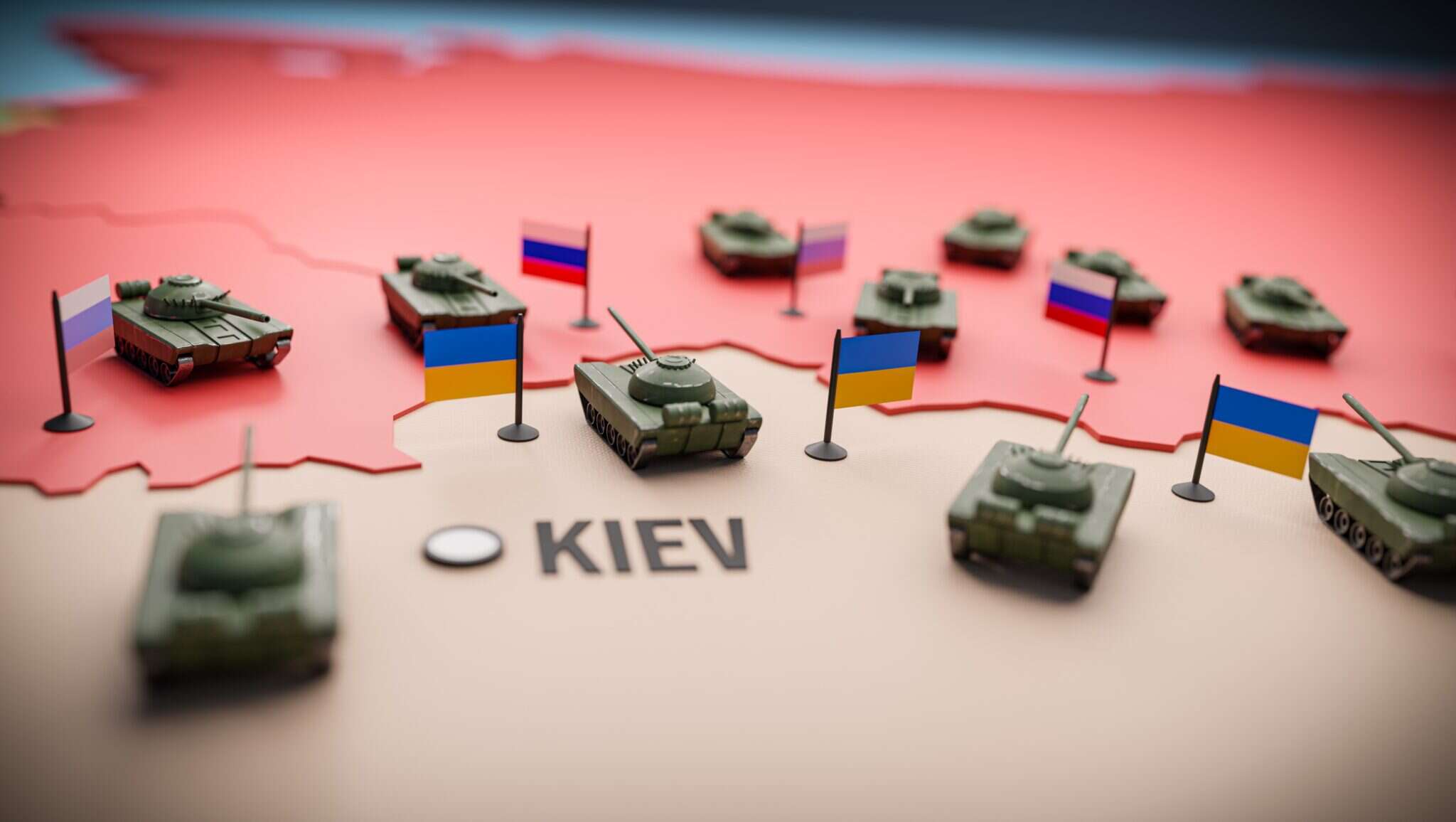
Russia-Ukraine War Did Not Stop. What Next?
PSCRP-BESA Reports No. 134 (June 16, 2025)
U.S. President Donald Trump’s campaign promises to end the Russia–Ukraine war within a short timeframe have yet to materialize. In recent days, media outlets across various countries have been actively discussing the following statement from the U.S. president: “I’ve always said that he [Putin] wants ALL of Ukraine, not just a piece of it, but if he does, it will lead to the downfall of Russia!”
Accordingly, growing concerns are emerging globally that the only way to prevent the expansion of the war into NATO member states bordering Ukraine may be the collapse of the current Russian regime.
The German government’s decision to implement a “new form of military-industrial cooperation” between Ukraine and Germany—particularly by lifting restrictions on the use of German-manufactured long-range missiles against military targets deep within Russian territory—marks a shift, at least among part of Ukraine’s Western allies, in their goals regarding the support they provide to the embattled country. That goal is now evolving from merely preventing Ukraine’s defeat to actively seeking the military defeat of the aggressor state, the Russian Federation. It appears that the slogan launched by Ukrainian President Volodymyr Zelenskyy in the fall of last year, “Make Russia small again” is turning into a practical guide to action.
In such a context, both Ukraine and the broader Western alliance must consider the need to develop a coherent policy regarding the various movements proposing postwar reorganization plans for Russia and its constituent regions. The Ukrainian intellectual and political elite, to a certain extent, have already formed a position on this matter. Based on the author’s direct engagement with representatives of this elite, it can be confidently stated that the idea of Russia’s disintegration as a strategic goal enjoys considerable popularity among them.
This perspective was, in the author’s view, clearly articulated in an interview with the Ukrainian analytical website Ukraїner by Volodymyr Viatrovych, a Member of Parliament from the opposition party European Solidarity (formerly the Petro Poroshenko Bloc), former head of the Ukrainian Institute of National Memory, and, since August 2023, Secretary of the Temporary Special Commission on the Issues of the Enslaved Peoples of Russia, established by the Ukrainian parliament: “I am convinced that supporting the enslaved peoples of the Russian Federation is a strategy for Ukraine’s victory. I see no alternative. Even reaching the 1991 borders or joining NATO will not eliminate the threat from Russia. As long as it remains an empire that subjugates other nations on such a scale, it will pose a threat to Ukraine. A reboot of this empire—its transformation into a collection of national, democratic states—is in our direct interest. This is what will truly guarantee security for future generations.” At the same time, representatives of the ruling Servant of the People party, as far as I am aware, have not yet publicly expressed themselves as directly on the idea of the Russian Federation’s disintegration.
As for the Russian opposition, which is making its voice heard in the media and on social networks—and most of which is in exile in the West, and in some cases in Israel—the position of the majority of Ukrainian society and elites toward them is clearly negative. In particular, Ukrainians find unacceptable the Russian opposition’s narrative that the full-scale aggression against Ukraine is “Putin’s war” rather than a war waged by Russians as a whole.
In this context, a Telegram post by Garry Kasparov, published on April 16, 2025, has recently been widely quoted.
In it, he wrote, among other things, “The position of many of my fellow exiles is indefensible. This constant effort to keep their white gloves clean—’we had nothing to do with it’—is bewildering. You did have something to do with it. We are all in this shit, and this shit is on all of us. Stop pretending you had no part in it. The longer you pretend, the more complicit you become in Putin’s crimes. With every Russian strike on Ukraine, the shameful lie of ‘Putin’s war’ crumbles to dust. This is not Putin’s war. This is Russia’s war. Stop lying to the West that there is an anti-war movement in Russia. There are a few decent people who remain silent. But they are still only a handful in the grand scheme. Some are in prison—but even they didn’t end up there because they dreamed of heroism.”
It is worth emphasizing that the former world chess champion considers himself a Russian opposition figure, despite the fact that his connection to Russia is complex. He was born in Azerbaijan, is half Jewish and half Armenian, has not lived in Russia since 2013, and has held Croatian citizenship since 2014. Perhaps partly for this reason, Kasparov stands out rather sharply from among the so-called “good Russians” — those who criticize Putin’s policies while denying the collective responsibility of Russian society for them and strongly opposing the idea of Russia’s potential decolonization or disintegration. In any case, the term “good Russians,” which emerged in 2022, has become a negative meme in Ukraine.
As for Ukraine’s Western partners, they have so far been reluctant to take seriously the organizations and movements advocating for the decolonization or disintegration of the Russian Federation and for the creation of independent states in its place, whether on ethnic or regionalist grounds. A number of such organizations and movements are united under the League of Free Nations, which was established in the spring of 2022, shortly after the start of Russia’s full-scale aggression against Ukraine. The League’s first congress was held in April 2024 in Estonia. It was attended by several Estonian politicians, though not by official representatives of the country’s government.
Despite the clear ineffectiveness of the “metropolitan” Russian opposition—the very same “good Russians”—Western partners continue to allocate grants to support their activities. Undoubtedly, this is partly due to the fact that such opposition figures as the late Alexei Navalny, Vladimir Kara-Murza, and Ilya Yashin are far better known in the West, and their declared goal of democratizing Russia aligns with familiar Western narratives and expectations. However, inertia also plays a role. The collective West, which has begun taking steps that could lead to the defeat of the Russian Federation, has yet to determine its stance on what might happen within Russia in the event of such a defeat.
It seems likely that before long, while continuing to provide a certain level of support to the “metropolitan” Russian opposition, the West will also begin assisting movements advocating for the decolonization or disintegration of the Russian Federation—perhaps at first without public fanfare, in order to maintain at least the appearance of hope for a peaceful resolution of the conflict with the current Russian regime.
In the interview quoted above, Volodymyr Viatrovych, speaking about the need to support national liberation movements of Russia’s subjugated peoples, specifically noted: “This does not mean that in the future, when independent states emerge from the ruins of the Russian Empire, we will have only friendly, neighborly relations with all of them. But in the current situation, the reconfiguration of Russia is our strategic interest.”
This statement by a Ukrainian politician is logical from the perspective of a state literally fighting for its survival and therefore compelled to form temporary alliances, including with forces that do not necessarily share the values of Western democracy—values to which today’s Ukraine, and in particular the European Solidarity party, declares its commitment.
In theory, newly formed states created by such forces may, due to their ideology or civilizational orientation, become sources of serious challenges for the collective West, of which Ukraine sees itself as a part. However, that is not Ukraine’s current concern. Ukraine’s Western partners, by contrast, are in a fundamentally different position. They do not currently face an immediate threat to their statehood and still have some time and capacity to develop a more nuanced and differentiated approach to the various movements and organizations advocating for the decolonization or disintegration of the Russian Federation.
Expanding on Viatrovych’s point that Ukraine’s relations with some of the new states that may emerge from the ruins of the current Russian Federation could prove far from ideal, one can reasonably assume that the largest and most significant of these entities might be a new Russia—an ethnic Russian state that has lost a substantial, if not the greater, part of its former territory, along with much of the natural resources it once controlled. This would be a state burdened with reparations and other consequences of military defeat, a state afflicted by ressentiment, and one that lays claim to the legacy of the current Russian Federation, just as the current Russian Federation claims to be the successor of the Soviet Union and the Russian Empire.
It is highly unlikely that the liberal “metropolitan” opposition figures currently living abroad will be able to take the reins of such a state. And even if they were to succeed in doing so, they would have to take into account the sentiments of the wider population in order to maintain power—either by aligning their behavior accordingly or at least by issuing statements that resonate with the prevailing public mood. It is no coincidence that these opposition figures (Kasparov being a notable exception) have so far withheld support from Ukraine—and especially from the Ukrainian Armed Forces—since doing so would cast them as collaborators or “Russophobes” in the eyes of the overwhelming majority of Russians, who broadly support the chauvinist rhetoric and aggressive political course of the current Russian regime.
Far more likely is the prospect that power in this hypothetical “ethnic Russia” would be seized by forces such as the Russian Volunteer Corps, which is currently fighting alongside the Ukrainian Armed Forces and whose members predominantly adhere to a radical nationalist ideology. Because of this, it cannot be ruled out that future tensions may arise between them and their current Ukrainian comrades-in-arms.
In addition, in some of the hypothetical new post-Russian states, the influence of radical Islam will undoubtedly be significant—something that could potentially pose challenges for both Ukraine and the collective West. This is especially likely in regions of the current Russian Federation where “ethnic Muslims” constitute an overwhelming majority of the population and where the influence of Muslim radicals is already strong—most notably in Dagestan, Chechnya, and Ingushetia. It appears that the greatest potential for establishing states that align with Western democratic standards lies with the Finno-Ugric peoples of the Volga region (the Komi, Udmurts, Mari, Erzya, Moksha), as well as the Chuvash, Kalmyks, Yakuts, and regionalist movements primarily oriented around ethnic Russians.
At the same time, not all national liberation movements of traditionally Muslim peoples should be automatically regarded as potential threats to Western democracies. Often, much will depend on who supports these movements—and thus who exerts the greatest influence over them: the West or fundamentalist Islamic states. Should these movements—and the national identities of the corresponding peoples—be shaped primarily by ethnicity and language rather than by religion, there is every reason to believe they, too, could establish “national, democratic states.”
This argument applies especially to the Circassian, Tatar, and Bashkir national movements. At this stage, even the names of the largest indigenous peoples of the Russian Federation may sound somewhat exotic as potential historical actors. Nevertheless, it seems increasingly clear that real-world policymaking already requires close attention to the ethno-political dynamics of the post-Soviet space.
Islamist Opposition in the Russian Federation
PSCRP-BESA Reports No 125 (April 18, 2025)
According to official data from the 2021 census, of the five largest national minorities in the Russian Federation—each numbering over one million—four are traditionally Sunni Muslim peoples: Tatars (4.7 million), Chechens (1.7 million), Bashkirs (1.6 million), and Avars (just over 1 million). The proportion of “ethnic Muslims” in Russia’s total population exceeds 10%. In regions such as Bashkortostan, Kabardino-Balkaria, Karachay-Cherkessia, and Tatarstan, they constitute an absolute majority. Chechnya, Dagestan, and Ingushetia are, in effect, mono-confessional Muslim entities of the federation, with no less than 96% “ethnic Muslims.” Under such conditions, the Islamic factor becomes a significant component of the broader landscape of separatist and autonomist movements opposing the imperial center in Moscow.
Russia’s attitude toward Islamists in general, and radical Islamist movements in particular, is neither consistent nor unambiguous. In its foreign policy, Russia actively supports Hezbollah and Hamas, which has been especially evident during the current Arab-Israeli war. The patron and protector of these and numerous other terrorist Islamist organizations, the Islamic Republic of Iran, is one of Russia’s strategic partners. This partnership was formalized in the Comprehensive Strategic Partnership Agreement signed on January 17, 2025.
At the same time, Russian forces have provided active military support to the Bashar al-Assad regime in Syria in its war against Sunni armed groups, including ISIS. This contradiction—supporting radical Shiite Islamist movements abroad while fighting against Sunni militias—highlights the pragmatic and often contradictory nature of Russia’s approach to Islamist forces, shaped by geopolitical calculations rather than ideological alignment.
Although Russia has officially included the radical Sunni movement “Taliban” on its list of banned organizations, it nevertheless continues to invite members of this group as legitimate representatives of Afghanistan (BBC Russian).
Regarding domestic policy, Islam is officially recognized in Russia’s federal law “On Freedom of Conscience and Religious Associations” as the second religion—after Christianity—among those that constitute “an integral part of the historical heritage of the peoples of Russia.” However, in practice, as with other religions, the Russian authorities consistently strive to bring official Muslim religious institutions under full state control, effectively making them part of the governmental apparatus. Any Muslim organizations or individual activists who fall outside this framework often become targets of persecution.
The most serious ideological opponents of these state-aligned Islamic structures are the Salafis, who in Russia are often—though not always accurately—referred to as Wahhabis. The central idea of this Sunni movement is to purify Islam of innovations not mentioned in the Quran or in the Sunnah of the Prophet Muhammad. In practice, this translates to Islamic fundamentalism. Salafism is widely spread in the Russian republics of Dagestan and Chechnya. Historically, its roots in the region trace back to the 19th-century Caucasian War. However, during the Soviet era, Salafism’s influence in these regions diminished significantly.
The revival of Salafism in Dagestan began in the 1970s, while in Chechnya it reemerged in the post-Soviet period. Since the outbreak of the Second Chechen War in 1999, Salafis have faced constant pressure from Russian authorities and security agencies. As a result, it is difficult to estimate the precise number of Salafi adherents in Russia today. According to a 2004 sociological study conducted by the Dagestan Scientific Center of the Russian Academy of Sciences, approximately 40% of Dagestani Muslims and around 83% of the republic’s Muslim clergy held fundamentalist views.
Ethnically, the majority of Salafis in Dagestan are Avars and Dargins. One of the most popular Russian-speaking Salafi preachers, Abu Umar Sasitlinsky (Israil Akhmednabiev, born in 1980), is an Avar by ethnicity and currently resides in Niger. The terrorist attacks against Jewish and Christian places of worship in Dagestan that gained wide attention were committed on June 23 of last year by ethnic Dargins.
Dagestan’s population does not have a unified, multiethnic national independence movement. Islam remains the main unifying factor in the republic. At the same time, the Salafi branch of Islam categorically rejects the importance of ethnicity, emphasizing that all Muslims should form a single ummah (community) and that in any conflict between religious and national identity, religion should take precedence.
The struggle between Muslim fundamentalists and the moderate Islamic institutions integrated into the Russian state—represented by the Muftiate of Dagestan—is currently one of the most important components of the domestic political dynamics in this North Caucasian republic. This struggle unfolds against a backdrop of inherent ethnic tensions between the Kumyks, the third-largest ethnic group in Dagestan (15.5% of the republic’s population according to the 2021 census), and on the other side the Avars (the largest ethnic group, 30.5% including related smaller groups) and the Dargins (second-largest group, 16.6% including related smaller groups).
This tension stems from Soviet-era policies, which relocated Avars and Dargins from mountainous regions to the lowlands traditionally inhabited by the Kumyks. The Kumyk national movement “Tenglik”, which was not connected to Islamist elements, sought to reclaim confiscated Kumyk lands and even advocated for the secession of Kumykiya from the Republic of Dagestan. However, by the early 2020s, the movement had largely ceased its activities. Nonetheless, this does not mean that the ethnic conflict has been resolved.
The Russian language, currently serving as the primary language of interethnic communication in Dagestan, is an important tool for Salafist preachers. It allows them to reach Muslims not only in Dagestan but across the entire Russian Federation. The main Russian-language Salafist YouTube channel is “Voice of Truth” (Голос истины).
In recent decades, Salafist ideology has significantly spread among Muslims in Tatarstan, Bashkortostan, Moscow, and the Astrakhan region—primarily among migrants from Dagestan and Chechnya, as well as local Nogais (while the largest traditionally Muslim group in the region are Kazakhs, accounting for 14.97% of the total population according to the 2020 census). It has also gained ground in North Ossetia (among Ingush communities) and in Ingushetia itself.
The Karachay Salafist Jamaat, which was actively operating in Karachay-Cherkessia and Kabardino-Balkaria (among the closely related Balkars), was dismantled by Russian security forces in the early 2000s. It is likely that the list of regions influenced by Salafism above is not full.
It is worth noting that, despite the primarily religious nature of Salafist propaganda, the broadcasts on “Voice of Truth” also address issues of interethnic relations in Russia. However, these discussions are always framed through the lens of interactions between ethnic Russians and peoples who have traditionally practiced Islam.
The revival of Salafism in Chechnya is closely tied to Chechen returnees from Jordan. A key starting point is considered to be 1994, when Sheikh Ali Fathi al-Shishani established the Islamic Battalion of the Chechen Republic of Ichkeria, known in English as the Islamic Salafi Jamaat. After the assassination of Ichkeria’s first president, Dzhokhar Dudayev, by Russian security services in April 1996, the position of the Salafis in the self-proclaimed republic significantly strengthened. By the fall of that same year, acting president Zelimkhan Yandarbiyev issued a decree replacing secular courts with Sharia courts.
In February 1999, President Aslan Maskhadov formally transformed Ichkeria into an Islamic state by fully implementing Sharia rule. During the Second Chechen War, which began in September 1999, Salafis became the main force resisting Russian troops. Following President Maskhadov’s death in March 2005, Vice President Abdul-Halim Sadulayev assumed the presidency. After Sadulayev was killed in June 2006, his successor became Vice President Doku Umarov. In September 2007, Umarov declared the dissolution of the Chechen Republic of Ichkeria, which then had turned into an underground guerrilla movement, and announced the establishment of the Salafi Caucasus Emirate. This entity included not only Chechnya (as the Vilayat Nokhchicho) but also Dagestan, where Salafi groups were especially active. There were also efforts to expand the Emirate’s influence into the Western Caucasus, particularly in Karachay.
Today, the Chechen opposition to the pro-Russian regime of Ramzan Kadyrov is clearly divided into two camps: supporters of the Salafis and supporters of the government of Ichkeria in exile, which was established in 2007 following Doku Umarov’s declaration of Ichkeria’s dissolution. The government in exile is led by Akhmed Zakayev, who previously served as Minister of Culture under President Dzhokhar Dudayev.
Due to deep ideological differences and mutually exclusive goals—establishing a supranational Islamic state in the Caucasus versus creating an independent Chechen national state—the relationship between these two opposition factions is extremely hostile. The Islamists have accused the supporters of the exiled Ichkerian government of takfir, formally denouncing them as apostates.
The Salafi Telegram channel Niyso, which addresses a Chechen audience (mostly in Russian), refers to itself as the “Telegram channel of the de-occupation organization”. Meanwhile, supporters of the government-in-exile also operate their own propaganda channels online, also primarily in Russian.
The radical Islamist organization Hizb ut-Tahrir (“Party of Liberation”) also belongs to the Salafist branch of Islam. It promotes the idea of uniting all Muslims under a single caliphate governed by Sharia law. Since the ideologues of Hizb ut-Tahrir do not recognize as truly Muslim the governments of Muslim-majority countries they consider insufficiently fundamentalist, the organization is banned in all Arab states except the UAE, Yemen, and Lebanon, as well as in Bangladesh, Indonesia, Turkey, Pakistan, Kazakhstan, Uzbekistan, Kyrgyzstan, and Tajikistan. In Europe, its activities are prohibited only in Germany and the United Kingdom. In 2003, Hizb ut-Tahrir was declared a terrorist organization and banned in Russia. However, since the organization is not banned in Ukraine, Hizb ut-Tahrir cells operated freely among Crimean Tatars until the Russian occupation and annexation of Crimea. After 2014, the occupying authorities began harsh persecution of the group’s activists.
Given that no involvement of Hizb ut-Tahrir in terrorist activity has been proven in either Russia or Ukraine, Ukrainian authorities, Russian human rights defenders, and national movements of Russia’s indigenous peoples tend to view the activists arrested by Russian security forces as political prisoners. In the current context, where Crimean Tatars are the only people on the peninsula who traditionally practice Islam and where the Crimean Tatar national movement faces widespread repression by the occupying authorities, arrests of Hizb ut-Tahrir supporters are seen as part of this larger campaign of persecution.
At the same time, within the umbrella organization uniting various national liberation movements of Russia’s peoples—the League of Free Nations, which advocates the disintegration of Russia—Islamists are notably absent. This is understandable, considering Salafists’ rejection of the concept of national liberation struggle as such, and the fact that participation in the League entails active cooperation with non-Muslim national and regionalist movements such as those of the Kalmyks, Erzyans, Yakuts, Buryats, Mokshans, and others.
Notably, the government-in-exile of the Chechen Republic of Ichkeria, which maintains a historically hostile stance toward Salafists, is a member of the League. Also participating are representatives of the Circassian national movement, which is not characterized by Islamic radicalism, as well as the Committee for Ingush Independence. The religious factor is secondary to national-democratic goals even in the activities of the Bashkir National Movement Committee Abroad, another League member. This is clearly reflected in the statements of the Committee’s leader Ruslan Gabbasov on his YouTube channel, where he expresses solidarity with other peoples fighting for liberation from Russia, regardless of their traditional religious affiliation.
Perhaps the only Islamist figure one might see on the Free Nations League channel is Tatar activist Ruslan Aysin, who openly condemned Russia’s aggression against Ukraine and left the country for Turkey in 2022. From 2008 to 2012, he served as the chairman of the World Forum of Tatar Youth. Afterward, Aysin moved to Moscow, where he became the personal assistant to the chairman of the Islamic Committee of Russia, the late philosopher Heydar Jemal (1947–2016), a known opponent of the Putin regime who was notorious for his hatred of Jews and the State of Israel. Jemal, a Moscow-born intellectual of Azerbaijani and Russian descent, advocated for the unity of all Muslims, dismissing the significance of ethnic differences between them. This worldview appears to have had a significant impact on Ruslan Aysin’s own ideological stance.
In his appearances on his personal YouTube channel, Aysin emphasizes that he addresses Muslims regardless of their ethnicity. His content often includes repeated attacks on Israel and, at times, critical commentary on Shiites, Druze, Alawites, and others. However, on the Free Nations League channel—where he is not a formal member—Aysin avoids topics that might provoke polemics with other members of the umbrella organization.
Given that Aysin still operates within the Tatar national movement and retains a degree of influence in it, it is worth noting that despite Islam’s indisputable role as a marker of Tatar national identity, the spread of radical Islamist ideas will inevitably clash with Tatar nationalism. This is particularly true because the Tatar nation includes a significant ethno-religious group—the Kryashens, who are Orthodox Christians.
Based on recent historical experience, it is clear that the spread of radical Islamism is dangerous and fraught with tragic consequences. Therefore, from the perspective of the interests of the free world, it seems both prudent and urgent to support national-democratic movements among Russia’s peoples—including those who traditionally practice Islam—so that, in the likely event of the Russian Federation’s collapse in its current form, these movements can offer a real alternative not only to the resurgence of aggressive Russian revanchism, but also to the emergence of radical Islamist regimes in various territories that currently constitute the Russian Federation.
Erzyan National Movement as an Example of Ethnic Separatism in the Russian Federation
PSCRP-BESA Reports No 121 (March 25, 2025)
Saransk, the capital of the Republic of Mordovia, with a population of just over 300,000, is a provincial city by Russian standards. Most Russians know very little about the ethnic challenges facing Mordovia. Against the background of the growing wave of repressions against dissidents in the Russian Federation, the aggressive campaign against the Erzyan national movement, which was launched by the Russian authorities in October 2023, is, at first glance, an inconspicuous episode. Nevertheless, the Erzyan national movement deserves special consideration: the problems it is trying to solve are characteristic not only of the Republic of Mordovia. They are also relevant for other national autonomies located in the east of the European part of the Russian Federation, far from the state borders, where the peoples belonging to the Finno-Ugric linguistic group live: the Republic of Komi, the Republic of Udmurtia and the Republic of Mari El.
In Russia, the Erzyans are officially regarded as part of the Mordvin people, which also includes the Mokshans, despite the fact that these peoples speak different, though related languages, which have their own literary norms and are formally recognized, along with Russian, as the state languages of the Republic of Mordovia. At the same time, neither Mokshans nor Erzyans have a common endonym in their languages. “Mordva” is an exonym, the use of which is actively opposed by the Erzyan national movement.
The first written mention of Erzya is considered by some to be in a letter dated to 968 AD, by Joseph, the Khazar khagan, in the form of ”arisa.” Modern researchers believe that for the first time the name Erzya was mentioned by Rashid-al-Din Hamadani in the 14th century, in the form of “ardzhani”.
The collapse of the Golden Horde, under the rule of which the Erzyans had lived for about two centuries, led to the fact that from the end of the 14th century their land became a zone of constant military confrontation between the Moscow Principality and the Kazan Khanate, which lasted until the conquest of the latter by Ivan the Terrible in 1556.
Since the late 16th century, the Russian conquerors began to force the Erzyans into abandoning their traditional pagan religion and adopting Orthodox Christianity. In the 17th century Erzyans together with Tatars, Chuvash and Mari took part in uprisings against Russian conquerors, such as Stepan Razin’s uprising in 1667–1671. The modern Erzyan movement considers the commanders of the Erzyan detachments who took part in the uprising, Alena Arzamasskaya and murza Akai Bolyaev, as their national heroes. In an attempt to escape Russian oppression and avoid Christianization, the Erzyans moved en masse to the east, outside their traditional ethnic territory. By the middle of the 18th century, after the suppression of the Teryushev rebellion of 1743–1745, all Erzyans were nominally converted to Orthodoxy, but this Christianization was superficial. The last uprising in defense of the old Erzyan faith took place in 1804.
By the beginning of the 20th century, the Erzyans were a typical “peasant people”, almost completely devoid of the urban educated elite, which retains its ethnic self-consciousness. After the February Revolution of 1917, the Mordovian Cultural and Educational Society was established in Kazan with the participation of the polymath and professor of Kazan University Makar Evsevyev (1864–1931). In 1920, the first newspaper in the Erzyan language “Chinya styamo” (“Dawn”) was published in Simbirsk (now Ulyanovsk).
As a result of the large-scale migration of the Erzyans outside their original ethnic territory, as well as the assimilation of a significant part of those who remained in their homeland by Russians, most of them found themselves outside the borders of the territorial autonomy created by the Bolsheviks in 1928 for the Erzyans and Mokshans — the Mordovian Autonomous District (since 1930 — the Mordovian Autonomous Oblast, since 1934 — the Mordovian ASSR). And even in this autonomy the majority of the population was Russian (60.53% according to the 1939 census), although some of these Russians undoubtedly had Erzyan and Mokshan roots.
The repressions of the 1930s — the “Case of the Union for the Liberation of Finnish Peoples” (most of the victims in this case were Udmurts, Komi and Mari) and especially the “Mordovian Case” — dealt the heaviest blow to the nascent Erzyan national intelligentsia. In the 1040s, during World War II, 240,000 inhabitants of Mordovia were sent to the front, primarily from rural areas where the Erzyan and Mokshan population prevailed. 131,000 of them were killed, which sharply weakened the demographic potential of the Mordovian rural population. In the post-war period the number of Mordvins (separate data on Erzyans and Mokshans are not available, but it is estimated that about two thirds of the total number are Erzyans) gradually decreased due to assimilation: 1, 285,000 according to the census of 1959, 1,263,000 according to the census of 1970, 1,192,000 according to the census of 1979, 1,154,000 according to the census of 1989. This process continued in the post-Soviet period.
The Perestroika period saw the activation of the Erzyan national movement. In 1989, the Public Center “Velmema” (“Revival”) was established. Its leader, the poetess Mariz Kemal (Raisa Kemaykina), put forward the slogan “Two languages — two peoples”, rejecting the Soviet-era concept of a unified Mordovian nation as artificial. However, a few months later, with the support of the republican authorities, the united Erzya-Mokshan movement “Mastorava” (“Native Land”) was created. In 1992, it initiated the First All-Russian Congress of the Mordovian people.
In 1993, the opponents of the concept of a unified Mordovian nation, who had left the Mastorava movement, created the Erzyan Mastor (“Country of the Erzyans”) movement. A year later, the movement began publishing its own newspaper under the same name. In 1995, Nuyan Vidyaz (Evgeny Chetvergov) created the Foundation for the Salvation of the Erzyan Language. In the same year, the First Congress of the Erzyan people was held in Saransk, which, among other things, put forward the demand to create an Erzyan territorial autonomy within the Russian Federation. The Foundation initiated the Day of the Erzyan Language, celebrated annually on April 16, the birthday of Anatoly Ryabov (1894–1938), professor of linguistics and creator of the Latinized alphabet for the Erzyan language.
The Erzyan national movement was closely connected with the revival of traditional Erzyan religion, which posed a conflict between it and the Russian Orthodox Church. As early as 1990, Erzyan public prayers were resumed. An important stage in the actual reconstruction of the traditional beliefs of the Erzyans on the basis of folklore was the writing of the epic “Mastorava” (published in Erzyan in 1994, later translated into Mokshan, Russian, Hungarian and Finnish) by folklorist and poet Professor Sharonon Sandra (Alexander Sharonov) of Mordovian University. In 1999, for the first time since 1629, an all-Erzyan prayer Ras’ken’ Ozks was held (one of the organizers of Ras’ken’ Ozks in this and subsequent years was Yogan’ Min’ka (Mikhail Chetvergov), the second defendant in the current case against Erzyan activists). It elected the council of Erzyan elders “Atyan Ezem” and its head, who received the ancient title of Inyazor. In 2004, the head of the Republic of Mordovia, Mokshan Nikolai Merkushkin, signed a decree granting Ras’ken’ Ozks an official status on the republican level. A year later, he also signed a decree awarding the title of laureate of the State Prize of the Republic of Mordovia to Sharonon Sandra, the author of the epic “Mastorava”.
On the surface, the Erzyan national movement seems to have achieved notable success despite the fact that its demand for territorial autonomy for the Erzyans was not satisfied. However, the toughening of the Russian Federation’s policy towards the national movements of non-Russian peoples living on its territory became apparent from the first years of Vladimir Putin’s presidency. Against this background, in 2006, Inyazor Kshumantsyan Pirguzh (Grigory Musalyov) (1940–2024) made a report at a seminar of non-profit Finno-Ugric organizations in Helsinki, in which he sharply criticized the national policy of the Russian Federation. In 2023, he was detained by the FSB but did not live to see trial.
Over the following years, the authorities increased pressure on the Erzyan national movement, which, having lost the support of the republican authorities of Mordovia, became increasingly active in the diaspora, outside the Russian Federation. In this regard, in 2019, Atyan Ezem decided to elect Bolyaen Syres (Alexander Bolkin), the organizer and head of “Erzyan Val” (“Erzyan Word”), the society of Erzyans of Ukraine, founded in 2011, as the new Inyazor. He was a colonel in the Ukrainian Armed Forces and fought against Russian aggression as part of the Anti-Terrorist Operation (ATO) in Donbass. Kshumantsyan Pirguzh traveled to Kyiv on purpose to officially hand over his authority. The new Inyazor was not wearing the traditional Erzyan national dress, but instead a defiantly plain outfit. “We are not a folklore group,” he asserted, “Our goal is to create a modern Erzyan secular European state. Thus, the Erzyan national movement took the path of uncompromising confrontation with Russia.
The first decree of the new Inyazor was the creation of the Atyan Ezem Secretariat operating outside the Russian Federation, ensuring the permanent functioning of the Council of Elders as a representative body of the Erzyan people. In 2021, Syres Bolyaen spoke at the 20th session of the UN Permanent Forum on indigenous issues (under the quota of Ukraine). In his speech, he accused Russia of ethnocide of indigenous non-Russian peoples and Erzyans in particular.
In the summer of 2022, after the beginning of the full-scale Russian aggression against Ukraine, another all-Erzyan prayer Ras’ken’ Ozks was held in Mordovia. Russian security forces searched those who attended in order to prevent the flying of the white-red-black Erzyan national flag (based on the colors of traditional embroideries), which had previously been flown at this ceremony without hindrance. In the fall of 2022, the first Erzyan congress was held in the Estonian town of Otepää, which was attended by activists in exile. The congress adopted a resolution according to which “the preservation of the Erzyan people, their development and the realization of their national, economic, political and other rights are possible only in the independent state of Erzyan Mastor.
The creation of Erzyan Mastor is the main goal of the Erzyan national movement. The Congress sees the state of the Erzyans as absolutely independent, ruled by law, democratic — a federal republic of Erzyan Mastor. (…) Until the declaration of independence of Erzyan Mastor, the struggle of the Erzyan people for self-determination is led by the national self-government bodies and personally by Inyazor”. The congress proposed a map of a hypothetical state, which according to the its supporters, in addition to the territory of the Republic of Mordovia, should include the Penza and Ulyanovsk oblasts, as well as some districts of the Nizhny Novgorod, Ryazan and Samara oblasts, i.e. territories with significant Erzyan and Mokshan populations present or formerly present in the recent past.
Thus, for example, Erzyan Mastor is supposed to include Dalnekonstantinovsky district of Nizhny Novgorod oblast, where, according to the 2010 census, 95.3% of the population is Russian, while the Mordvins (Erzyans and Mokshans) make up only 0.8%. The logic behind it is the fact that in the past — up until the 1920s — most of the population here was made up of Teryukhans, representatives of the ethnographic group of Erzyans, which was almost completely assimilated by Russians during the 20th century.
Given that there was no significant influx of population from outside into the Dalnekonstantinovsky district, it is only logical to assume that the overwhelming majority of the local Russian population has Erzyan roots. Nevertheless, given that the territory claimed by the Erzyan national movement is currently inhabited not only by Erzyans, but also by Russians, Mokshans, Tatars, Chuvashs, etc., it is assumed that Erzyan Mastor will be, as already mentioned, a federative state. The Erzyan national movement advocates the return of assimilated descendants of Erzyans to their Erzyan roots. The current Inyazor himself, who was born in the city to a mixed family (his mother is Russian), does not hide the fact that as a child he heard Erzyan speech mainly when he visited his paternal grandmother in the village.
Since the Erzyan activists emphasize that they do not intend to forcefully incorporate anyone into their future state, it can be assumed that the Erzyan Mastor map they adopted is extremely optimistic. However, there is more to the problem than that. The geographical position of Mordovia, as well as Mari El, Udmurtia and the Komi Republic in the very heart of the European part of the Russian Federation, far from its state borders, implies that the plans of their national movements to create their own independent states are realistic only in case of the collapse of Russia in its present form and the formation of new states in its place, based on ethnic or regional principles. This is the main line of action chosen by the Erzyan national movement amidst the full-scale war in Ukraine. In this regard, the Erzyan national movement, together with a number of other ethnic and regionalist movements, became in May 2022 one of the founders of the Free Nations League, which rejects the idea of a “beautiful Russia of the future” and openly calls for “decolonization”, i.e., the disintegration of Russia.
Inyazor of the Erzya people Bolyaen Syres has become one of the unofficial leaders of the Free Nations League over the past two years. In his regular video speeches on YouTube and other platforms, he addresses not only his people, but also representatives of other peoples of Russia, rightly believing that the chance for the Erzyans and other Volga-Finnish peoples to achieve independence can only come to fruition in an alliance with other peoples oppressed by the Russian Federation.
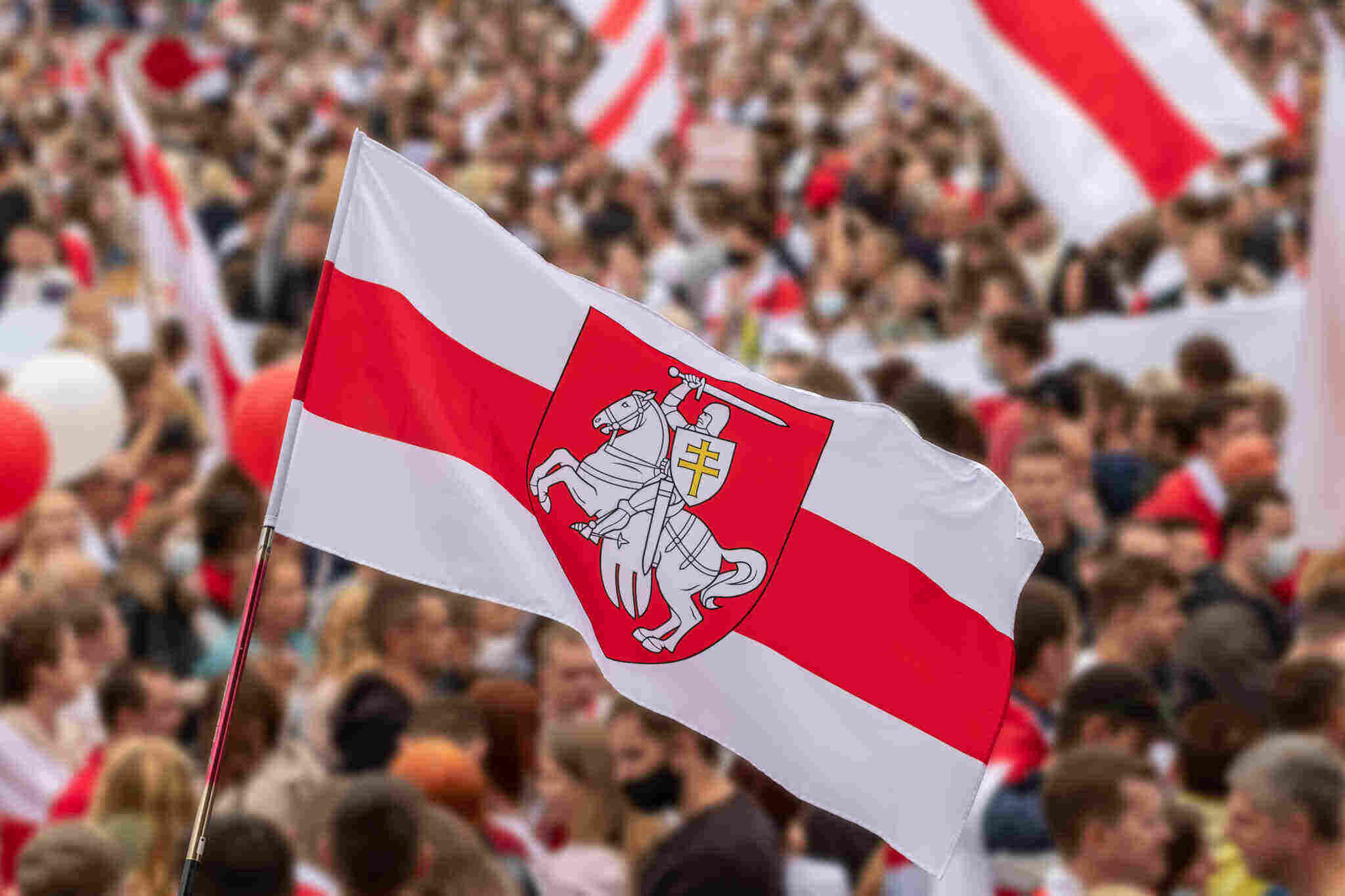
National-Democratic Movement of Belarus
PSCRP-BESA Reports No 120 (March 18, 2025)
Belarus is the only post-Soviet country whose national language has been losing its positions over the decades that followed the collapse of the USSR. At the same time, it is the only post-Soviet state other than the Russian Federation where Russian has the status of the state language (in Kyrgyzstan, Russian has the status of “official” but not the state language). Despite the fact that the Belarusian language nominally has the same status as the Russian language, the total dominance of the Russian language in Belarus is apparent to anyone who has visited the country. According to the 2019 census, 54.1% of the country’s population called the Belarusian language their mother tongue (while 84.9% identified as ethnic Belarusians), but only 26% said that they speak Belarusian at home. According to experts, in reality this figure is even lower. In many cases a mixed form of speech known as “trasianka”, which has elements of both Russian and Belarusian languages, is referred to as the Belarusian language. According to the National Statistical Committee of Belarus, in the 2023/2024 school year only 8.58% of schoolchildren were taught in the Belarusian language. The curtailment of education in the Belarusian language began when Alexander Lukashenko came to power in 1994: back in the 1994/1995 school year, 40.6% of the country’s schoolchildren were taught in the Belarusian language. Currently, many public services in the country (e.g., courts, law enforcement agencies, STEM higher education) are available only in Russian. Paradoxically, after three decades of independence, Belarusian has found itself in the position of a language whose further existence is under threat. Live communication in Belarusian cities now looks a kind of exotic — a situation that in Europe is comparable, perhaps, only to the situation of the Irish language in Ireland.
However, unlike Irish, which bears limited resemblance to English, Belarusian is very close to Russian. Therefore, since Belarusian language and literature remain compulsory subjects in Belarusian schools, the overwhelming majority of the country’s residents understand Belarusian well, although they are not its active speakers. In everyday life, the dialects of the Belarusian language are spoken by rural residents (and their use is dwindling), while its literary form is spoken almost exclusively by teachers of the Belarusian language and literature, Belarusian-speaking writers, journalists, actors, and the like. The question arises: why does the Lukashenko regime, which pursues a consistent course not just for cooperation, but for integration with Russia, retain state support of the Belarusian language, albeit very limited?
The answer to this question is unambiguous: this regime needs the Belarusian language not as a living language, but as a symbol of the national uniqueness of Belarusians and Belarus. Alexander Lukashenko is not interested in the complete elimination of the Belarusian statehood and its absorption into the Russian Federation, since in this case he would lose power, turning, at best, into the head of one of the regions of the federation, whom Vladimir Putin appoints and dismisses at will. It is no coincidence that despite the fact that the Union State Treaty between Russia and Belarus was signed back in December 1999, right after Vladimir Putin came to power, and that Belarus’ dependence on Russia is very high, Belarus still retains a certain degree of statehood. For the time being, Alexander Lukashenko manages to balance on the verge of complete loss of independence, although he has long ago turned the country under his control into a satellite of Russia.
It is doubtful that without Russian support Alexander Lukashenko would have managed to stay in power during the mass protests against election fraud in 2020–2021. These protests showed that Belarusian civil society falls somewhere between Russia and Ukraine in terms of ‘passionarity’, or commitment to their cause. Unlike the protests of the Russian opposition, which peaked in 2011–2013, the protests of the Belarusian opposition were truly massive (considering the size of the population of both countries), and their participants demonstrated organized behavior and persistence, which the Russians could not even dream of. However, unlike the Ukrainian opposition during the Euromaidan of 2013–2014, the Belarusian opposition did not respond to violence on the part of the authorities by choosing a strategy of peaceful protest.
As a result, the protests in Belarus were suppressed with unprecedented brutality: according to human rights organizations, between 5 and 12 people were killed, at least 6 went missing, more than 1,400 were injured, more than 35,000 were detained by security forces, at least 450 were tortured, at least 663 were sentenced to various prison terms. By comparison, the protests in Russia in 2011–2013 failed to achieve their goals — in spite of the fact that the Russian authorities did not use even a fraction of the violence used against the protesters in Belarus. In the notorious Bolotnaya Square case, opened in Russia against opposition activists, 15 people were sentenced to 2.5 to 4.5 years in general regime correction facilities, 1 person was sentenced to compulsory treatment in a closed psychiatric ward, and 1 person was given a suspended sentence.
It should be noted that the Belarusian opposition actively used and still uses the Belarusian language. Communicating in Belarusian in everyday life became a marker of opposition sentiments for many Belarusian citizens. Moreover, we are mainly talking about people who grew up in Russian-speaking families and consciously switched to the Belarusian language. One can find many accounts of such a transition and recommendations to those wishing to switch from Russian to Belarusian on the Internet. In this respect, modern Belarusian opposition circles are ideological successors to the government of Belarus in the first years of independence (1991–1994), when, under the influence of the small opposition of the Belarusian Popular Front “Adrazhenne” (BPF “Revival”), the conservative majority of the Supreme Soviet made decisions that distanced Belarus from what later became known as the “Russian world”: the Russian language did not enjoy the status of the state language, and the coat of arms and the flag of the Belarusian People’s Republic proclaimed in 1918 were adopted as symbols of the independent Republic of Belarus. It was also proposed that the national anthem of the Belarusian People’s Republic, banned during the Soviet era, be adopted, but this never happened. After Alexander Lukashenko came to power, the flag and coat of arms of the Belarusian SSR were restored, with some adjustments, and the Russian language received the status of the state language along with Belarusian.
After multiple amendments to the Constitution of the Republic of Belarus, allowing Alexander Lukashenko to stay in power indefinitely, and after the forceful suppression of the 2020–2021 protests, many people consider Alexander Lukashenko an illegitimate president. However, this does not cancel the fact that he originally came to power with the support of the majority of Belarusians, opposing the national-democratic course of the BPF, primarily for economic reasons. Nothing of the kind happened in other post-Soviet states, in particular in Ukraine, Lithuania and Latvia that border Belarus. The reason for this difference was the long-standing weakness of the Belarusian national movement compared to the national movements of neighboring nations, including the Ukrainians, who are historically and linguistically close to Belarusians.
In the 17th–18th centuries, Ukrainians had their own autonomous state entity, the Hetmanshchina. The liquidation of the Hetmanshchina and the strengthening of Russian colonial oppression caused discontent of at least part of the Ukrainian elite. Belarus was in this period an integral part of the Grand Duchy of Lithuania, which was dominated by Polish and polonized nobility.
By the beginning of the 19th century, the Ukrainian elite had a good command of their national language. Even after becoming part of Russian literature, many writers of Ukrainian origin retained an interest in Ukrainian issues and adherence to the Ukrainian national narrative — suffice to name the writings of Nikolai Gogol. There were no comparable figures in Belarusian culture in the 19th century. Prominent historians Mykola Kostomarov (1817–1885) and Mykhailo Hrushevsky (1866–1934) actively worked on Ukrainian historiography. Thus, the first issue of the 10-volume “History of Ukraine – Rus’”, positioning Ukraine as the successor of Kievan Rus’, was published in 1898. Comparable editions on the history of Belarus appeared only in the 21st century. The modern Belarusian national narrative considers modern Belarus as the successor of the Grand Duchy of Lithuania and claims its history and symbols.
Additional factors contributing to the development of the Ukrainian national movement were the existence of a “Ukrainian Piedmont” in the form of Galicia and the Ukrainian Greek Catholic Church, which acted as the Ukrainian national church in western Ukraine. This turned Galicia into a springboard for the spread of Ukrainian literature and Ukrainian national ideas throughout most of the Ukrainian ethnic territories that were part of the Russian Empire, just as Piedmont served as a springboard for Giuseppe Garibaldi in unifying Italy. The Belarusian national movement had no such “Piedmont”.
The weakness of the Belarusian national movement in comparison with the Ukrainian one also manifested during the period of the struggle for independence that followed the collapse of the Russian Empire. The Belarusian People’s Republic, proclaimed in March 1918, was unable to form a full-fledged state, as its territory was under German occupation, which did not recognize the independence of the Belarusian People’s Republic, and in December it ceased to exist. In contrast, the Ukrainian People’s Republic existed for three years and was destroyed by the Bolsheviks after fierce resistance. During the short period of independence, many important institutions of Ukrainian statehood were established.
“Belarusization”, i.e., the policy of active expansion of the functions of the Belarusian language pursued in the 1920s, was a particular case of the policy of ‘Korenizatsia’, or ‘indigenization’, carried out in the USSR at large. Its curtailment began in the Belarusian SSR as early as 1929, and its results were much more modest than the achievements of Ukrainianization, the curtailment of which in the Ukrainian SSR was carried out a decade later.
The facts mentioned above predetermined the weakness of the Belarusian national movement and facilitated both linguistic and ideological Russification of Belarus. It is indicative that the poll conducted at the end of 2023 showed that 55% of Belarusians believe that Belarusians, Ukrainians and Russians are parts of the “three-pronged Slavic nation”, and only 42% — that Belarusians are a separate nation. There is no doubt that the modern Belarusian national-democratic opposition relies primarily on the second, smaller, but socially active group of the country’s population that is distancing itself from Russia and Russians.
After the suppression of the 2020—2021 protests, most of the Belarusian opposition leaders who avoided imprisonment found themselves in exile, as well as many thousands of their supporters. At the same time, unlike the Russian opposition, the Belarusian opposition showed a high degree of self-organization. Back in August 2020, at the height of the protests in Belarus, ex-presidential candidate Svetlana Tikhanovskaya announced the creation of the Coordinating Council of the Belarusian opposition (CC), which has since continued to work actively as a single representative body of the national-democratic opposition, with seven party factions. The EU adopted a resolution recognizing the CC as “a temporary representation of people demanding democratic change” and called on all EU member states to assist it.
In August 2022, after the beginning of a full-scale Russian invasion of Ukraine, including the incursion launched from the territory of Belarus, the CC created its executive body, the United Transitional Cabinet of Belarus, headquartered in Vilnius, which became, in fact, the government of Belarus in exile. It was headed by Svetlana Tikhanovskaya. The Belarusian opposition openly says that the transitional cabinet created by it is planning to become the real government of Belarus in the transitional period after the removal of Alexander Lukashenko from power.
Given the current realities of Eastern Europe, it is extremely important that the Transitional Cabinet took upon itself, among other things, the function of forming a new Belarusian army. It should be based on the Belarusian volunteer formations fighting on the side of Ukraine, first of all, the Kastuś Kalinoŭski Regiment. Unlike members of the Russian opposition, the organized Belarusian opposition has no doubts about the necessity to support the AFU.
To summarize, we can state that the fate of Belarus depends to a very large extent on the outcome of the Russian-Ukrainian war. In case of Ukraine’s defeat or freezing of the conflict, the current situation may continue for a long time. And in case of Russia’s defeat, Belarus’s path to Europe may turn out to be very short.
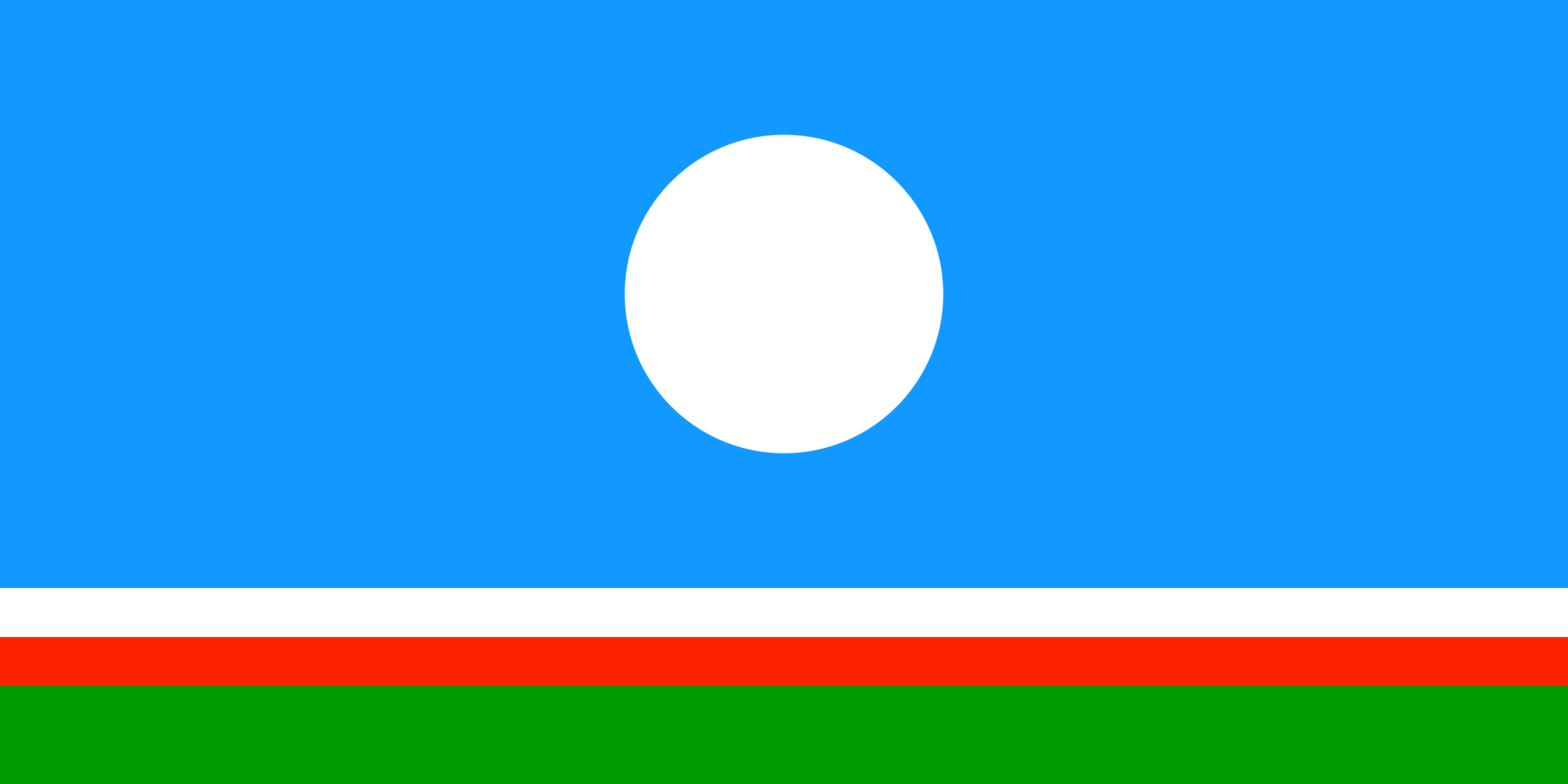
On China’s Territorial Claims Against the Russian Federation
PSCRP-BESA Reports No 116 (March 1, 2025)
A year and a half ago, in the summer of 2023, a forum titled “Yakutia and the Provinces of China: Sister-City Relations for Strengthening Russian-Chinese Relations” was held in Yakutsk, the capital of the Russian Republic of Sakha. Given that China is Yakutia’s most important foreign trade partner and considering Russia’s increased dependence on China after launching its full-scale aggression against Ukraine, this event was not surprising. However, in the lead-up to this international gathering, several publications appeared on the semi-official Chinese blog platform Sohu.com, seemingly intended for a domestic audience, promoting certain narratives that could not fail to alarm Russians:
Yakutia is a region fighting for independence, but this struggle is doomed to fail because Russia will never allow it.
Yakutia is the second-largest territory in the world (after China) populated by representatives of the “yellow race.” Historically, it has strong ties to China.
Yakutia is extremely rich in natural resources, but harsh natural conditions and a dire economic situation are causing mass emigration. In the foreseeable future, it faces depopulation.
Chinese-Yakut ties must be developed as widely as possible. Beyond mutually beneficial economic cooperation, this will grant Yakutia a certain degree of autonomy.
Against this backdrop—perhaps in response to the media activism of Yakut independence supporters and not without the involvement of Russian security services—an open letter by a group of Yakut intellectuals began circulating online. Its main argument was: “For the Yakut people, the disintegration of Russia would be a catastrophe. In that case, Yakutia would become part of the Chinese state.”
However, Russia chose not to respond openly to this Chinese propaganda move. The forum in Yakutsk proceeded successfully, and ties between China and the Republic of Sakha continue to strengthen. In May 2024, the head of the republic, Aisen Nikolaev, stated in an interview with China’s Xinhua News Agency that “China is Yakutia’s largest trading partner. More than 45% of the region’s foreign trade is with China, and its volume continues to grow year after year”.
The authors of the aforementioned publications on Sohu.com among other things expressed shock at Yakutia’s extremely harsh climate: winter lasts from October to April, with temperatures dropping below -50°C and in some areas reaching -70°C. Because of this, the settlement of Yakutia by Chinese people or its takeover by the People’s Liberation Army of China (PLA) seems highly unlikely. However, according to the PLA’s “strategic boundaries and living space” doctrine—stating that “population growth and limited resources naturally create the need for expansion beyond internationally recognized borders”—the Republic of Sakha, whether remaining within the Russian Federation or gaining nominal independence, could easily fall within China’s “living space” without being formally annexed.
Besides Yakutia’s immense natural resources, it is also strategically important for China due to its access to the Arctic Ocean—an increasingly critical factor amid global warming and the ongoing geopolitical struggle for the Arctic.
It is also worth noting that directly south of Yakutia are Russian regions to which China has almost openly laid claim, as they were once part of the Qing Empire. These include the Amur Oblast, the Jewish Autonomous Oblast, most of Khabarovsk Krai (excluding the Tuguro-Chumikansky, Ayano-Maysky, and Okhotsky districts), and Primorsky Krai. Nominally, territorial disputes between Russia and China were resolved when Russian President Vladimir Putin and Chinese President Hu Jintao signed a border demarcation agreement on October 14, 2004. Under this agreement, Russia ceded several border areas totaling 337 square kilometers to China. However, from the Chinese perspective, Russia still occupies much larger Chinese territories, meaning historical justice has not been restored.
It is no coincidence that Taiwanese President Lai Ching-te publicly rebuked the Chinese government, accusing it of hypocrisy: “If China truly cares about territorial integrity, why not reclaim the lands occupied by Russia under the Treaty of Aigun? Russia is currently very weak, isn’t it? They could demand these territories back, but they don’t. Clearly, Beijing’s true goal in seeking control over Taiwan is not about territory but about dominance in the western Pacific region.”
According to the Treaty of Aigun (1858) and the Convention of Peking (1860), signed between the Russian Empire and the Qing Dynasty—then weakened by the Second Opium War with Britain, France, and the U.S.—China was forced to cede vast lands along the left and right banks of the Amur River. The Chinese consider these treaties unfair and patiently await the restoration of historical justice. Notably, they continue to use their own names for cities and geographical features in these territories, much to the Russians’ frustration.
The territories annexed by Russia from the Qing Empire were never ethnically Chinese. Before Russian colonization, they were primarily inhabited by indigenous Tungusic-Manchu peoples (Evenks, Nanai, Udege, and others), who were closely related to the Manchus—the rulers of China in the 17th century and the founders of the Qing Empire. In 1911, the Chinese overthrew the Manchu dynasty, but this has not stopped them from considering these former Manchu territories as inherently their own, following their own historical logic. It would not be an exaggeration to say that the Chinese have appropriated Manchu history.
Before Russia’s full-scale aggression against Ukraine, the author had visited Siberia and the Russian Far East multiple times. The most striking observations were the low standard of living among the vast majority of the population, widespread anti-Moscow sentiments due to the federal government’s ruthless exploitation of the region’s resources, and the low population density. Chinese presence was noticeable, especially in the extensive illegal logging carried out by Chinese companies in these areas. However, in all four federal subjects of this region, the Russian and Russian-speaking population clearly dominates.
In Amur Oblast, according to the 2010 census, ethnic Russians made up 94.74% of the population, Ukrainians 2.02%, Belarusians 0.51%, and officially recorded Chinese only 0.08%. Indigenous Siberian and Far Eastern peoples of Mongoloid descent—Koreans, Evenks, Yakuts, Buryats, and Tuvans—accounted for a total of 0.53%. The population density of the oblast, which had a population of 750,000 in 2024 according to the Russian Federal Statistics Service (a quarter less than in 1989), is only 2.07 people per km².
In the Jewish Autonomous Oblast, the 2010 census recorded 92.33% Russians, 2.82% Ukrainians, 0.94% Jews, 0.42% Belarusians, and only 0.05% Chinese. Indigenous Mongoloid peoples—Koreans, Yakuts, Nanai, Buryats, Evenks, Nivkhs, Ulchs, Udege, and Evens—together accounted for 0.43%. The population density is 4.02 people per km². As of 2024, the region’s population, according to the Russian Federal Statistics Service, is 146,000, having continuously declined since 1992, when it stood at 220,000.
In Khabarovsk Krai, according to the 2010 census, 92.86% of residents were Russians, 0.64% Ukrainians, 0.12% Belarusians, and officially 0.06% Chinese. Indigenous Mongoloid peoples—Nanai, Koreans, Evenks, Ulchs, Nivkhs, Buryats, Evens, Yakuts, Udege, Negidals, Orochs, and Tuvans—collectively accounted for 2.42%. The population density is 1.62 people per km² (though it is particularly low in the three northern districts of the krai, which China does not claim). According to the 2024 Russian Federal Statistics, the population is 1,278,000, down from 1,625,000 in 1991.
In Primorsky Krai, the 2010 census recorded 92.52% Russians, 2.76% Ukrainians, 0.33% Belarusians, and 0.16% Chinese. Indigenous Mongoloid peoples—Koreans, Buryats, Udege, Yakuts, Tuvans, Nanai, Taz, Nivkhs, Orochs, Ulchs, and Oroks—accounted for 1.23%. The population density is significantly higher than in the three other mentioned federal subjects, reaching 10.97 people per km². According to 2024 Russian Federal Statistics, its population is 1,806,000, having declined from 2,315,000 in 1992.
For comparison, the population of Heilongjiang Province, China, according to the 2020 census, was 31,850,000, several times larger than the combined population of all four bordering Russian regions. The population density in Heilongjiang is 70 people per km². Thus, if the Chinese authorities decide to act, Chinese settlers could quickly become, if not the majority, then a significant part of the population in these four Russian federal subjects. Moreover, official statistics regarding the number of ethnic Chinese in Russia (19,644 people according to the 2021 census) are clearly understated. Unofficial estimates suggest that the real number of Chinese in Russia—particularly in Siberia and the Far East—is many times higher.
It is possible that China may pursue a return to the borders established by the Treaty of Nerchinsk (1689) if the Russian central government significantly weakens. Depending on circumstances, Beijing could either openly annex these territories or temporarily support the revival of the Far Eastern Republic, which existed from 1920 to 1922. This idea was actively discussed in the early 1990s and, as I personally know, still has its supporters today. One way or another, China intends to include these lands within its “living space.” Notably, Koreans, Evenks, and Nanai are among the 54 officially recognized ethnic minorities in China—as are Russians.
Russia: The Karelian Question
PSCRP-BESA Reports No 112 (Jan 30, 2025)
Karelia is the only republic within the Russian Federation where Russian is the only state language, while the local language is deprived of any status, whether formal or not. The reason for this is the federal law adopted by the State Duma in 2002, which prohibits the use of any alphabet other than the Cyrillic alphabet for the state languages of the constituent republics of the Russian Federation. The authorities of the Republic of Tatarstan, who intended to convert the Tatar language to the Latin alphabet, tried to fight against this discriminatory law, but in 2004 the Constitutional Court of the Russian Federation ruled that republics cannot change the script of local state languages without the consent of the federal government.
The language situation in Karelia has its origins in history. As a single administrative-territorial unit, this subject of the Russian Federation emerged in 1920 under the name of the Karelian Labor Kommune. Along with Russian, the Finnish language, which traditionally uses Latin script, was declared the state language in the Kommune. The choice of the Finnish language was motivated by the fact that the Karelian language had no written tradition of its own. At the same time, it, like the Vepsian language spoken in the south-east of Karelia, is closely related to the Finnish language, which had a developed literary norm by the beginning of the twentieth century. The leading role in the formation of Soviet Karelian territorial autonomy was played by the Finnish Red Guards, who fled to the RSFSR after the defeat in the Finnish Civil War. They generally regarded the Karelian language as a dialect of the Finnish language. The status of the state language was retained for Finnish in Karelia even in 1923–1936, when it was called the Autonomous Karelian Socialist Soviet Republic (AKSSR). At the same time, the unscientific term “Karelian-Finnish language” was introduced into the official use.
In 1937, a wave of repressions against the “Red Finns” ensued. Karelia became known as the Karelian Autonomous Soviet Socialist Republic, and the Karelian language with Cyrillic script was recognized there as the state language along with Russian and Finnish. However, as early as 1940, the Soviet authorities needed “Red Finns” again. Karelia was declared the Karelian-Finnish Soviet Socialist Republic, and the Karelian language was deprived of its official status. The purpose of elevating the status of Karelia to the level of a union republic was to turn it into an “alternative Bolshevik Finland” in order to create a pretext for the takeover of the Republic of Finland under the pretense of “reunification” (by analogy with the reunification of Western Ukraine with the Ukrainian SSR, Western Belarus with the Belorussian SSR, and Bessarabia with the Moldavian ASSR). However, the heroic resistance of the Finnish army thwarted the USSR’s plans, although as a result of the war considerable areas were ceded from Finland and became part of the Soviet Union.
In the post-war period, thousands of Ingrian Finns, who had been deported from the Leningrad Oblast during the war, moved to the Karelian-Finnish SSR. They were not allowed to return to their native lands, and Karelia, located relatively close to them, stood as their ethnic homeland. The 1959 census recorded the maximum number of Finns in Karelia — 28 thousand (4.2% of the total population).
After the relations between the USSR and Finland were established, Karelia was returned to the status of ASSR, but the Finnish language retained its status of the state language. In the 1990s, attempts were made to raise the status of the Karelian and Vepsian languages (on a Latin script basis) without revoking the status of Finnish. However, in the early 2000s, after Vladimir Putin came to power, Moscow’s policy changed.
Currently, the Republic of Karelia is almost completely Russified. According to the 2021 census, Karelians make up only 5.5% of the population (in 1989 — 10%). Finns comprise 0.72% (2.3% in 1989) and Veps 0.5% (0.8% in 1989). According to official data, 86.4% of the republic’s population are Russians (in 1989 — 73.6%). This situation has developed as a result of decades of assimilation of Karels and Veps, as well as mass departure of Finns (and to some extent Karels as well) to the Republic of Finland after the collapse of the USSR. The absolute numbers of indigenous peoples of Karelia are also decreasing. While in 1939 there were 108.5 thousand Karelians (23.2% of the total population) and 9.5 thousand Veps (2% of the total population), in 2021 there were only 26 thousand and 2.5 thousand respectively. Only three districts of the Republic continue to have a significant share of indigenous peoples: Olonetskiy (39.81% Karelians + 0.57% Finns), Kalevalskiy (27.96% Karelians + 0.36% Finns) and Pryazhinsky (20.89% Karelians + 2.01% Finns + 0.41% Veps).
Active contacts with Finland after the collapse of the USSR gave the people of Karelia a clear picture of what life in the republic might have been like if it had not remained under Russian rule. Against this background, during the last 30 years a number of public organizations have been established in Karelia advocating real autonomy of the republic or its independence in some form of union with Finland.
A very moderate cultural organization, the Union of the Karelian People, has been active since 1989. In the same year the Karelian society of Ingrian Finns, “Karjalan Inkerin Liitto”, was established, which by now has almost completely ceased its activity. In 1993, the Karelian Congress was registered, which put forward a number of political demands, in particular, the introduction of clauses guaranteeing the national rights of Karelians, Veps and Finns into the Constitution of the Republic of Karelia. The Congress did not succeed in this field.
The youth organization “Nuori Karjala” (“Young Karelia”) was registered in 1994 and soon became a collective member of the Youth Association of the Finno-Ugric Peoples, MAFUN, which has branches in Finland and Estonia in addition to the Russian Federation. In 2015, the Russian Ministry of Justice included “Nuori Karjala” in the register of foreign agents. After several months of struggle, the organization changed its leadership and re-registered in a new, more “pro-Russian” format.
In 2012, the Stop the Occupation of Karelia movement was founded, which advocated for the independence of the Republic of Karelia and union relations with Finland. The activists of the movement saw themselves as the successors of the Karelian rebels of 1921–1922, who created the so-called Ukhta Republic. From the very beginning, the movement has been in open confrontation with the Russian authorities. In 2015, Russian regulator Roskomnadzor blocked its website. In 2014, the regionalist Republican Movement of Karelia was created and unsuccessfully tried to elect representatives to the Petrozavodsk City Council. The Republican Movement distanced itself from ethnic Karelian nationalists. However, a year later, it too was persecuted by the authorities and ceased its activities.
In 2022, after the start of Russia’s full-scale invasion of Ukraine, Stop the Occupation of Karelia activists outside the Russian Federation created the Karelian National Movement (KKL), which joined the Free Nations of Post-Russia Forum. In 2023, a Karelian division was created within the Armed Forces of Ukraine at the initiative of KKL. In 2024, the Karelian National Movement was added to the list of banned organizations by the Russian authorities.
“The Karelian question” is not limited to the republic itself: in Finland, the Russian Republic of Karelia is seen as part of the larger historical region of Karelia. Within modern Finland there are the provinces of South Karelia and North Karelia. These are a small part of historical Finnish Karelia, most of which became part of the USSR (and later the Russian Federation) in 1940 as a result of territorial cessions. Despite the fact that the official authorities of Finland do not make territorial claims to the Russian Federation, there are political forces in the country fighting for the return of these lands. The most influential of them is the Karelian Association, which unites deportees from the territories ceded to the Soviet Union and their descendants.
These are the Vyborgskiy and Priozersky districts of the Leningrad Oblast (Karelian Isthmus), as well as the Suoyarvskiy, Sartavalskiy, Pitkaryantskiy and Landepokhskiy districts of the Republic of Karelia (Northern Ladoga). These territories were ceded by Finland to the USSR as a result of the Winter War of 1939–1940. Local Finnish and Karelian population left their native lands alongside the Finnish troops. Already in 1941 the Finns recaptured these territories, but in 1944 Finland was forced to stop fighting and leave these territories again. In the territories included in the Leningrad Oblast, the Finnish place names were changed to Russian; in the territories included in the Karelian-Finnish SSR, the original names have been preserved to this day.
At present, in all six above-mentioned areas, Russians constitute the overwhelming majority, while the Baltic-Finnish peoples — Karelians, Finns, Veps, Estonians and Izhorians — together constitute from 0.05 to a maximum of 7% of the population.
In Finland, the Karelian question has never left the agenda. When Russian President Vladimir Putin visited Finland in 2001, he was met everywhere by protesters demanding the return of the territories that had been ceded to the USSR. Despite this, on an official level, the Russian president’s visit was a success. Since then, however, Russian-Finnish relations have deteriorated considerably. After the start of the full-scale Russian invasion of Ukraine, Finland joined NATO in the spring of 2023, and already in the summer of 2023, Nikolai Patrushev, Secretary of the Russian Security Council, said, speaking in Petrozavodsk, the capital of the Republic of Karelia, that Finland’s territorial claims against Russia are a reality that must be reckoned with. According to him, “In order to destabilize the socio-political situation in the Republic of Karelia and provoke unrest, foreign special services have intensified their work to stimulate separatist sentiments […]. Extremist messages and information about plans to create a nationalist battalion “Karelia”, formed, among others, from citizens of Finland, are being disseminated in Karelia through social media.”
Now it is impossible to predict how the conflict between Russia and NATO countries and Finland in particular will evolve. It is only obvious that in case of Russia’s disintegration in its current form Finland would have an opportunity to regain the territories that were taken away from it — not only the 6 districts mentioned above, but also two more areas that were ceded to the USSR. These are Salla — Kuusamo (5 thousand square kilometers), originally part of the Karelian-Finnish USSR, and since the 50s — part of the Murmansk Oblast. And Petsamo (about about 10,500 square kilometers), now part of Murmansk Oblast, which once had provided Finland with access to the Barents Sea. (The indigenous inhabitants of this territory, the Sámi, left with the retreating Finnish troops.)
In Finland, the history of these and other territories that are now part of the Russian Federation is well remembered. Hundreds of thousands of Finnish citizens, descendants of exiles who used to live in the territories handed over to the USSR, have kept it fresh in memory. But the history goes back even deeper, to the times of the Russian Empire’s exploration of the region. Not only the Karelian Isthmus, but also the entire Leningrad Oblast of the Russian Federation in the relatively recent past was inhabited by Baltic-Finnish peoples. Russia acquired the historical region of Ingria in 1704, and according to the data of 1732, Russians accounted for 26.6% of the population of St. Petersburg province (the Baltic-Finnish peoples — more than 60%). In 1920, two centuries later, the latter made up less than 20% of the population of this region. The Russian census of 2020 recorded only 3,559 representatives of the Baltic-Finnish peoples in the present-day Leningrad Oblast, or 0.15% of the total population. Their share in the population of St. Petersburg is approximately the same.
The likelihood of returning the territories that were once part of historical Finland, with the remnants of the “Finnish-speaking” population, at this stage looks rather vague. Finland itself is not necessarily interested in this either. Judging by public opinion polls, many Finns fear that the reintegration of such territories would be a heavy burden for Finland. Apart from purely economic costs, the most serious problem could be the Russian and Russian-speaking population living in these territories. They number about 300 thousand people, while the entire population of Finland is 5 million 608 thousand people. In this regard, many supporters of the return of the ceded territories openly discuss the possibility of forcibly displacing the “alien” population living there, as the Finnish troops tried to do when they occupied most of the territory of the Karelian-Finnish SSR in 1941–1944.
However, things may change. Not so long ago, it seemed that the horrors of World War II would never be repeated in modern Europe. However, the events of the past three years have shown that this assumption was wrong. By making a large-scale attempt to redraw the existing borders with Ukraine, the Russian Federation has also called into question the inviolability of its borders with other states, including Finland.
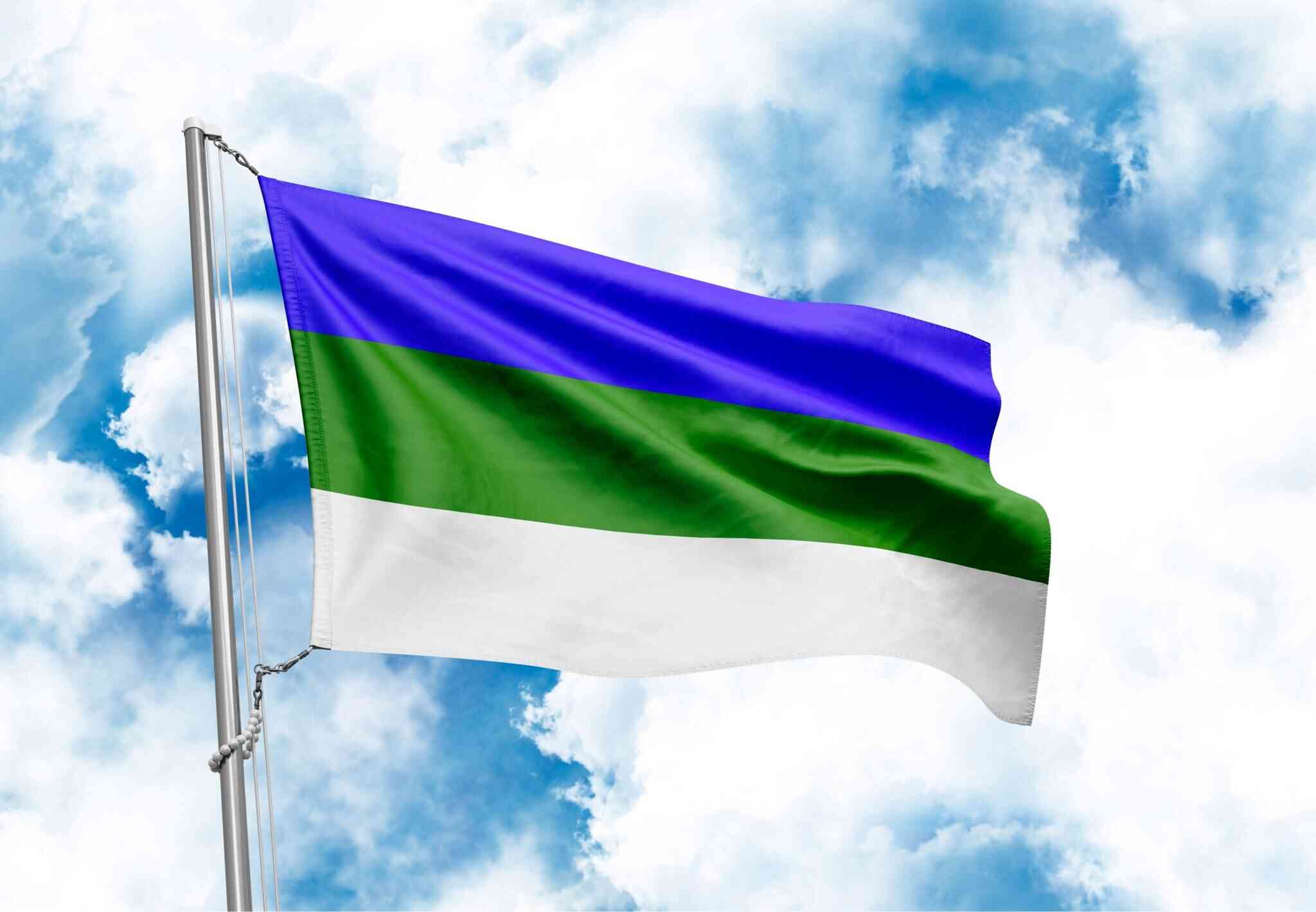
“Separatism”: Russia vs. Komi Ethnic Activists
PSCRP-BESA Reports No 110 (Jan 20, 2025)
Over the centuries, the Russian state expanded its ethnic base through the assimilation of Finno-Ugric peoples, the indigenous population of the north of the European part of the present-day Russian Federation and Western Siberia. Slavs only arrived here in the 9–10th centuries. Now all that is left in these areas from the Finno-Ugric peoples are numerous geographical names, including, in fact, “Moscow”, and a small number of not yet fully assimilated Veps people in Babaevsky district of Vologda Oblast (509 people according to the census of 2021).
At the beginning of the 21st century, a group of enthusiasts emerged trying to reconstruct and revitalize the culture, identity and language of the long-Russified Finno-Ugric tribe of Meryans, which inhabited the central regions of present-day Russia in the Early Middle Ages. In the 2020–2021 census, 109 Russians claimed Meryan ethnicity.
One of the most important tools of assimilation of the indigenous population in tsarist Russia was the introduction of Russian Orthodoxy. To this day, the overwhelming majority of the Finno-Ugric peoples of Russia practice it.
The policy of the tsarist and Soviet authorities aimed at the complete Russification of the Finno-Ugric peoples resumed after a short period of leniency in the 1990s. As a reaction to the assimilation processes, groups of ethnic activists emerged to try to confront them. Occasionally they would opt for extremely radical methods of struggle. However, the majority of Finno-Ugric activists in the Russian Federation are much more moderate. They advocate real autonomy for the respective federal entities and carry out various projects aimed at preserving and promoting the languages and cultures of Finno-Ugric peoples. Some support in this direction has traditionally been provided by Finnish and Estonian public organizations.
Recently, in line with the policy of radical Russian imperial nationalism, which openly proclaims the necessity of Russification of all citizens of the Russian Federation, the Russian authorities are getting more and more tough in persecuting the initiators of such projects. The reaction to this is only natural — for example, roof organization Free Nations of Post-Russia Forum, created in 2022 by emigrants, openly calls for the division of the Russian Federation into independent states on ethnic or regional grounds.
Persons of mixed descent, such as Valera Ilinov, who was born into an urban Komi-Russian Russian-speaking family, have also become part of such initiatives. The idea he expressed even before the full-scale Russian aggression against Ukraine began pointed the way to the integration of at least part of their large Russian population into the titular nationalities of the hypothetical new states that the Free Nations of Post-Russia Forum is now calling for. It can be assumed that the inevitable deep disappointment in the ideas of the “Russian world” by a significant part of the ethnically Russian population will contribute to the change of their ethnic identification. To an even greater extent, this will be characteristic of the mixed or simply Russified population with “titular” ethnic roots. At the same time, the process of Russians changing their ethnic identity to a non-Russian one will be simplified in the case of peoples who traditionally practice Orthodoxy, as do Russians. The Komi are among such peoples.
According to the 1926 census, the Komi made up 92.2% of the population of their autonomy (then called the Autonomous Oblast of Komi-Zyryans), while Russians made up only 6.6%. In the following years, the Soviet authorities built multiple Gulag camps in the Komi ASSR, and the Komi soon became a minority in their own land. According to the 2020 census, the population of the Komi Republic is about 750 thousand people, of which 65.1% are Russian, and the Komi are only 23.7%. The total number of Komi in the Russian Federation amounted to 228 thousand, of which 202 thousand lived in the Komi Republic, and another 11 thousand — in the bordering Nenets, Yamalo-Nenets and Khanty-Mansi Autonomous Okrugs. The number of Komi-Zyryans peaked in 1989, when the census recorded 345 thousand Komi in the USSR. Thus, the absolute number of the people is also decreasing, mainly due to assimilation.
Similar processes are unfolding among the Komi-Permyaks, who are closely related to the Komi-Zyryans (Russian official statistics considers them a separate people, but some ethnic activists consider the Zyryans and Permyaks to be sub-ethnic groups of the single Komi people), who are the titular population of the Komi-Permyak District bordering the Komi Republic in the south-west. According to the last census, its population amounted to more than 100 thousand people, of whom 59% were Komi-Permyaks and 38.2% were Russians. The total number of Komi-Permyaks in the Russian Federation amounted to 95 thousand, of which 81 thousand lived in Perm Krai, mainly in the Komi-Permyak District and other northern regions of the Krai, and more than 2 thousand in the Khanty-Mansi Autonomous Okrug bordering the Komi Republic. The population of Komi-Permyaks also reached its maximum in 1989, when the census recorded 152 thousand Komi-Permyaks in the USSR.
The Komi have no state tradition of their own, except for the principality of Great Perm, which existed in 1451–1505 and was formally dependent on Moscow. Despite this, the Komi people have a fairly well-developed national culture. Before the restrictions introduced in recent years under pressure from the federal center, from 2011 to 2017, the Komi language was taught as a state language on a compulsory basis in all schools of the republic. The Komi language is still taught as a state language (1–2 hours per week) in more than half of the republic’s schools, but, as in other ethnic autonomies of the Russian Federation, the pressure of the federal authorities to supplant national languages is evident.
The most important ethnic organization of the Komi-Zyryans is the inter-regional movement, Komi Voityr, founded in 1989 and still functioning legally, which has branches in all districts of the republic and beyond, in particular in the Nenets Autonomous District bordering the Komi Republic from the north. The movement has a youth wing — the Union of Komi Youth, “MI”. In 2019, a noticeably more radical nationalist movement, Doryam asnymös (“Let’s Protect Ourselves”), emerged, which after the beginning of full-scale Russian aggression in Ukraine was included in the “register of terrorist organizations” of the FSB.
In recent years, it has become popular among supporters of the anti-Putin opposition in the Komi Republic to use the Komi language (which still retains the status of one of the state languages of the republic along with Russian) in communication with representatives of the authorities. It is worth noting the cooperation of the Komi branch of the Communist Party of the Russian Federation (CPRF) with the Komi Voityr movement and with local supporters of Alexei Navalny, which was clearly manifested during the high-profile protests against the construction of a landfill in Shiyes in 2018, and continued after them. Indicative in this sense is the stream of accusations of Komi nationalism against Oleg Mikhailov, the first secretary of the Committee of the Komi Republican Organization of the CPRF in 2021, against the background of his much-publicized conflict with the then head of the Komi Republic Vladimir Uiba from United Russia, who had been appointed a year earlier from Moscow and had nothing to do with the Komi people or the Komi Republic.
The attempt to break off the Komi and then the entire Russian North is actualized in the context of the development of the Northern Sea Route and the growing international interest in the development of the Arctic zone. In this context, it is important to remember that the territory of the Nenets Autonomous Okrug (NAO) used to be a former part of the Komi Republic. The population of the Nenets Autonomous Okrug is about 40 thousand people, of which 66.13% are Russians, 18.62% are Nenets, and 8.99% are Komi. In the capital of the autonomous district, Naryan-Mar, the Komi outnumber the Nenets. As mentioned above, there is a branch of the “Komi Voityr” movement in the NAO.
Since 2021, the situation in the Russian Federation has changed dramatically. What was acceptable then is unacceptable now. Nikolai Udoratin, 25, who refused to give up his principles and, in particular, openly opposed Russian aggression in Ukraine, was mobilized in November 2023 for compulsory service in the Russian Army and deprived, in this connection, of his deputy mandate. Doxa, an opposition online publication operating from outside Russia, reported—citing an anonymous correspondent in Syktyvkar—that “although due to the threat of repressions none of the deputies and public figures in the Komi Republic speaks out in support of Udoratin, almost all representatives of the CPRF in the Republic are against the war. Also, judging by personal conversations, the vast majority of political figures in the Republic are strongly against the war, but they are very much afraid to show their position publicly”.
The Nenets Autonomous Okrug is not the only administrative unit of the Russian Federation that Komi separatists, in theory, can claim. As already mentioned, the Komi Republic is bordered by the Komi-Permyak District, formerly an autonomous Okrug, which on December 1, 2005 became “an administrative-territorial unit with a special status” within the Perm Krai. The fact that in the process of “enlarging the federation entities”, the Russian authorities annexed it to the Perm Oblast, and not to the Komi Republic, directly indicates their desire to weaken the non-Russian ethno-cultural character of this territory. One way or another, the residents of the Komi-Permyak District are dissatisfied with the results of its unification with the Perm Oblast. Today Komi-Permyaks have no ethnic public organizations of their own, with the exception of Yugör — the Society for the Promotion of the Komi-Permyak Language, History and Culture, which was founded back in 1988 and has existed only formally in recent years. Under such conditions, should the process of disintegration of the Russian Federation begin, the annexation of the Komi-Permyak District to the Komi Republic could easily become a reality.
The Komi Republic is one of the donors to the budget of the Russian Federation. It has huge reserves of minerals — oil, gas, coal, bauxite, semi-precious stones, as well as small deposits of gold, titanium and diamonds. The basis of its economy is their extraction and primary processing, as well as wood processing. The loss of control over these riches — as a result of the hypothetical creation of an independent Komi state or the transfer of its revenues to the autonomy itself, as moderate Komi activists insist — would certainly be a tangible economic blow to Moscow. However, it seems that the Russian authorities tend to view the struggle of Komi activists, as well as ethnic activists of other indigenous peoples of the Russian North, in the context of larger international politics, namely the struggle for control over the Arctic Ocean, in which the Russian Federation is facing the United States and a number of other NATO member states. It is not by chance that an article in the Russian propaganda resource The New Insider, dedicated to the Komi activist with Jewish roots Nikita Goldin, is subtitled “In the fight for the Arctic, the West is playing the separatist card”.
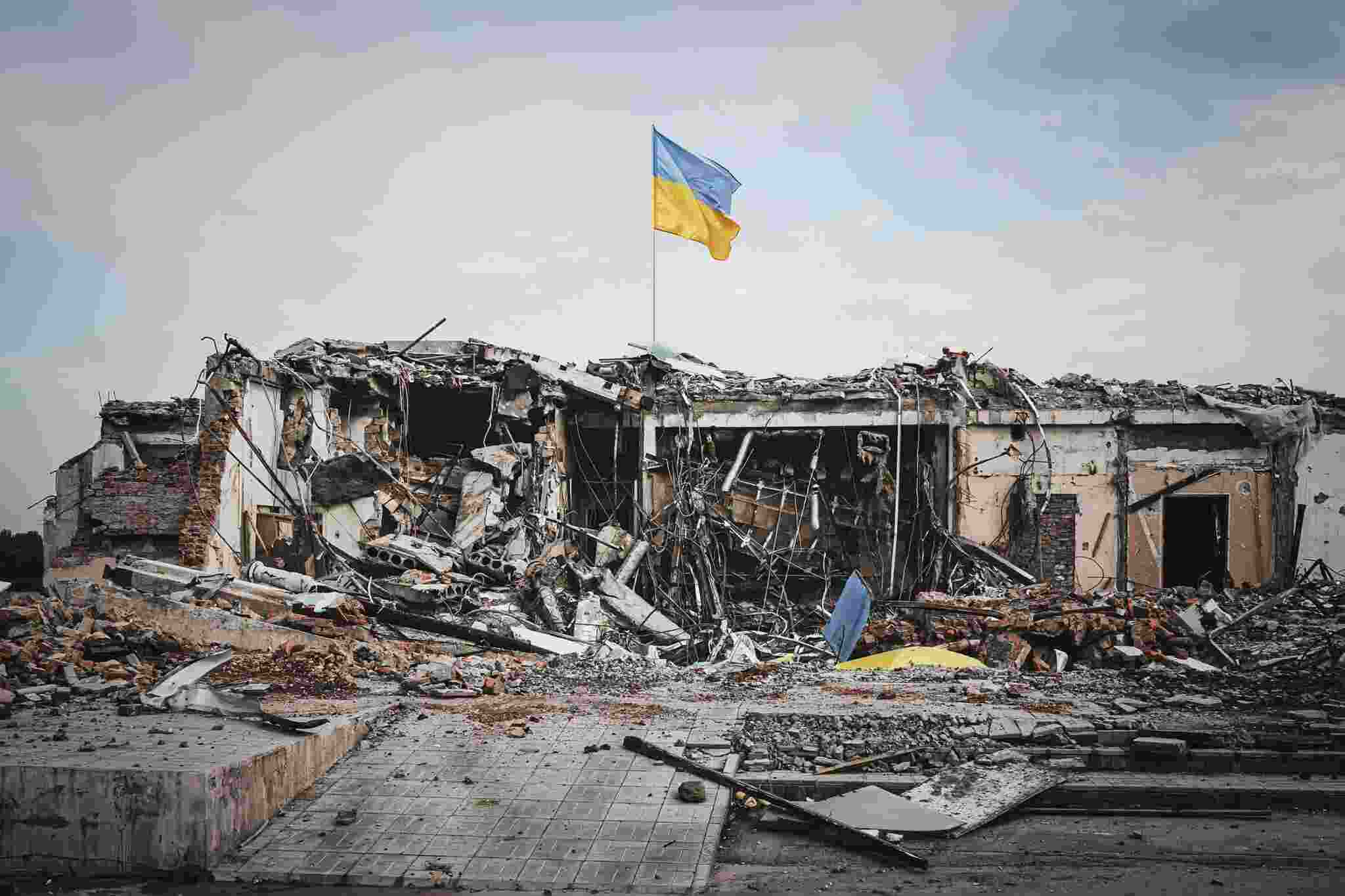
Ukraine at War: Sociological and Political Considerations
PSCRP-BESA Reports No 100 (Nov 28, 2024)
In the first decade of independence, Ukraine was quite distinctly divided into a number of regions, which differed greatly from each other in terms of ethno-identification and linguistic composition:
1. Western Ukraine: oblasts that were part of Austria-Hungary before World War I (Lviv, Ternopil, Ivano-Frankivsk, Zakarpattya, and Chernivtsi) and Volyn and Rivne oblasts that were part of Poland in the interwar period. This region of Ukraine was the least Russified and Sovietized. The legacy of the Ukrainian national movement was strong here, including the fresh memory of the Ukrainian Insurgent Army (abbreviated UPA) armed struggle against Soviet rule (especially in the first three oblasts, where Greek Catholics rather than Orthodox Christians predominate among the believers);
2. Central Ukraine. This region more or less fits within the boundaries of The Cossack Hetmanate, or Hetmanshchyna, a semi-independent Ukrainian state entity that existed in the 17th-18th centuries (Chernihiv, Poltava, Kyiv, Zhytomyr, Vinnytsia, Khmelnytskyi, Cherkasy and Kirovohrad oblasts). It was characterized by the stable preservation of the Ukrainian language in villages and small towns, with the prevalence of “surzhik” (mixed Ukrainian-Russian idiom) and the local variant of the Russian language in larger cities. The level of national self-consciousness of the local Ukrainian population was quite high, but, unlike in Western Ukraine, the tradition of the Ukrainian national movement was significantly disrupted by the long process of Sovietization and Russification;
3. Southern and Eastern Ukraine: oblasts that were once part of Sloboda Ukraine (Sumy and Kharkiv oblasts) and Novorossiya Governorate (Odesa, Mykolaiv, Kherson, Zaporizhzhia, Dnipropetrovsk, Donetsk and Luhansk oblasts). This region was characterized by a significant presence of ethnically Russian population, total dominance of the Russian language in cities and in some (ethnically predominantly non-Ukrainian) villages, mass transition of the local Ukrainian population to surzhik (in villages) and to the Russian language (in urban areas). The ethnic self-consciousness of a significant part of the local Ukrainian population was severely eroded.
Kyiv, like other large cities in Central Ukraine, was predominantly Russian-speaking. However, a significant part of its population had a high level of political and national consciousness, which brought the capital closer to Western Ukraine and — in combination with significant migration from western oblasts as well as from villages — paved the way for linguistic Ukrainianization.
Crimea was the most Russified region of Ukraine. The Russian language (its status as an official language along with Ukrainian and Crimean Tatar was legally recognized in the region) unambiguously dominated in all spheres, there was no Ukrainian-language education system, and there was only one district of the Autonomous Republic of Crimea — Krasnoperekopsky district — where ethnic Ukrainians were a relative majority.
Outside of Western Ukraine, addressing strangers in Ukrainian by default in both official and everyday communication was not the norm — despite the fact that Ukrainian was proclaimed the only state language. Demands to recognize Russian as a second state language were articulated openly by politicians in Eastern and Southern Ukraine.
Russian aggression in 2014 led to a gradual change of this situation. After the full-scale invasion began in 2022, it changed dramatically. I got to visit Ukraine many times after the Russian aggression began in 2014 — I traveled to Kyiv, Lviv, Kharkiv, Poltava, Kremenchug, Dnipro, Zaporizhzhia, Kryvyi Rih, Odesa, Mykolaiv, Kherson, Uzhgorod, Khust, Mukachevo, as well as Mariupol (occupied by the Russians in 2022) and Bakhmut (now completely destroyed), which are practically on the line of contact. On behalf of the Jewish Agency, I also visited occupied Crimea twice (in Simferopol, Bakhchysarai and Yevpatoria). Shortly after the full-scale invasion began, I traveled to Ukraine and visited the country only a few times thereafter. I also had many conversations with refugees from Ukraine in Moldova, Poland and Hungary. This empirical experience, as well as information from the Ukrainian media, allows me to form my own preliminary impression of the social, ethno-identification and linguistic processes developing in Ukraine itself and among Ukrainian refugees outside of it.
The first thing that immediately catches the eye is the almost universal complete exclusion of the Russian language from all official and semi-official spheres of use. A very significant part of the population has switched or is switching to Ukrainian in informal communication. At the same time, under stress or in situations of trustful communication, people accustomed to conversing in Russian often involuntarily resort to the Russian language. Undoubtedly, Ukrainian society as a whole is strategically aimed at maximizing its distance from Russia and Russians, including both in language and culture, as well as at the complete switching of the younger generations to the Ukrainian language, which is facilitated by the elimination of Russian-language schools and classes.
The rapid growth of settlements in Western Ukraine due to the arrival of numerous migrants from the east, from areas occupied by the Russians or in close proximity to the zone of active hostilities, is noteworthy. Some of these predominantly Russian-speaking migrants, having found themselves in places with total predominance of the Ukrainian language, feel insecure about their Ukrainian language competence, fearing that their Ukrainian speech will be perceived by the locals as a ridiculous and uneducated surzhik. In this regard, I have seen announcements in some stores and cafes in Lviv that read something like “Russian speakers, you are not ridiculous. You are encouraged to speak Ukrainian.” Migrants from the East settle not only in large urban centers, but also in villages. I happened to visit many villages in Transcarpathia and in the Hungarian villages adjacent to the border. It is striking that while in the villages on the Hungarian side of the border there are abandoned houses (because young people often leave the villages and move to the cities), there is nothing like that on the Ukrainian side of the border. The locals explain this by the fact that migrants from the east buy or rent almost all available housing in the west of Ukraine. It goes without saying that the closer to the border with EU countries, the safer it is, as there is little chance of Russian missile attacks.
For almost three years of full-scale war, Ukrainian society has adapted to quasi-normal functioning in the environment where mortal danger exists not only on the line of contact, but also in the rear. It is important to emphasize that quasi-normal life continues not only in the west of the country, but also in Kharkiv, Zaporizhzhia and Kryvyi Rih, which are dozens of kilometers away from the front line and are exposed almost daily to rocket fire and drone attacks. At the same time, the war fatigue and lack of prospects accumulated in society are becoming evident. There is a feeling that Western allies are not letting Ukraine win, combined with the realization that without their help it is impossible to continue active and quite successful resistance to Russian aggression. We should not forget that Ukrainian society and the Ukrainian military are suffering from a growing PTSD, which will inevitably manifest itself in the future, when the active phase of the conflict is over.
Apart from the horrors of war, a powerful factor traumatizing the public consciousness is the feeling of injustice regarding the distribution of the war burden within Ukrainian society itself. In this regard, Ukrainians often refer to the Russian saying meaning “war to some is boon to others.” While some Ukrainians have been fighting at the front for the third year already, others are quietly living abroad, evading conscription in Ukraine or doing their army service far from the front. The lack of proper rotation at the front, associated with the actual failure of mobilization efforts, is the direct cause of this situation. At the same time, the notorious TCCs (Territorial Centers of Recruitment and Social Support) often simply detain men in public places and send them to the army, including the elderly and sick. I can confirm this by personal experience. TCC representatives stopped me twice and sought to verify whether I am really over 60 years old (because I apparently look too young) and whether I really do not have Ukrainian citizenship (apparently, I speak Ukrainian too well). Against this background, Ukrainian government officials of different levels, as well as other influential individuals and their family members have reservations from mobilization.
Moreover, many of them, according to a significant part of the population, earn money from the war through various corruption schemes. The impossibility of organizing anti-government protests (“Maidan”) and holding elections during the war reinforces the feeling of hopelessness. In this context, there is a sad joke that goes like this: “There is only one way to defeat corruption in Ukraine: shoot all the deputies of the Verkhovna Rada, then shoot all those who will come to their funerals, and only then hold elections.”
As a result of the full-scale Russian invasion, millions of Ukrainians became refugees abroad, causing the largest migration crisis in Europe since World War II. It should be noted that at the first stage, the Ukrainian authorities themselves de facto called on those unfit for active service from the most threatened areas to temporarily leave the country in order to save their lives and reduce the burden on the Ukrainian economy. During the chaos of the first weeks of the full-scale invasion, a significant number of men of conscription age (up to 60 years old) also left Ukraine. Some of them were able to do so by taking advantage of the corruption in the Ukrainian border services. The presence of Ukrainian refugees in Poland is particularly noticeable.
It is not uncommon to see Ukrainian inscriptions in the Polish capital. For example, ATMs offer Ukrainian as one of the options along with Polish and English. Ukrainian, surzhik and Ukrainian variant of Russian can be heard in Warsaw and beyond very often. It is very obvious that a significant part of the technical staff in hotels, small stores, etc., are Ukrainians. Many of them, despite the patriotic feelings they demonstrate, do not intend to return to Ukraine in the foreseeable future — or ever.
At the same time, there is a kind of “shuttle migration” between Poland and Ukraine, when women living in Poland visit their husbands who remain in Ukraine, because they are in the army or simply cannot leave the country because they have not reached the age of 60. This situation, being indefinitely stretched in time, naturally creates a lot of problems for maintaining normal family relations. It is obvious that Ukraine’s irreversible demographic losses as a result of emigration due to the war will be even higher than those resulting from combat losses and civilian casualties caused by Russian shelling and bombing. This subject is widely discussed in Ukrainian society, and the authorities are making some, so far not very successful, efforts to return at least some of the refugees from abroad.
In this grim situation, many Ukrainians, primarily those who can be regarded as the intellectual elite and expert community, see the Jewish state as a successful model of survival and development in extreme conditions. They see Israel as a model of a small, dynamically developing state that has successfully resisted external aggression from an uncompromising enemy, many times superior in human and material resources, which denies the right of this state to exist and whose goal is to destroy it completely. There are strong sympathies for Israel among ordinary Ukrainian citizens as well, as I have witnessed more than once in the course of direct communication with them in various situations. This is facilitated, in particular, by Israel’s war against Iran, which is the closest ally of Russia. To Ukrainians, Jews are not some “exotic people” but “neighbors”. There are many natives of Ukraine in Israel, and natives of Ukraine played a decisive role in the establishment of the Jewish state. In addition, many Ukrainians are personally acquainted with Jews now living in Israel. All this allows them to perceive the Israeli model as partly “their own” and as fundamentally implementable in Ukrainian conditions.
To summarize, I can say that the majority of Ukrainian society and its elites have come to terms with the idea that the liberation of the Russian-occupied territories is impossible in the foreseeable future. In this regard, against the background of accumulated fatigue, it needs a respite, which can be provided by a ceasefire agreement along the existing lines of contact. At the same time, there is no question of an official renunciation of the territories seized by Russian troops or any normalization of relations between Ukraine and Russia. Ukrainian society is mostly convinced that Russia is an immanent enemy of Ukraine, so the resumption of active armed confrontation is inevitable.