
Theme - Palestinians
Palestinian Arabs in the Context of Russia’s Demand for Leadership of the Global South and Conflict with the West
PSCRP-BESA Reports No 102 (Dec 11, 2024)
Vladimir Putin’s second presidential term (2004–2008) was marked by Moscow’s obvious desire to regain its status as a global superpower, which had been lost by the Soviet Union as a result of its defeat in the Cold War. The point of official departure from the former policy of open partnership with Western countries and close cooperation with NATO was the so-called 2007 Munich Speech of the Russian President and the invasion of Georgia that followed in August 2008. Moscow’s global claims gained momentum sharply after Russia’s annexation of Crimea in 2014, and received an even more refined doctrinal formulation after February 24, 2022.
A critical element of the Kremlin’s new doctrine, which represented a peculiar synthesis of neoconservatism and formally leftist Soviet ideology, was its anti-colonial aspect: the movement of the unprivileged countries of the Global South against the world economic and political dominance of the Global North, usually identified with the U.S.-led bloc of “old” and “old-new” Western democracies. From the point of view of the Russian leadership, such ideological constructs were to become the common denominator of the geopolitical, diplomatic and economic strategy of the international organizations that Moscow is building as a tool to confront the “collective West”. Notable among them is BRICS — an informal association of initially four non-Western states with rapidly growing economies, established in 2006 at the initiative of the Russian Federation, which has gradually expanded to nine member states, together accounting for 46% of the world’s population and 37% of global GDP.
Moscow’s bid for leadership in the global South also had an obvious Middle East dimension. Already at the beginning of the shift in Russia’s foreign policy, it was made clear there that Moscow was no longer willing to settle for the rather formal status of “co-sponsor of the Middle East peace process,” but intended to set the tone in the region. It is clear that with such an “anti-imperialist” vision, which, incidentally, is shared by ultra-leftist and radical-progressive circles in Western countries, the emergence of the subject of “Israeli colonialism” allegedly oppressing the “freedom-loving people of Palestine” in the official rhetoric of the Kremlin was a matter of time.
As a result, in late 2010s Russia’s initial practice of balancing and mediating between almost all actors involved in the Middle East conflict began to gradually change, and its final reformatting took place after October 7, 2023. This time Moscow almost openly supported Hamas as a satellite of Iran, Russia’s current closest partner in the Middle East.
Russia’s support for the Palestinian National Authority in the West Bank, whose leaders from the very beginning of the Russian military invasion of Ukraine in February 2022 have taken the side of Moscow, where they continue to repeat the long-exhausted formula about the creation of an independent Palestinian state with East Jerusalem as its capital as the only way to resolve the conflict in the Middle East. (In this context, the results of voting by PA residents with Russian citizenship in the March 2024 Russian presidential election are quite revealing. More than 90% of those who took part in the elections in the PA voted for Vladimir Putin, while Vladislav Davankov was the leading candidate among the Russian citizens who voted in Israel)
The appearance of the PNA/PLO and Hamas delegations at the next BRICS summit in Kazan in late October 2024 as honorary observer guests in the “BRICS plus/outreach” format was in line with this policy. The head of the Palestinian Authority Mahmoud Abbas (Abu Mazen) made the most of the arena graciously provided by the organizers and the sympathetic attention of the federal and local Russian press to accuse Israel of “genocide” of Palestinian Arabs, “ethnic cleansing in the Gaza Strip”, and other alleged “violations of international law”. He concluded by demanding that BRICS member states impose sanctions against Israel and expressed hope that “Palestine will be accepted as a member of BRICS” in the near future.
In fact, it is not so much the bilateral relations with the virtual “Palestinian state” that are important for Russia itself, but rather more significant things for Moscow – its attempts to intercept the status of the main sponsor of the “Palestinian cause” from the West in order to gain geopolitical regional and global advocacy perspectives. Apparently, it is within the framework of such a strategy that the Soviet rhetoric about the alleged “pivotal nature of the Palestinian-Israeli conflict for the entire situation in the Middle East” and its “key role in the major regional crises threatening the security and stability of the region” is being revitalized.
Russian society, which until recently was generally favorably disposed toward Israel, has embraced the revival of propaganda clichés that seemed to have been long gone: according to polls, the percentage of Russians sympathizing with the Palestinian Arabs today is many times higher than the percentage of those sympathizing with the Jewish state. In fact, this was not a big surprise. Data collected over 26 years of sociological observations by the authoritative Moscow-based Levada Center showed that although the majority of Russians do not support either side in the Palestinian-Israeli conflict, since 2011 there has been a gradual increase in the share of respondents whose sympathies are on the side of the Palestinian Arabs, while at the same time the number of respondents who support the Israelis has been decreasing. By October 2024, the level of support for Palestinian Arabs exceeded the level of support for Israelis by 4.5 times (28% and 6%, respectively), while 13 years ago the ratio was inverse.
However, also in 2011 there was an absolute maximum — more than 70% — of respondents who did not express sympathy for either side in the conflict. In October 2024, the share of such respondents in Russia amounted to 57% — almost identical (56%) to the share of Americans who chose the same answer option in a parallel survey by the Chicago Council on Global Affairs. At the same time, while the share of those who found it difficult to answer was four times lower than among respondents in Russia, the share of Americans who supported Israel (31%) was five times higher than the share of Russians (6%), among whom the number of those who sympathized with the Palestinians was, on the contrary, 2.5 times higher than among those who sympathized with the Israelis (28% and 11%, respectively).
In light of these data, it is not surprising that the share of American respondents who believe that Israel is protecting its interests in the current conflict and its actions are justified is more than twice as high (32% and 14%) as the share of Russians who share this opinion. But among those who chose the statement “Israel has gone too far and its actions are not justified,” the split was the opposite: 59% of the Russians surveyed and 34% of the Americans thought so.
The fundamental question — What is going to be “the day after”? — eventually leads the debate to the problem of establishing a Palestinian state, which in the romantic period of the Norwegian Accords of 1993–1997 was considered in by many to be the optimal solution to the Palestinian Arab problem and the trigger for ending the almost century-long Arab-Israeli confrontation and the Middle East conflict as a whole. While the idea of resolving the Palestinian-Israeli conflict according to the Oslo model (“two states for two peoples”) has clearly exhausted itself long ago, this formula is still too entrenched in international political and diplomatic discourse to be abandoned without severe consequences for the strategies based on it, the careers built on it, and the diplomatic, political and economic resources invested in it. And it is in this capacity that it remains a notable geopolitical and geostrategic factor.
It seems that public sentiments in the two countries quite accurately reflect the local media agenda: rather diversified in the United States, and relatively homogeneous, with the dominance of pro-government media, in Russia. At first glance, the opinions of Americans and Russians are completely identical on this point: 49% of respondents in both the American and Russian samples were in favor of the creation of an independent Palestinian state. At the same time, the number of those who were against the creation of such a state in the United States (41%) was slightly less than those who were in favor, while in Russia this number was three times less (14%).
However, if for the United States and its allies this subject, in one way or another, mistakenly or not, is still seen as one of the ways to solve the problem, for Russia and its allies it is hardly more than an active propaganda resource and a tool of geopolitical confrontation with the “global West” and competition with China, Turkey and the Saudi bloc for influence in the Middle East.
Israel, the Middle East, and the Russian Public Opinion Part 2: What Russians Think of Israeli War with HAMAS and the Israeli-Palestinian Conflict
PSCRP-BESA Reports No 94 (Oct 30, 2024)
Russia and Israel: From Allies to Adversaries?
It is hard not to notice that the war Israel is waging, with the support of the United States and other allies in the Western bloc, against Iran’s terrorist alliance and its radical Islamist Arab proxies—Hamas in the Gaza Strip, Hezbollah in Lebanon, the Houthis in Yemen, Shiite militias in Syria and Iraq, and others—has its reflection in the ideological, political, and diplomatic discourse of post-Soviet conflicts, primarily the Russian-Ukrainian and Armenian-Azerbaijani conflicts. It also introduces adjustments to the foreign policy stance of those USSR successor states that have various geopolitical interests in the Middle East.
A prime example in this regard is the Russian Federation, whose return as a key player in the second half of the 2000s became an important factor in the new configuration of political forces in the region. In Israel, the then Middle Eastern reflection of Russia’s bid to reclaim its status as a global superpower was met with mixed assessments. Optimists were inclined to believe that Moscow was returning to the Middle East not as a proponent of any particular ideology but out of purely pragmatic considerations. Therefore, even if global geopolitical interests might, in principle, place Israel and Russia on opposite sides of the barricades, this would not necessarily lead to direct confrontation between the two countries, leaving ample room for cooperation beyond points of disagreement.
On the other hand, pessimists were convinced that Russia would sooner or later revert to the global political models and views of the late Soviet era—including seeing Israel as a potential adversary, given its strategic partnership with the United States. Consequently, the dynamics of a potential intensification of U.S.-Russian competition in the Middle East would ultimately shift almost any discrepancies between Jerusalem and Moscow from the category of “disagreements between partners” to that of “direct confrontation, leaving little room for compromise.” [1]
Initially, Moscow indeed attempted—with some success at times—to position itself as a party capable of cooperating with virtually all actors in the Middle Eastern conflict and even mediating between them. However, after October 7, 2023, Russia explicitly supported Hamas, Hezbollah, and the Iranian bloc as a whole. At the same time, the profile of the rapidly developing Russian-Israeli relations of the past decade sharply diminished, although Moscow and Jerusalem attempted to maintain a semblance of “business as usual”.
In other words, recent events appear to conclude the nearly fifteen-year debate between “Kremlin optimists” and “Kremlin pessimists.” The current situation fits into a normative framework characteristic of a substantial and influential segment of Russia’s foreign policy elites: Russia’s strategic partner in the region is Iran, which supplies critically important weapons for use on the Ukrainian front and secures Russia’s “southern flanks” in terms of geopolitical interests. This logic does not, however, extend to Russia’s view of Israel’s interests, as Israel is a strategic ally of Russia’s adversary—the United States. Against this backdrop, it is unsurprising that numerous practical steps and statements by Russian leaders have been widely interpreted as expressing solidarity with Iran’s Arab satellites, including Hamas and Hezbollah.
“Overnight” Shifts in Russian Public Discourse
The Russian public’s response has closely mirrored the foreign policy positions of the Russian political establishment, shaped largely by state-controlled information channels, as outlined in Part 1 of this article.
According to one of the earliest sociological surveys conducted in the USSR—though not fully representative, it provided some insight into the effectiveness of Soviet propaganda and the internal and external policies of Soviet leadership—Israel was among the top five enemies of the USSR, along with the United States, the United Kingdom, West Germany, and China. This survey, conducted by Professor B. Grushin in the late 1960s, highlighted these perceptions. However, after the collapse of the USSR and a shift in foreign policy, attitudes toward Israel appeared to change drastically. Regular sociological measurements by the reputable Yuri Levada Center in Moscow, beginning in the late 1980s, indicated that in the absence of state-driven anti-Israel or anti-Semitic sentiment, Russian public opinion toward Israel was predominantly neutral (“similar to other countries in the region”) or mildly positive. [2]
From the mid-1990s and over the next 25 years, approximately 60% of respondents consistently reported a lack of hostility or animosity toward Israel. About one-fifth of those surveyed expressed positive sentiments or interest in Israel, while an average of only 1 in 10 respondents indicated a negative view of the country. Isolated years marked by “spikes” in anti-Israel or “negatively neutral” attitudes—such as during the 2006 Lebanon War, noted in the first part of our article—were unfortunate exceptions.
Despite this generally neutral or favorable stance, research from this and other sociological agencies found that a considerable legacy of Soviet anti-Zionist propaganda persisted in the public consciousness, particularly among older individuals, residents of rural areas, and those with lower levels of education and income. Superficially, the longstanding Arab-Israeli conflict seems to have little effect on current levels of anti-Semitism in Russia or public attitudes toward Israel. Only 3% of Russians closely follow Middle Eastern political news or actively seek related information, primarily those who have traveled to Israel or have relatives or close friends there. Another 17% follow the situation “from time to time,” while the majority remain indifferent, uninformed, or simply do not follow developments in the region. Three-quarters of respondents stated they do not support either side in the conflict, while 10% expressed sympathy for both. Among the remaining respondents, support was almost evenly split: 8% sided with Israelis, and 7% with Arabs. This neutrality is gradually increasing, as previous surveys showed support levels at 12% and 10%, respectively.
Nevertheless, anti-Zionism, though less overt than in the Soviet era, remains an “acceptable” expression of latent anti-Semitism among certain groups. This includes belief in Zionist conspiracies and notions of Jewish plans for global dominance. “Traces of this ideological indoctrination and propaganda, along with a rejection of liberal values and democracy,” note the authors of a 2020 study by the Levada Center, commissioned by the Russian Jewish Congress, “are still evident today in attitudes toward Israel and Jewish emigration.”
The reversion of Russian leadership to Soviet-era narratives on the Arab-Israeli conflict has notably shifted public sentiment. In an October 2024 Levada Center survey, respondents had a favorable view of China (81%), Brazil (55%), Turkey (52%), and Iran (50%), with only 27% expressing positive views of Israel—comparable to views of France (20%), the UN (19%), the EU (16%), the U.S. (16%), and Ukraine (14%). This is a marked contrast from 2013, when respondents viewed Israel as a friendly state. In September 2018, 52% of Russians surveyed by the Public Opinion Foundation also viewed Israel as friendly, with only 16% holding an opposing view.
Who Is Responsible for the Middle Eastern Conflict?
There is little doubt that the current decline in public sympathy for Israel stems from the official rhetoric and stance of Russian authorities. This trend has had a noticeable impact on Russian public opinion. A survey conducted by the Levada Center in late October 2023 revealed that while two-thirds (66%) of respondents did not support either side in the Israeli-Palestinian conflict, those who sympathized with the Palestinian Arabs (in this case, Hamas) outnumbered those sympathetic to Israel by 3.5 times. Support for Israel was more common among members of the “internet party”—younger people aged 25-39 and residents of major cities.
In general, compared to data from 2007–2010, the share of supporters of Palestinian Arabs in the conflict with Israel has doubled (from 9–14% to 21%), while support for the Jewish state has similarly halved, dropping to 6%.
Nevertheless, Russians largely consider the United States and NATO countries to be primarily responsible for ongoing bloodshed and instability in the Middle East—a view shaped by both Soviet-era and current Russian state propaganda. The belief that the U.S. and NATO bear the main responsibility is most prevalent among older respondents (44% of those aged 55 and older), low-income respondents (44%), those who believe the country is on the right track (40%), and those who rely on television for information (44%).
However, compared to the 2023 survey, support for this viewpoint has dropped by nearly a quarter—from 45% to 38%—largely due to a nearly twofold increase (from 12% to 22%) in those blaming Israel entirely. The proportion attributing responsibility to Hamas and Palestinian extremists has remained steady over the past year, with less than 10% of respondents holding this view. Meanwhile, the percentage assigning blame to Iran and its allies, or to Russia, hovered around or below the margin of error.
Some demographic divides are present, though not pronounced, along lines of gender, age, political outlook, and socioeconomic status. Men (27%), respondents aged 55 and older, and those who believe “things in Russia are going in the right direction” (25%) are more likely to hold Israel responsible for the continuation and escalation of the conflict. On the other hand, younger respondents under 24 (13%), more affluent respondents (10% of those able to afford durable goods), and those who believe the country is on the wrong track (13%) are more likely to attribute responsibility to Hamas and Palestinian Arabs.
Interest within Russian society in Israel’s conflict with Arab terrorist groups has noticeably waned over the year since the beginning of the IDF’s “Operation Iron Swords” in Gaza. While over 80% of Russians surveyed by the Levada Center in September 2024 stated that they were aware of Israel’s war with Hamas, only one in five respondents (19%) reported closely following the developments—almost half the figure from October 2023 (32%). Nearly two-thirds (62%) of respondents said they had “heard something but without details,” which is only slightly higher than the previous year (56%). Those who admitted to hearing about the conflict “for the first time during the survey” nearly doubled, reaching 18% in September 2024 compared to 11% in October 2023.
In other words, Russian public engagement with Israel’s fight against Iranian-backed Arab terror—and the Middle Eastern conflict more broadly—remains limited. The “television party,” which represents a significant portion of Russian society, continues to follow official narratives. Should a direct confrontation between Russia and Israel occur in the Middle East, Russian society is likely to accept it with the same “understanding” that many Russians displayed toward the military aggression against Ukraine.
That said, another perspective also exists, such as among the dwindling number of “optimists” in Israel who argue that the differences, or even sharp disagreements, between Israel and Russia on various issues do not reflect a fundamental conflict of interests between the two nations but rather the current global context of Russia’s interests. They believe that if the context shifts or Israel’s role within it changes, so too could the state of Russian-Israeli relations—and, with it, Russian public sentiment.
In any case, if this shift does happen, it likely won’t occur until after the wars in Eastern Europe and the Middle East have concluded—something that does not appear imminent.
[1] Personal interviews conducted by the author with experts and staff from relevant Israeli, American, and Russian think tanks (Tel Aviv, Herzliya, Jerusalem, Ramat Gan, Washington, and Moscow, 2011–2015).
[2] Anti-Semitism and Xenophobia in Contemporary Russia. Analytical Report on Sociological Research. Moscow: “Yuri Levada Analytical Center” and REC, 2020, pp. 85-87.
Israel, the Middle East, and the Russian Public Opinion Part 1: Russian View of the Jewish State
PSCRP-BESA Reports No 92 (Oct 23, 2024)
A year has passed since the beginning of the war that Israel, with the support of its allies, primarily the United States, has been waging against the “Axis of Evil”—an anti-Western alliance consisting of Iran, its satellites (Syria, Iraq), and terrorist proxies that have effectively taken control of their respective regions, such as Hezbollah in Lebanon or specific territories like the Houthis in Yemen and Hamas in the Gaza Strip. As the conflict escalates, the issue of international support for Israel’s actions has become increasingly pressing.
Of particular concern to Jerusalem, naturally, is the stance of Western countries, especially Israel’s allies, most notably the United States and several key European nations. As the fighting intensifies, the diplomatic rhetoric of these governments has increasingly emphasized the “humanitarian dimension” of the conflict, largely driven by the growing trends in local public opinion, which are not always favorable to the Jewish state. However, a closer look reveals that the sympathies of some segments of the public in democratic countries towards the Palestinian Arabs do not, in most cases, translate into support for the radical Islamist terrorist groups in the Middle East. The primary diplomatic message from Washington and the majority of its NATO partners remains steadfast support for Israel’s right to self-defense.
Another perspective is that of the so-called “Global South,” a diverse and loosely organized conglomerate of developing and moderately developed countries from the Third World and, to some extent, the former Second World. The majority of these nations tend to hold either moderately pro-Palestinian views regarding the current Middle Eastern conflict or, more commonly, remain neutral. However, this does not prevent both groups from almost automatically voting in favor of anti-Israel resolutions at the UN, in line with the traditions of the still residual “Non-Aligned Movement.” The approach of regimes vying for leadership of the “Global South” looks fundamentally different. Competing for this status, they attempt, to varying degrees, to challenge the global economic and political dominance of the so-called “Global West,” typically associated with the U.S.-led bloc of “old” and “old-new” democracies of both the New and Old Worlds.
The discussion is generally about Russia, China, and, to a lesser extent, India. While Delhi, whose relations with Jerusalem have reached a state of strategic partnership in recent years, maintains a largely neutral position in the conflict between Israel and Iran, as well as its Arab proxies, Moscow and Beijing have taken sides—and it’s clearly not Israel’s side. China’s support for Iran remains largely moral, and Tehran has little chance of dragging Beijing into a direct confrontation with Israel. However, Russia’s support for its current closest partner in the region—Iran—is significantly more tangible, despite some differences between them. This includes direct solidarity from Moscow with Tehran’s Arab satellites, including Hamas and Hezbollah.
All of this significantly distinguishes the current situation from Moscow’s previous strategy of balancing and mediating between nearly all parties involved in the Middle East conflict, which was intended to position itself as an “impartial mediator.”
Factors of Views of Israel in the Russians Public Discourse
Over the course of 12 months of Israel’s war with Iranian proxies, the Russian leadership’s propaganda and diplomatic efforts in support of these regimes and groups, often loosely and not always convincingly framed as “solidarity with the Palestinians”, have become quite significant. On the flip side of this trend, there has been a series of anti-Israel moves, featuring elements bordering on antisemitism.
Unsurprisingly, the reaction of Russian society, which is highly susceptible to official propaganda—particularly pro-Kremlin television (which, according to polls, remains the main source of information for Russians)—and “patriotic” Telegram channels, has also shifted. Public sentiment among Russians, who were generally quite favorable toward Israel in the past, changed almost instantly. This is notable given that, according to public opinion monitoring conducted by the reputable Levada Center since 1988, Israel has historically been viewed positively in Russia. The country’s economically established, younger, and better-educated citizens, as well as residents of Moscow, have been the most likely to show interest in and sympathy toward Israel.
Twenty years ago, in 2004, over two-thirds of respondents in a Levada Center poll reported very positive or somewhat positive attitudes toward Israel, while fewer than one-fifth of those surveyed held the opposite view. One possible factor contributing to such favorable sentiments was the emerging public partnership between Jerusalem and Moscow in the fight against terrorist groups. This included Russia’s willingness—expressed by Russian Foreign Minister Sergey Lavrov during a visit to Israel—to learn from Israel’s experience following the Beslan school tragedy in North Ossetia, where an attack by armed Islamists killed over 350 people, half of them children.
However, by 2006, the proportion of those with positive views of Israel had dropped by about half, while the share of those holding negative opinions increased from less than 20% to over 30%. A March 2006 poll appears to have captured a surge in public frustration, likely driven by the sharp and widely discussed response from official Jerusalem to Moscow’s refusal to classify Hezbollah and Hamas as terrorist organizations. This frustration was compounded by the high-level reception of a Hamas delegation in the same month (and again a year later), led by Khaled Mashal, the head of the group’s political bureau and one of Israel’s most bitter enemies. Additionally, the Hamas delegation’s meeting with Patriarch Alexy II, head of the Russian Orthodox Church, was seen by many as not just political but also religious legitimization of the radical Islamist group.
These negative sentiments among the Russian public regarding Israel were, at the very least, not softened during the 34-day Second Lebanon War in July–August 2006, when the Israel Defense Forces (IDF) launched an operation against Hezbollah, the pro-Iranian Shia terrorist group controlling southern and eastern Lebanon.
The rise in Russian-Israeli relations began in the second half of the 2000s, as Russia reestablished itself as a significant player in the Middle East. Moscow recognized that, unlike the Soviet Union, modern Russia could not rely solely on its ties to the Arab world and sought greater understanding with Israel as well. This approach was positively received by Israel’s leadership at the time. The shift toward a close partnership with Russia was considered one of the foreign policy priorities of Benjamin Netanyahu’s second government (2009–2013). Netanyahu viewed his personal relationship with Russian President Vladimir Putin as a valuable political asset.
Most of the second decade of the 21st century indeed saw a significant revitalization of Russian-Israeli relations, including rapid growth in mutual trade, as well as increased cooperation in economic, technological, scientific, cultural, and humanitarian sectors—although the scale of this cooperation lagged behind the real potential of both countries. Political dialogue at the highest levels was also very active. While these political and diplomatic contacts were “more symbolic than practical,” as noted by prominent Russian political analyst Fyodor Lukyanov, this symbolism reflected an unusual situation where “Russia’s relations with Israel were better than with almost the entire Arab world. Apart from the Iran issue, there were few significant points of differencs between Moscow and Tel Aviv [sic]. Meanwhile, Russia’s cooling relations with most Arab regimes were tied to its support for Syria”.
This positive portrayal of Russian-Israeli relations in both federal and regional Russian media was paralleled by a gradual improvement in Russian public opinion toward Israel. By 2010, according to Levada Center data, favorable attitudes toward Israel had peaked at 70%. However, over the next decade, this support steadily declined. A notable exception was a sharp drop in 2014, likely in response to the Israel Defense Forces’ (IDF) anti-terror operation in Gaza, Protective Edge. Nonetheless, this dip was short-lived, and thanks to the relatively balanced position taken by Russian authorities during the conflict, public sympathies for Israel rebounded to around 60%. This level of support remained fairly stable over the following four years.
The 2015–2017 agreements on the “deconfliction” of Russian and Israeli interests in Syria, as well as numerous meetings—around two dozen—between Russian President Vladimir Putin and Benjamin Netanyahu, likely played a key role in the development of their relations. Netanyahu, who valued his warm personal relationship with Putin as a crucial factor in bilateral cooperation and a significant resource for both his foreign and domestic policies, met with Putin roughly twice as often as he met with U.S. presidents during the same period. However, even at that time, it was clear that this was more of a tactical partnership, based on overlapping interests and mutually agreed-upon “rules of the game.” As a result, there were lingering concerns that if the political landscape changed, so would the interests.
The first signal that these fears were well-founded came with the incident in the skies over Syria on September 23, 2018. During this incident, one of the dozens of missiles fired by Syrian air defense batteries equipped with Russian S-200 systems shot down a Russian IL-20 electronic intelligence aircraft. The Russian side quickly blamed the Israeli Air Force, which had been conducting an operation to destroy Iranian equipment intended for the production of precision missiles in Syria. According to Israeli and foreign media, by the time the Syrian forces began their “indiscriminate firing,” the Israeli F-16s had already completed their mission and were back in Israeli airspace.
Despite this, the Russian Ministry of Defense—and to a lesser extent, the Kremlin—blamed Israel without substantiation. However, both Jerusalem and Moscow soon moved to de-escalate the diplomatic conflict, clearly showing a desire to maintain their coordination mechanism in Syria. It was harder to ignore the “patriotic” campaigns in many Russian media outlets, including federal TV channels, where numerous public figures competed in making harsh anti-Israel statements, some of which bordered on or crossed into antisemitism. Although this media campaign was quickly wound down—likely due to guidance from relevant authorities—it became evident that the reintroduction of Soviet-era anti-Israel and antisemitic clichés into Russia’s legitimate public discourse was a real possibility, should such narratives be required by the government.
The impact of this political atmosphere on the Russian public was quickly evident. The once-positive attitude of Russians toward Israel began to sharply decline, while negative sentiment toward the Jewish state increased in parallel. For example, compared to 2018, when 60% of surveyed Russians still had a “very positive” or “mostly positive” view of Israel, and less than one-fifth held an opposing view, by 2020 Israel’s positive rating had dropped by 10%, while negative perceptions rose by 50%.
This trend accelerated dramatically after the start of the war in Ukraine in February 2022, and even more so with the onset of Israel’s war with the Iranian bloc in October 2023. Although Israel, unlike NATO member states that provided Ukraine with security guarantees, did not directly align itself with the Western coalition opposing Russia, official Jerusalem condemned the Russian invasion, offered significant humanitarian and material aid to Ukraine, provided diplomatic and political support, and supplied the Ukrainian Armed Forces with some types of defensive and non-lethal equipment. Despite attempts to maintain a sense of “business as usual,” this approach caused notable irritation within the Russian leadership. Consequently, public support for Israel among Russians dropped to 35%, a historic low, nearly matching the share of those holding a negative view of Israel for the first time in Levada Center’s years of polling.
By September 2024, 51% of Russians expressed a negative attitude toward Israel, marking a 34 percentage point increase from 2018. Meanwhile, positive sentiment toward Israel fell by 32 percentage points, reaching just 27%.
Since the collapse of the USSR, Russian-Israeli relations have experienced both highs and lows, but the current situation, where the number of Russians with a negative view of Israel nearly doubles the number of its supporters, is unprecedented in the post-Soviet era.
It seems reasonable to assume that the opinions and sentiments of Russians, at least regarding the subject of this text, are largely—if not entirely—a reflection of the foreign policy vision of the Russian political establishment, shaped by the tools it controls to influence public consciousness. In other words, we are witnessing a phenomenon that, until recently, appeared to be a relic of the distant past.
Anti-Semitism and Islamophobia: Friendship Between Russia and Hamas Through the Prism of Russian Militarists
PSCRP-BESA Reports No 84 (Sept 19, 2024)
In the context of the new Palestinian-Israeli war, Russia has effectively adopted a pro-Palestinian stance, although its diplomacy tries to present itself as staying above the fray. This is hardly surprising given the ongoing Russian-Ukrainian war and the de facto break with the West for years to come. To position itself in the Muslim world, Russia needs to openly sympathize with the Palestinians, and close relations with Iran in the energy and military sectors make close ties with Israel difficult.
However, even against the backdrop of growing militarization and entrenched anti-Westernism, an unexpected rapprochement with Hamas is far from natural. Despite the proclaimed “turn to the East” and claims to leadership in the anti-Telegliberal world, Russian society remains socially and culturally oriented towards Europe. Beyond official declarations, Russian officials have made little progress: Iran, Saudi Arabia or North Korea are hardly seen as normative models. The memory of the Chechen wars is still alive in the public, where they are framed in a dominant narrative as a struggle against separatism and Islamism. Terrorist attacks such as the bombings of apartment buildings in Moscow (2000), the hostage-taking at the Dubrovka theater (2002) and at the school in Beslan (2004) are key reference points. Since the mid-2010s, Russia’s intervention in the Syrian civil war, as well as poorly publicized operations in the Central African Republic and Mali, have been publicly justified as fighting radical Islamism, while propagandists have labeled supporters of political Islam as such.
These contradictions are clearly visible in the rhetoric of Russian online Z-militarists: numerous Telegram channels, whose administrators are directly involved in the Russian-Ukrainian war, are often close to the front line and take a more radical position than the state propaganda in the rear. Their reaction to Israel’s war against Hamas has been quite cynical, accompanied not only by anti-Semitism but also outright Islamophobia.
Israel and Z-Anti-Semitism
Undoubtedly, after October 7, Russian militarists largely sided with Hamas and Hezbollah. The reasons lay in the ideological realm and were rooted in the desire to frame the conflict in a way that would fit their narrative: anti-Western sentiment, criticism of the United States and its allies, demonstration of Russia’s strength, and convincing readers that “in general” Russia was not committing “any particular” war crimes.
The first line of interpretation is geopolitical: another “hot spot” is beneficial to war-torn Russia because it could potentially divert U.S. attention and resources away from Ukraine. Z-blogger Govorít TopaZ, affiliated with the neo-Nazi group Rusich (157,000 followers), wrote in November 2023 about the protracted nature of the confrontation between Israel and Hamas: “It will be hard for them, the load will increase exponentially, so more and more Western aid would go to Israel. And if it goes there, it won’t go to the ‘khokhol’” (a derogatory term for Ukrainians). Moreover, Israel does not support Russia in its war, which prompts sympathy for Hamas and Hezbollah on the principle of “the enemy of my enemy is my friend”. This is a key reason why militarists refer to these organizations as “allies.”
The most consistent supporter of Hamas and Hezbollah was the Telegram channel Grey Zone, one of the main media outlets of the Wagner group (its administrator was killed in Mali in the summer of 2024). The reasons for this liking, which translates into full acceptance of anti-Israel narratives, lie partly in the administrator’s anti-Semitism, which was extreme even by the Z-community standards. For example, in October 2023, he called Amir Weitman, a Likud member, a “talking soap.” But Grey Zone’s sympathies are rooted in their perception of Hamas as something akin to the Wagner group itself: a community of true warriors united by a common goal of struggle. The rhetoric of the small nation’s anti-colonial resistance plays an important but not decisive, role. Thus, on October 9, Grey Zone directly compared the elite Russian airborne troops to Hamas. It posted videos of Hamas airborne attackers and captioned them with the well-known slogan of the Russian elite airborne troops, “For you! For us! And for the special forces!” adding “Hamas airborne troopers.” A month later, the channel praised Hamas’s high tactical training, reposting related videos. Similar publications continued to appear later.
The anti-Semitism of Russian militarists usually takes the form of anti-Zionism and is rooted in their geopolitical fantasies. A foreign war serves only as an excuse to reinforce their own propaganda line. Militarists deliberately emphasized U.S. aid to Israel to show their readers that the Jewish state is less important to the U.S. than Ukraine. In early October, they pushed the narrative that Hamas was using Ukrainian weapons to make Kyiv look like it was working against the U.S. Some repeat this claim to this day, portraying Ukraine as a global security threat. Next, they moved on to another thesis — that Ukraine is of secondary importance to the U.S. For example, in mid-November, military ‘journalist’ Alexander Sladkov (who has more than over 900,000 followers), discussing the arrival of American ships off the coast of Israel, concluded: “Not to the Black Sea, not to Odesa, but to the Mediterranean. Ukrainians need to understand their role in modern history.”
The second line of interpretation is the military angle: viewing the conflict as a mirror that emphasizes the superiority of the Russian army. Such “comparisons” were particularly popular in the early months of the war between Israel and Hamas, and ranged from attempts at analysis, to claims that the IDF was learning from Russian war-experience, to attempts to demonstrate the weakness of the Israeli army.
However, given the general critical attitude of Russian militarists toward their own military leadership, we also find statements in which Israel’s war becomes a source of examples for direct or veiled criticism.
Thus, the aforementioned Alexander Sladkov noted on October 9 that Israel began its operation by blocking enemy forces: “Not with a broad front offensive, not with focal operations, but with cutting off the borders. Well, damn it, that’s a classic victory strategy”. This comment hints at criticism of Russia’s February 2022 offensive. Blogger Govorít TopaZ wrote in late October, “In other words, we are now watching Israel ruthlessly exterminate Arabs in Gaza, while Muslims around the world stand in traffic are expressing concern, drawing red lines, and issuing China’s final warnings”. The phrases “expressing concern”, “drawing red lines”, and “issuing warnings” are typical formulas used by militarists to criticize Putin’s leadership for refusing to wage a tougher war against Ukraine. In late July 2024, “journalist” Alexander Kharchenko (80,000 followers), discussing the irresponsible treatment of soldiers in the Russian army and advising reliance on FPV drones, stated: “But no, instead of technical progress, we will take pride in tactics used by Hamas.”
The third line is military-humanitarian: using pro-Palestinian propaganda to present Russia in a better light. This embodies the key thesis of Russian propaganda: war, with all its brutality, is the norm for the modern world. This leads to a remarkable willingness to uncritically label Israel’s actions in Gaza as genocide, while simultaneously accusing the U.S. for covering for its ally. However, this hypocritical approach has drawn limited criticism from some militarists. For instance, on October 11, war “correspondent” Astrakhan (35,000 followers) shamed his colleagues: “Not so long ago, fueled by hysteria from some failures and fear after the Ukrainian terrorist attacks, they demanded blood. The phrase “what if they did this to Israel” was constantly repeated. […] And now, four days in, these pussies, these angels are in all seriousness condemning crimes, genocide and all this. The phrase “we are not like that” is being used in all seriousness by the same people who used to use it exclusively alongside the word ‘cuckold.’“
However, this call went unheeded: the most radical Russian militarists, on the contrary, used the old image of the uncompromising Israeli army to urge Russia to abandon all decency in its war with Ukraine. The channel Veteran’s Notes (316,000 followers) unambiguously expressed this in January 2024: “We must crush this viper. Crush it until it’s dead. Russia has everything it needs to solve the Ukrainian question once and for all. We need determination like Israel, which has decided to finish Hamas once and for all and which methodically, systematically, meter by meter eliminates its threat, ignoring any international pressure and law”. At the same time, this didn’t stop the administrator from blaming “American Jews” for the Jewish pogrom in Dagestan in late October.
Despite the general anti-Israeli rhetoric, at least in the early days of the war, there were pro-Israel responses among militarists. For example, on October 8, 2023, the well-known Z-channel Kargach (26,000 followers) republished (and then deleted a few hours later) a pro-Israel post written by another little-known ‘war correspondent’. The post argued that Israel was not a direct supporter of Ukraine, that many Jews had a favorable view of Russians, and the Z-bloggers’ enthusiastic support of Hamas was dismissed as dangerous and pointless support for radical terrorists (deleted posts can be viewed using TGStat, a premium service for Telegram users). This did not stop him from declaring the exact opposite by the end of the month: “All Dagestanis should enlist as volunteers to destroy the Zionist stronghold in Eastern Europe by eliminating the fascist Zelensky, so that his oligarchs can sell the last weapons on the black market to Hamas. After that, veterans of the Special Military Operation (SVO), with the support of all Russians, will be able to embark on jihad against Israel and for the Freedom of Palestine (preferably one-way)”. However, this post reads more like irony, where war is seen as a game, and anti-Semitism coexists with the rejection of pro-Palestinian Dagestanis in Russia.
Kirill Fedorov, another prominent military blogger who fled Latvia for Russia in 2022, posted photos of dead Hamas terrorists with the comment, “Photos of de-Nazified dead Hamas fighters”. In early November 2023, he posted about an IDF soldier who had previously donated to a Z-channel, “Not a single donation came to the Russian Armed Forces from Palestine”. Another popular Z-blogger, Starche Edda (633,000 followers), also maintains a neutral-favorable stance toward Israel. In response to the elimination of Ismail Haniyeh, he commented, “As for Israel, Tel Aviv has once again proved that it is capable of carrying out the most complex special operations, and I am sure they have carefully calculated the consequences”.
However, for obvious reasons, there has been no split among Z-militarists regarding Israel. Immersed in their own war, they see no point in consistently opposing the general pro-Palestinian state line, let alone criticizing their anti-Semitic colleagues.
Z-Islamophobia
Recognizing Hamas as a tactical ally does not mean that Russian militarists fully empathize with them or are willing to invest in promoting an alliance between Russia and the Islamic world. The reasons lie in the deep-rooted Islamophobia that is fundamental to their worldview. On the one hand, they constantly reproduce the image of Russia as a country of “friendship of peoples”, emphasizing the frontline heroism of the “right” Muslims. On the other hand, they compare them with “wrong” Muslims who pose a constant threat to the country.
Even before October 7, some militarist publications expressed negative attitudes towards Hamas. For example, in July 2022, “war correspondent” Roman Saponkhov compared it to Ukraine: “The AFU is shelling Russian territory in the same fashion that Hamas is shelling Israeli territory — to demonstrate its presence and intimidate the civilian population. In the same way, the missiles fly simply in the direction of the territory, with no military target or without hope of hitting said target.”
This rhetoric continued after October 7. Thus, one of the largest militarist channels, Readovka Explains (716,000 followers), called for maintaining distance regarding the Middle Eastern conflict, equating Hamas with Chechen terrorists: “The sector is effectively run by a terrorist movement; this is indeed a collective Shamil Basayev.”
In late October, despite sympathizing with the Palestinians and seeing them as allies in the geopolitical struggle, war correspondent Saponkhov burst into xenophobic rhetoric: “Israel will always defeat the Arab world, if only because the average IQ of Jews is above 80. All it takes is making their kids memorize the multiplication table every night before going to bed, instead of sending them to wrestling clubs.”
At the same time, “war correspondent” Alexander Kharchenko recalled that Russia had also fought against Hamas in Syria, predicting a protracted war for Israel based on the experience of battles in Damascus: “No, we did not bomb the Gaza Strip, but the specialists of this Palestinian movement fought against government forces near Damascus. I found photos of the tunnels in Gaza and caught myself thinking that they are identical to those I saw in Eastern Ghouta.”
While top bloggers generally adhered to the pro-Palestinian propaganda narrative, less influential militarists did not shy away from expressing more divergent views. For example, in mid-October, the Telegram channel Russian Patriot (10,000 followers) spoke out against supporting Hamas, calling them uncontrolled Islamists and urging against repeating the mistakes of the US in supporting the mujahideen in Afghanistan against the USSR. In July 2024, the far-right conservative-monarchist channel Sons of Monarchy (blogger Roman Antonovsky, 71,000 followers) echoed similar sentiments. According to him, Russians should not support anyone in the Palestinian-Israeli conflict, presenting it as a conflict between two Old Testament tribes: “Hamas can also be very loosely classified as Muslims. They are pure Islamists who emerged as a Salafi cell of the Muslim Brotherhood in opposition to the secular leftist PLO. So if you are a Muslim but not a Salafist, you shouldn’t worry about Hamas.” The dislike of Israel stems from its closeness to the United States and the perception that Judaism is far from Orthodox Christianity.
In the fall of 2023, Russian propagandists were increasingly alarmed by the Jewish pogrom in Dagestan and the rise of pro-Palestinian sentiment among Russian Muslims, which they viewed as a blatant betrayal of the Russian world and a refusal to fight for Russia’s interests. They were equally concerned about the return of Russian citizens and their families who had lived in Palestinian territories prior to October 7. Linked to this rhetoric was a critical attitude toward Chechnya and the Chechen units on the frontline, which were repeatedly branded as ‘TikTok troops’: the entire burden of fighting falls on the ethnic-Russian soldier, while the ‘undeserving Chechens’ only know how to promote themselves with their achievements.
The private Z-channel Heroism of Donbas (access to publications is possible via TGStat), which directly linked to the Donbas separatists, took a sharp stance against friendship with Hamas. In mid-November, its administrator sarcastically commented on reports that Hamas had lost control of the Gaza Strip: “There is still hope for Chechens, who have repeatedly intended to go to Gaza to defend their Muslim brothers. They are probably on their way already, especially Kadyrov’s son. He’s going to tear the entire Israeli army to shreds in hand-to-hand combat”. Even harsher comments followed when, in January 2024, Chechen leader Ramzan Kadyrov announced plans to build a separate settlement for Palestinian refugees: “It’s immediately clear who our state cares about: The residents of Donetsk and Belgorod can only dream of such generosity.”
The neo-Nazi channel Govorít TopaZ was equally skeptical of the Palestinians. It drew attention to the Arab world’s refusal to provide military aid to Hamas, reproducing a racist image of cowardly Muslims: “There is a word popular among Caucasian peoples, quakebuttock (‘очкошники’). It very succinctly describes the reason why Hamas is still fighting alone”. In other instances, pro-Palestinian statements by Russian Muslims were caricatured.
The most prominent reaction came from one of the mixed martial arts fighters from Dagestan, who recorded a video in which he expressed his readiness to go to Gaza to fight for his fellow believers. The administrator of the Z Operation channel (13,000 followers), exposing the cowardice of Palestinian supporters, labeled them all as Islamists: “And to all Islamists out there, if you’re so brave, go to Gaza and help your fellow believers. Instead, you’re making a lot of fuss with all these calls for Russia to support Hamas”.
Even more irritating was the prospect of Palestinian refugees receiving Russian citizenship through a simplified procedure (45 people by the end of 2023), while many Russian-speakers who support or even participate in the war against Ukraine had to wait for months. “War correspondent” Kots (625,000 followers) limited himself to merely raising the issue. Propagandist Andrei Medvedev provided several examples, including one fighter from the PMC Wagner who received an award for his efforts in Bakhmut: “All these people speak Russian. They love Russia. They even fight for it. They are Russians. But their path to citizenship is difficult. What is the merit of the Palestinians who are now receiving Russian citizenship en masse?” The administrator of Heroism of Donbas noted the growth of domestic terrorist threats due to refugees: “They are not going to their like-minded brothers in Makhachkala, but to our unfortunate capital. Now these terrorists are with us, ready to join the ranks of local Islamists and aggressive migrants, of whom there are already plenty.”
In 2024, three events triggered anti-Islamist and anti-migrant rhetoric: a major terrorist attack in Moscow (March 22), the takeover of detention centers in Rostov-on-Don (June 16) and in Surovikino (Volgograd region) (August 23) by Islamists, and another attack in Dagestan against an Orthodox church and synagogue (June 23). Official Russian propagandists have sought to link the activities of the Islamic State to the West and Ukraine, conflating the two discourses and redirecting discontent toward diasporas and prisons where terrorist cells are forming.
In response, the militarist community fomented various domestic conflicts, which were of varied natures, but were invariably interpreted as migrants rampaging against Russians. Thus, in May there were reports of migrants extorting property from a “special operation” veteran’s family in Rostov-on-Don and of migrants beating up a State Duma deputy. In mid-July, news broke of an FSB officer being assaulted in Moscow and an attack on a woman with a child in Yekaterinburg. The channel War Obsessed (789,000 followers) provided an ironic xenophobic interpretation: “In Yekaterinburg, a Russian skinhead girl with her skinhead child attacked a valuable foreign specialist; he just ran after her and wanted to give her a friendly hug, he probably just wanted to get to know her better and culturally enrich her”.
The list of such conflicts could go on, but it clearly indicates what Russian militarists are genuinely concerned about. In this context, news such as the September reports of a newly opened school in France operating under Sharia law expanded the narrative. Thus, a general image of the Islamic threat was created, it has not fully developed only because of the general focus on the war against Ukraine.
Hate Rhetoric
The rhetoric of Russian militarists is a mixture of cynical pragmatism, geopolitical fantasies, and hatred of all forms of otherness. It is not surprising, therefore, to see simultaneous negative attitudes to both Israel and the Palestinians, although the nature of these attitudes is different. Z-anti-Semitism is rooted primarily in geopolitics and the rejection of anti-war Russians who have moved to Israel. Propagandists are willing to take any opportunity to create a positive image of Russia and its army, yet overall, they respect only strength and, despite their outward or genuine sympathy for Palestinians, they look at the Israeli state with some envy.
Geopolitical fantasies that portray Hamas as an ally cannot override the general disdain for Islamism, political Islam and migration. Even their criticism of the West is intertwined with an aversion to liberal migrant policies. Russian militarists are, first and foremost, Russian nationalists who distrust the state and constantly fear its betrayal. From fragmentary news reports and brief comments, a generalized image emerges: a Russian man at the call of his country goes to fight an external enemy, while Russian cities are filled with newcomers who oppress Russians. This leads to an increase in internal tensions, which the Russian state must address. Pressure on diasporas and tougher immigration laws, including a proposed bill to ban migrant workers from moving with their families, are part of this response. However, in the context of a protracted war, the authorities cannot do without an influx of cheap, largely disenfranchised labor.
This makes the migration issue one of the most acute and pressing in the foreseeable future, which is likely to lead to an increase in Islamophobia. Against this backdrop, any tactical alliances or attempts at rapprochement with Islamist forces in foreign policy will increasingly risk domestic discontent. The question is how long the resource of geopolitical fantasies and justifications for and of Russian nationalists will last.
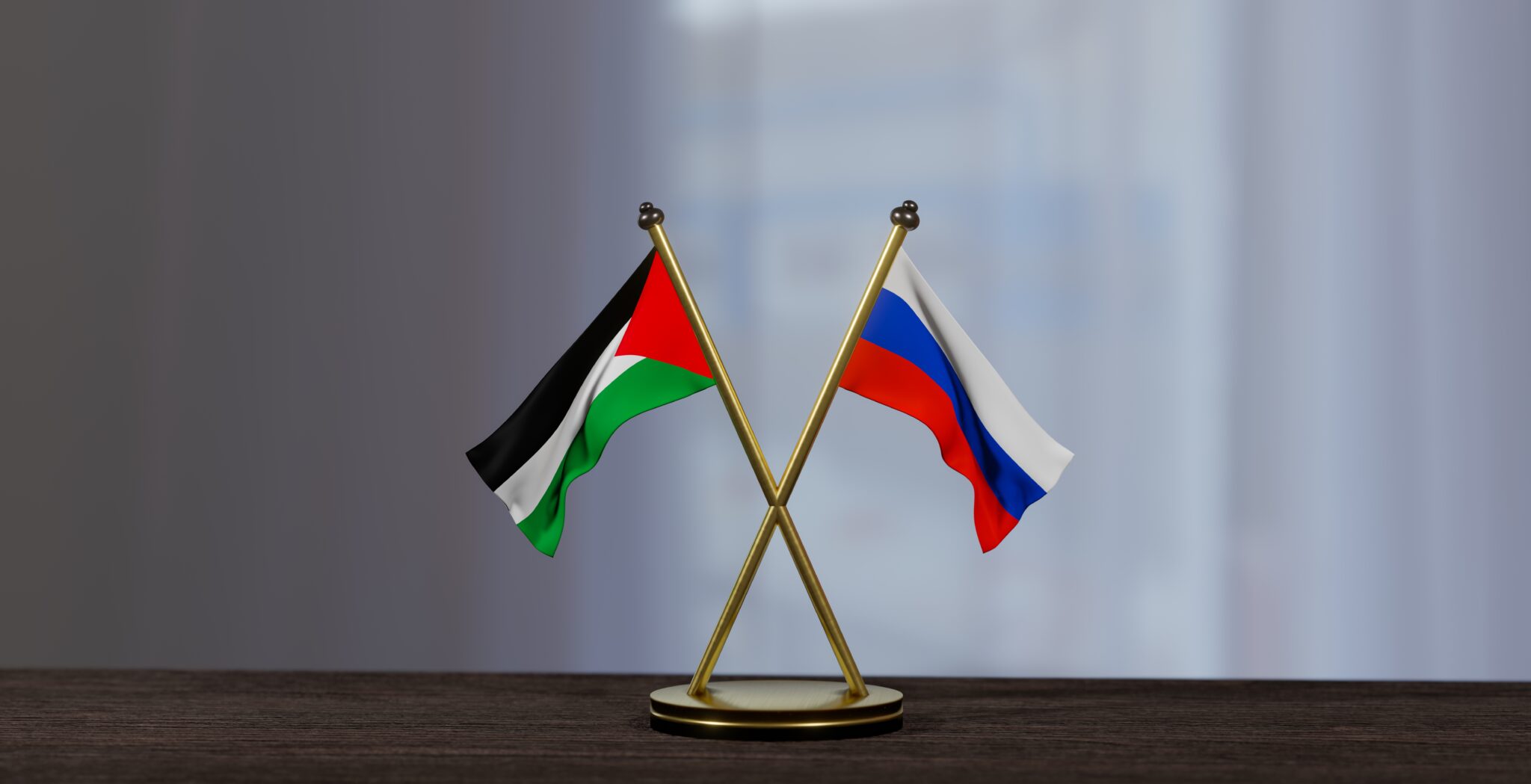
Mahmoud Abbas’ Visit to Moscow: Who Needs Him There and Why?
PSCRP-BESA Reports No 79 (August 30, 2024)
Against the background of the dramatic events in Eastern Europe and the Middle East that dominated the world information agenda in August, the visit of Mahmoud Abbas (also known as Abu Mazen), head of the Palestinian National Authority (PNA) in Ramallah, to Russia and his meeting with Vladimir Putin at the Novo-Ogaryovo residence near Moscow looked like a routine and, in general, unimportant event. But only at first glance.
Struggle for leadership in the Global South
It is quite clear why Abu Mazen needed this trip, which was declared a “state” visit in both Moscow and Ramallah. After the failure of Barack Obama’s “Russian reset” doctrine, after the Arab Spring and especially Trump’s “deal of the century” and Abraham accords of 2020–2022, the relevance of the PNA/PLO as a key factor in the Arab-Israeli settlement and the Middle East conflict as a whole in the eyes of the world and leading regional players has sharply declined. Therefore, Mahmoud Abbas’ obvious interest is to slow down, and ideally to torpedo this negative (for him) trend, using Russia as one of the few places in the world influencing the international agenda, where the head of the PNA/PLO is still taken relatively seriously.
Accordingly, from the very beginning of the Russian military invasion of Ukraine, Ramallah has sided with Moscow, which continues to repeat its long-exhausted chants about the creation of an independent Palestinian state with East Jerusalem as its capital as the only way to resolve the Middle East conflict.
As for the Russian Federation itself, it is not so much concerned with bilateral relations with the virtual “Palestinian state” as with much more pressing matters — its attempts to hijack the status of the main sponsor of the “Palestinian cause” from the West in order to gain geopolitical regional and global propaganda perspectives. These efforts have been visible since 2007, when President Putin officially announced Moscow’s desire to regain its status as a global superpower lost by the USSR as a result of its defeat in the Cold War. They intensified dramatically after Russia’s annexation of Crimea in 2014, and the final doctrine was formulated after February 24, 2022.
A critical element of this doctrine, which represented a specific synthesis of the Kremlin’s “neoconservatism” and formally “leftist” Soviet ideology, was its “anti-colonial aspect” — the movement of unprivileged “non-Western countries” (the “Global South”) against the “neocolonialist financial and technological hegemony” (or, in Putin’s words, the opportunity to “plunder the world through the power of the dollar and the technological dictate”) of the “Global North,” i.e., the countries of the West.
This trend, which has been evolving for a decade and a half, also had an obvious Middle East dimension: Moscow made it clear at the beginning of this change in Russia’s foreign policy that it was no longer ready to be satisfied with the (admittedly, to be fair, rather fictitious) status of “co-sponsor of the Middle East peace process.” The Kremlin intends to set the tone for it as one of the important old-new players in the region. It is clear that with such an “anti-imperialist” vision, which, incidentally, is also shared by the ultra-leftist and radical-progressive circles of Western countries, the theme of “Israeli colonialism,” allegedly oppressing the “freedom-loving people of Palestine,” was simply begging to be explored. This, in fact, manifested itself in the gradual revitalization of Soviet rhetoric about the alleged “pivotal nature of the Palestinian-Israeli conflict for the entire situation in the Middle East” and its “key role in the major regional crises threatening the security and stability of the region” and “efforts to eradicate extremism and terrorism”.
In Israel, meanwhile, the transformation of the long-exhausted cliché about the creation of an independent Palestinian state with a capital in East Jerusalem as (allegedly) the only solution to the Arab-Israeli conflict from a non-binding figure of speech into an operational doctrine of Russian diplomacy has become another argument of the Kremlin pessimists. That is, the revival of fears that by engaging in political confrontation with the United States and the West, Russia will sooner or later slip back to the global-political models and visions of the late Soviet era. And, consequently, to seeing Israel as a potential adversary, given its strategic partnership with the United States.
However, considering the booming Russian-Israeli relations at the end of the first and in the second decade of this century, such discrepancies between Jerusalem and Moscow initially looked secondary and surmountable. Both capitals realized that, unlike the USSR, Russia could not stand “on one Arab foot” in the Middle East — and for a long time Moscow did indeed try to observe, at least in appearance, the principle of the “balance of interests”. The first, initially latent signs of the failure of this scheme became visible in September 2018, when an incident in the skies of Syria (the destroying of an Il-20 electronic reconnaissance plane of the Russian Air Force by Syrian air defense, for which the Russian side rushed to accuse Israel) provoked a “patriotic” campaign in the Russian media. Many Russian public figures then literally competed in the harshness of anti-Israeli attacks, on the verge of, if not beyond, anti-Semitism. Although this campaign was soon curtailed, it became clear that the return of anti-Israeli and anti-Semitic tropes to the public discourse of the Russian Federation is quite possible should they be demanded by the authorities, and the winding down of the “special relationship” between Moscow and Jerusalem could become a reality.
This is precisely the prospect that has become increasingly apparent since the onset of Russia’s full-scale invasion of Ukraine. Israel condemned the Russian invasion and provided Ukraine with massive humanitarian, material, diplomatic and political support. Although it has not officially joined the bloc of Western countries opposing Russia, tensions between Moscow and Jerusalem have grown palpably — even if at first both sides tried to maintain a feeling of “business as usual.”
But even this tentative paradigm of relations was called into question after the bloody terrorist attack by Iranian proxy Hamas on October 7, 2023. The consequence of this aggression was not only an IDF anti-terrorist operation against Palestinian Arab Islamists, but also one of the most large-scale armed clashes between the global North and South. In this case, between Israel, openly supported by the United States and unofficially — the pro-American Sunni regimes of the Saudi bloc, on the one hand, and the Iranian-led “axis of resistance” to the West, on the other.
Abu Mazen in the Russian scenario
Moscow’s stand in the current sprawling regional military conflict in the Middle East is, at the very least, political and diplomatic support for the Arab proxies of Iran, while at the same time positioning itself as the patron of the still symbolically significant for the Arab-Islamic world “Palestinian Arab cause” as a whole. Which may perhaps look logical to the Kremlin’s geopolitical priorities: strengthening the strategic partnership with Iran, as well as competing for leadership of the “global South” with China and other contenders for this status in general.
It is revealing, for example, that almost immediately after the beginning of Israel’s war with Hamas in the Gaza Strip, the Russian Federation at the highest level voiced (with considerable pleasure) declarations about the “failure” of American diplomacy, which allegedly “monopolized” the mediation efforts to resolve the Palestinian problem. This discourse was instantly joined by the Russian state media, in which a pronounced pro-Palestinian and anti-Israeli line began to dominate literally overnight, shaping the corresponding sentiments of the Russian public.
In our opinion, the fact that the Kremlin needed the head of the Palestinian Authority Mahmoud Abbas in this arrangement, and not, for example, Abu Marzook, a member of the Hamas political bureau, who is also warmly received in Moscow, has its own explanation.
First, Moscow cannot ignore the fact that Hamas, which is viewed as quite respectable there, is still officially considered a terrorist organization not only in almost all Western countries, but also in most moderate Sunni Arab regimes, which officially continue to declare their commitment to the creation of a “Palestinian state”. And that is why the head of the PNA, Abbas, for all (and a lot of) the irritation he causes in these capitals, remains their official contact on the “Palestinian street”. Therefore, the claims of the Russian authorities for leadership of the “global South”, with an emphasis on such groups as Hamas, are unlikely to look legitimate in the eyes of the leaders of the Saudi bloc states.
It is no coincidence that when Vladimir Putin met with Palestinian Authority Chairman Mahmoud Abbas this month, Russian reconfirmed “Russia’s support for the creation of a Palestinian state” (based on the Abu Mazen’s infamous “preliminary conditions”) and stressed that their “position on a peaceful settlement with Israel remains unchanged”. In return, the PA Chairman insured Putin that he stood with Moscow “without the slightest doubt” . Both declarations may become additional arguments to persuade the leaders of moderate Arab regimes to continue in a more positive way the dialogue that Vladimir Putin tried to start with them during the hastily organized visit to Saudi Arabia and UAE in December last year.
Second, although it is quite obvious which side the Russians have actually taken in this Middle East war, it is still important for them to show that Moscow is still a partner and mediator for all actors in the Muslim part of the Middle East. And, accordingly, it is able to speak on equal terms with both Shiite Iran and Sunni Arab regimes; with Russia’s protégé, the pro-Iranian Assad regime in Damascus, and with pro-American Riyadh. And finally, and perhaps most difficult of all, to show that Moscow is equally respected by the hard-line “secular nationalists” of the PNA/PLO in Ramallah and the radical Islamists of Hamas in the Gaza Strip.
Russian repeated attempts to reconcile rival factions and restore the “unity of the Palestinian people” have been linked to this last aspect, which can yield a lot of image points in the region. Russia has already openly organized state-level events four times to show that the West is not the only one capable of influencing the resolution of this issue. The first time was in late May 2011 in the form of a summit of Palestinian Arab organizations, which included Hamas, Islamic Jihad and other terrorist groups, in addition to the Fatah organization, the governing wing of the PLO ruling the Palestinian Authority.
The inviting party was the Institute of Oriental Studies of the Russian Academy of Sciences, and not the state authorities (who, apparently, were still a little uncomfortable with formal participation in a dialogue with representatives of organizations that were not going to renounce terror even in lip service). That is why it was stressed that the participants in this seemingly “private public-academic initiative” were organizations and movements that had already signed a treaty for the restoration of Palestinian unity in Cairo earlier that May.
The next three events were officially held under the auspices of the Ministry of Foreign Affairs of the Russian Federation. The first such meeting of representatives of the leadership of Fatah, Hamas, and 7 other factions took place in Moscow on January 16, 2017, with no practical results other than statements and declarations. The second meeting of rival Palestinian factions, which gathered in Russia in 2019 at the invitation of the same level to reach a unification agreement, ended in much the same way — the parties could not even agree on a final communiqué.
In other words, these and other such events on the Russian soil supplemented the long list of failed negotiations between Fatah/PLO and Hamas leaders that took place, sometimes with the participation of other Palestinian groups of various persuasions, between 2007 and 2021 under the auspices of Saudi Arabia, Qatar, Egypt and others. As well as the series of agreements they signed in Mecca, Sana’a, Cairo, Algiers, Beirut, Doha and Damascus on moving towards an “era of unity” and partnership that none of them intended to honor.
The fourth meeting (the third officially hosted by Russian government agencies), a three-day consultation between Fatah/PLO, Hamas and 12 other Palestinian Arab factions, was held in Moscow from February 29 to March 2, 2024. Despite the fact that the five-month-long war in Gaza seemed to have called into question the previous ideas and rules of the game, the goal of the consultations was once again declared to be “restoring Palestinian unity”. It must be assumed that the Kremlin and the Russian Foreign Ministry no longer harbored any illusions in this regard.
The new meeting in Moscow, which, as Foreign Minister Sergei Lavrov frankly stated, was supposed to “knock the trump cards out of the hands of the forces” holding up the settlement of the Palestinian-Israeli conflict (probably in the way Moscow would have liked), looked more like an occasion for yet another propaganda attack on Washington. And in practical terms — to question “the actions of the United States, which in recent months, along with Qatar and Egypt, has become a key mediator in the Palestinian-Israeli settlement”. Equally important for the Russian leadership was the issue of forming a “unified Palestinian government of technocrats,” on which, according to Ayman Al-Raqab, a member of the Fatah delegation, the Palestinian factions intended to reach a common agreement in Moscow, as he told the Russian news agency TASS.
As expected by many, the event ended with almost nothing, and then China immediately took the initiative (and the pro-government Russian media pretended that this was the way it had been planned from the beginning).
But if an agreement between the former and current terrorist Palestinian Arab factions, even purely declaratory, ever happens, Moscow will have grounds to insist that it was there that the process was given impetus. And accordingly – on its right to influence decisions concerning the post-war arrangement in the Middle East region. And this is the third reason why Moscow needs Abu Mazen as head of the PNA, and especially as leader of the PLO, regardless of the degree of fairness of his claims to represent all Palestinian Arabs – in Judea and Samaria (in the “West Bank” of the Jordan River), in the Gaza Strip, as well as the Palestinian diaspora, and even Arabs who are citizens of Israel.
Fourth, the “Palestinian issue,” which still enjoys a lot of sympathy in the world and which is symbolized by the PNA (rather than by Hamas, which is becoming a symbol of “Palestinians in general” only in strongly anti-Israeli circles), is a convenient way for Russia to link the two conflicts: the Ukrainian-Russian and Iranian-Israeli conflicts. It creates a convenient analogy between Russia and Iran, which are at war, as they claim, with “American satellites” — Ukraine and Israel, respectively. And the reason for attacking them, first with the help of their proxies and then directly, in both cases is claimed to be the “protection of brothers” (the eastern Ukrainian separatists of DNR/LNR for Moscow, and Palestinian Arabs for Tehran).
It can be argued to what extent such allusions are actually helpful to Moscow, but so far they seem to serve the main purpose of Russian foreign policy strategy — to justify and legitimize the new ideology of Russian anti-colonialism. In effect, summarizes Andrei Kazantsev, an expert on Russian foreign policy, “Putin has presented his own aggression and annexation of foreign territories as self-defense, allegedly aimed at dismantling Western imperialism and liberating the global South.”
Initially, this ideological link in the global confrontation between the “North” and the “South” was felt mainly in the strategy of the Iranians, but now, apparently, this approach is becoming acceptable in Moscow as well. Especially given the fact that if Russia is included in the “Axis of evil,” it would make no sense for it to play second fiddle there.
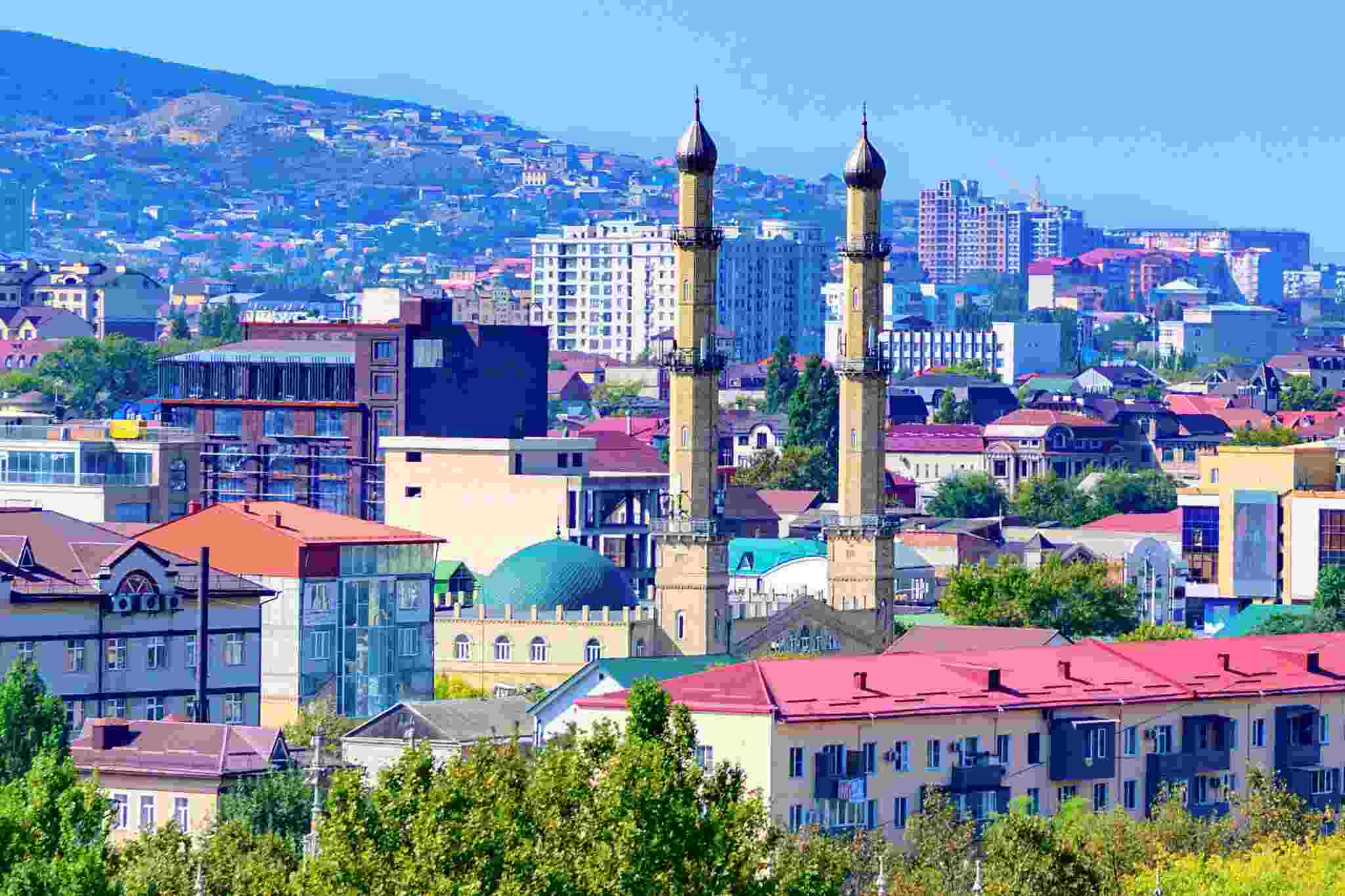
Islamist Danger and Antisemitism in Dagestan (the Russian Federation)
PSCRP-BESA Reports No 69 (July 10, 2024)
Dagestan witnessed a series of terrorist attacks on June 23, when anonymous terrorists attacked churches and synagogues in Derbent and Makhachkala. After this, the militants attacked an Orthodox Church on Lenin Street and then set fire to the Kele-Numaz Synagogue on Tagi-Zade Street while continuing to exchange fire with the police. The church and synagogue burned down. Simultaneously, militants in Makhachkala set fire to a synagogue on Yermoshkin Street and opened fire on a traffic police post in the same area. The Holy Assumption Cathedral, where 19 people took shelter after the shooting began, also came under fire.
The authorities launched a counter-terrorist operation, which ended on June 24. According to the Interfax news agency, 22 people lost lives as a result of the terrorist attacks and counter-terrorist operations. These terrorist attacks cannot be considered unrelated to the anti-Semitic riots at the Makhachkala airport on October 29. A mob of hundreds of rioters, chanting anti-Semitic slogans, stormed the airport after the arrival of a flight from Israel. The rioters checked the passports of the passengers and airport workers, looking for Jews among them. The authorities did nothing to stop the riots, whereas riot police (OMON) arrived only after the riots had stopped. Anti-Semitic riots broke out in other cities of Dagestan as well.
Most comments in the Western and Russian liberal media focus criticism on the ineffectiveness of the Russian authorities, arguing that the Kremlin’s current policy of brute force is not working. While it is difficult to question the ineffectiveness of the Russian authorities in fighting terrorism in the Caucasus, it should be remembered that the Russian authorities are ineffective everywhere in Russia, and Dagestan is hardly an exception. Most analysts, while rightly drawing attention to the lack of good governance and human rights violations in Russia, avoid addressing Islamist terrorism and anti-Semitism as separate problems in Dagestan. Likewise, no liberal media outlet (Western or Russian) has attempted to offer reasonable explanations for the anti-Semitic and anti-Christian nature of the riots and subsequent terrorist attacks. While the Kremlin has no qualms to instrumentalize anti-Semitism for its political needs, there are no grounds to blame it for the violent anti-Semitic riots. Such an approach absolves the concerned population of responsibility for what happens in their country.
Some precedents of anti-Semitism in Dagestan
Antisemitism in Dagestan is neither a new phenomenon nor an innovation introduced by the federal authorities. For the first time, anti-Jewish violence in the Caucasus broke out in the 19th century during the Caucasian War. The level of religious confrontation increased, and intolerance towards non-believers appeared, which forced Jews to migrate under the protection of Russian fortresses in the North Caucasus. This led to the establishment of Jewish communities in Grozny, Nalchik, Kizlyar and other Russian fortresses. During the Civil War, violence was widespread in the Caucasus — there were both pogroms and murders.
Anti-Semitic incidents also occurred after World War II. In August 1960, an article titled “Without God, the Road is Wide” was published in a Buynaksk newspaper. It claimed that Jews were buying 5-10 grams of Muslim blood, diluting it in a large bucket of water and selling it to other Jews. On the same day, the contents of this article were broadcast on local radio. The situation almost ended in a pogrom, which did not happen only thanks to Moscow’s intervention.
During the Six-Day War, a rally condemning Israel was held in a mosque in Derbent. It was addressed by kolkhoz (collective farm) chairmen and directors of factories and plants, who called on the authorities to “strike at the aggressor.” The people in the streets took these words as permission to attack Jews, and an impending pogrom loomed in the city. Jews appealed to the authorities for protection and also organized self-defense units in case of an attack. That time, it was avoided.
In the early 1990s, immediately after the collapse of the Soviet Union, Mountain Jews in Dagestan became the target of very severe criminal violence, including property seizures and murders. Many Mountain Jews left for major Russian cities and Israel.
Foreign violent Islamism
The exact ideological affiliation of the perpetrators remains unclear, although some Telegram channels identified them as Osman and Adil Omarov. They both were killed in a shootout with law enforcement. The Baza channel published footage of the attack in Makhachkala and claimed it had been filmed by Osman Omarov.
Al-Azaim, the media of the Russian branch of IS, Khorasan, praised the attack by “their brothers from the Caucasus” for demonstrating their capabilities. Given that Al-Azaim referred to their Caucasian “brothers” without claiming responsibility for the attack, it can be assumed that the direct culprit is Wilayah al-Qawqaz (Islamic State — Caucasus Province, IS-CP), which is also an ISIS branch.
IS-CP was established in June 2015 and has previously claimed responsibility for a number of terrorist attacks in the Caucasus and elsewhere in Russia. In 2017, the group claimed an attack on a Russian National Guard unit in Chechnya that killed six servicemen. In 2019, the terrorists claimed responsibility for the explosion in an apartment building in Magnitogorsk on December 31, 2018, which killed 39 people. Also in 2019, the group claimed an attack on police officers near the residence of Chechen head Ramzan Kadyrov in Grozny.
Roots of Islamism in Dagestan
ISIS and other types of violent Islamism spread across the Caucasus; however, they have never been uprooted. The structure of local society in Dagestan may provide an explanation for how the Caucasus has become a hotbed for all kinds of imported violent Islamism.
Local Dagestani traditions have always been intertwined with Islam. The peculiarities of the region are manifested in the clan system and the ubiquity of the Muslim mystical tradition, Sufism. Jamaat in Dagestan is not a synonym for an Islamist cell, but rather another word for clan. Islam in the Caucasus is a popular traditional religion, not necessarily a political ideology. Sufism throughout the Muslim world is divided into various Sufi orders which are called “tariqats”.
The” import” of Saudi Wahhabism and Islamism began in the 1990s. Numerous Arab emissaries came to the Caucasus and influenced local youth. The interaction between the two varieties of Islam created tensions between young people and more traditional adults. Salafis and Wahhabis supported armed struggle not only against the Russian authorities but also against local authorities, who were considered “kuffar” and “tawaghit” (infidels and tyrants).
One of the Salafi leaders of Dagestan, Bahauddin Kebedov attempted to conquer the mountain regions of Dagestan with his troops. Salafi “daawah” (preaching of Islam) appealed to Caucasian youth who were experiencing economic deprivation, unemployment and lack of prospects for the future. Salafism in its imported form opposes any understanding and cooperation with the authorities. Of course, economic hardship alone does not lead to radicalization, so poverty and deprivation cannot be considered the ultimate cause of Islamism. However, there is no doubt that socio-economic grounds coupled with certain cultural-historical metrics enhance susceptibility to the violent messages of Islamism. Moreover, the more people suffer from hardship in the present, the more their propensity to embrace an Islamist political utopia increases.
Dagestan is a very multi-ethnic region, as its population consists of at least seven Muslim ethnicities, including Avars, Lezgins, and Chechens. Many Dagestani Islamists were Chechens, so thus, the two Chechen wars had a direct impact on the dynamics of Islamism in Dagestan. The ethnic heterogeneity of the population warrants tensions and lack of national cohesion. Islamism fills this lacuna and therefore creates an alternative community that replaces the missing national one.
Connection with the Middle East
From the very beginning, the spread of Islamism in the North Caucasus has been closely linked to geopolitical fluctuations in the Middle East, starting with Arab veterans of the jihad against the USSR in Afghanistan. They later spread their ideology throughout the Muslim world and shared their combat experience with the Caucasians. Islamic preachers in Dagestan are generally well versed in Arabic and learn from native Arabic speakers.
Thanks to Arabic media such as Al-Jazeera, Dagestani Muslims closely follow the plight of the Palestinians. Having embraced Islamism, Dagestanis also adopted a virulent form of anti-Semitism, which has been superimposed on already existing antisemitic patterns.
Genesis of anti-Semitism among Russian Muslims
The dogmatic and conspiratorial anti-Semitism is thus inextricably linked to the ideology of Muslim radicals who aggressively criticize the state of Israel. Anti-Zionism among Muslims can manifest itself in various forms, from expressing solidarity with the “struggling Palestinian people” to supporting fanatical terrorists. While few are willing to participate in a war against “infidels and Zionists,” there is a consensus among Russian Muslim leaders in support of “the just right of the Palestinian people to establish an independent state with Jerusalem as its capital.”
Dogmatic anti-Judaism may well be part of the ideology of Islamic fundamentalists, which implies taking the foundations of the Muslim faith seriously. Russian Islam has for centuries actively interacted with both Orthodoxy and the pagan traditions of the peoples of Russia, which means that there is an acute conflict between Islamism imported from abroad and the generally accepted, traditional forms of Islam in Russia. In addition, fundamentalism implies an uncompromising struggle not only with Judaism, but also with Christianity, and even more so with the secular model of the state.
The inevitable conflict with the authorities and Islamic clergy interested in stability pushes hardened radicals underground, which, of course, is fraught with extremism and terrorist methods of struggle.
Anti-Zionism, on the other hand, can be considered acceptable both to the broader Muslim population (due to a sense of solidarity with the Palestinian part of the Ummah) and to the political establishment in modern Russia (due to the traditions of Soviet propaganda). Anti-Zionism was part of the official ideology and propaganda of the Soviet regime. Therefore, Muslim leaders can easily find common ground on this issue with Russian anti-Semites.
Modern Islamic fundamentalism is a political rather than a purely religious movement, and anti-Semitism plays an important role in it, helping to mobilize and consolidate supporters in the face of a common (albeit mythological) enemy. This enemy is described in religious terms but is perceived in political realities.
In terms of political ideology, Islamic fundamentalism is characterized by a declared war against modern Western democratic values that are perceived as “Jewish”. The essence of a democratic society is that Jews can engage in debauchery, lies and deceit with minimal consequence. [1] Another author argues that anyone who separates the Ummah from its religion and Quran can only be a Jewish agent, willingly or unwillingly, regardless of their origin.[2]
The distinctive feature of Muslim anti-Semites is that they do not merely oppose Jews as agents of modernism, democracy and, according to Islamists, universal human values incompatible with the Quran. Instead, their struggle takes on the character of confronting a metaphysical, absolute evil. One prominent Islamic theologian asserts that Allah has commanded Muslims to fight those whom he considers “friends of Satan” wherever they are. And among those who are considered Satan’s best friends in our time are the Jews.
In essence, anti-Zionism is tantamount to anti-Semitism because it is directed against the legitimacy of Israel’s existence, not against specific policies of the Israeli state. It is simply a semantic ploy that allows anti-Semites to claim that they are merely objecting to Israeli policies. In both Soviet and contemporary Iranian discourse, the official parlance uses the term “world Zionism” to avoid using the word “Jews”.
Finally, modern leftist ideologies, including Soviet propaganda and Islamism (both Sunni and Iranian Shi’ite), deny the Jewish nation, claiming that Judaism is merely a religious denomination. Consequently, they argue that Jews have no right to self-determination as a nation.
Samples of Anti-Semitic Content
Content analysis of Dagestan Islamist Telegram channels fully confirms the above-mentioned trends. The channel Islam Dag positions itself as “an information channel for Muslims in Dagestan”. However, its URL address is revealing: it is called “ahlu sunna Dagestan”, which hints at its Salafist affiliation. The channel is rife with anti-Semitic content.
The channel’s owner Dawood Abu Jamal has posted antisemitic content since October 2023
On June 25, he posted a link to an antisemitic YouTube video in which Russian nationalists discuss “the plans of Chabad followers to destroy Russia through the implementation of the Dulles Doctrine and the Harvard Plan ((Harvard Project on the Soviet Social System (HPSSS))” .
On June 5, he posted a link to footage claiming that “Chabad is preparing to stage a nuclear apocalypse”. Abu Jamal posted a link to a YouTube video about “the Chabad mystical sect controlling the world”.
On June 9, Abu Jamal reposted several pieces from Russian news agencies condemning the “Ukrainian regime” and reporting on “human rights violations in Crimea (by Ukrainian authorities prior to Russia’s annexation of Crimea)”.
The channel’s owner posted a link to an interview with Caucasian mystic Alan Mamiyev. The latter went into lengthy explanations about occult energies that govern the world. “One such energy is the Kaballah, which strengthens the Mossad, the IDF and Israel as a whole. The fact that Israel’s banking system continues to operate proves that this occult energy is effective. Yet it strengthens not only the power of Israel, but also the power of the Jews throughout the world — judging by the effectiveness of their control over everything”. [3]
On June 05, Abu Jamal posted a link to an interview with author Alexandre Usanin. In his musings, Usanin delves into the conspiracies of Freemasons, who he says exert control over the media. He repeatedly praises Putin and the KGB, claiming that the Russian media is held back by liberals who forbid the broadcast of positive content and are interested in spreading drugs and alcohol among Russians. In the interview, Usanin echoed some typical features of Russian propaganda, including the claim that there is no real conflict between the West and Russia, just as there is no conflict between Ukraine and Russia. Only those who hold opaque liberal views and control the media seek to create conflict. In this context, he argues that the German media is controlled by liberals and Freemasons of Jewish descent. The latter exercise control over the German media to the extent that they see fit. After World War II, the Jews forced Germany to make financial contributions, while Russia never received compensation. Usanin argued that the Soviet Union was effective in maintaining the nation’s spiritual health. Despite its atheistic nature, the censorship prevented the broadcasting of negative materials such as pornography, drugs, and alcohol.
His wording regarding World War II fits perfectly with the Kremlin’s narrative bordering on the Holocaust denial. According to this narrative, the primary victim of the Nazis was the Soviet Union (with the Russian people implied), not the Jews.
On June 23, Abu Jamal reposted a news story about Israel’s ongoing war with Hamas and Hezbollah. Prior to that date, he had consistently portrayed Jews as “descendants of the children of apes and pigs”, a typical Islamic pejorative term for Jews in Arabic. [4]
On June 29, Abu Jamal posted a YouTube video of a Dagestani Jew appealing to the leadership of Dagestan to stop anti-Semitic riots. The footage also showed a destroyed synagogue. Sounds of a firefight during the counter-terrorist operation could be heard.
He added the following text to the link: “Here’s another one coming out to whine about his Jews. This scumbag is snitching to the FSB about Khabib and Islam Makhachev because they support Palestine. In this situation, all the Jews of Dagestan will be on the screens and we will know their faces, these assholes will sweep away all the diapers from the store shelves.”
All Islamist channels in Dagestan are full of Arabic content. Some of this content is blatantly anti-Semitic and is no different from Hamas propaganda. One such channel is “Khawater Daghestaniya” (Thoughts of a Muslim Woman). The address of the channel bears the name of Salma Kebedova, who may be a relative of the aforementioned Dagestani terrorist. Her posts are full of the most anti-Jewish quotes from the Quran and Hadith and support for Palestine. [5]
Another channel, Daru Salataw, on October 8 quoted a verse of the Quran calling on Muslims to fight the infidels and praying to Allah to shake the earth beneath the feet of the Jews.
On October 10, Daru Salataw posted a statement by Egyptian sheikh Ali Tantawi: “I curse Hitler in his grave — if he has a grave — not for what they falsely claimed he did to the Jews, but for not ridding humanity of the abomination of the Jews completely”.
Conclusions and Implications
The revealed patterns of anti-Semitic content fully correspond to Likhachev’s methodological description of the patterns of anti-Semitism among Russian Muslims. Anti-Semitism in Dagestan functions in two interrelated directions:
On the one hand, it fully coincides with both Kremlin propaganda clichés and popular Russian anti-Semitism. This anti-Semitism echoes the Kremlin’s war on Ukraine, which seeks to minimize the conflict between the West and Russia and to appropriate the Holocaust by claiming that Russian people were its real victims.
On the other hand, the Arabic content of the Dagestani Islamist media is no different from the most violent Islamist propaganda, including that of Hamas. These anti-Semitic statements also meet all the characteristics of Muslim fundamentalist anti-Semitism. These characteristics include Holocaust denial, portraying Jews and Israel as demonic, metaphysical enemies couched in political terms, and completely ignoring the atrocities perpetrated by Hamas.
Despite the Russian authorities’ undeniable responsibility for the current difficulties in the region, Islamism and the virulent anti-Semitism it engenders are themselves a serious problem in Dagestan. Neither the leadership nor the population of Dagestan should enjoy the condescending attitude of the West.
[1] Sayid Qutb, Our battle with the Jews. The main ideologue of the Muslim Brotherhood, Sayid Qutb authored a book “Ma’rakatuna ma’ al-Yahud (Our Battle with the Jews). The book is quoted abundantly by Islamists on the Web. https://www.odabasham.net/مقالة/109072-معركتنا-مع-اليهود-للأستاذ-سيد-قطب
[2] Abd Al-Halim Mahmoud, al-Jihad wa-l-Nasr ( Jihad and Victory), p.50, https://www.noor-book.com/en/ebook-الجهاد-عبد-الحليم-محمود-pdf
[3] https://t.me/ahlu_sunna_dagestan/3223 ; https://www.youtube.com/watch?v=-k6Qc36b5H4
[4] https://t.me/ahlu_sunna_dagestan/3215; https://www.jewishvirtuallibrary.org/muslim-clerics-jews-are-the-descendants-of-apes-pigs-and-other-animals
[5] https://t.me/kebedovaSalma1994/683; https://t.me/kebedovaSalma1994/762; https://t.me/kebedovaSalma1994/1709