
Theme - Turkey

Monthly Monitoring of Analytical Publications on Post-Soviet Conflicts
PSCRP-BESA Reports No 234 (September 29, 2026)
August is traditionally considered a month when academic activity grinds to a halt—a trend that applies particularly to publishing. It is precisely in August that reputable journals make room for publications with unusual or even exotic themes, and authors find the time to work on such pieces. In this edition of our monitoring report, we have not strayed beyond the scope of conflicts in the post-Soviet space—and yet, we will be discussing epic heroes, artificial intelligence systems in public service, and medical education amidst political instability.
The article “Multilingual Education in Kazakhstan: Policy and Practice,” authored by Kulpash Koptleuova of Baishev University, Akhmaral Khairzhanova of Kh. Dosmukhamedov Atyrau University (corresponding author), Kamar Aldasheva of Abai Kazakh National Pedagogical University, and colleagues Kulyash Bainiyeva, Alla Leonova, and Gulim Saiynova, appeared in the International Journal of Society, Culture & Language in August 2026. It offers a timely examination of Kazakhstan’s language education policy as an instrument of nation-building and conflict management in a multiethnic post-Soviet state.
The study centers on how official discourses and institutional measures shape the roles of Kazakh as the state language, Russian as the language of interethnic communication, and English as the vehicle of global integration. The authors ask what policy discourses, language ideologies, and status-planning mechanisms define Kazakhstan’s educational language regime, and how far official statistics reflect the stated goal of balancing the three languages. Their method is qualitative document analysis of the Constitution, the 2003 Law on Languages, the State Program for the Development of Education and Science 2020–2025, the 2023 Concept for preschool and secondary education, CLIL guidelines, and national statistical reports, including the 2021 census and 2023 sociological surveys on language proficiency. Following a six-phase thematic procedure adapted from Braun and Clarke, they identify five interlocking themes: the ideological framing of the “Trinity of Languages,” the construction of language hierarchies through status planning, mechanisms of pedagogical implementation, teacher preparation as a persistent challenge, and the tension between nation-building and global competitiveness.
The analysis reveals that the “Trinity” is not a neutral technical arrangement but an ideological construct that privileges Kazakh symbolically while preserving Russian’s functional dominance and casting English in instrumental terms. Constitutional and statutory provisions place Kazakh at the apex, yet Russian retains de facto primacy in administration, education, and everyday life, with 90.6 percent overall proficiency. English has advanced modestly—29 percent of adults report some competence—but advanced command remains limited. Statistical trends confirm a steady expansion of Kazakh-medium schooling and higher education, from roughly 37 percent of students in 1993 to over 70 percent of recent school graduates, yet the authors underscore the uneven rollout of trilingual instruction, the conflation of basic CEFR B1 proficiency with genuine CLIL pedagogical capacity, and the absence of transparent criteria for institutional readiness. These gaps reproduce regional and resource asymmetries, leaving the policy’s equity claims only partially realized.
For scholars of the post-Soviet space, the article contributes a carefully documented case of how language planning seeks to prevent interethnic conflict while consolidating statehood. Its relevance to Israeli academic readers lies in the parallel challenges of managing linguistic diversity within multiethnic societies, the strategic use of education to foster social cohesion, and the delicate balance between national identity and international competitiveness—issues that resonate with Israel’s own experience of nation-building amid competing cultural claims and its growing engagement with Central Asian partners. By illuminating both the achievements and the structural tensions of Kazakhstan’s trilingual project, the study supplies a nuanced lens through which to view language as a potential site of both conflict and accommodation in the wider post-Soviet region.
***
Artem Hmelnykov of Taras Shevchenko National University of Kyiv and Nataliia Khoma of Lviv Polytechnic National University examine the conceptual interdependence of local democracy and local political management in an article published in the Baltic Journal of Economic Studies, volume 12, number 1, 2026. Drawing on a neo-institutional approach, the authors treat local democracy as a value-institutional dimension centred on citizen participation, legitimacy of authority, transparency and accountability, while presenting local political management as the organisational-managerial dimension concerned with the development, adoption and implementation of decisions at the territorial level. Their working hypothesis holds that local democracy supplies the institutional foundation of procedures, norms and practices that confer legitimacy and participatory quality on local governance, and that political management in turn supplies the technologies, competencies and mechanisms through which democratic principles are realised.
The analysis proceeds by first mapping the regulatory and legal prerequisites that enable genuine local democratic institutions—constitutional guarantees of self-government, statutes regulating referendums, public hearings, electronic petitions and participatory budgeting, anti-corruption standards, inclusion norms and financial transparency rules. These elements together constitute the “operating environment” within which management operates. The authors then formulate a dialectical relationship: democracy shapes the rules and opportunities for management, while the quality of management either strengthens trust, participation and institutional resilience or, conversely, undermines them through bureaucratic insulation or opacity. A concise conceptual formula crystallises this mutual dependence: local democracy provides the institutional, value-based and procedural foundation; local political management, resting on that foundation, ensures the formulation and execution of decisions; together they constitute a coherent system of democratic community governance.
Particular attention is given to the prospective post-war reconstruction. Under wartime conditions, local democracy adapted by prioritising mobilisation, solidarity and secure online and offline participation, while local political management performed critical crisis functions—evacuation coordination, defence support, assistance to displaced persons and rapid infrastructure repair. The authors argue that the legitimacy of these managerial actions rested on residual democratic trust. Looking ahead, they contend that reconstruction will amplify the same interdependence: large-scale resource allocation, priority-setting and integration of veterans and returnees will require inclusive consultation, public oversight and budgetary transparency if they are to avoid corruption, social discord and loss of legitimacy. Without robust democratic institutions, even well-funded programmes risk inefficiency; without competent management, democratic procedures remain empty formalities.
The study’s contribution lies in reframing two concepts usually treated in isolation as mutually reinforcing elements of contemporary local governance, and in demonstrating the continued validity of this coordinate system under conditions of existential conflict and recovery. For Israeli academic readers concerned with post-Soviet conflicts, state resilience and the management of contested territories, the analysis offers a timely reminder that the durability of local institutions under external pressure is inseparable from the quality of the democratic-managerial nexus that sustains them. The Ukrainian case illustrates both the vulnerability and the adaptive potential of that nexus, providing comparative insight into how communities maintain governance capacity amid war and prepare for reconstruction without sacrificing legitimacy.
***
Neda Atanasoski and Redi Koobak’s article “Automated Myth and the Postsocialist Digital State: The Imperial Trick of the Kratt AI Initiative in Estonia,” published in Imaginations: Journal of Cross-Cultural Image Studies, volume 17, number 1, 2026 (pages 131–165), examines Estonia’s national strategy for incorporating artificial intelligence into public services. The authors analyze the state’s decision to name these systems after the kratt, a mythic servant from Estonian folklore constructed from everyday objects and animated through supernatural means, which turns on its master when left idle. They advance the concept of “automated myth” to describe folklore embedded in AI systems that naturalizes the link between technological progress and liberal democracy.
The study addresses how cultural narratives shape AI governance in a postsocialist context. Methodologically, the authors combine Roland Barthes’s understanding of myth as depoliticized speech with Evgeny Morozov’s critique of techno-solutionism. They examine state promotional materials for Bürokratt, the world’s first public-service AI virtual assistant, alongside two artistic responses: Eugénie Baccot and Cyril Abad’s digital photo essay The Kratt Metaphor (2024), commissioned for Tartu 2024, and Rasmus Merivoo’s horror-comedy film Kratt (2020). This approach reveals how policy branding and cultural interfaces construct national identity while obscuring geopolitical entanglements.
The central conclusion is that the automation of the kratt myth performs an imperial trick. It indigenizes technofutures as Estonian national heritage, presenting AI as an organic extension of local folklore and identity, while simultaneously masking the influence of Silicon Valley capitalism that has driven postsocialist digital reforms since the 1990s. The authors argue that this process erases the Soviet technological foundations of the present, depoliticizes citizens by recasting them as consumers of efficient services, and naturalizes a model of governance oriented toward global competitiveness and foreign investment. Analysis of Bürokratt shows how the state contrasts the new transparent digital servant with the opaque Soviet bureaucrat, yet the system ultimately aligns Estonia with transnational capital through initiatives such as e-residency. The photo essay aestheticizes technology as continuous with sacred Estonian landscapes and rituals, thereby defanging potential risks, whereas the film satirizes techno-utopianism by exposing hidden costs, including exploited labor and residual imperial relations.
The article contributes to both postsocialist studies and critical AI research by demonstrating that folklore operates as an infrastructure of state power in the era of algorithmic administration. For an Israeli academic audience concerned with transformations in the post-Soviet space, the work illuminates how digital statecraft and techno-nationalism reconfigure sovereignty and identity after the dissolution of the Soviet Union. It highlights cultural mechanisms that sustain new forms of imperial entanglement under the appearance of national innovation and democratic service, offering comparative insight into the long-term political effects of technological modernization in the region.
***
Veja Lianga’s master’s thesis, submitted on 1 August 2026 for the Erasmus Mundus Euroculture program jointly awarded by the University of Strasbourg and Uppsala University, examines the discursive construction of opposition to the Istanbul Convention in Lithuania. Supervised by Sandrine Beaudry (Strasbourg) and Andreaz Fagerberg (Uppsala), the work is framed as an original contribution to the study of anti-gender politics in Central and Eastern Europe.
The central research question asks how Lithuanian political actors discursively constructed “gender” (translated as “social gender”) in opposing ratification of the Council of Europe Convention on Preventing and Combating Violence against Women and Domestic Violence between 2018 and 2024, and how these constructions relate to the broader European anti-gender mobilisation and the restriction of women’s rights. Drawing on literature on the anti-gender movement (Kuhar and Paternotte, Graff and Korolczuk), Europeanization theory, norm contestation, post-Soviet historical legacies, and moral-panic frameworks (Cohen, Butler), the author employs qualitative critical discourse analysis. Primary material consists of quotations from politicians, political spokespeople and religious figures published in mainstream Lithuanian news outlets. The analysis identifies six recurring discursive constructions: gender as ideology, gender as moral threat (especially to children and family), gender as foreign imposition, legal/pragmatic irrelevance, confusion, and cultural irrelevance.
Lianga demonstrates that anti-ratification discourse systematically portrays “gender” as an ideological project that endangers traditional family structures, national sovereignty and cultural identity. These framings closely mirror rhetoric circulating in other EU member states and in Russian discourse, positioning the Istanbul Convention as a symbolic battleground for anxieties over European integration, social change and patriarchal order. The thesis argues that such constructions generate a moral panic that impedes the advancement of gender-equality measures and leaves gaps in protection against gender-based violence unaddressed. Lithuania’s specific post-Soviet and Catholic heritage intensifies the framing of “social gender” as an externally imposed threat, whether attributed to Brussels or residual Soviet influence. Counter-discourses exist but remain marginal within the political arena examined.
By focusing on a smaller Baltic state often overlooked in English-language scholarship that privileges Poland and Hungary, the thesis enriches understanding of how transnational anti-gender narratives are localised and adapted. For an Israeli academic audience interested in conflicts and identity politics in the post-Soviet space, the study offers insight into the mechanisms of norm contestation, the instrumentalisation of historical memory, and the entanglement of religious nationalism with resistance to European legal frameworks—dynamics that illuminate broader patterns of sovereignty claims and cultural security discourses across the region.
***
The syllabus under review, authored by Professor Julia Verkholantsev of the Department of Russian and East European Studies, outlines the intellectual framework and structure of the undergraduate course.
The course is offered at the University of Pennsylvania (Penn).It is a specialized Benjamin Franklin Seminar (BFS) that is currently scheduled for the Fall 2026. Although presented as a pedagogical document rather than a conventional monograph, it functions as a carefully reasoned scholarly intervention into the study of how medieval narratives and material culture have been mobilized to construct modern national identities across Central, Eastern, and Southeastern Europe.
The subject of the course is the phenomenon of “national antiquities”—genealogical origin stories, hagiographic traditions surrounding holy figures of national significance, and sacred objects such as crowns, manuscripts, and icons—and the ways these elements have shaped nationalist discourse from the nineteenth century to the present. Verkholantsev situates the inquiry against the backdrop of contemporary European political rhetoric that continues to draw on medieval sources to assert ethnogenetic claims, territorial entitlement, or historical grievance. The methodological approach is comparative and critical: students are guided to examine primary medieval texts and later historiographic traditions, distinguishing between information, interpretation, argument, and significance, while remaining alert to the methodological weaknesses that allow such materials to be instrumentalized. The syllabus emphasizes active, AI-free engagement with approximately thirty to sixty pages of reading per session, regular production of concise reading notes, and two in-class assessments derived largely from students’ own analytical takeaways. The culminating project requires each participant to curate an imagined national museum, selecting and arranging a limited set of antiquities so as to construct a coherent narrative of national identity.
The central conclusions advanced by the syllabus are that national pasts are not simply recovered but actively constructed, that medieval materials acquire political force only through successive layers of interpretation, and that scholarly scrutiny of these layers is essential for dismantling the uncritical authority they still command in public discourse. Verkholantsev argues that nineteenth- and twentieth-century philological and historiographic scholarship transformed origin myths, royal sainthood, and sacred objects into instruments of nationalist mobilization; the task of contemporary scholarship is therefore to expose the selective and often anachronistic character of those transformations. Case studies of Bohemia and Moravia, Hungary, Poland, the Rus’ lands and the Grand Duchy of Lithuania (encompassing modern Lithuania, Ukraine, and Belarus), and Croatia illustrate how the same medieval repertoire—Attila and Scythian ancestry, St. Wenceslas and the Knights of Blaník, the Holy Crown of St. Stephen, the Częstochowa icon, Varangian legends, Glagolitic script—has been differently appropriated to serve distinct national projects.
The scholarly contribution of the syllabus lies in its insistence on treating national antiquities as objects of critical rather than celebratory study. By combining ethno-symbolic approaches to nationalism with close attention to medieval textual and material evidence, it offers a model for historicizing the very claims that continue to structure political debate in the region. For an Israeli academic audience concerned with conflicts in the post-Soviet space, the syllabus is particularly relevant. Its examination of competing origin narratives in Ukraine, Belarus, and Lithuania, and of the symbolic resources deployed to legitimize or contest political boundaries, supplies analytical tools for understanding how historical memory shapes contemporary identity conflicts. The neutral, source-critical posture modeled throughout the course encourages precise discussion of competing national myths without recourse to partisan labeling, thereby enriching scholarly discourse on the region’s enduring tensions.
Orhan Gültekin, a doctoral student at the Social Sciences University of Ankara’s Institute of Area Studies, published the article “The Social and Political Impact of Turkish TV Series in Central Asia in the Context of Cultural Diplomacy” in the International Journal of Idil-Ural and Turkistan Studies, volume 8, issue 2, pages 337–353, in 2026. The study examines the influence of Turkish television series on the Central Asian Turkic republics of Kazakhstan, Kyrgyzstan, Uzbekistan, and Turkmenistan, framing these productions as instruments of soft power and cultural diplomacy in the post-Soviet environment.
The research rests on a qualitative literature review and secondary-data analysis that draws together sectoral reports, academic studies, field inquiries, and institutional publications. Gültekin organizes the inquiry around a central question: how Turkish series shape political perceptions, everyday social practices, and collective identity constructions in these societies, and through which mechanisms—linguistic affinity, shared religious and historical references, and a synthesis of modern and traditional values—they operate. The analysis proceeds along three interrelated dimensions: the political, the social, and identity formation.
At the political level the author argues that the series transmit Turkey’s experience of modernization and its democratic values, thereby raising the visibility of a “Turkish model” and lending societal legitimacy to interstate diplomatic ties. Socially, linguistic closeness and common cultural codes allow the productions to affect consumption patterns, family norms, and lifestyle preferences; historical dramas reinforce notions of shared ancestry and unity. In the realm of identity, the series supply a unifying reference point of “Turkishness” for populations still negotiating national self-understanding after the dissolution of the Soviet Union. Gültekin concludes that Turkish television drama functions not merely as entertainment but as one of the most effective tools of cultural diplomacy, amplifying Turkey’s regional influence, catalyzing social change, and nourishing a common cultural foundation. The study introduces the notion of “dizi diplomacy” as a contribution to the broader literature on soft power.
For scholars concerned with the post-Soviet space the article offers a concrete case of non-state cultural actors shaping political and social realities in Central Asia. It demonstrates how media flows can reinforce or reconfigure identity narratives in societies that emerged from Soviet institutional frameworks, and how such flows interact with state-led initiatives such as those of TİKA and the Organization of Turkic States. The findings therefore illuminate the softer dimensions of regional realignment and the ways cultural proximity can translate into durable political capital—issues of direct interest to Israeli academic and policy communities that monitor stability, identity politics, and external influence across the former Soviet periphery.
***
The article “Digitalization of medical and healthcare education in a Low- and middle-income country: a mixed-method case study of institutional transformation at Yerevan State Medical University,” authored by Karine Sargsyan and colleagues affiliated with Yerevan State Medical University, the Medical University of Graz, Cedars-Sinai Medical Center, and related Armenian institutions, appeared in Frontiers in Digital Health in August 2026. It examines the deliberate institutional shift toward digital modes of medical training in Armenia, a post-Soviet low- and middle-income setting marked by infrastructural constraints, a lingering Soviet-era pedagogical legacy, and recurrent regional disruptions.
The study is framed as a mixed-methods institutional case study covering the period 2019–2023. Its central subject is the translation of constructivist and activity-based pedagogical theories into practical digital infrastructure, faculty development, student digital literacy programs, simulation-based training, telemedicine, tele-education, and hybrid learning formats. The authors pose the question of how a resource-limited medical university can sustain educational continuity and quality amid pandemic pressures and regional tensions, including the conflict in Artsakh. Methodologically, the work rests on an institutional transformation framework that sequences strategic vision, faculty digital-competency training, infrastructure development, student engagement, digital interventions, assessment, and quality assurance. Supporting evidence is drawn from an anonymous electronic survey of 513 undergraduate medical students (response rate 12.6 percent of the eligible cohort), employing eleven Likert-scale items and optional open comments. Analysis remains descriptive, reporting frequencies, percentages, and mean scores without inferential testing, and is supplemented by institutional observation and process documentation.
The principal findings indicate high levels of student-perceived satisfaction, with an overall positive response rate of 90.2 percent and mean scores ranging from 4.26 to 4.51 on a five-point scale. Respondents reported gains in theoretical knowledge, clinical skills confidence, digital literacy, and appreciation of hybrid flexibility; simulation training received particularly strong endorsement among clinical-year students. Technical barriers scored lowest, suggesting they were not perceived as insurmountable. Qualitative comments praised simulation centers and telemedicine sessions while noting occasional internet instability and the need for further faculty digital preparation and bilingual materials. The authors position these perceptual outcomes as evidence that a coherent institutional strategy—rather than technology alone—can overcome infrastructural, pedagogical, and equity obstacles. They stress that the results reflect self-reported experience rather than objectively measured learning or patient-care gains, and they explicitly limit claims of generalizability to a single institutional trajectory.
In scholarly terms the study contributes a concrete, context-sensitive roadmap for digital transformation within the post-Soviet medical-education landscape. It demonstrates that strategic alignment of mission, sustained faculty development, active student participation, and modest infrastructure investment can generate resilient hybrid and remote educational capacity even under conditions of regional instability. For an Israeli academic audience concerned with conflicts and institutional resilience across the post-Soviet space, the Armenian case offers instructive parallels: the capacity of higher-education institutions in geopolitically exposed environments to maintain professional training pipelines, to mitigate brain-drain pressures, and to preserve human-capital continuity during crises. The documented emphasis on simulation, tele-education, and quality-assurance mechanisms underscores practical pathways for sustaining medical expertise when physical access is constrained—an issue of enduring strategic relevance for regional security and public-health preparedness.

Reimagining the Persianate Sphere: Iran’s Response to Turkic Regional Integration
PSCRP-BESA Reports No 227 (August 31, 2026)
1. Introduction
In mid-August 2026, Iran’s First Vice President Mohammad-Reza Aref met in Tehran with Tajikistan’s Minister of Energy and Water Resources, Daler Juma. The substance of the meeting was unglamorous: oil bitumen and petrochemical exports, aviation fuel, a joint energy commission, and a first half of 2026 in which bilateral trade already ran some 15 percent ahead of the same period in 2025. Only after working through this ledger did Aref turn to something else — a proposal, in his words, to build on the “extensive cultural, civilizational, and linguistic commonalities” between the two countries by establishing a “Union of Persian-Speaking Countries and Regions,” and to pursue the idea “seriously” through further meetings and visits. (IRNA, 2026; Mehr News Agency, 2026)
It is worth being precise about what did, and did not, occur. No union was announced. Tajikistan did not agree to join one. No institution, charter, or secretariat exists. What exists is a proposal, advanced by a senior Iranian official and appended to a routine bilateral economic meeting — and, as this article will show, not for the first time.
That sequencing is itself significant. The cultural proposal did not occasion the meeting; the meeting created an opening for the cultural proposal. Understood this way, Aref’s remarks appear less as the launch of a coherent geopolitical project than as a rhetorical addition to an unrelated transaction — low-cost, low-commitment, and revealing precisely because it cost Tehran nothing to voice. The question this article poses is therefore not whether such a union will come into being; in any binding institutional form, it almost certainly will not. The more interesting question is why Iranian officials continue to reach for this particular idea, and what its persistent, low-cost recurrence suggests about a strategic problem Tehran has not yet resolved.
2. The Arithmetic of a Narrow Proposal
Taken at face value — a union defined by the Persian language — the arithmetic of Aref’s proposal is unforgiving. Its core membership would consist of Iran, Tajikistan, and Afghanistan. Iran remains a significant regional power, but one degraded by war, sanctions, and domestic economic strain. Tajikistan is culturally central to any Persian project yet lacks the economic or political weight to anchor one. Afghanistan has a large Dari-speaking population, but its government — the Taliban — has maintained a historically difficult, at times openly hostile, relationship with Tehran. Set against the Organization of Turkic States, which already links Turkey, Azerbaijan, Kazakhstan, Uzbekistan, and Kyrgyzstan through transport corridors, coordinated diplomacy, and a growing institutional apparatus, a purely linguistic Persian union resembles a three-member club, two of whose members can scarcely sustain it.
Nor is the idea new. In February 2024, at a “Night of Iranian-Tajik Cultural Heritage” held at Niavaran Palace in Tehran, Ali Darabi — then deputy minister of Iran’s Ministry of Cultural Heritage, Tourism, and Handicrafts — advanced substantially the same proposal: a union of Persian-speaking countries, grounded in shared language, culture, and civilization. Darabi went further than Aref would two years later. Addressing Tajikistan’s deputy culture minister and ambassador, he described Tajikistan as pāre-ye tan-e Irān — “a torn-off piece of Iran’s body.” (ISNA, 2024; Mehr News Agency, 2024)
The phrase merits close attention. It is not a claim about shared literature or festivals; it is a claim about territory and belonging, voiced by a sitting Iranian official at a state-adjacent cultural occasion. It illustrates a structural tendency built into the linguistic framing of a “Persian union”: once the operative criterion becomes ancestry and language rather than shared heritage, the logic drifts toward irredentism — and toward precisely the kind of claim likely to alarm Dushanbe, Tashkent, and Baku rather than draw them closer.
The difficulty with Aref’s proposal, then, is not only its narrowness. It is that its underlying logic points in a genuinely destabilizing direction.
3. The Persianate Alternative
There is an alternative available, and Iranian officials have gestured toward it without ever quite naming it. Scholars of the region have long used a different concept for a different kind of space: the Persianate world. First articulated by the historian Marshall Hodgson and subsequently elaborated by scholars such as Nile Green and Richard Eaton, the term does not describe where Persian is spoken today. It describes the far larger zone in which, for centuries, Persian functioned as a language of literature, courtly culture, administration, and elite education — irrespective of what populations spoke at home or which polity governed them. (Hodgson, 1974; Green, 2019; Eaton, 2019) Isfahan, Herat, Bukhara, Samarkand, and Delhi were, in this sense, nodes within a single cultural system, even though most of their inhabitants were never ethnically Persian.
This shift in criterion substantially alters the map. Consider Central Asia. Uzbekistan today is unambiguously a Turkic-speaking state, and no serious analysis should suggest otherwise. Yet Samarkand and Bukhara — its two most historically consequential cities — served for centuries as centers of Persian literary and scholarly production. The case for a Persianate layer there requires no claim on Uzbek political allegiance; it requires only acknowledging a stratum of shared cultural history that predates, and outlasts, the modern linguistic border.
The Caucasus offers a more consequential case. Azerbaijan’s contemporary national identity rests substantially on Turkic language and orientation toward Turkey. Yet for much of its history the territory lay within Iranian political structures, and its classical elite culture was produced largely in Persian. More broadly, several of the Turkic dynasties that ruled portions of the Iranian plateau — the Safavids prominent among them — governed as patrons of Persian court culture rather than as its rivals. Turkic political authority and Persian civilizational prestige were not historically opposed; they frequently operated through the same institutions.
This is the argument available to Tehran, and it is considerably more sophisticated than anything in Aref’s current framing: not that Azerbaijanis are covertly Persian, but that their poetry, their cities, and their historical administrative traditions took shape within a civilizational space that Iran helped construct but never owned outright.
Nowruz offers the clearest instrument for making this case without provoking the territorial anxieties that language inevitably raises. Its most recent UNESCO inscription, joined by Mongolia in 2024, now covers thirteen states: Iran, Afghanistan, Azerbaijan, India, Iraq, Kazakhstan, Kyrgyzstan, Pakistan, Tajikistan, Turkey, Turkmenistan, Uzbekistan, and Mongolia. (UNESCO, 2024) No signatory is required to concede any ethnic or political claim by joining that list — which is precisely why it functions as an effective instrument of cultural diplomacy in a way that a “union of Persian speakers” cannot. A shared spring festival demands nothing of anyone. A union defined by language asks every participant to choose a side.
4. Turkey Within the Persianate World
The most striking implication of the Persianate framing is also the one Tehran has the strongest incentive to articulate explicitly: it does not exclude Turkey.
Regional commentary has already begun reading Aref’s proposal along these lines — as a Persian-speaking counterweight to the Organization of Turkic States. (Caspian Post, 2026) That framing is not wrong, but it is incomplete. If Iran’s proposal is understood primarily as a response to Turkic integration, Ankara becomes an adversary by definition. But under a civilizational rather than a present-day political framing, Turkey turns out to occupy a position partly inside the space Iran claims to represent. Ottoman court poetry developed in sustained dialogue with the Persian literary canon; Persian served for centuries as a prestige language of Ottoman elite education, alongside Arabic and Ottoman Turkish. The single most globally recognized figure of that shared canon, Jalal ad-Din Rumi — celebrated today, with justification, as part of Turkey’s own cultural heritage and buried in Konya — composed the overwhelming majority of his work in Persian. Turkey itself continues to observe Nowruz.
None of this diminishes Turkish identity or Ankara’s Turkic-world project; that is precisely what makes it a more effective rhetorical instrument than a rival ethnic claim would be. An assertion of the form “you are not truly Turkish” invites easy and confident rejection. An assertion of the form “your civilization, like ours, took shape within a shared Persianate space, long before either of our modern states existed” cannot be dismissed the same way, because it demands nothing be relinquished. It asks only that Turkey recognize the map it has spent two decades drawing was never monochrome.
This is the argument Iran has not yet made, notwithstanding ample historical resources to make it. Aref’s proposal does the opposite: by defining the project around who speaks Persian today, it hands Ankara precisely the clean, exclusive contrast that best serves Turkish interests — a small, impoverished Persian club set against a large, confident Turkic one. The apparent irony is that Tehran’s stronger asset was never linguistic exclusivity but cultural inclusiveness, deployable at Turkey’s own expense.
5. The Ceiling of the Shi’a Model
If a more persuasive civilizational alternative is available, the question follows why Tehran has not organized its strategy around it. The answer lies in what Iran actually chose to export after 1979.
The Islamic Republic’s foreign policy toolkit since the revolution has rested overwhelmingly on religious-ideological solidarity: revolutionary Shi’ism, the “Axis of Resistance,” and a narrative of opposition to the United States and Israel. This toolkit has produced durable results — footholds in Lebanon, Iraq, Syria, and Yemen, cultivated over decades of investment in Shi’a communities and allied militias. It is not a toolkit that failed; it succeeded within a specific and bounded geography.
That geography does not extend into Central Asia. Tajikistan, Uzbekistan, Kazakhstan, Kyrgyzstan, Turkmenistan, and Afghanistan are overwhelmingly Sunni societies, as is Turkey. For these audiences, an ideology built on revolutionary Shi’a identity is not merely unpersuasive; in some contexts it is regarded with active suspicion, carrying associations with sectarian export that regional governments have every incentive to keep at arm’s length.
Analysis of the August meeting by SpecialEurasia captures this asymmetry precisely, framing Iran’s approach in Central Asia as pragmatic and non-ideological — built on trade, energy, transport, and cultural exchange — in explicit contrast to the ideological, resistance-based model Tehran pursues in the Levant. Tajikistan’s growing trade relationship with Iran — some $254.3 million in the first half of 2026 alone, up nearly 15 percent year-on-year, alongside Iranian-backed drone manufacturing on Tajik soil — illustrates a second, quieter track of Iranian influence in the region: transactional, security-oriented, and largely free of revolutionary rhetoric. (SpecialEurasia, 2026)
Cultural and civilizational appeals — Ferdowsi, Nowruz, the historical memory of Bukhara and Samarkand — carry none of the sectarian baggage attached to revolutionary Shi’ism. They ask nothing of a Sunni Central Asian state that Turkish or Turkic appeals do not equally ask.
The resulting picture is symmetrical: the identity that makes Iran a formidable actor along the Mediterranean coast is the same identity that constrains its reach across the Caspian and beyond. Tehran’s strength in the Middle East and its comparative weakness in Central Asia are not two separate phenomena; they are a single phenomenon observed from two directions.
6. Implications for Israel
For Israeli strategic analysis, this dispute over cultural framing might appear academic — a matter of competing historical claims among states over which Israel exercises no direct influence. It is not. It bears directly on how Israel ought to read the current map of regional power.
The prevailing framework has been straightforward and, for some time, serviceable: Iran constitutes the primary threat, while the Turkic world — Azerbaijan above all, and by extension a more accommodating orientation toward Ankara and Central Asia — has functioned as a natural counterweight. Baku has been a genuine security and energy partner; Turkey, notwithstanding periodic friction, has generally been treated as a state whose interests diverge sufficiently from Tehran’s to be useful. The logic of “the enemy of my enemy” performed real strategic work.
That framework is now under strain, for reasons unrelated to Iran’s cultural proposals and entirely related to Turkey’s own trajectory. Ankara is no longer simply a counterweight to Tehran; it is emerging as an independent center of regional power, with its own institutional architecture in the Organization of Turkic States, its own military reach into Syria and the South Caucasus, and its own ambitions that do not automatically align with Israeli interests merely by virtue of running contrary to Iran’s. A regional order organized around the principle that “whoever opposes Iran is aligned with us” was never a complete strategy; it functioned only so long as Iran remained the sole aspiring regional hegemon.
It no longer is. This is where Iran’s faltering attempt to construct a civilizational counter-pole — however unlikely to succeed in its present form — becomes relevant to Israeli policy in a manner its architects did not intend. A weak, contested, but genuinely existing Persianate pole of gravity, situated alongside an increasingly assertive Turkic one, does not by itself improve Iran’s record toward its adversaries. But it performs a function that unchecked Turkic ascendancy would not: it keeps the region’s cultural and political map plural rather than allowing a single project to define it.
This should not be read as an argument for rapprochement with the Islamic Republic. The regime in Tehran remains what it has been: a state sponsor of terrorism, an active threat to Israel, and a proliferation risk. The distinction that matters is between Iran as a civilization and the Islamic Republic as a regime; conflating the two, in either direction, produces poor policy. What Israeli strategy requires is not fewer adversaries but a clearer accounting of which adversary’s unconstrained rise would prove more consequential — and that calculation now requires monitoring Ankara’s civilizational ambitions as closely as Tehran’s.
7. Conclusion
Three outcomes appear plausible from this point. The most likely is that the proposal recedes quietly, as its 2024 predecessor did — a paragraph in a communiqué, a working group that never reconvenes. A second, marginally more durable possibility is a decorative institution: a cultural commission, a set of memoranda, without meaningful capacity to shape events. The third, and most consequential, is that Tehran abandons the framework of formal union-building altogether and instead invests, quietly and incrementally, in the underlying instruments — language institutes, joint heritage nominations, university exchanges, tourism — without ever declaring a union at all.
Any of these three outcomes leaves the same underlying dynamic in place. For four decades, the Islamic Republic constructed its foreign policy around what makes Iran part of a larger Islamic world. Confronted with a rising Turkic order it cannot out-compete on ideological terms, it may be discovering — tentatively, and without yet saying so plainly — what makes Iran a world of its own.
References
Caspian Post. “A Persian-Speaking Alliance Against the OTS? Why Iran is Reviving an Old Idea.” 2026.
Eaton, Richard M. India in the Persianate Age, 1000–1765. Allen Lane, 2019.
Green, Nile, ed. The Persianate World: The Frontiers of a Eurasian Lingua Franca. University of California Press, 2019.
Hodgson, Marshall G. S. The Venture of Islam: Conscience and History in a World Civilization, Vol. 2. University of Chicago Press, 1974.
IRNA. “Iran’s VP Proposes Formation of Union of Persian-Speaking Countries, Regions.” 2026.
ISNA. اتحادیه کشورهای فارسیزبان تشکیل [“Formation of the ‘Union of Persian-Speaking Countries.’”] 2024.
Mehr News Agency. ضرورت تشکیل اتحادیه کشورهای فارسیزبان [“The Necessity of Forming the ‘Union of Persian-Speaking Countries.’”] 2024.
Mehr News Agency. “Iran Calls for Setting Up Persian-Speaking Communities: VP.” 2026.
SpecialEurasia. “Iran-Tajikistan and the Persian-Speaking Union Proposal.” 2026.
UNESCO. “International Day of Nowruz.” UNESCO Intangible Cultural Heritage, Representative List, 2024.
Written Sovereignty: Turkey, Russia, and Iran in the Battle Over Post-Soviet Scripts
PSCRP-BESA Reports No 223 (August 10, 2026)
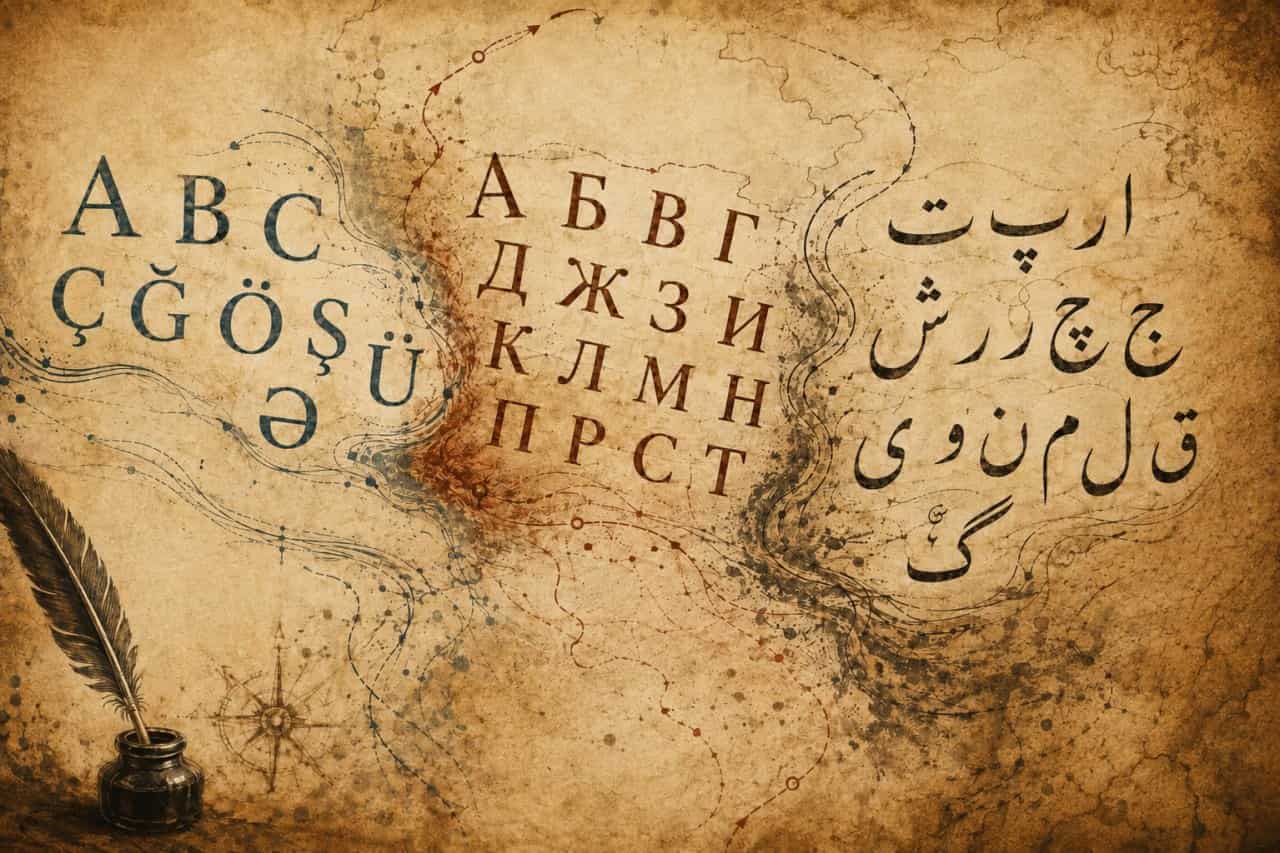
Script is rarely a neutral technical choice in this region. Which alphabet a state teaches its children is a declared vector of civilizational allegiance — a public signal of which power it expects to matter for its future. This is what “written sovereignty” means in practice: not legal independence, but the ongoing, contested right to decide whose cultural gravity a nation writes itself into. Three powers are currently making competing claims on that gravity in the post-Soviet Turkic and Persianate world — Turkey, Russia, and Iran — and they are not equally equipped to press the claim.
I. Facts on the Ground
On September 21, 2024, a commission convened in Baku under the Turkic Academy approved a Common Turkic Alphabet — a 34-letter Latin-based script intended to harmonize the writing systems of Azerbaijani, Turkish, Kazakh, Kyrgyz, Uzbek, and other Turkic languages.1 The project builds on decades of piecemeal Latinization: Azerbaijan completed its own transition from Cyrillic in the 1990s and has since positioned itself as one of the effort’s most committed sponsors, hosting the commission that produced the 2024 declaration. At the commission’s fourth meeting, held in Astana on June 15, 2026, delegates moved from declaration to implementation — endorsing practical recommendations for the alphabet’s use, reviewing proposed Kazakh and Kyrgyz variants, and citing new editions of Abai and Aitmatov printed in the common script as proof of concept.2 The recommendations remain non-binding; each state retains final authority over its own orthography, and the Academy has been explicit that adoption will proceed at each government’s own pace.
That authority has been exercised unevenly. Turkmenistan’s Latinization, begun in the 1990s, is the most institutionally complete in the region. Uzbekistan, officially Latin since 1993, still operates in practice as a digraphic society: a July 2026 reading in the lower chamber of parliament proposed bringing its script closer to the Turkish model by replacing the digraphs sh, ch, o’, g’ with dedicated letters — Ş, Ç, Ö, Ğ — though the bill has not completed the legislative process.3 Kazakhstan’s promised transition, announced in 2017, remains unfinished: as of June 2026 the Ministry of Science and Higher Education had not approved a final Latin alphabet, and its own projections anticipate only 5 percent of written communication in Latin script by 2027, rising to 15 percent by 2029 — modest targets for a reform now entering its second decade.4 Kyrgyzstan’s presidential administration has stated explicitly that the Kyrgyz alphabet — 36 Cyrillic letters — will not change, even as Bishkek continues to participate in the Turkic Academy’s alphabet commission on a symbolic and consultative basis.5
Tajikistan presents the sharpest counter-current. On July 30, 2026, its Ministry of Education confirmed the formation of a working group to strengthen instruction in the traditional Perso-Arabic script — officially termed alifboi niyogon, “the script of the ancestors” — following an instruction from President Emomali Rahmon.6 The announcement stopped short of proposing to replace Cyrillic, Tajikistan’s official script since the Soviet period; it framed the initiative as expanding, not substituting, literacy, and floated the possibility of publishing scholarly work in Persian and Arabic alongside Tajik Cyrillic. Meanwhile, in Iranian Azerbaijan, the Perso-Arabic script has never been displaced, though this continuity reflects the absence of Azerbaijani-language schooling in Iran — where the language is taught in no script at all — rather than any deliberate script policy on Tehran’s part.
A parallel but distinct trend deserves separate treatment: the expansion of Arabic-language instruction across the region under religious and cultural auspices. Between September 2025 and June 2026, ICESCO and the Sultan bin Abdulaziz Al Saud Foundation ran a six-phase teacher-training program — the Sultan bin Abdulaziz Al Saud International Language Training Program: Arabic Language in Central Asia and the Caucasus — moving through Kyrgyzstan, Kazakhstan (Almaty and Turkistan), Bashkortostan, Uzbekistan, and finally Azerbaijan, where it closed in Baku on June 22, 2026 after training more than 200 educators and postgraduate students.7 This is a substantial and well-documented initiative, but its object is modern standard Arabic as a foreign language and religious-educational tool, not the historical Perso-Arabic orthography of Uzbek, Kazakh, or Azerbaijani. Reciting Quranic Arabic, studying modern Arabic, and reading a historical text in Chaghatai or Persianate orthography are three distinct skills that do not automatically follow from one another.8 Growing Arabic literacy in the region is a measurable fact; a corresponding revival of the pre-Soviet national scripts written in Arabic characters is not — Tajikistan, discussed above, remains the only case where a state has moved to institutionalize the latter.
These developments are unfolding against a wider and more assertive Turkish security posture. On August 7, 2026, Turkey, Saudi Arabia, and Pakistan signed the Mecca Agreement, a mutual-defense pact under which an attack on any signatory is to be treated as an attack on all three — a formula Turkish Foreign Minister Hakan Fidan explicitly compared to NATO’s Article 5.9 Officials in Ankara and Riyadh describe the pact as defensive and not directed against any third state, but analysts trace its acceleration to the US-Iran war that began on February 28, 2026, and to the erosion of Gulf confidence in American security guarantees after Israel’s September 2025 strikes on Qatar.10 The Mecca Agreement is a hard-security instrument, not a cultural one, but it reflects the same underlying pattern that runs through the softer evidence collected above: Ankara is currently the most willing and best-resourced actor building new regional architecture — military, religious, and linguistic — while Tehran is largely reacting to events set by others.
II. Three Logics, Not One Contest
It is tempting to read these developments as a single contest between Latin and Cyrillic script, with Arabic-Persian writing as a marginal historical curiosity. That framing obscures more than it reveals. What is actually underway are three distinct mechanisms of influence, each rooted in a different kind of power — and, in Turkey’s case, one that carries an unresolved contradiction of its own.
Turkey: infrastructure with a contradiction at its core. The Common Turkic Alphabet is not merely a philological convenience; it is the latest instrument in a decades-long effort — through TİKA-funded schools, joint universities, satellite television, and now the Organization of Turkic States — to make Ankara the practical center of a shared Turkic communicative space. This effort has an intellectual genealogy that predates the Republic of Turkey itself. In the 1870s–80s, the Azerbaijani playwright and reformer Mirza Fatali Akhundov proposed replacing the Arabic-based script used for both Azerbaijani and Persian with a phonetic, largely Latin-based alternative, arguing that Arabic orthography obscured vowels and impeded literacy among Turkic speakers — a project he framed as part of a broader anticlerical and enlightenment agenda rather than a narrowly technical fix.11 Akhundov’s proposal failed in his own lifetime, but its logic — that the alphabet is a lever of enlightenment and modernization, not merely a technical convention — reappeared in Atatürk’s 1928 reform and again in Soviet Azerbaijan’s own Latinization, which drew on an overlapping pool of Turcological and nationalist thought even as the Soviet and Kemalist states pursued rival visions of modernity.12 What is new in the 2020s is the scale on which this old logic now operates: Turkey has the university system, media market, and diplomatic apparatus to make the same argument regionally rather than nationally, a divergence in outcome between the Turkish and Azerbaijani reforms that later comparative scholarship attributes to precisely this gap in institutional capacity.13
But this Latin-alphabet project sits awkwardly next to the other face of Erdoğan-era Turkey: a sustained ideological turn toward re-Islamization and Ottoman nostalgia, and an explicit bid for leadership of the Sunni Muslim world — a bid the Mecca Agreement itself advances. That bid is written, historically, in Arabic script; the Ottoman Empire whose legacy Ankara increasingly invokes never wrote Turkish in Latin letters at all. A state pursuing Islamic leadership while exporting a Latin alphabet is, in a specific and unresolved sense, offering the region a modernizing script attached to a re-traditionalizing politics. Whether this tension is felt as a contradiction by the governments adopting the Common Turkic Alphabet, or simply absorbed as one more inconsistency of contemporary Turkish self-presentation, is an open question — but it is a real fault line inside Ankara’s own project, not only in the region’s response to it.
Azerbaijan: agency, not submission. It would be a mistake to read Baku’s alignment with Ankara as passive absorption. Azerbaijan did not merely adopt the Common Turkic Alphabet — it hosted and chaired the 2024 commission that produced it, positioning itself as the administrative hub of Turkic script integration rather than a mere recipient of Turkish standards. Azerbaijan is Latin, has been for three decades, and is geographically the hinge between Turkey and Central Asia; hosting the institution that sets the regional standard is a way of converting proximity to Turkey into leverage over the entire Turkic space, not a symptom of losing independent standing. Baku continues to insist, in its own state rhetoric, on the distinctness of the Azerbaijani literary language from Istanbul Turkish, even as it absorbs Turkish media, vocabulary, and educational partnerships. This distinction matters beyond linguistics: a genuinely independent-minded Azerbaijan, using the Turkic-integration project for its own ends rather than simply following Ankara, is also the more useful and more predictable partner for outside actors — Israel among them — who have built a substantial relationship with Baku and have an interest in an Azerbaijan that hedges rather than one that becomes a straightforward extension of Turkish foreign policy.
Russia: inertia that is also leverage. Russia’s position rests on inertia rather than script reform — but it would understate Moscow’s hand to call this passive. An open push to entrench Cyrillic would invite immediate accusations of colonialism and empire-building, with uncertain returns; Russia has largely avoided that fight. What it has instead is the region’s principal labor market. A Tajik, Uzbek, or Kyrgyz citizen can rebrand his national identity as Turkic, adopt a Turkish-modeled alphabet, and consume Turkish television — and still find that the country where the money is earned is Russia, not Turkey. That fact requires functional Russian, and in practice Cyrillic literacy, regardless of what the state does with its own national orthography. Comparative sociolinguistic work on the post-Soviet space shows this persistence varies by domain — Russian retains particular strength in employment, higher education, and private life even where states have symbolically prioritized the titular language in law and public signage.14 Kazakhstan’s stalled transition and Kyrgyzstan’s explicit refusal to change script are not simply evidence of the cost of alphabet reform; they reflect a population for whom Cyrillic remains tied to the language of remittances.
Iran: an archive that activates itself, but not for Tehran. Iran’s position is different in kind from both. Unlike Turkey, it is not building new institutions to project script influence in the region; unlike Russia, it has no comparable economic leverage to fall back on. What it has is depth of prior text: a body of classical Persian and Persianate literature — Ferdowsi, Rudaki, Hafez, and the “Azerbaijani school” of Persian poetry produced in Ganja, Shirvan, and Tabriz — that predates the modern national borders of the region and remains, in principle, legible to anyone who can read the Perso-Arabic script. Tajikistan’s alifboi niyogon initiative draws on exactly this reservoir, and the fact that Dushanbe, not Tehran, is doing the drawing should be read carefully rather than simply as a mark of Iranian weakness. Persian literary capital appears able to activate itself transnationally precisely because it is not owned by any single state — it belongs to Tajik, Afghan, and diaspora communities as much as to Iran, and a third country can claim it without asking Tehran’s permission. That is a genuine strength of the tradition.
It is also, for Iran specifically, the source of the problem this paper is tracing: a cultural asset that does not require Iranian institutions to survive is also an asset that does not translate into Iranian diplomatic leverage over the states that draw on it. The Tajik government has taken care to frame the script as ancestral and national, not Iranian or Islamic — treating Iran’s literary heritage as a common inheritance to be claimed, not a patron relationship to be entered into. The historical record supports reading this as an Iranian institutional failure rather than a simple absence of interest: Shireen Hunter’s assessment of Iranian foreign policy in the post-Soviet space finds that Tehran’s civilizational capital has repeatedly been outweighed by sanctions, the securitized caution of secular Central Asian regimes toward a revolutionary Shia state, and competition from a more agile Turkey.15 Hamid Ahmadi’s study of Iran-Tajikistan relations is more pointed still: an earlier, more ambitious attempt to revive the Perso-Arabic script in Tajikistan stalled into what he calls a deadlock, undone not by cultural distance but by political friction between the two states.16 A separate study of Ahmadinejad-era “strategic partnership” rhetoric reaches a compatible conclusion — public amity between Tehran and Dushanbe repeatedly failed to translate into substantive cooperation, undercut by dysfunction in Iran’s own foreign-policy execution as much as by Tajik reluctance.17 The 2026 initiative is best read against this history: a second attempt, this time initiated and controlled by Dushanbe rather than proposed by Tehran, which may be precisely why it has gone further than its predecessor.
A second archive that stayed on the shelf. Iran’s position looks stronger still when set against the obvious counter-case: Uzbekistan’s own pre-Soviet literary canon, above all Alisher Navoi, who wrote in Chaghatai Turkic in Arabic script and remains a celebrated national symbol in Tashkent — a competing archive available to the Turkic side without reference to Persian sources at all. In practice, however, the Uzbek state has not developed a comparable script-literacy initiative around it. What Uzbekistan has built instead is a heritage brand: an international Uzbek-language olympiad bearing Navoi’s name for students abroad, a national theater and museum complex, and cultural showcases at events like the Bukhara Biennale.18 None of this restores the ability to read Navoi’s actual Chaghatai text in its historical orthography, in the way Tajikistan’s initiative is explicitly designed to restore Perso-Arabic reading competence. Navoi functions in today’s Uzbekistan largely as a museum exhibit and a source of national pride, not as a living, re-readable archive. This asymmetry — one tradition being reactivated for reading, the other mainly commemorated — is itself evidence for, not against, the paper’s central claim: Iran’s literary capital in the region remains comparatively the more “alive” of the two available archives, even though Iran itself is not the one reviving it.
What ordinary readers actually do. It is worth being concrete about who bears the cost of these choices. A construction laborer from Tajikistan or a cleaner from Uzbekistan working in Moscow learned one alphabet in school and knows it; repeated state-level script changes do not touch their daily literacy so much as they threaten to leave the next generation stranded between the schoolbooks their parents can read and the ones the state now prints. For this population, the practical alphabet is whichever one is tied to where the work and the money are — which is currently Cyrillic, because that is Russia’s script, not because of any residual ideological attachment to it. Emerging machine-transliteration tools for the Tajik-Persian language pair are a genuine technical development, and may eventually make cross-script reading easier for scholars, journalists, and diaspora communities with reliable internet access.19 But they are not yet, and may not soon be, part of the daily toolkit of a Tajik construction worker or an Uzbek migrant cleaner, and it would overstate the case to treat this technology as a near-term equalizer of the region’s script politics. For the population actually doing the writing and reading day to day, the practical alphabet remains the one tied to employment, not to historical depth or software.
III. Archives Are Not Instruments
None of this points toward a single alphabet’s victory. The more likely trajectory, over the next five to ten years, is a functionally stratified writing landscape: Latin script consolidating as the medium of Turkic integration and digital modernity; Cyrillic persisting wherever Russian-language labor markets and infrastructure remain more valuable than any alternative; and Perso-Arabic script surviving as a register reserved for religion, classical literature, and acts of historical reclamation rather than for everyday state communication. Kazakhstan’s stalled transition and Uzbekistan’s enduring digraphia suggest this stratification is already the default outcome even where governments have formally committed to something cleaner.
Turkey did not win its current position through cultural affinity alone; it won it through universities, broadcasters, and a diplomatic and now security apparatus willing to spend money and attention on the region for three decades — and, as of August 2026, willing to formalize that commitment into a defense pact with explicit NATO-style obligations. Russia did not preserve Cyrillic through persuasion; it preserved it by remaining the region’s most reliable source of income, which is a harder thing to dislodge than any single government’s alphabet decree. Iran’s advantage, by contrast, remains what it has been since the Qajar period: an archive without a delivery system — one that other states can and do activate for their own purposes, but which Tehran itself has repeatedly failed to convert into diplomatic or cultural leverage of its own.
This has a bearing beyond orthography. The Mecca Agreement shows Turkey building hard-security architecture around exactly the same set of states — Central Asia, the Caucasus, the wider Sunni world — where it is also setting the cultural and linguistic pace, at a moment when Iran has been substantially weakened by the war that began in February 2026. For an Israeli and Western policy audience, the interesting conclusion is not that Iran is culturally rich but strategically impotent, an observation that by itself has limited operational value. It is that the region’s cultural and linguistic vacuum left by Iran’s institutional weakness is not staying empty — it is being filled, systematically and on multiple fronts, by an assertive Ankara that is simultaneously building a Sunni-aligned military bloc, a pan-Turkic linguistic bloc, and a media and education footprint that stretches from the Caucasus to Central Asia. A Turkey that leads unopposed in all three registers — security, script, and religious authority — across this space is a materially different regional actor than a Turkey that has to share civilizational ground with a weakened but still-present Iranian archive. That may be a real, if narrow, argument for why Western and Israeli policy should not treat Iran’s cultural weakness in this region purely as good news: an Iran with zero capacity to project its literary and linguistic capital removes one of the few countervailing claims on a space Turkey is otherwise positioned to dominate outright.
This is the real fault line in Eurasia’s alphabet politics, and it will not be resolved by counting how many states use which letters. The question that will determine the region’s cultural realignment over the coming decade is not which script prevails, but which power — or which government acting on its own initiative — proves able to convert written heritage into a functioning instrument of statecraft. On present evidence, Turkey and Russia both can, in different registers. Iran, so far, cannot — and that gap is now opening at the same moment Ankara is converting the same regional relationships into a formal security bloc.
Bibliography
Academic literature
Landau, Jacob M.; Kellner-Heinkele, Barbara. Politics of Language in the Ex-Soviet Muslim States: Azerbayjan, Uzbekistan, Kazakhstan, Kyrgyzstan, Turkmenistan and Tajikistan. London: Hurst, 2001.
Landau, Jacob M.; Kellner-Heinkele, Barbara. “Alphabet Reform in the Six Independent Ex-Soviet Muslim Republics.” Journal of the Royal Asiatic Society 20, no. 1 (2010).
Algar, Hamid. “Āḵūndzāda.” Encyclopaedia Iranica.
Swietochowski, Tadeusz. Russian Azerbaijan, 1905–1920: The Shaping of National Identity in a Muslim Community. Cambridge: Cambridge University Press, 1985.
Fierman, William. Language Planning and National Development: The Uzbek Experience. Berlin/New York: Mouton de Gruyter, 1991.
Dave, Bhavna. Kazakhstan: Ethnicity, Language and Power. London: Routledge, 2007.
Kudaibergen, Diana T. The Kazakh Spring: Digital Activism and the Challenge to Dictatorship. Cambridge: Cambridge University Press, 2024. Esp. ch. 5, “Generation Q and Decolonizing Alash.”
Perry, John R. “Modern Tajiki Persian: Gharbzadagi of a Different Kind.” Nationalities Papers.
Ahmadi, Hamid. “Iran and Tajikistan: How Culture and Civilization Fade in the Shadow of Politics and the Political.” Iran and the Caucasus 23, no. 1 (2019): 105–.
Clark, B. “Ahmadinejad, Iran, and Foreign Policy Dysfunction in Tajikistan.” Asian Politics & Policy 7, no. 2 (2015): 213–244.
Hunter, Shireen T. Iran’s Foreign Policy in the Post-Soviet Era: Resisting the New International Order. Westport, CT: Praeger, 2010.
Khalid, Adeeb. Islam after Communism: Religion and Politics in Central Asia. Berkeley: University of California Press, 2007.
Güven Kılıçarslan, Zehra. “Language Policy in Turkey and Azerbaijan: A Comparative Approach to the Two Language Reforms.” Littera Turca Journal of Turkish Language and Literature 8, no. 2 (2022): 1660–.
Lummus, Wesley. “One Nation, Two Languages: Latinization and Language Reform in Turkey and Azerbaijan, 1905–1938.” PhD diss., University of Minnesota, 2021.
Pavlenko, Aneta. “Russian in post-Soviet countries.” Russian Linguistics 32, no. 1 (2008): 59–80.
Primary / official documents
Turkic Academy. “Declaration on the Common Turkic Alphabet.” Baku, September 21, 2024.
Turkic Academy. Materials of the Fourth Meeting of the Commission on the Common Turkic Alphabet. Astana, June 15, 2026.
Republic of Uzbekistan, Legislative Chamber (Oliy Majlis). First reading on alphabet amendment (introduction of Ş, Ç, Ö, Ğ), July 2026.
Republic of Kazakhstan, Ministry of Science and Higher Education. Statement on Latin alphabet implementation timeline, June 2026.
Tajikistan, Ministry of Education and Science / Asia-Plus. “This Is the Script of Our Ancestors.” July 30, 2026.
ICESCO / Sultan bin Abdulaziz Al Saud Foundation. Closing ceremony announcement, Sultan bin Abdulaziz Al Saud International Language Training Program — Arabic Language in Central Asia and the Caucasus. Baku, June 22, 2026.
APA. “Хакан Фидан: Мекканское соглашение готовилось 2 года и 8 месяцев.” August 8, 2026.
Vfokuse.mail.ru. “«Мусульманское НАТО»: что стоит за соглашением Турции, Саудовской Аравии и Пакистана.” August 2026.
Podrobno.uz. “Олимпиада имени Навои. В Узбекистане запустят международное соревнование по узбекскому языку.” May 19, 2026.
III. Preprints / technical
Arabov, Mullosharaf K. “A Systematic Benchmark of Machine Transliteration Models for the Tajik-Farsi Language Pair: A Comparative Study from Rule-Based to Transformer Architectures.” arXiv:2605.02270, 2026.
Arabov, Mullosharaf K. “TajPersLexon: A Tajik–Persian Lexical Resource and Hybrid Model for Cross-Script Low-Resource NLP.” arXiv:2605.06886, 2026. (Note: author is affiliated with Kazan Federal University, not with a Tajik or Iranian institution.)
Footnotes
Turkic Academy, “Declaration on the Common Turkic Alphabet,” Baku, September 21, 2024.
Turkic Academy, Materials of the Fourth Meeting of the Commission on the Common Turkic Alphabet, Astana, June 15, 2026.
Republic of Uzbekistan, Legislative Chamber, first reading on alphabet amendment, July 2026.
Republic of Kazakhstan, Ministry of Science and Higher Education, statement on Latin alphabet implementation timeline, June 2026.
Statement of the Kyrgyz presidential administration on the retention of the 36-letter Cyrillic alphabet, 2026.
Tajikistan Ministry of Education and Science / Asia-Plus, “This Is the Script of Our Ancestors,” July 30, 2026.
ICESCO / Sultan bin Abdulaziz Al Saud Foundation, closing ceremony announcement, Baku, June 22, 2026.
Khalid, Islam after Communism, 2007.
APA, “Хакан Фидан: Мекканское соглашение готовилось 2 года и 8 месяцев,” August 8, 2026.
Vfokuse.mail.ru, “«Мусульманское НАТО»: что стоит за соглашением Турции, Саудовской Аравии и Пакистана,” August 2026.
Algar, “Āḵūndzāda,” Encyclopaedia Iranica.
Lummus, “One Nation, Two Languages,” 2021.
Güven Kılıçarslan, “Language Policy in Turkey and Azerbaijan,” 2022.
Pavlenko, “Russian in post-Soviet countries,” Russian Linguistics 32, no. 1 (2008): 59–80.
Hunter, Iran’s Foreign Policy in the Post-Soviet Era, 2010.
Ahmadi, “Iran and Tajikistan,” Iran and the Caucasus 23, no. 1 (2019): 105–.
Clark, “Ahmadinejad, Iran, and Foreign Policy Dysfunction in Tajikistan,” Asian Politics & Policy 7, no. 2 (2015): 213–244.
Podrobno.uz, “Олимпиада имени Навои,” May 19, 2026.
Arabov, “A Systematic Benchmark of Machine Transliteration Models for the Tajik-Farsi Language Pair,” arXiv:2605.02270, 2026; Arabov, “TajPersLexon,” arXiv:2605.06886, 2026.
What Azerbaijan’s Mediation within the Israeli-Turkish Disputes Reveals about the Current State of Affairs between Jerusalem and Ankara
PSCRP-BESA Reports No 219 (July 23, 2026)
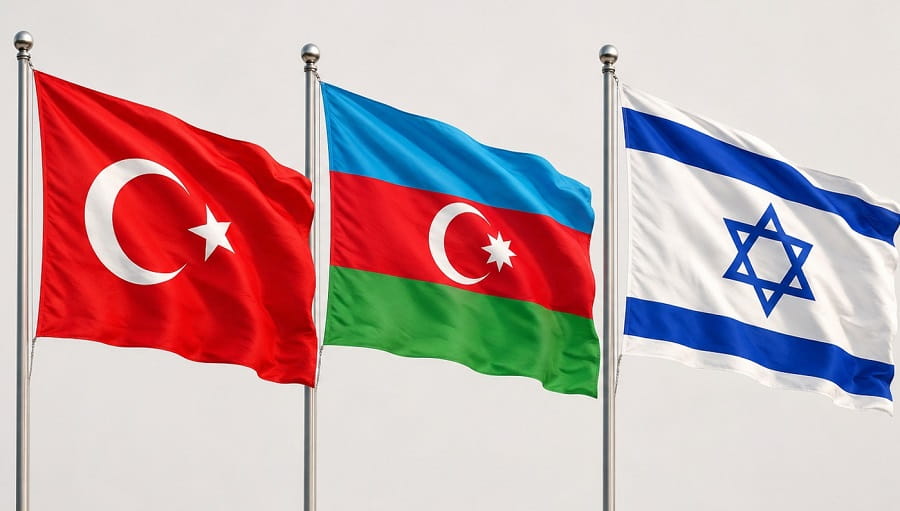
One of the geopolitical aftermaths of the Hamas terrorist attack on Israel on October 7, 2023, is the deteriorating bilateral relations between Israel and Türkiye. The South Caucasus state of Azerbaijan, which considers both states its closest allies, unsurprisingly once again serves as a mediator between the two antagonists. Drawing on expert interviews and qualitative data, this paper will be the first to illuminate these mediation efforts in greater detail. Focusing on Azerbaijan’s mediation formats and policies enables analysts to gauge the current state of Israeli-Turkish relations more precisely. In addition to generating policy recommendations for Jerusalem at the end, this analysis will also highlight why Jerusalem and Baku should consider Germany a constructive additional component in the Azerbaijani-led mediation efforts between Israel and Türkiye.
Talk to My Friend
Since the Hamas terrorist attack on Israel on October 7, 2023, the Turkish government around President Recep Tayyip Erdoğan has hardened its rhetoric against the Jewish state to such a degree that it openly fantasizes about invading Israel and capturing Israel’s capital Jerusalem. Unsurprisingly, such rhetoric multiplies Israeli concerns that a Türkiye-led Sunni axis might replace the plummeting Iran-led Shia axis. One state, however, sees both countries as its most important allies: Azerbaijan. Therefore, it is unsurprising that Baku often served as a mediator between the two states. The Azerbaijani President Ilham Alijew first officially mentioned Azerbaijani involvement in such initiatives in April 2025 during an address at the Azerbaijani Diplomatic Academy (ADA) in April 2025 when he stated:
“Both countries [Israel and Türkiye] are close friends of Azerbaijan. […]. As it is already known, though we never made it public ourselves, but already it has been circulated quite broadly. The first successful reconciliation between Türkiye and Israel was to a certain degree facilitated by Azerbaijan. […]. But I would say that Azerbaijan was number one in this process. Again, it was behind the scenes. We never made it public. […] We just wanted to help our ally and brother Türkiye and our friend Israel to rebuild their relationship.”
These Azerbaijani mediation efforts, especially after October 7, 2023, deserve more attention, as their format and procedures reveal much about the current state of Israeli-Turkish relations and, more broadly, about the trilateral relations among Baku, Ankara, and Jerusalem. Drawing on expert interviews and qualitative data, this analysis will be the first to illuminate these mediation efforts in greater detail, focusing on their formats. By doing this, this BESA paper will formulate policy recommendations for Jerusalem at the end. Moreover, it will showcase why Baku and Jerusalem should consider Germany as a constructive additional component in the Azerbaijani-led mediation efforts between Israel and Türkiye.
Azerbaijan and its Mediation Efforts in the Israeli-Turkish Conundrum since October 7, 2023
Since Israel’s creation in 1948, Türkiye always managed to be a reliable strategic partner of the Jewish state, while at the same time supporting Palestinian statehood and a so-called “Two-State Solution.” Although Erdoğan’s rise to power since the early 2000s and his departure from Atatürk’s secularism produced the first eruptions in bilateral relations, a radical qualitative change occurred after October 7, 2023. Erdoğan replaced his pro-Palestinian stance with an open pro-Hamas stance. This circumstance became particularly evident by hosting parts of the Hamas politburo in Türkiye and labeling this internationally recognized Islamist terrorist organization “freedom fighters.” Considering the poor state of the Turkish economy, the flourishing corruption practices, and high youth unemployment in the country, it is nothing new in world history that leaders with such domestic problems play the Anti-Zionism and Anti-Semitism card to distract from their domestic problems. As was often the case in human history, anti-Semitism helps such governments to create a rally-around-the-flag effect among the actually economically and politically unsatisfied citizenry in support of their government. Interestingly, one can observe a similar development in the left-wing Pedro Sánchez -led minority government in Spain. The latter cannot escape continuous political, economic, and corruption scandals, yet has proclaimed itself the West’s alleged moral compass – especially when it comes to Middle East affairs.
Taking notice of the rising tensions, Azerbaijan has conducted several mediation initiatives between Israel and Türkiye between 2008 and 2010, in 2018, and between 2022 and today. These helped ease Israeli-Turkish tensions. Yet, after regular periods, these disagreements erupted repeatedly. Because of this, some observers express skepticism towards Baku’s mediation initiatives. This critique often states that, although Baku has made several mediation attempts between Israel and Türkiye since 2008, relations between Jerusalem and Ankara have always returned to disputes. Thus, doubts could emerge about the effectiveness of these Azerbaijani mediation efforts. At first glance, this could seem like a legitimate critique, yet another perspective on this issue might be more crucial.
Independently of each other, Azerbaijani and Israeli experts familiar with this matter point out that the Azerbaijani mediation initiative should not be seen as the ultimate panacea for Israeli-Turkish disagreements. Rather, they constitute ad hoc measures to de-escalate tensions between Jerusalem and Ankara, aiming to prevent them from spilling over into an open military conflict. The establishment of a direct communication line between the Turkish and Israeli militaries in Syria via Azerbaijani diplomacy in May 2025 is one such instance. It aims to help both states avoid unintended clashes in post-Assad Syria.
The Mediation Formats as an Expression of the Current State of Affairs between Jerusalem and Ankara
Strikingly, the changed Turkish attitude towards Israel since October 7, 2023, is also reflected in the way the Azerbaijani-mediated Israeli-Turkish talks proceed. Throughout 2025, most of these talks proceeded only indirectly. Allegedly, only in one of the discussion rounds in 2025 did both antagonists manage to talk directly to each other. This situation exemplifies once more the often-mentioned current low point in Israeli-Turkish relations. If one considers that in September 2023 Azerbaijani officials managed to organize a personal meeting between Erdoğan and the current Israeli Prime Minister Benjamin Netanyahu in New York on the sidelines of the annual UN General Assembly and compares it to the above-mentioned current situation where both sides mostly do not manage to sit in one room anymore, this deterioration of relations becomes even more evident.
What is also interesting is that these talks are allegedly not conducted at the level of the foreign ministries, but rather directly through the presidential offices of Azerbaijan and Türkiye, as well as the Israeli Prime Minister’s Office. Although this is not an unusual practice in international relations, the fact that the highest hierarchical levels of the executive branches in all three states deal personally with this issue shows how much weight all three involved parties (Azerbaijan, Türkiye and Israel) place on the current tensions between Israel and Türkiye.
For Azerbaijan, this is a particularly delicate issue, as it fears that an escalation between its two most important allies could put it in a political dilemma. This concern is one of the reasons why Baku tries so relentlessly to calm the waters between Jerusalem and Ankara again and again. As discussions with Azerbaijani experts reveal, for Baku, the best-case scenario would be a strong, stable trilateral strategic partnership among Azerbaijan, Türkiye, and Israel.
Conclusion: Policy Recommendations for Jerusalem
As the author of this analysis mentioned in his previous BESA paper, discussions with Israeli and Azerbaijani experts highlight in a repeated manner how both sides view the current Turkish-Israeli relations as simultaneously the biggest risk (should the Turkish-Israeli relations further deteriorate) and the biggest (economic and security-related) opportunity for the Azerbaijani-Israeli strategic partnership (as soon as the tensions between Ankara and Jerusalem calm down). The points above showed what these mediation initiatives look like and, more importantly, what they tell about the seriousness of the current tensions between Israel and Türkiye.
As the Middle East security order is still evolving after the ongoing crumbling of the Iran-led Shia axis, new (potential) conflict zones between Middle Eastern states emerge, making it profoundly difficult to say with guarantee that the Azerbaijan-led mediation efforts in Israeli-Turkish relations will succeed. Thus, this analysis calls for a dualistic Israeli foreign policy approach by extending an open hand and a fist towards Ankara. Such an approach could consist of Israel’s expressed readiness to de-escalate further its relations with Türkiye if Ankara shows a gesture of goodwill –for instance by giving up its holding of a protective hand over the living rest of the Hamas politburo members residing in Türkiye) (“the open hand”). In parallel and until then, precautionary measures should remain the call of the hour for Israeli foreign policy as well (“the fist”) – especially when it comes to Erdoğan’s Neo-Ottoman aspirations, which are also seen critically by Baku and other predominantly Muslim states in the region. Additionally, Israeli foreign policy should consider the following points in this regard:
Differentiating between Turkish Domestic and International Rhetoric: Although the current Turkish foreign minister, Hakan Fidan, has tempered his tone toward Israel in a recent media appearance on July 10, 2026, stating that Ankara is not in conflict with Israel, but rather with the current Israeli government, analysts should register Fidan’s mood change with utmost caution. Fidan made this statement to a foreign media platform (The National). In interviews with domestic media outlets, the Turkish foreign minister’s rhetoric is exactly the opposite. This fact became clear just one week before his interview for “The National” when he described in an interview for CNN Türk that the “[…] [Israeli] people have become a burden that humanity can no longer bear.” Moreover, as the analysis above showed, even if Fidan is truly committed to de-escalation, Israel should keep in mind that the foreign ministries of both states are not the primary actors in the crisis management of the Israeli-Turkish tension, but the presidential and prime ministerial administrations of the respective countries. Thus, it remains unclear how much political weight Fidan’s de-escalation statements truly have.
The Repercussions of Reducing the Role of National Foreign Ministries in Crisis Management: Circumventing or reducing the role of national foreign ministries and their diplomats in the crisis management of Israeli-Turkish relations risks missing the opportunity to fortify the relationship between Israel and Türkiye. Elected officials come and go, and the same applies to their staffers within their administrations. Diplomats, however, remain in their profession, often throughout their careers. States should view such binding measures and contacts between the diplomatic personnel of all involved states as a political investment in the future, especially given that some of these diplomats might later assume political offices. Their collective experience in dealing with “the other side” might be an important trust base on which future Israeli-Turkish relations can operate.
Keeping the New Syrian Regime out of Lebanon: Although US President Donald Trump hinted in June 2026 that he would like the new regime in Syria (instead of Israel) to fight against the Shia terrorist organization Hezbollah in Lebanon, Jerusalem should be aware of the risks this might entail. As the new Syrian regime is closely aligned with and highly dependent on Ankara, the danger might arise that Türkiye might use the Islamist militias around the new Syrian leader, Abu Mohammad al-Julani, as a proxy to increase its influence in Lebanon. Indeed, such a scenario showcases once more the security risk for Israel of inadvertently replacing the former Iran-led Shia crescent with a Türkiye-led Sunni crescent.
Strengthening the Hellenic Alliance further: As a precautionary measure, Israel should expand the existing security ties within the Hellenic Alliance, namely the already-established security partnership among Israel, Greece, and Cyprus, to counterbalance Turkish influence in the Eastern Mediterranean and gain bargaining chips vis-à-vis Ankara. Moreover, the issue of Cyprus, with its since 1974 Turkish-occupied northern part, presents one of several other unexploited loopholes (like the Kurdish issue) allowing Israel to highlight the contradictions within Ankara’s international demeanor – especially concerning Ankara’s constant condemnation of Israel’s security policies in the Palestinian territories. Here, a newly recalibrated and more profoundly designed Israeli public diplomacy than before (by relying also on international expertise) can highlight the hypocrisy of Turkish foreign policy and the ignorance of the current paradoxical international liaison between Islamism and left-wing self-proclaimed progressivism in many Western states.
Germany and the Azerbaijani-Led Mediation Efforts in the Strained Israeli-Turkish Relations: Germany should be considered an additional pillar of support for these mediation efforts. Not only is Berlin, due to its past dark role in Jewish history, now one of the strongest allies of Israel, but it is also the home of the largest Turkish diaspora in the world (approximately 3 million people, of which 1,5 million are German citizens with voting rights). Therefore, similar to Azerbaijan, an escalation of the current Israeli-Turkish relations might also put Germany in a very precarious position. For Azerbaijan, this would allow it to deepen its ties with the biggest economy in Europe. For Germany, it would be a step toward stepping up its role as a peace facilitator. Several German officials practice self-criticism by pointing out that Germany has lost its past role as a mediator between Israel and the Lebanese government. However, it seems the officials in Berlin have not yet recognized that the Israeli-Turkish tensions might be even more significant to them than the Israeli-Lebanese issue, as it could also affect very sensitive German domestic issues. Furthermore, for Israel, it would be an opportunity to strengthen an important ally, such as Germany, on the international stage. This goal might be particularly important now, as Germany suffered an international blowback in June 2026 in its failed quest to secure a non-permanent seat on the UN Security Council. In addition to miscommunication between Germany and other EU states seeking such seats (Austria and Portugal), an anti-German campaign by Russia among UN members from the so-called Global South, driven by Berlin’s siding with Ukraine, also contributed to Germany’s defeat. However, an additional reason for Germany’s unsuccessful application lies in its open support for the Jewish state’s security. Thus, strengthening the international role of an ally like Germany also has advantageous implications for Jerusalem.
Diplomatic Blow in the Wrong Direction? Gideon Sa’ar’s Initiative for Israel to Recognize the Armenian Genocide
PSCRP-BESA Reports No 215 (July 2, 2026)
It is well known that the Knesset has traditionally preferred not to adopt resolutions dealing with issues of historical memory. A clear example is the repeatedly debated, yet never adopted, bill recognizing the Armenian Genocide.
On Thursday, June 25, 2026, an unusual diplomatic development attracted the attention of both the Israeli public and international observers. On that day, Israeli Foreign Minister Gideon Sa’ar announced on his official X account that he intended to submit, at the next cabinet meeting, a draft resolution calling for Israel’s official recognition of the genocide committed against the Armenian people by the Ottoman Empire during the final years of the First World War. Three days later, the resolution—which, according to the foreign minister, represents “a moral and historical obligation” of the Jewish state and also condemns “the denial, minimization, or distortion of historical truth”—was unanimously approved by the government. The next step, it was announced, will be a vote in the Knesset.
Previous Attempts
In fact, the issue of the Armenian Genocide has been raised in the Israeli parliament on numerous occasions. Among the officially registered parliamentary lobbies in the Knesset is an Armenian lobby. However, unlike Gideon Sa’ar—who recently returned to the ruling Likud party and positions himself as a right-wing politician—the leading voices within this lobby have traditionally come from the political left.
These included Zahava Galon, leader of the left-wing Meretz party, who initiated parliamentary committee discussions on the issue, and Tamar Zandberg, then leader of the moderately left-wing Labor Party (Avoda), who introduced legislation seeking official recognition of the 1914–1916 events in Ottoman Turkey as genocide.
Another prominent figure from Israel’s left, the late Yossi Sarid, sought to introduce the study of the Armenian Genocide into the national school curriculum. Outside this political camp, one may also mention Yaakov Margi, a veteran member of the ultra-Orthodox Sephardic Shas party. As chairman of the Knesset Education, Culture and Sports Committee, he secured the committee’s adoption of a resolution recognizing the Armenian Genocide during one of its sessions in the summer of 2016. He also called on both the government and the Knesset to follow suit—though without any tangible practical outcome.
Russian-speaking members of the Knesset also contributed to efforts aimed at securing Israel’s official recognition of the Armenian Genocide. Among them was Alexander Tzinker, a native of Yerevan who represented the Democratic Choice party in the Knesset from 1999 to 2003. Democratic Choice was a center-left splinter faction that had broken away from Yisrael BaAliyah, the political movement established in 1996 by immigrants from the former Soviet Union.
Another notable supporter was Ze’ev Elkin, originally from Kharkiv, who left Likud together with Gideon Sa’ar in 2021 before returning to the party alongside him three years later. It should be noted, however, that today, as Co-Chairman of the Azerbaijan–Israel Joint Commission, Elkin has completely distanced himself from this issue.
During the speakership of another Russian-speaking Likud politician, Yuli Edelstein, toward the end of the previous decade, there were also plans to bring a similar resolution before the Knesset plenary. Like previous initiatives of this kind, it would not, in principle, have been binding on the government. Nevertheless, these plans, too, ultimately failed to materialize.
There were two main reasons for this.
The first was that, although the average Israeli is deeply sympathetic to the tragedies suffered by other peoples—and generally believes that the Jewish people, with their centuries-long history of persecution, are uniquely capable of understanding the suffering of others—very few are willing to equate those tragedies with the Holocaust of European (and North African) Jewry.
Numerous sources of Russian origin maintain that following the Russo-Turkish War of 1877–1878, Russian intelligence used the Armenian population of the Ottoman Empire to advance its geopolitical interests by encouraging demands for autonomy and by arming Armenian partisan units that later took part in the fighting during the 1914–1917 campaigns. By contrast, before the Holocaust, Germany’s Jews neither sought territorial autonomy nor engaged in subversive activities; on the contrary, the overwhelming majority sought to integrate into German society.
The Ottoman authorities carried out the mass killing of Armenians on their own territory during wartime—and there can be no justification for these atrocities. At the same time, unlike Nazi Germany, the Ottoman government’s objective was not the systematic extermination of every Armenian in the world. Moreover, despite significant restrictions, a substantial Armenian community continued to exist in Istanbul throughout that period. Whatever their personal views on the Armenian Genocide issue, Israeli politicians have long felt compelled to take these distinctions into account.
The second reason was Israel’s complex relationship with Turkey.
During the era of Mustafa Kemal Atatürk and his successors, when Jerusalem and Ankara maintained what was effectively a strategic partnership—including close military and security cooperation—Israeli leaders deliberately avoided touching an issue that remained extremely sensitive for Turkish nationalism. Israel traditionally maintained a position of neutrality, viewing the matter as an “internal dispute” between Turkey and Armenia that should be addressed through historical research and the opening of archives, rather than through political campaigns and parliamentary declarations.
Israeli governments attempted to adhere to this approach even after the rise to power, during the first decade of this century, of Recep Tayyip Erdoğan’s Islamist government. Initially regarded as relatively moderate, Erdoğan’s regime gradually became increasingly radicalized, promoting the doctrine that modern Turkey is the rightful successor to the Ottoman Empire and therefore entitled to political leadership in territories that had once been under Ottoman rule.
This vision naturally entailed dismantling Turkey’s strategic partnership with Israel. Erdoğan embraced that course all the more readily because it aligned with his own increasingly radical Islamist worldview, his pronounced antisemitic tendencies, and his deep hostility toward the Jewish state. Added to this was Ankara’s support for radical Islamist regimes, such as Qatar, as well as terrorist organizations including Hamas and Syrian branches of the Islamic State.
The decisive turning point in Turkish-Israeli relations came with the highly publicized May 2010 “Freedom Flotilla” incident, in which a convoy of vessels attempted to breach Israel’s naval blockade of the Gaza Strip—a blockade that, according to the conclusions of the UN Panel of Inquiry at the time, was legally justified. Documents recovered by Israeli commandos after boarding the Turkish flagship Mavi Marmara indicated that Erdoğan himself had personally supported the organizers of the operation.
It was generally during periods of deteriorating Turkish-Israeli relations that the above-mentioned initiatives to recognize the Armenian Genocide resurfaced. Nevertheless, successive Israeli governments continued for many years to avoid unnecessarily escalating tensions and sought, wherever possible, to preserve a business as usual relationship with Ankara. Given Turkey’s continued interest in maintaining—and even expanding—its trade and economic ties with Israel, Israeli policymakers hoped that relations would eventually normalize. Indeed, from time to time, during the intervals between Erdoğan’s recurrent anti-Israel campaigns, they did.
Why Now?
As we can see, the situation today is fundamentally different. What is at issue is no longer the personal initiative of individual politicians or symbolic parliamentary gestures, but rather a formal declaration by the foreign minister and a decision adopted by the Government of Israel—something that has never happened before.
The Foreign Ministry’s June 28 press release refers to earlier “relevant statements” by Prime Minister Benjamin Netanyahu and by Israel Katz during his tenure as foreign minister. However, it provides no indication as to whether those statements contained any concrete commitments.
Clearly, much has changed since Hamas’s brutal October 7, 2023 attack on Israel. Following the launch of the IDF’s Operation Iron Swords—which became the catalyst for the current full-scale war in the Middle East—Ankara’s anti-Israel and antisemitic rhetoric reached unprecedented levels. This included repeated, highly inflammatory, and entirely unfounded accusations that Israel was committing “genocide” against the population of the Gaza Strip.
Against this backdrop, the Jewish state’s official recognition of the genocide committed by the Ottoman authorities against the Armenians more than a century ago appears to be a diplomatic response based on the principle of measure for measure. Sa’ar, however, sought to reject any interpretation of his initiative as an act of political retaliation, insisting that his decision was motivated solely by “a moral and historical obligation.”
Jerusalem is also deeply concerned about the current regional strategy pursued by the Turkish leadership. Many Israeli policymakers believe that Ankara is attempting to replace the anti-Israel Shiite Islamist axis led by Iran and its terrorist proxies—which has been significantly weakened by the IDF and the Israeli-American alliance—with an equally anti-Israel Sunni axis led by Turkey.
From this perspective, Sa’ar’s move can also be interpreted as part of the ideological groundwork for a possible future direct confrontation with Ankara, including in Syria.
If this assessment is correct, many in Israel will likely find such an approach understandable. This remains true even if, alongside broader national interests, Sa’ar is also motivated by domestic political considerations—specifically, securing a favorable position on the Likud electoral list, where not everyone has welcomed the return of the former party defector with open arms.
Viewed more broadly, however, the long-term effectiveness of such a move remains far from obvious.
The Azerbaijani Context
Beyond the Turkish dimension, the entire story has another important—and considerably less encouraging—aspect: Azerbaijan.
As we have previously noted, relations between Jerusalem and Baku have, in recent years, evolved into a genuine strategic partnership. Azerbaijan is Israel’s principal supplier of energy and participates in natural gas exploration projects off Israel’s Mediterranean coast. In return, Azerbaijan imports advanced Israeli agricultural and civilian technologies and has become one of the largest purchasers of Israeli defense products. These systems played an important role in Azerbaijan’s victory during the Second Karabakh War in 2020 and in the rapid conclusion of military operations in September 2023. It is also widely believed that Baku provides Israel with an important platform for intelligence activities directed toward Iran.
Beyond the bilateral partnership itself, Azerbaijan’s leadership views cooperation with Israel within the broader framework of its regional and extra-regional strategic interests.
It was Heydar Aliyev, the first president of independent Azerbaijan, who developed the country’s geopolitical doctrine in which Israel occupied a clearly defined and important place. The fundamental contours of the long-term strategic partnership between the two countries were formulated at the highest level as early as 1997. At that time, for most other former Soviet republics—and, until almost the end of the 1990s, even for Moscow, despite retaining some assets in the Middle East remained a relatively peripheral issue, both in itself and within the broader regional context.
It is telling that Heydar Aliyev’s son and successor, President Ilham Aliyev, who inherited his father’s geopolitical vision, has on several occasions acted as an intermediary in efforts to normalize Turkish-Israeli relations. Those efforts were repeatedly undermined by Erdoğan himself, who consistently derailed the process from within—but that, of course, can hardly be attributed to Aliyev.
The significance of the level of partnership that Jerusalem and Baku have managed to achieve over recent decades has been demonstrated by Israel’s current war against radical Islamist regimes. Despite pressure from the Turkish leadership, Azerbaijan has continued—and continues—to provide Israel with critically important energy supplies and other services, while discreet defense cooperation, against the backdrop of shared challenges and threats, continues to develop.
But now a serious rift may be emerging in relations between the two countries—if it has not already appeared. As in Turkey, the issue of the Armenian Genocide is received very painfully in Azerbaijan, though in a different context. The long-standing confrontation, including three rounds of armed conflict between Baku and Yerevan, is largely connected to the expulsion of more than 800,000 Azerbaijanis from Karabakh in the 1990s, the massacre in Khojaly—which, according to Yerevan’s official narrative, was a response to the Armenian pogrom in Baku on the eve of the collapse of the USSR—and three decades of occupation of roughly 20 percent of Azerbaijani territory.
The reconciliation process between Azerbaijan and Armenia, launched in Washington on August 8, 2025, rests on a painfully difficult decision by both sides to abandon the continuation of a long and bloody conflict. The desire to open a new chapter in relations, reinforced by a major joint economic project—the TRIPP corridor promoted by President Trump—enabled the parties to set aside the pain of past tragedies.
The revision of Israel’s previously cautious approach to this explosive issue, in a certain sense, brings old disagreements back to the center of the agenda. In effect, what Tehran and Ankara were unable to do—damage or downgrade the strategic partnership between Azerbaijan and Israel—may now be facilitated by the Israeli government’s demarche, initiated at Sa’ar’s prompting.
The Israeli foreign minister’s position and the government’s vote have caused bewilderment and sharp criticism within Azerbaijan’s Jewish community, which in recent years has served as a kind of bridge for Azerbaijani-Israeli cooperation. Thus, one member of the community, a local businessman, told the Israeli publication IsraLife that, in his view and in the view of his colleagues, Gideon Sa’ar had effectively shot Israeli-Azerbaijani relations in the foot. The leaders of all three Jewish communities—Sephardic, Ashkenazi, and Mountain Jewish—sent letters to the Knesset and, separately, to Israel’s religious parties, asking them to take measures to ensure that recognition of the genocide is not adopted in a parliamentary vote.
It is also worth noting separately that Armenian Prime Minister Nikol Pashinyan reacted rather sharply to Sa’ar’s initiative. “Even if Turkey itself recognizes the genocide, we will not consider ourselves obliged to comment on such an event, so as not to undermine the peaceful trends in relations between our countries or turn this process into a political weapon against Turkey.”
As a result, commentators who share this view believe that advancing the Israeli foreign minister’s bill will strengthen Erdoğan’s standing among Islamist circles in Turkey, worsen the attitude of many Azerbaijanis toward Israel, and is unlikely to improve relations between Jerusalem and Yerevan. Armenia is clearly interested, within the framework of the new “Western vector” of its foreign policy, in developing relations with the Jewish state as part of the “collective West.” But as Pashinyan’s reaction shows, not by this route.
What Next?
Does all of the above mean that Israelis should ignore the humanitarian and moral dimensions of the Armenian Genocide? Of course not. The question is rather whether elected officials, before taking steps and making statements whose benefit to their own country may be questionable, should first leave the consideration of such controversial issues to specialists, followed by a calm public discussion of historical narratives within the societies of the countries concerned.
It should be noted that the Jewish state does have experience in reaching understandings on such extremely difficult issues. One example is the Holodomor of the 1930s, a subject that for many years overshadowed otherwise generally positive relations between Israel and Ukraine. In Israel, the events of those years are viewed as a tragedy of the peoples of Ukraine who fell victim to a criminal regime, among them Jews as well—the residents of Jewish collective farms, who, like Ukrainian peasants, were decimated by famine. This was precisely the point of contact that Israel and Ukraine were able to find, although, of course, other views also exist there. What is very important is that all these “grievances” remain on the far periphery of bilateral relations.
There is no reason why the same approach could not be applied within the Jerusalem-Baku-Yerevan triangle. The main thing is to avoid sharp, ill-considered steps without first coordinating one’s position with long-standing and loyal allies.
Conflict Between The Authorities Of Armenia And The Armenian Apostolic Church: Causes, Participants, Chronology And Development Scenarios
PSCRP-BESA Reports No 202 (May 12, 2026)
by Alexander Shpunt
Introduction
By May 2026, the confrontation between the civil authorities of the Republic of Armenia, headed by Prime Minister Nikol Pashinyan and the Armenian Apostolic Church (AAC) has become, according to a number of global analytical centers and researchers, into the deepest gap between secular and spiritual power in the entire period of the country’s independence.
The conflict is multi-layered: it affects the constitutional and legal status of the Armenian Apostolic Church, the post-revolutionary redistribution of political power following the 2018 Velvet Revolution, competing versions of national identity (“Historical” and “Real” Armenia), as well as Yerevan’s geopolitical pivot away from Russia toward cooperation with Western partners and the normalization of relations with Azerbaijan and Turkey.
Historical And Legal Context
Constitutional and legal status of the Armenian Apostolic Church
The Constitution of the Republic of Armenia recognizes the special role of the Armenian Apostolic Church. As amended after the 2005 constitutional reform, Article 18 stipulates that the Republic of Armenia recognizes the “exclusive historical mission” of the Armenian Apostolic Holy Church. At the same time, the Constitution simultaneously enshrines the principles of secularism and the separation of religious organizations from the state, which creates dual legal regime: the AAC has a recognized exclusive mission, but remains formally separate from the state and is not endowed with state powers.
Researchers from the Armenian Regional Center for Democracy and Security (RCDS) note, that academic discussion about the real separation of powers has been absent for a long time, and attempts to bring legislation into line with the standards of the ECHR have increased the politicization of the topic and provoked resistance from church and national-patriotic circles.
The Role of the Church in Post-Soviet Politics until 2018
After the restoration of independence in 1991, the AAC quickly came to be perceived as one of the pillars of the new statehood and the moral legitimation of power. Academic research by A.B. Krylov (IMEMO RAS) shows that in the 1990s–2010s, the AAC effectively regained its quasi-state status: only this church received the right to teach the fundamentals of religion in state schools, its representatives participated in state ceremonies, and significant amounts of property confiscated during the Soviet period were returned to it.
Under Presidents Robert Kocharyan and Serzh Sargsyan (1998–2018), a “theocratic-political symbiotic ” model emerged: the government provided the church with material and institutional privileges, while the church leadership de facto supported the regime and participated in its legitimization.
Root Causes Of Conflict
Think tanks and researchers identify several complementary interpretations of the root causes of the conflict, none of which has absolute priority over the others.
Interpretation 1: Dismantling the symbiosis of the Church and the former elites
A number of analysts view the confrontation as a direct consequence of the post-revolutionary dismantling of the long-standing alliance between the Church and the ruling elites formed before 2018. The Central Asian-Caucasus Institute (CACI) points out in an analytical article from 2025, that the current government and the AAC “have never been allies”: from the first days after the 2018 revolution, Pashinyan criticized the church hierarchy for its ties to the “former criminal regime.”
Interpretation 2: Ideological confrontation between “Historical” and “Real” Armenia
Another set of analyses interprets the confrontation as an expression of a deeper ideological conflict between the traditional national-religious paradigm, in which the Church is the guardian of “Historical Armenia,” and the secular project of “Real Armenia,” oriented toward state pragmatism and Western values. The Yorktown Institute analysts interpret confrontation as “competition between two visions of Armenia.”
Interpretation 3: Geopolitical Dimension – The Church as a Channel of External Influence
Much of the research emphasizes the foreign policy context: attempts at normalization with Azerbaijan and Turkey and the associated change in the role of the AAC.
Eurasianet and CACI define a joint publication in 2026 the geopolitical dimension as key: the escalation of the conflict should be seen both as an intra-institutional dispute and as a manifestation of a broader geopolitical transformation.
The geopolitical context became especially clear and even symbolic after 2022: Catholicos of All Armenians Garegin II received a Russian state award from President Putin; Archbishop Yezras (Nersisyan), head of the Russian Diocese of the Armenian Apostolic Church and brother of Garegin II, publicly blessed the Arbat Battalion in 2023—a militarized unit associated with actions on the Russian side in the conflict in southeastern Russia and Ukraine. Security records: The Armenian Apostolic Church is a key participant in the electoral standoff, and the Kremlin has simultaneously fueled this conflict and exploited it for its own purposes.
Interpretation 4: Electoral context
Jamestown Foundation emphasizes political dimension: Many suspect that Pashinyan is seeking to silence critical voices ahead of parliamentary elections scheduled for June 2026. According to an MPG/ Gallup International Association poll, in January 2025, support for the ruling Civil Contract party was only 11 percent. According to the CRRC Caucasus Barometer (July–October 2024, 1,561 respondents), approximately 79 percent of Armenians expressed trust in the Armenian Apostolic Church—the highest figure among all public institutions in the country.
Chronology Of The Conflict
December 6, 2015: Constitutional referendum
A referendum approved a new version of the Constitution, legally enshrining the exclusive mission of the Church while formally maintaining the principle of separation of spheres. The combination of these two provisions forms the legal basis for future conflicts.
Spring 2018: The Velvet Revolution and the First Signs of Tension
Pashinyan to power . The government initiated an audit of tax and property benefits for religious organizations. In late 2018, the civic initiative movement “New Armenia, New Catholicos” began to form, demanding the resignation of Garegin II and accusing him of abuses and ties to criminal and oligarchic networks.
November 2020: War, defeat, and the AAC’s transition to open opposition
Armenia’s defeat in the Second Karabakh War (a 44-day conflict ended by a tripartite agreement brokered by Russia) was a watershed. On November 16, 2020, the Supreme Spiritual Council publicly questioned the political responsibility of the country’s leadership. Since then, research centers have assessed that relations have been irreversibly undermined.
September 2023: Complete loss of Nagorno-Karabakh
Baku fully recaptured Karabakh in a lightning offensive, forcing over 100,000 ethnic Armenians to flee their homes. Church leaders openly defended the rights of displaced persons and criticized Pashinyan’s actions , seeing them as a failure to protect Armenian Christians in Nagorno-Karabakh.
February 19, 2025: Proclamation of the “Real Armenia” ideology
Prime Minister Pashinyan publicly presented the concept of “Real Armenia,” contrasting it with the concept of “Historical Armenia.” Pashinyan argued that focusing on historical lands outside the current republic creates geopolitical vulnerability and opens the door to Russian intervention. Carnegie Politics regards this as an attempt to displace traditional national-historical narratives sponsored by the Church.
April–November 2024: Tavush for the Motherland movement
Archbishop Bagrat Galstanyan led a civil disobedience campaign, the Tavush to the Motherland (Sacred Struggle) movement . On May 4, 2024, thousands of people marched from Tavush to Yerevan; on May 9, a large rally took place in Republic Square. In November 2024, the Investigative Committee of Armenia charged Archbishop Galstanyan was accused of plotting a violent coup. This accusation marked the transition of the conflict into an open criminal phase.
June-October 2025: Escalation, public accusations and mass arrests
On May 29, 2025, Prime Minister Pashinyan , speaking at a government meeting, remarked that “our churches have been cluttered”—that is, turned into storage rooms. Beginning in June 2025, the Armenian government imprisoned four bishops and one priest, along with dozens of others, including church workers, lawyers for the arrested clergy, family members of the clergy, and public supporters of the Church. On May 26, 2025, Archbishop Galstanyan announced his readiness to run for the post of prime minister.
January 5, 2026: A Roadmap for Church Reforms
Armenian Prime Minister Nikol Pashinyan officially presented a plan for reforming the Armenian Apostolic Church, announcing the announcement at his residence in the presence of 10 senior clerics calling for the resignation of the Catholicos. The document outlined a plan to remove the current Catholicos and create a Coordination Council under Pashinyan’s leadership .
The See of Holy Etchmiadzin responded: “Issues of regulating and reforming the Church do not fall within the purview of the self-proclaimed council. These matters fall within the jurisdiction of the Patriarchate of the Armenian Apostolic Church and its highest bodies.”
April 2026: Election Platform
The ruling party published an election platform calling for the removal of the current Catholicos and the restructuring of the church amid ongoing arrests and travel restrictions for church leaders.
Key Participants And Stakeholders
The Government of Armenia and the Civil Contract Party
The Armenian government, headed by Prime Minister Nikol Pashinyan is the leading instigator of the conflict with church structures. The government claims to be fighting corruption and entrenched business interests within the Church. Specifically, the Church, which is legally exempt from property taxes, is accused of using this benefit for enrichment. However, no official court ruling or independent investigation has yet confirmed these allegations.
The Armenian Apostolic Church and Catholicos Garegin II
The Supreme Spiritual Council consistently accuses the authorities of an “anti-church campaign” and demands an end to the criminal prosecution of clergy (statements of November 16, 2020, June 2, 2025, January 31, 2026, March 13, 2026). The interests of the Church lie in maintaining influence, independence from state control, and fulfilling its constitutional mission .
Archbishop Bagrat Galstanyan
Archbishop Bagrat Galstanyan , the head of the Tavush Diocese, became the leader of the “Tavush for the Motherland” movement (also known as “Sacred Struggle”) , which united thousands of people in a march from Tavush to Yerevan (May 4, 2024) and a large rally in Republic Square (May 9, 2024). Galstanyan for the first time explicitly declared his readiness to lead an “interim government” and hold early elections, which turned him into a political figure of national significance. On May 26, 2025, he announced his readiness to run for prime minister. Galstanyan was subsequently arrested on charges of organizing a coup d’état and attempting to seize power.
Samvel Karapetyan
Russian-Armenian billionaire Samvel Karapetyan, owner of the Tashir Group and an energy grid company in Armenia who has been an outspoken critic of Pashinyan, was arrested in June 2025 on charges of advocating for the government’s ouster, which he denied. CACI Analyst and Yorktown Institute notes that Karapetyan has long been considered a key pro-Russian business partner in Armenia and a major donor to church and opposition projects; his arrest and subsequent government moves to nationalize his power grid are interpreted as part of a crackdown on Russian pressure channels.
Russia as an external participant
Russian authorities have allowed Armenian Diaspora communities to publicly speak out about disputes between the Armenian government and church leadership and openly criticize Pashinyan’s actions , demonstrating tacit approval of the Russian authorities.
Russian and Armenian participants of the seventh meeting of the International Russian-Armenian Lazarev Club, held on April 28, 2026, in Moscow, unanimously condemned the unprecedented persecution of the Armenian Apostolic Church by the Armenian authorities and demanded an end to repression against the political opposition, expressing doubt that the elections in June 2026 can be recognized as fair and legitimate.
Armenian Diaspora
An estimated 3 million Armenians reside within the Republic of Armenia, while the vast majority of the estimated 10 million Armenians live in the Diaspora, with more than one million in the United States. On February 12, 2026, several prominent Diaspora figures issued a public statement characterizing the attacks on Church leadership as a direct threat to all Armenians worldwide. Professor Gerard Libaridian , a historian and diplomat, in an interview in February 2026 expressed a different point of view: this statement by the diaspora leaders is political in nature, since the Church itself is politicized.
The European Union and the Council of Europe
The EU and the Council of Europe act as indirect stakeholders: their human rights commitments on religious freedom provide the normative framework to which both the government (regarding secular reforms) and the Church (regarding the protection of autonomy) appeal. The European Council on Foreign Relations (ECFR) interprets the standoff as a test for the Armenian model of secularism.
Azerbaijan, Turkey and regional actors
Turkey’s AVIM Center criticizes the Church’s interference in the discussion of normalizing relations between Yerevan, Baku, and Ankara, interpreting it as a factor hindering the implementation of new regional transport and economic projects. The Azerbaijani think tank BakuNetwork describes the Armenian Apostolic Church as an institution that “fuels nationalism and conflict” through militaristic rhetoric. Yorktown analysis The Institute also describes the supposed role of Iran, which views the AAC as a “social security actor ” and a potential channel of influence.
Articular Scenarios For Conflict Development
Scenario 1: Further escalation and institutional polarization
The Central Asia-Caucasus Institute (CACI) warns: Further deterioration of church-state relations could lead to civil conflict within the country and pose a threat to the re-election of the current authorities in the upcoming parliamentary elections of 2026, which could undermine efforts to normalize relations with Azerbaijan and Turkey. The HRWF ( CaspianAlpine ) Center sees the deepening standoff as a risk of escalating into a “structural crisis of statehood,” especially if the confrontation is accompanied by the growing influence of radical nationalist groups associated with some of the clergy.
Scenario 2: Canonical schism within the Church
The International Center for Law and Religious Studies (ICLRS) (author – Isabella Sargsyan ) formulates a specific risk: the church now risks facing a canonical schism that threatens the integrity of its internal structures. Khar Center also emphasizes that a radical change in church leadership under direct pressure from the state, even if it leads to a more reform- minded elite, may be perceived by a significant part of society and the diaspora as a “usurpation of spiritual authority.”
Scenario 3: Institutional Cold War and Frozen Conflict
AGBU in the article “Confrontation” and Crisis” formulates a scenario for a protracted “institutional cold war,” in which neither the state nor the Church manages to gain the upper hand: the parties avoid direct dialogue, hold parallel ceremonies, and society remains split between secular and ecclesiastical legitimacy.
Scenario 4: Reform of state-church relations and peaceful de-escalation
AGBU analysts are considering a scenario of “negotiated de-escalation ” mediated by diaspora figures, which could lead to an agreement on preserving canonical autonomy while simultaneously reaffirming the principle of the Church’s separation from party politics. However, as of late 2025, there were no signs of readiness for such compromises on the part of either the government or the Church leadership.
Conclusion
Analytical and academic sources agree that the conflict between the Armenian civil authorities and the Armenian Apostolic Church is multifaceted and cannot be reduced to a purely religious, political, or foreign policy dimension. Research centers estimate that the task of developing a sustainable model of church-state relations in Armenia will remain one of the central challenges for the Armenian political system, at least in the medium term—especially against the backdrop of ongoing foreign policy reorientation, post-war trauma, and preparations for the June 2026 parliamentary elections.

The Baku Process: An Open Triangle in Israel–Azerbaijan–Turkey Relations
PSCRP-BESA Reports No. 133 (June 11, 2025)
Almost half a decade has passed since the diplomatic breakthrough in the previously informal relations between Israel and the “moderate” Sunni regimes of the Saudi-aligned Arab countries. The establishment, under U.S. auspices, of full diplomatic relations between Israel and the United Arab Emirates and Bahrain in September 2020 marked the beginning of the “Abraham Accords” process, which was subsequently joined by Sudan (North) and Morocco.
However, the widely anticipated “wave” of recognition of Israel by Arab states did not materialize at that time. There were several reasons for this, including two primary ones. The driving force behind these agreements—U.S. President Donald Trump—was not re-elected for a second term in the November 2020 election. Those countries that had opted to wait for the outcome of the U.S. election before joining the process—such as Oman, which was expected to inaugurate a second round of agreements—ultimately did not become part of it.
Another influential factor was the position of King Salman bin Saud of the Kingdom of Saudi Arabia—the leading country of the pro-American Arab bloc—who declared that his nation would be the last to normalize relations with Israel, and only after Jerusalem demonstrates a willingness to establish a Palestinian state. Moreover, this would be expected more in accordance with the parameters of the Saudi (Arab) Initiative than with the provisions of the “Deal of the Century”—a comprehensive regional conflict resolution plan presented by U.S. President Donald Trump on January 28, 2020.
Abraham Accords 2.0
The Democratic administration of Joe Biden was, to a considerable extent, aligned with the vision of official Riyadh, yet nevertheless sought to continue the policy trajectory of its predecessors and, as far as can be judged, considered the normalization of relations between Israel and the Kingdom of Saudi Arabia (KSA) to be one of the primary focal points of its Middle East policy. As a result, at a certain point, the Saudis appeared to be relatively close to establishing diplomatic relations with Israel without making the creation of a Palestinian state a precondition.
However, the war launched by Hamas on October 7, 2023, disrupted this trajectory. According to internal Hamas leadership protocols cited by The Wall Street Journal and discovered by Israeli forces in tunnels under Gaza, one of Hamas’s principal goals was to derail the process of Israeli-Saudi rapprochement.
Just days after October 7, officials from Saudi Arabia announced the suspension of talks with the United States regarding normalization with Jerusalem and, as expected, joined the chorus of Arab-Muslim states and antisemitic (and anti-Zionist) circles in the West accusing Israel of committing a “genocide of Palestinians.” The reason lay in the powerful anti-Israeli sentiments of the “Arab street,” which even the pro-Western Arab leaders—often lacking deep pro-Palestinian sentiment themselves—could hardly afford to ignore, especially in the wake of the region’s past upheavals during the Arab Spring and the “ISIS Summer,” and given the renewed wave of public radicalization sparked by the Gaza war. That said, it would likely be inaccurate to speak of a complete identity between the sentiments of the Saudi establishment and those of the broader society.
For instance, a study published in December of last year (2024)—a content analysis of thousands of opinion articles and columns published throughout the year in leading Saudi English-language media outlets (Asharq Al-Awsat, Arab News, the Saudi Gazette, and others)—conducted by the Diane and Guilford Glazer Foundation Information and Consulting Center of the Jewish People Policy Institute (JPPI), revealed two opposing trends. On the one hand, the tone of the overwhelming majority of the analyzed publications regarding Israel was very negative, or at best simply unfavorable, with an almost complete absence of articles presenting the Jewish state in a positive light. On the other hand, articles specifically addressing the issue of normalization between KSA and Israel tended, in most cases, to present this topic in a relatively neutral and balanced manner.
It would be premature to interpret this data as an indication of a return to the pre-October 7 status quo. Nevertheless, one may reasonably concur with the conclusion drawn by the authors of the study: in a country where the media operates under the control of the monarchy, such a tone in relation to the idea of normalization likely reflected a directive from the authorities. If this is the case, then the chances of a resumption of the negotiation process along the Riyadh–Jerusalem track should not be considered negligible.
Such assessments gained additional momentum following the return of Donald Trump to the White House, along with renewed hopes for the resumption of processes that could expand the circle of participants in the Abraham Accords. The cost of such an agreement had long been understood: the first and foremost component remains Riyadh, which would normalize relations with Israel in exchange for US security guarantees; US assistance with the kingdom’s nuclear program; cooperation on technology; and progress on Palestinian statehood. The final demand left open the question of how much progress would precisely be required—indicating that the Saudis would, for the time being, be willing to settle for general statements of intent.
A certain cooling in relations between Israeli Prime Minister Benjamin Netanyahu and Donald Trump—particularly in terms of divergent interests and approaches to resolving Middle Eastern conflicts, and most notably the White House’s growing frustration with the Israeli leadership’s position on how to bring the Gaza war to a close—also influenced the sentiment of the United States’ Arab allies. With some of these allies, including Saudi Arabia and the UAE, Trump reportedly preferred to negotiate with minimal (if any) coordination with Israel. One indicator of this was a recent statement by Saudi Crown Prince and de facto ruler Mohammed bin Salman, who declared that normalization of relations with Israel would not begin until the war in Gaza ends and a political process is initiated that leads to the creation of a Palestinian state. At this stage, vague declarations of intent to move in such a direction are clearly no longer sufficient for the Saudis and their Arab allies.
Nevertheless, it can be asserted with a high degree of confidence that the idea of abandoning plans for expanding the Abraham Accords as a strategic American-Israeli-Arab regional project is not under consideration. This possibility—indeed, its potential realization in the near future—was hinted at on May 5, 2025, during Israel’s 77th Independence Day celebration at the Israeli Embassy in Washington, D.C., by U.S. Special Envoy to the Middle East Steve Witkoff. It is safe to assume that policymakers in both Washington and the Arab capitals fully understand that “not pursuing this treaty would be rewarding Hamas”.
Moreover, in this new, second phase of the Abraham Accords, consideration is being given not only to expanding the agreements to Arab countries within the Saudi-aligned bloc that currently lack diplomatic relations with Israel but also to including certain non-Arab Muslim states. Importantly, this includes countries that already have relatively close partnerships with Israel, which may also be integrated into the emerging strategic alliance.
Azerbaijan in the New Regional Order
First on the list of this third category of potential members of the expanded Abraham Accords is Azerbaijan—a post-Soviet country in the South Caucasus whose long-standing partnership and alliance with Israel surpass, by a significant margin, those linking Jerusalem with any of the Arab signatories of the original Abraham Accords. The most frequently cited fact—namely, that Azerbaijan supplies Israel with 50% of its oil needs and, in return, receives 60–70% of its weapons imports from Israel—is perhaps the most vivid indicator of this phenomenon. Another illustrative example: despite widespread anti-Israel sentiment in the Muslim world since the outbreak of the current war with Hamas in Gaza, and despite pressure from Turkey on Azerbaijan to halt its energy exports to the Jewish state, Baku did the opposite—substantially increasing oil shipments to Israel.
Jerusalem and Baku are also connected through a wide array of business, diplomatic, scientific, technological, cultural, and other forms of cooperation. Many of these areas represent only the “tip of the iceberg” of a far-reaching strategic partnership between the two states, which extends well beyond the confines of bilateral relations. Among the public examples of this partnership, one of the most recent is a $900 million deal through which Azerbaijan’s national oil company, SOCAR, acquired a 10% stake in Israel’s Tamar gas field. As part of the same deal package, SOCAR, in partnership with British Petroleum, won a March 2025 tender for new natural gas exploration in Israeli waters. Notably, it was clear from the outset that this cooperation extends far beyond purely economic considerations.
For Baku, Israel is a vital partner in the pursuit of its regional and supra-regional interests. Among other factors, the rapprochement between the two states is grounded in shared geopolitical challenges—first and foremost, those posed by the radical Islamist regime in Iran. The key difference, however, is that while Israel has long regarded the Shiite fundamentalist regime of the Iranian ayatollahs—who regularly threaten to “wipe” the Jewish state “off the political map of the Middle East”—as an open and declared enemy, Azerbaijan officially maintains what President Ilham Aliyev has termed “working relations” with the new administration in Tehran. Nonetheless, there is no doubt that in Baku—despite formally accepting Iranian leaders’ rhetorical assurances of “good neighborly intentions”—Iran’s imperial ambitions in the eastern segment of the “Greater Middle East” (including the Persian Gulf, the Levant, and the South Caucasus) are perceived as an existential threat to national security.
For its part, Baku, whose foreign policy doctrine is based on building balanced relations with Turkey, Israel, Russia, the European Union, the United States, and China, is ready and willing to respond to requests to mediate conflicts in the Middle East—or to initiate its own diplomatic efforts to reduce tensions—whenever such initiatives are in line with its national geopolitical interests.
In this sense, Jerusalem’s efforts to promote Azerbaijan’s inclusion in the Abraham Accords—in its renewed form as a regional economic and defense alliance capable of effectively countering Iranian and other threats — are fully consistent with Baku’s geopolitical vision. This alignment has, from time to time, been conveyed to Israeli interlocutors (including the present author) by members of the Azerbaijani political and diplomatic establishment directly involved in strategic decision-making processes within the country.
It is telling that in Tehran, this possible course of events is viewed as entirely realistic—and evidently causes considerable concern. According to the Tasnim news agency, which is affiliated with the Islamic Revolutionary Guard Corps (IRGC), Iran expects that following Azerbaijan, the “reconciliation pact” (i.e., the Abraham Accords) will attract the participation of Central Asian states and the broader Turkic world. In Tasnim’s words, “Baku plays a key role in persuading these countries.”
This conclusion is further supported by Azerbaijan’s launch of an ambitious initiative to position itself as one of the critical links in the Middle Corridor (TITR)—a trade route connecting Southeast Asia to Europe via Central Asia. From its side, Baku has recommended that Israel join this promising framework as well.
But the scope of potential expansion does not stop there: the broader vision for the Abraham Accords includes not only additional Arab nations—from Saudi Arabia to Indonesia (the world’s most populous Muslim-majority country)—but also states across Africa. Moreover, a number of experts and political figures have proposed that the “extended” Abraham Accords vision could be effectively integrated with the India–Middle East–Europe Economic Corridor (IMEC)—a 5,000-kilometer network including railway lines, an electricity transmission cable, a hydrogen pipeline, a high-speed data cable, and other strategic infrastructure components —envisioned as an economic and geopolitical alternative to China’s Belt and Road Initiative.
Finally, one of the most significant contributions of the India–Middle East–Europe Economic Corridor (IMEC) could be its potential to reduce the global economy’s reliance on critical maritime chokepoints such as the Suez Canal. The corridor offers an alternative route that could alleviate congestion and significantly enhance trade resilience for countries like India, another major Israeli and American ally in South and Southeast Asia. This would represent an entirely new strategic configuration, offering both new and existing participants in the “Abraham Accords 2.0” substantially broader long-term geopolitical and economic prospects.
Accordingly, the inclusion of Azerbaijan in the U.S.-Israeli regional development framework—encompassing investment, technological partnerships, defense cooperation, and other strategic engagements—as part of an economic, diplomatic, and defense alliance built on the foundation of the Abraham Accords would constitute a full realization of Azerbaijan’s geopolitical potential within the emerging architecture of the “Greater Middle East.” It is also reasonable to assume that Baku could expect tangible benefits from participation at an early stage of implementation. For example, at a minimum, it might seek dividends comparable to those received by the Muslim-majority states that joined the Abraham Accords in 2020, including the lifting of U.S. sanctions under Section 907.
There is ample reason to believe that, if these plans come to fruition, the Washington–Jerusalem–Baku axis would emerge as a key structural pillar of the broader geopolitical framework outlined above. In strategic terms, it would play a role on the western-northern flank of the Middle Eastern–South Caucasian macro-region analogous to that which, on the western-southern flank, appears increasingly likely to be assumed by the Washington–Jerusalem–Riyadh vector. Within a framework of coordinated and complementary efforts, both axes could play a decisive role in constraining the destructive influence of the Iranian ayatollah regime and in advancing the interests of alliance members and their partners across critical domains such as energy, infrastructure, and regional security.
If the initiators of the “expanded version” of the Abraham Accords indeed share this vision, then the pairing of Israel and Azerbaijan on one axis and Israel and Saudi Arabia on the other—each operating under the aegis of Washington—will play a leading role in the implementation of corresponding programs on the ground.
The only distinction lies in the fact that, as of today, the formalization of the Israel–Saudi Arabia partnership, including the establishment of full diplomatic relations, remains contingent upon a series of preconditions set forth by Riyadh, as previously mentioned, and is further complicated by the negative public sentiment toward Israel within the kingdom in connection with the ongoing war in Gaza.
By contrast, the diplomatic relations between Jerusalem and Baku, established a quarter-century ago, have consistently experienced positive development, ultimately evolving— as demonstrated above—into a relationship of strategic partnership between the two states.
Notably, there have been no public protests against Israel in Azerbaijan in response to the current events in the Middle East. On the contrary, there have even been expressions of solidarity with the Jewish state, further underscoring the distinctive nature of Israeli-Azerbaijani relations in the context of the broader regional landscape.
The Cancelled Visit and Future Prospects
However, even on the Azerbaijani-Israeli track, certain challenges have emerged in the present context. One of the outward manifestations of these issues was the cancellation of a planned visit by Israeli Prime Minister Benjamin Netanyahu to Baku on May 7 of this year, where he was scheduled to meet with Azerbaijani President Ilham Aliyev. The timing of the visit was not accidental: the meeting between the two leaders was intended to take place shortly after the visit to Baku by Iranian President Masoud Pezeshkian and then that of U.S. Middle East Envoy Steve Witkoff, during which Azerbaijan presented itself as a mediator in regional stabilization efforts—reflecting the prevailing view in both Israel and the United States of Ilham Aliyev as a figure capable of engaging in dialogue with virtually all sides in the region.
The five-day program for the Israeli prime minister’s visit was to include the presentation of Israel’s perspective on the content and prospects of the U.S.–Iran nuclear negotiations. However, the main focus was expected to be the discussion of final details and parameters—largely outlined during Witkoff’s visit—regarding Azerbaijan’s accession to the Abraham Accords. Notably, this was likely to occur within the broader macro-regional geopolitical context mentioned above, including, according to media reports, “strengthening Baku’s influence in Central Asia.”
However, the Netanyahu visit ultimately did not take place. On May 3, the Prime Minister’s Office announced his decision to postpone the trip to Baku to a later date, citing “developments on the Gaza and Syria fronts, as well as an intensive schedule of political and security commitments.”
Nevertheless, other explanations have circulated in the information sphere. One such version claims that Netanyahu’s visit to Azerbaijan was postponed due to threats from senior Iranian military officers, including IRGC Commander-in-Chief Hossein Salami. Supporters of this theory refer to information published by Raja News, the media outlet of Iran’s ultra-conservative Front of Islamic Revolution Stability party, and subsequently cited by several media sources.
A third version, presented by the popular Israeli news agency Walla, cites its own sources and suggests that Netanyahu was forced to cancel the trip due to Turkey’s refusal to allow his aircraft to transit through Turkish airspace—a significant development given that Israeli–Turkish relations had already reached a “boiling point” following the events of October 7, 2023—and the inability to secure alternative flight routes.
If the first explanation did not convince everyone in Israel—at least because throughout a year and a half of war, even amid dramatic political and security developments, Netanyahu still found time for international visits—then the second and third versions appear, at first glance, more plausible. Indeed, both similar explanations were acknowledged as early as November 2024, when Israeli President Isaac Herzog canceled his planned appearance at the United Nations COP29 climate conference in Azerbaijan, citing “security considerations” as the official reason. However, commentators suggested that the real reason was Turkey’s refusal to allow the “Wing of Zion” jet to pass through its airspace.
In fact, Turkish President Recep Tayyip Erdoğan’s objectives are not limited to hostile anti-Israeli rhetoric—bordering on, and at times crossing into, antisemitism—nor to the demonstrative trade embargo on Israel (which, incidentally, was ignored by Baku, which not only refused to curtail but significantly increased the flow of Azerbaijani oil to Israel through Turkish territory after October 7, 2023).
Erdoğan’s ambitions are far broader and more global. Upon coming to power in 2003, and in contrast to the earlier “European orientation” of Turkish foreign policy, he advanced the doctrine of “Neo-Ottomanism”—a vision of dominance in the Mediterranean region formerly ruled by the Ottoman Empire and, through that position, the aspiration to be a major actor in both the Arab-Islamic world and global politics more broadly.
The gradual cooling and eventual dismantling of the strategic partnership that had existed between Turkey and Israel since the era of Ben-Gurion and Atatürk, along with Erdoğan’s claim to be a protector of the Palestinian Arabs (allegedly “suffering under the yoke of Israeli occupation”), was envisioned as a natural path to winning influence and prestige among Arab nations and populations. This strategic calculation, however, proved fundamentally flawed. The proclaimed Turkish policy of “zero problems with neighbors” quickly devolved into conflicts not only with Israel, but with nearly every country in the region, as well as with many external powers. As a result, Neo-Ottomanism was, for a time, shelved.
In recent times, however, amid the noticeable weakening of the Iranian Shiite axis—which has suffered significant damage from Israeli Defense Forces operations against Iranian proxies including Hamas in Gaza, Hezbollah in Lebanon, Shiite militias in Iraq, and (in coordination with the U.S.) the Houthis in Yemen—and a corresponding shift in the regional balance of power, Erdoğan’s team has made efforts to resurrect the earlier doctrine.
In this context, a major success for Turkey was the fall in November 2024 of the pro-Iranian Alawite Assad regime in Syria and the rise to power of a pro-Turkish Sunni government led by Ahmad al-Sharaa (Abu Mohammad al-Julani), the head of Hay’at Tahrir al-Sham, a jihadist group that originally split from ISIS. Following these developments, Ankara, as the chief patron of the new Syrian regime, dramatically increased its presence in Syria, including a significant military buildup.
It is evident that Jerusalem views with little enthusiasm the prospect of replacing the collapsed hostile Iranian-Shiite foothold on territories adjacent to Israel’s northeastern borders with a similarly adversarial Turkish-Sunni presence. This concern is particularly acute given that, beyond Erdoğan’s standard “ideological” anti-Zionist motives, there may also be a desire to deflect attention from Turkey’s domestic problems by escalating confrontation with Israel.
Such a volatile situation not only further complicates already severely deteriorated bilateral relations between Jerusalem and Ankara, but also threatens the integrity of the entire northern flank of the geostrategic alliance being constructed on the basis of the expanded Abraham Accords framework.
This turn of events inevitably raises concern in Baku, where, by all indications, the leadership is seriously committed to joining the alliance and playing one of its key roles. Judging by recent developments, Azerbaijan does not intend to remain a passive observer. On April 9, 2025, during a keynote address at the Azerbaijan Diplomatic Academy on the country’s geopolitical strategy, President Ilham Aliyev emphasized the following: “Both countries [Turkey and Israel] are close friends of Azerbaijan.” With the former, he noted, Baku has officially been allied since 2021, and regarding the latter, “for many years, mutual friendship [between Azerbaijan and Israel] has been demonstrated in difficult times for both of us.” He further underlined that: “It is always bad when your friends have bad relations. It is bad for them. It is bad for us, and bad for the world.” Finally, Aliyev expressed his hope that “despite legitimate concerns and despite quite a high level of mistrust, still, there can be found the grounds for normalization, and the areas of mutual interest.”
In fact, Baku already has experience mediating between Jerusalem and Ankara: this occurred in 2022. Following the visit of Israeli President Isaac Herzog to Ankara, and Erdoğan’s meetings with then-Prime Minister Yair Lapid—after which, in August 2022, Israel and Turkey restored full diplomatic relations—and later with Lapid’s successor Benjamin Netanyahu, it seemed that the bilateral relationship might finally emerge from years of decline.
At the time, Aliyev’s role in this process was not publicly acknowledged (he officially confirmed it for the first time in the aforementioned April 9 address). Understandably, it was not his fault that, after October 7, 2023, Erdoğan chose to deliberately dismantle the fragile Israeli–Turkish détente from within.
Nevertheless, President Aliyev clearly did not consider the situation irreversible. In fact, on the very same day he expressed confidence in the possibility of détente on the Turkish–Israeli track, talks were already underway in Baku at his initiative between an Israeli negotiating team—led by National Security Council head Tzachi Hanegbi—and a high-level Turkish delegation. In Jerusalem, the meeting was described as the launch of a “dialogue for the sake of regional stability”; in turn, Ankara referred to it as the “first technical meeting between Turkey and Israel aimed at establishing a deconfliction mechanism to prevent unwanted incidents in Syria.” This appears to have been, at least in part, a response to the warning reportedly issued during the Baku contact that Israel “made it unequivocally clear that any change in the deployment of foreign forces in Syria, in particular the establishment of Turkish bases in the Palmyra (Tadmor) area, is a red line.”
According to the Israeli Public Broadcasting Corporation, Israel is pressing two principal demands: (1) the prevention of the deployment of forces that could pose a threat near its border with Syria, and (2) opposition to the presence of strategic weaponry on Syrian territory that might be used against it.
Despite mutual distrust, these contacts appear to have had some tangible impact. In mid-May, it was reported that Israel and Turkey have established a permanent direct communication line to prevent misunderstandings and possible military escalation in Syria.
A few days later, it was further revealed that direct, non-public talks between Israeli and Syrian officials had taken place in Azerbaijan, with Turkish observers present.
Finally, according to a Reuters report citing Middle Eastern sources, Israel and Syria are holding direct talks in an Israel-controlled area along the border between the two countries.
In parallel, rumors began circulating in diplomatic and media circles—shortly after the May 14 meeting between Donald Trump and Ahmad al-Sharaa in Riyadh—regarding a (still unconfirmed) interest on the part of Damascus in joining the Abraham Accords. This would potentially include mutual recognition of Israeli and Syrian sovereignty, the establishment of official diplomatic relations, and the formal conclusion of the state of war that has existed between the two countries since 1948.
In an interview with the Jewish Journal, Syria’s new president, Ahmad al-Sharaa addressed the subject of Syrian–Israeli relations:
“We have common enemies, and we can play an important role in regional security.”
He called for a return to the 1974 disengagement agreement, which, as the publication noted, he invoked not merely as a ceasefire line, but as a potential foundation for mutual respect. Al-Sharaa also stressed the need to protect civilian populations, particularly the Druze communities residing in southern Syria and the Golan Heights.
None of this, of course, would have been possible without a “green light” from the Turkish leadership to Damascus and strong encouragement from Washington to Israel. The remaining question is what policy line Jerusalem should adopt—especially considering that the level of trust toward Ankara, even after all these developments, remains only marginally above zero, and not without reason.
Currently, neither sustainable cooperation nor a strategic partnership seem feasible. The most Israel can realistically afford under current conditions is to follow the same principle that Baku applies to Iran: namely, to maintain what President Ilham Aliyev has termed “working relations” with the new administration in Tehran—formally accepting Iranian leaders’ rhetorical assurances of good neighborliness while realistically assessing their imperial ambitions through the lens of Azerbaijan’s national interests and security.
If this analogy holds, then the process of constructing—even if not yet fully consolidated—a triangle of Israeli–Azerbaijani–Turkish relations, facilitated by what might be termed the “Baku Process” (a term still unofficial), and, in parallel, the development of substantial segments of the emerging “Abrahamic Alliance 2.0”, would indeed hold significant long-term promise.

Kazakhstan’s Policy of Diversifying the Routes of Energy Supplies to Europe: Interests of Israel and the EU
PSCRP-BESA Reports No 108 (Jan 5, 2025)
Faced with new challenges amid the war in Ukraine and increased pressure from Russia, Kazakhstan is taking a series of strategic measures to diversify its hydrocarbon trade and reduce dependence on the Russian route for transportation to Europe.
Traditionally, Kazakhstan has been heavily reliant on Russian transport infrastructure for exporting oil and gas. Given that Iran blocks Central Asian countries’ access to the Persian Gulf and considering the traditional supply routes to Europe established during the Soviet era, Russia’s territory appeared to be the most obvious path to Europe. The Caspian Pipeline Consortium (CPC) route, via the Russian port of Novorossiysk, exported the majority of Kazakh oil. The CPC project was implemented with the participation of major international corporations at a time when relations between Russia and the West seemed stable, and thus, the potential risk of a “new Cold War” was not factored in. However, since 2022, this route has become highly vulnerable due to ongoing military actions in the Black Sea and Russia’s political pressure aimed at fully subordinating Kazakhstan to Russian priorities amid Moscow’s conflict with the West and Ukraine.
In response, Kazakhstan has intensified efforts in recent years to develop alternative routes, such as the Caspian Sea corridor. The Kazakh port of Aktau is becoming an important logistics hub for transporting oil and other goods to Europe via Azerbaijan, Georgia, and Turkey. Overall, Kazakhstan is actively developing trade and economic relations with China, Turkey, the European Union, South Asia, and the Middle East. However, the main direction for diversifying Kazakh oil supplies to Europe—where the majority of oil from Caspian fields is exported—has become the Trans-Caspian International Transport Route.
The Trans-Caspian route has given rise to an intriguing geopolitical dynamic that diverges from the usual anti-Western Eurasian axis of Beijing-Moscow-Tehran. Iran has consistently and aggressively opposed any Trans-Caspian energy transportation projects, fearing competition with its own energy exports to Turkey and Europe. The large-scale supply of Caspian oil and gas to European markets would render Iranian exports economically unviable. This would enable Europe to support U.S. sanctions against Iran indefinitely without bearing significant economic costs. Conversely, in the absence of alternative supplies, Europe has historically hesitated to fully embrace such sanctions due to the economic harm they inflict—especially now, with Russian energy supplies largely blocked.
In this context, supporting energy deliveries via the Trans-Caspian route is a direct national interest for Israel, though this is rarely discussed in Israeli expert and political circles. Such support not only undermines Iran’s economic interests but also strengthens Israel’s relations with Azerbaijan, an informal strategic partner, and with Central Asian countries that maintain a neutral stance in Middle Eastern conflicts.
It is evident that supporting the construction of Trans-Caspian energy transportation routes—for both Kazakh oil and natural gas from Turkmenistan and Kazakhstan—aligns with the interests of the EU and the broader Western coalition. These routes bolster the EU’s energy security amid its conflict with Russia, enhance the independence of Central Asian countries from both Russia and China, and encourage greater economic alignment of the South Caucasus with the West. Moreover, they tie Turkey more closely to its Western policy vector, reducing Ankara’s incentives to engage with Moscow. For the Turkish government, transforming Turkey into an energy hub is a critical strategy for overcoming its prolonged economic crisis. This goal becomes even more appealing when it involves the resale of energy resources from friendly Turkic nations.
Russia supports Iran’s stance against the construction of Trans-Caspian pipelines as such projects weaken Moscow’s leverage over Europe through energy pressure and create competition for Russian oil and gas. Additionally, Moscow fears that advancing Turkic integration projects through pipelines could undermine its influence in the southern post-Soviet region. Finally, the development of Trans-Caspian routes would further enhance the economic independence of Central Asian countries, Azerbaijan, and Georgia from Russia.
However, China’s interests in this case are opposite to those of Russia and Iran. For China, the Trans-Caspian routes represent the middle corridor of its Belt and Road Initiative (BRI), where the establishment of routes through Kazakhstan to Europe plays a crucial role. Due to the conflict in Ukraine, the northern corridor of the BRI through Russia to Europe has been blocked, while the southern corridor faces obstacles from conflicts involving Iran and the broader Middle East. Consequently, the middle corridor through the Caspian Sea becomes important for China. Thus, Kazakhstan and other Central Asian countries receive support for Trans-Caspian routes not only from the collective West but also from Beijing. Simultaneously, Kazakhstan garners backing from Turkey and other Turkic nations, which serve as significant partners in energy, logistics, and security.
Over the past five years, the export of Kazakh oil via various routes has undergone significant changes. The Caspian Pipeline Consortium (CPC) through Russia remains the primary export route for Kazakh oil, accounting for about 80% of total shipments.
In 2019, 55.6 million tons of oil were exported through the CPC, accounting for 77% of Kazakhstan’s total oil exports. In 2020, exports via the CPC decreased to 51.8 million tons (75.6% of the total), driven by a general reduction in production and exports due to the pandemic. In 2021, exports through the CPC rose to 53.2 million tons (78.7% of the total). However, in 2022, exports via the CPC declined to 52.0 million tons (80.8% of the total). This decrease occurred despite a favorable post-pandemic recovery, which, under normal circumstances, would have led to a substantial increase in shipments. Russia’s pressure and Kazakhstan’s efforts to diversify supply routes were the reasons for the decline.
In 2023, 56.5 million tons of oil were transported through the CPC (80% of the total), an 8% increase compared to 2022. In 2023, Kazakhstan also significantly increased oil exports, bypassing Russian ports, doubling volumes to 3.73 million tons (primarily via the Caspian Sea) compared to 1.91 million tons in 2022. Shipments through the port of Aktau to Azerbaijan alone rose to 1.5 million tons from 0.3 million tons in 2022. Exports via the Baku–Tbilisi–Ceyhan (BTC) pipeline increased to 1.4 million tons.
Thus, despite the dominant role of the Caspian Pipeline Consortium (CPC) in exporting Kazakh oil, recent years have seen a trend toward increasing shipments through alternative routes, such as the Trans-Caspian route via Azerbaijan and Turkey. This shift reflects Kazakhstan’s desire to diversify export pathways and reduce dependency on the Russian route, particularly amid the ongoing war.
A significant factor in this development has been Russian political pressure, driven by the Kremlin’s discontent with Kazakhstan’s continuation of its multi-vector foreign policy during the conflict. In 2022, Russia repeatedly suspended Kazakh oil exports through the port of Novorossiysk, citing various reasons.
The alleged discovery of World War II-era mines in the port’s waters halted oil shipments through Novorossiysk in June 2022. The port area was fully closed for demining, leading to a suspension of exports. Demining operations were scheduled for June 20 and were expected to last until the end of the month.
In July 2022, Russia again blocked the operation of the pipeline transporting Kazakh oil through Novorossiysk. This occurred shortly after Kazakh President Kassym-Jomart Tokayev publicly declared, in Putin’s presence, Kazakhstan’s non-recognition of the self-proclaimed republics in eastern Ukraine.
In August 2022, the CPC announced a reduction in oil flow through Novorossiysk due to defects discovered in the floating storage tank systems.
In 2023 and 2024, further suspensions of Kazakh oil shipments through the CPC to Novorossiysk occurred, including in December 2023 and April 2024. However, experts believe these suspensions were not politically motivated.
In light of the risks that emerged after 2022, Kazakhstan has formulated ambitious plans to expand oil shipments across the Caspian Sea, bypassing Russia.
Kazakhstan’s Minister of Energy, Almasadam Satkaliyev, announced in November 2024 the country’s intention to increase oil shipments via the Baku–Tbilisi–Ceyhan (BTC) pipeline to 20 million tons per year. However, he did not specify a timeline for implementing these plans. In total, Kazakhstan is set to export 68.8 million tons of oil in 2024, including 55.4 million tons through the CPC pipeline via Novorossiysk, 8.6 million tons via the Atyrau-Samara pipeline also through Russia, 3.6 million tons across the Caspian Sea, and 1.1 million tons via the pipeline to China.
To support the growth of exports across the Caspian Sea, Kazakhstan and Azerbaijan are negotiating port modernization and increasing the capacity of maritime oil transport. Discussions are also ongoing regarding the potential construction of a Trans-Caspian oil pipeline, which could significantly shift the regional landscape. However, this project remains far from realization at present.
Turkmenistan and Kazakhstan have also long expressed interest in building a Trans-Caspian natural gas pipeline to Azerbaijan. However, this initiative faces technical, financial, and political challenges, including pressure from Russia and Iran. Nevertheless, the gas reserves of Turkmenistan and Kazakhstan are sufficient to address the European Union’s energy concerns arising from its conflict with Russia, should the project be completed.
Kazakhstan also wields leverage over Russia in the oil and gas sector, allowing it to continue exporting hydrocarbons to Europe through Russian territory. Russia has begun redirecting a small portion of its gas and oil, previously destined for Europe, via Kazakhstan to Uzbekistan. Additionally, Russia has unsuccessfully sought access to Turkmenistan’s gas transport network, which passes through Kazakhstan to China. Between 2022 and 2024, the transit of Russian oil through Kazakhstan’s pipeline system to China significantly increased. These shipments occur via a pipeline that transports oil from Siberia through Kazakhstan’s Priirtyshsk and Atasu to Alashankou in China. In 2023, the transit volume reached approximately 9.14 million tons, and this figure is expected to approach 10 million tons by the end of 2024. Thus, Kazakhstan exports oil to Europe via Russian territory, while Russia exports oil to China via Kazakh territory. This situation exemplifies classic mutual interdependence.
Plans are also underway to increase the export of Russian natural gas through a proposed pipeline from Russia via Kazakhstan to China. Unlike the stalled pipeline project between Mongolia and China, this route has not faced significant obstacles. The projected capacity of the pipeline is 45 billion cubic meters per year, with 10 billion cubic meters earmarked for gasifying various regions in Kazakhstan.
In addition to its energy role, Kazakhstan plays a crucial part in facilitating Russia’s foreign trade amid international sanctions. This includes the practices of Russian companies in the sphere of bypassing international sanctions. However, official Astana, in coordination with the U.S. and the EU, has taken significant steps to combat sanctions evasion. Despite these efforts, completely resolving this issue is nearly impossible due to the Eurasian Economic Union (EAEU), which creates an integrated economic space between Russia and Kazakhstan modeled after the EU.
Overall, Kazakhstan, alongside its diversification strategy, possesses certain tools that compel the Russian government to negotiate. Certain compromises between Astana and Moscow, particularly in oil and gas trade, are inevitable. These two countries share the world’s longest land border and have a high degree of economic interdependence, formally institutionalized through the EAEU.
Even if Kazakhstan successfully increases oil shipments to Azerbaijan to 20 million tons—although no specific timeline has been provided—this will still represent a small share compared to the 50-60 million tons of oil exported to Europe via the Russian port of Novorossiysk. The situation in oil supplies could be dramatically altered by constructing a Trans-Caspian oil pipeline, while the gas supply landscape could shift with the development of a Trans-Caspian gas pipeline. However, these projects would require significant political decisions from multiple international actors to overcome pressure from Iran and Russia, as well as substantial investments.
The collective West and Israel could have vested interests in supporting such initiatives. This could lead to the creation of a powerful regional coalition of post-Soviet states, Turkey, the West, and Israel against Iran and Russia, with China likely adopting a neutral stance. The development of Trans-Caspian energy routes, alongside the trade corridor from India to Europe via Arab countries and Israel, could contribute to a complete restructuring of the Greater Middle East. In essence, such a system of new transportation routes would encircle and isolate Iran entirely.