
Theme - Uzbekistan
How Iranian Narrative Operations Are Quietly Reshaping the Post-Soviet Information Space
PSCRP-BESA Reports No 208 (June 6, 2026)
Western strategic analysis of Iran follows a well-established perimeter: the nuclear file, ballistic missile development, proxy networks across the Middle East. This perimeter is not wrong — but it is incomplete. It systematically excludes a vector that is already operational: Iran’s engagement with the political imagination of post-Soviet societies.
The evidence is visible in open sources. A consistent pattern emerges from monitoring comment sections and audience responses across major outlets covering the Iran–US standoff — including TRT, Yeni Şafak, Al Jazeera, and BBC Arabic — as well as Telegram channels oriented toward Central Asian audiences. Across these platforms, Tehran is framed overwhelmingly as the aggrieved party. More significantly, internal Iranian dissent is systematically recast as externally sponsored provocation. Criticism of the Islamic Republic originating from within Iran is not engaged; it is immunized against. This is not spontaneous sentiment. It is the signature of a narrative that has already found its audience and shaped its cognitive filters. (Author’s monitoring, 2025–2026.)
The post-Soviet space is not a passive recipient of Middle Eastern security dynamics. It is a contested informational environment in which Iranian narrative operations, transit dependencies, and identity fault lines interact to produce strategic consequences that neither Iran specialists nor post-Soviet analysts are adequately tracking. This paper argues that the gap between these two analytical communities is itself a vulnerability — and that closing it is a prerequisite for understanding what is already unfolding across the Eurasian arc.
Why the Post-Soviet Space Is Not Peripheral to Tehran
For much of the 1990s and 2000s, Iranian strategic thinking treated the post-Soviet space as a secondary environment — fragmented, inward-looking, and largely insulated from Tehran’s core security concerns. (Keddie, 2006; Vakil, 2020) This perception has changed, driven by the structural transformation of Eurasian connectivity over the past decade. Two channels account for Tehran’s growing stake in the region.
Transit and economic interdependence. Iran is a critical node in Eurasian overland logistics, including the North-South International Transport Corridor. Central Asian states — Kazakhstan, Uzbekistan, Turkmenistan — depend on Iranian territory for the viability of trade routes that bypass both Russia and China. This dependency creates a structural asymmetry: Central Asian governments have limited incentive to align publicly with Western pressure on Tehran. Economic interdependence generates political deference — and political deference creates informational receptivity. (Al-Monitor, 2021; International Crisis Group, 2024)
Islamic networks and cultural proximity. Across Central Asia, Islamic institutions maintain connections — historical, financial, and personal — to Iranian religious infrastructure. These networks do not function primarily as ideological transmission belts; their influence is ambient and durable. Collectively, they produce a baseline interpretive disposition toward Iranian narratives: a vocabulary, a set of implicit assumptions about religious authority and its relationship to political legitimacy. (Pew Research Center, 2017)
Central Asian states are not neutral observers of the Iranian crisis. They are embedded in it — through corridors, through networks, through the quiet calculus of governments that cannot afford to be seen choosing sides.
The Mechanics of Iranian Narrative Reach
Iranian narrative reach in Central Asia does not operate through direct consumption of Persian- or Arabic-language state media. The linguistic reality makes this implausible: Kazakhs, Uzbeks, Kyrgyz, and Turkmen neither speak nor read Persian, and Arabic-language broadcasting faces an identical barrier. The partial exception is Tajikistan — where Tajik, classified by Soviet and Russian linguistic tradition as a distinct language from Iranian Persian and Afghan Dari, nonetheless shares sufficient spoken intelligibility that Tajik audiences can follow Iranian audio and video. What Soviet-era alphabet reform foreclosed is not comprehension but literacy: the Arabic script was replaced by Cyrillic in 1940 and never restored at the popular level. Iranian narrative reach therefore operates almost entirely through intermediaries.
Indirect media amplification. The most consequential intermediaries are Turkish-language outlets — TRT and Yeni Şafak — which embed Iranian framing within a broader Islamic solidarity narrative resonant across Turkic-speaking societies. Russian-language aggregators and Telegram channels constitute a second amplification chain: for educated Central Asian audiences, Russian remains the primary language of international news, and Iranian framing circulates through this ecosystem within a wider anti-Western narrative architecture sustained since 2014. Neither channel requires Iranian editorial direction — structural alignment of interests between Iranian, Turkish Islamist, and Russian anti-Western framings ensures consistent amplification without coordination. (Author’s monitoring, 2025–2026.)
The transit dependency effect. Central Asian governments’ transit dependencies generate editorial self-restraint: government-aligned media in Kazakhstan, Uzbekistan, and Turkmenistan consistently avoids framing requiring a public position against Tehran. The absence of critical coverage is not silence — it is a signal. In an environment where state media remains dominant, governmental restraint functions as implicit endorsement, shaping audience priors before any explicit Iranian narrative reaches them.
The inoculation effect. These mechanisms converge to produce narrative inoculation: Central Asian audiences develop resistance to counter-narratives. The testimony of Iranian protesters, the documentation of IRGC repression — all arrives pre-labelled as Western-sponsored disinformation. This is the signature of a mature narrative operation: not persuasion requiring ongoing reinforcement, but the restructuring of interpretive filters so that counter-evidence is automatically discredited at the point of reception. (Author’s monitoring, 2025–2026.)
Azerbaijan as the Cognitive Fault Line
Of all the post-Soviet states, Azerbaijan occupies the most structurally complex position in Iran’s narrative calculus. It is simultaneously the primary target of Iranian narrative operations in the South Caucasus, the principal transit node connecting Central Asia to European markets, and a secular Turkic state rooted in a historically Shi’ite cultural space that maintains documented security cooperation with Israel.
The narrative target. Iranian state-aligned media has constructed a consistent picture of Azerbaijan: a secular state captured by Israeli and American influence, functioning as a forward platform for hostile operations against Iran’s northern frontier. (Tasnim, 2026; Fars News, 2026; Mashregh News, 2022) This framing serves a precise domestic function — externalising internal instability by anchoring it to a culturally familiar enemy. What makes it analytically significant is not its accuracy but its operational consequences: Iranian security institutions act on this picture. Military exercises near the Azerbaijani border, diplomatic protests over Israeli defense presence, and encirclement rhetoric are behavioural outputs of a threat perception that the narrative both reflects and reinforces. (Reuters, 2021) Perception here is not a soft variable — it is a driver of robust security decisions.
The structurally inconvenient reference point. Azerbaijan generates a deeper Iranian anxiety that is ideological in character. The Islamic Republic’s legitimizing narrative rests on the presumed inseparability of Shi’ite identity from Islamic governance. (Keddie, 2006; Vakil, 2020) Azerbaijan disrupts this claim structurally, not intentionally: decades of Soviet secularisation have produced a society in which Shi’ite cultural heritage coexists with secular governance and stable cooperation with Israel. Baku does not export this model — the disruption is a byproduct of proximity and divergent historical trajectories, not a strategic objective. (Cornell, 2017) An ideological rival can be debated; a structural alternative can only be denied — and denial requires sustained narrative effort. As Iran’s internal crisis deepens, the narrative labour required intensifies. (Brookings Institution, 2023)
Where the two vectors converge. Azerbaijan is the point at which Iranian narrative operations and Central Asian transit dependencies become one strategic problem. If Iranian framing of Baku as a hostile, Israeli-controlled platform gains traction — in Central Asian public opinion, in Turkish media, in Russian-language aggregators — it introduces friction into the transit relationships that post-Soviet states depend on. It does not need to be believed universally; it needs only to raise the political cost of visible alignment with Baku. The resilience of Israeli–Azerbaijani cooperation cannot be assessed in isolation from this informational environment. That environment is being actively shaped in ways that increase the political cost of the partnership and reduce its legibility to outside observers. (Inbar, 2018; Rubin, 2022)
The Analytical Gap and Its Strategic Consequences
The phenomenon mapped in this paper has attracted little systematic attention in Western analytical communities—not1 for absence of evidence, but because of how analytical institutions are structured. Western expertise on Iran and on the post-Soviet space has developed as separate intellectual communities with distinct language requirements, publication venues, and policy interlocutors. Iran’s engagement with the post-Soviet space falls precisely into the gap between them: too peripheral to the Middle Eastern security agenda for Iran specialists, too remote from Russian and Chinese competition narratives for post-Soviet analysts.
Three consequences follow. First, the inoculation effect goes unmonitored until it has already structured audience priors across an entire region — early warning requires tracking the ambient informational environment, not merely specific campaigns. Second, the strategic value of Israeli–Azerbaijani cooperation is assessed against an assumption of informational neutrality that does not exist. Third, Central Asian governments’ editorial self-restraint on Iranian matters is consistently misread as geopolitical neutrality, distorting expectations in Western diplomatic engagement with Astana, Tashkent, and Ashgabat.
Framing Iran as a Middle Eastern problem, and the post-Soviet space as a separate file, is not a neutral analytical choice — it reproduces the geographical error that Iranian narrative operations exploit. Closing the gap requires institutional mechanisms that reward cross-community collaboration and build monitoring capacity for the indirect amplification chains through which Iranian framing enters regional information ecosystems.
Conclusion: The Invisible Front and What It Demands
Iran is already operating across the post-Soviet information space — not through overt propaganda campaigns, but through structural dependencies, ambient cultural connectivity, and indirect amplification chains that function below the threshold of conventional influence-operation monitoring. The post-Soviet space is not a passive recipient of Middle Eastern security dynamics. It is an active front.
Three conclusions emerge. The first is structural: Iranian narrative reach is a function not of messaging capability but of a pre-existing informational environment shaped by transit dependencies, religious networks, and indirect media amplification. Instability and influence travel through networks, not along administrative boundaries — and monitoring frameworks need to reflect that logic. The second concerns Azerbaijan: Baku sits at the intersection of Iranian narrative targeting and Central Asian transit dependence, making it the single most consequential node in this dynamic. The operating conditions of Israeli–Azerbaijani cooperation demand considerably more sophisticated monitoring than is currently applied. The third is institutional: the analytical gap between Iran specialists and post-Soviet analysts is a structural vulnerability. Closing it requires not individual initiative but institutional design.
The invisible front is invisible not because it is hidden — it is visible in open-source monitoring, in comment sections, in editorial patterns, in the self-restraint of governments that depend on Iranian transit. It is invisible because the analytical communities tasked with seeing it are looking in the wrong direction. And cognitive fragmentation — the quiet restructuring of how regional audiences read political reality — does not wait for political fragmentation to become strategically consequential. It precedes it. Reorienting that gaze is the prerequisite for everything else.
Bibliography
Academic and Scholarly Sources
Cornell, Svante E. Azerbaijan Since Independence. London: Routledge, 2017.
Keddie, Nikki R. Modern Iran: Roots and Results of Revolution. New Haven: Yale University Press, 2006.
Vakil, Sanam. Iran and the Global Order: Aspiration and Constraints. London: Chatham House, 2020.
Asgarov, Shahin. “Azerbaijan–Israel Relations and Regional Security Dynamics.” Journal of Eurasian Studies, 2024.
Think Tanks and Policy Research
Brookings Institution. Iran Protests and the Crisis of Regime Legitimacy. Washington, DC, 2023.
International Crisis Group. Iran’s Domestic Unrest and Regional Implications. Brussels, 2024.
Inbar, Efraim. Israel–Azerbaijan Relations and the Iranian Factor. BESA Center, 2018.
Rubin, Uzi. Missiles, Drones, and Deterrence: Israel’s Strategic Environment Beyond the Middle East. INSS Strategic Assessment, 2022.
Media Sources
Al-Monitor (Turkey Desk). “Turkey, Azerbaijan, and the Changing Security Architecture of the South Caucasus.” 2021.
BBC Persian. “Iran’s Protests and the Limits of Repression.” 2026.
Reuters. “Iran Warns Against Israeli Presence Near Its Borders.” 2021.
Iranian Sources (cited as narrative illustration)
فارس (Fars News Agency). «نقش اسرائیل در بیثباتسازی پیرامون ایران» [The Role of Israel in Destabilising Iran’s Periphery]. Tehran, 2026.
مشرق نیوز (Mashregh News). «آذربایجان، اسرائیل و معادلات جدید امنیتی در شمال ایران» [Azerbaijan, Israel, and the New Security Equations on Iran’s Northern Frontier]. Tehran, 2022.
تسنیم (Tasnim News Agency). «چاлшهای امنیتی ایران در مرزهای شمالی» [Iran’s Security Challenges on Its Northern Borders]. Tehran, 2026.
Demographic and Social Data
Pew Research Center. Religious Belief and National Identity in Central and Eastern Europe. Washington, DC, 2017.
Primary Empirical Source
Kogan, Gershon. Monitoring of open-source social media, comment sections, and regional media ecosystems — including TRT, Yeni Şafak, Al Jazeera, BBC Arabic, and Russian-language Telegram channels oriented toward Central Asian audiences. 2025–2026.
Transactional Diplomacy and Business Style: The Trump Administration in Central Asia
PSCRP-BESA Reports No 203 (May 15, 2026)
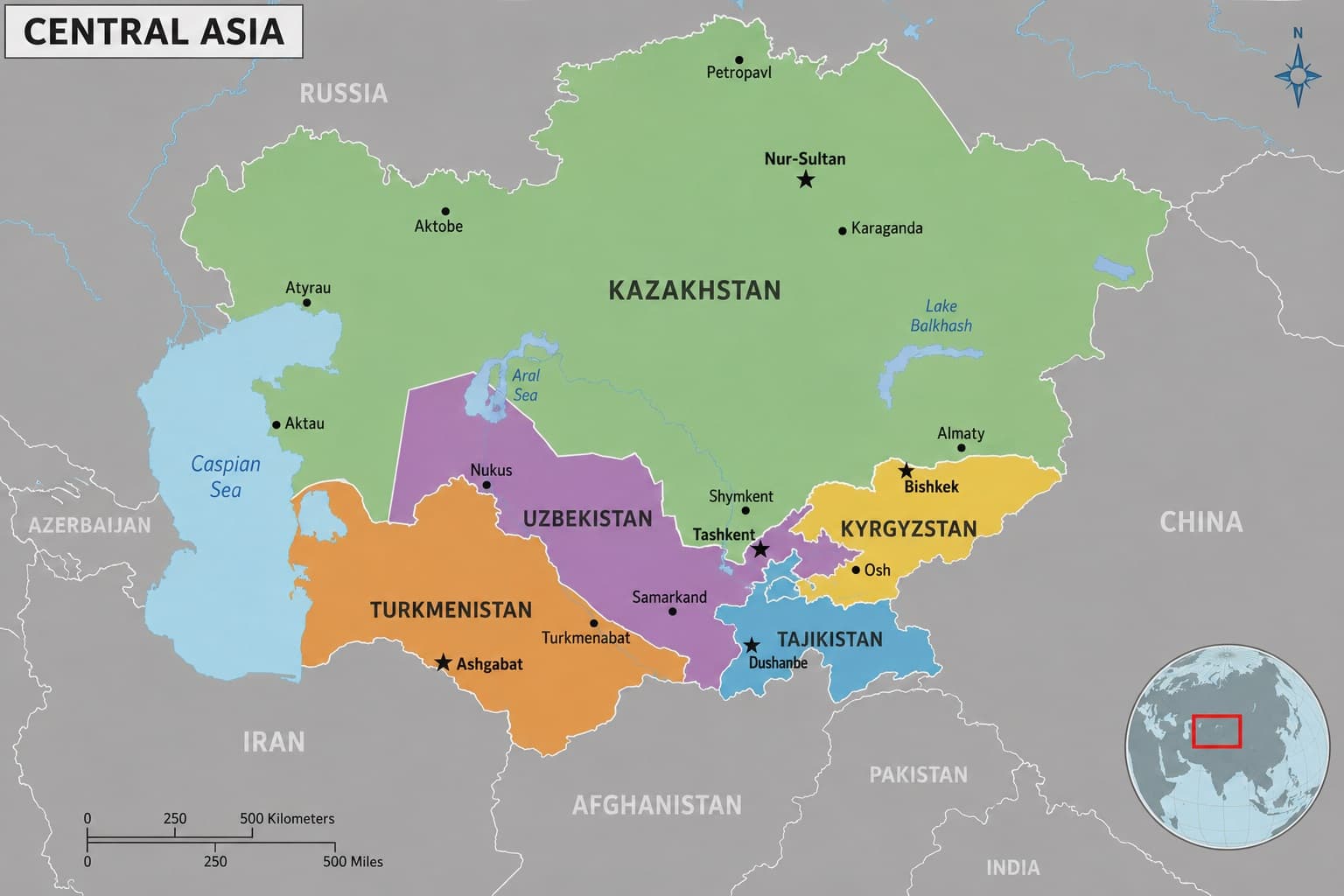
For more than two decades, U.S. policy in Central Asia and the Caspian region was closely linked to the military operation in Afghanistan. The region was viewed primarily as a logistical and political periphery of the Afghan campaign: supply routes ran through it, transit agreements were concluded, and counterterrorism cooperation was developed. The withdrawal of U.S. troops from Afghanistan in August 2021 marked not only the military end of the campaign, but also the end of an entire era of U.S. regional policy. The Afghan factor ceased to be the structural element of the American presence in Central Asia. A strategic vacuum emerged: whereas security had previously defined the agenda, after 2021 Washington no longer had an obvious new “anchor” for a systematic policy in the region. Under these circumstances, the key question is as follows: what will become the new driver of U.S. strategy in Central Asia and the Caspian region? In 2026, the United States Strategy for Central Asia 2019–2025: Advancing Sovereignty and Economic Prosperity expired. Accordingly, a process is underway to formulate a new U.S. strategy. Below, I analyze the new trends that may form a strategy that has in fact been taking shape under the Trump administration in Central Asia and the Caspian region. Many elements of this new policy were already outlined in the 2019–2025 strategy and in the policy of the previous administration; however, the specific features of the Trump administration’s foreign policy have clearly accelerated the transition to a new model of relations. This model can be described as one based on business transactions and flexible diplomatic formats.
Kazakhstan and Uzbekistan as the key Eurasian players in the Board of Peace
Kazakhstan and Uzbekistan played the role of important participants at the inaugural summit of the Board of Peace on February 19, 2026. They were the only representatives of the post-Soviet space (along with Azerbaijan and Armenia). They also represented (together with Azerbaijan) a distinct Eurasian, Turkic and Former Soviet cluster of participants in this organization. Kazakhstan and Uzbekistan were the only Soviet countries that assumed certain financial, political, and even military commitments during this summit. Kazakhstan agreed to participate in the reconstruction of Gaza, undertook financial commitments, and expressed its readiness to send peacekeepers. Uzbekistan declared its readiness to take part in the construction of housing, hospitals, schools, and kindergartens.
In the context of the evolving relations between the Trump administration and these three countries, this carries strategic significance. The participation of the three states signals their willingness to deepen dialogue with the United States on terms that do not imply military-political confrontation with Russia or China — a matter of fundamental importance for the states of Central Asia. All of them pursue multi-vector foreign policies, seeking to maintain good relations simultaneously with the West, Russia, and China. The active participation of the regional countries in the inaugural summit of the Board of Peace demonstrates their readiness to work with Washington outside traditional multilateral frameworks — such as the UN. The emphasis of U.S. foreign policy under the current administration is shifting toward flexible diplomatic formats, business transactions, and infrastructure deals. The countries of Central Asia and the Caspian region are actively seeking to integrate into this model, adapting their multi-vector diplomacy to it.
The renewed interest of the current U.S. administration in Central Asia
It is important to emphasize that the Board of Peace summit continues and consolidates an already existing trend in U.S. relations with Kazakhstan and Uzbekistan as two regional leaders of Central Asia.
The most recent U.S.–Central Asia summit in the C5+1 format took place on November 6, 2025, in Washington under the chairmanship of President Donald Trump. It demonstrated a shift toward concrete economic deals. The emphasis was placed on critical minerals, energy, transport infrastructure, and supply chains.
Uzbekistan announced its intention to purchase American goods and services worth approximately $100 billion over the next decade and about $35 billion in the next three years. Kazakhstan presented a package of 29 agreements, including joint investments totaling nearly $17 billion. At the same time, Kazakhstan announced its support for the Abraham Accords, which creates a favorable political and diplomatic backdrop for economic cooperation with the United States, as well as with Israel as Washington’s key Middle Eastern ally.
In December 2025, Donald Trump invited the presidents of Kazakhstan and Uzbekistan to participate as guests in the G20 summit in Miami in 2026, thereby elevating their international status.
The above-described line of the Trump administration toward flexible diplomacy based on business deals became even more evident during the visit of U.S. Special Representative for South and Central Asia Sergio Gor to Kyrgyzstan and his participation in the B5+1 summit in Bishkek on February 4–5, 2026. “B5+1” is a two-day business forum that brought together representatives of business communities and government bodies from Central Asian countries and the United States. During the forum, discussions focused on the development of agriculture, tourism, the financial and banking sector, transport and logistics, e-commerce and information technology, as well as cooperation in the field of critical minerals.
Gor noted that the “B5+1” forum in Bishkek became a logical continuation of the “C5+1” summit in Washington. He also stated that the United States would strengthen its economic presence in the countries of Central Asia in the coming years. At the same time, the key instrument of engagement will be the private sector. The U.S. government intends to support American businesses operating in the region in order to reduce investment risks. Gor also emphasized the role of TRIPP and the Middle Corridor in enhancing the economic interconnection between the South Caucasus and Central Asia.
Will the Middle Corridor Become “Western” Again Rather Than “Chinese” project?
The Middle Corridor (TITR – Trans-Caspian International Transport Route) connects China, Central Asia, the Caspian Sea, the South Caucasus, Turkey, and Europe. In recent years, it has gained additional relevance for the countries of Central Asia surrounded by the conflicts in Eastern Europe, Afghanistan and the Middle East. In 2026, in particular, southern trade routes from Central Asia have become constrained due to the crisis surrounding Iran and internal instability in Afghanistan. Consequently, the importance of the Middle Corridor for the functioning of Central Asian economies has increased significantly.
From the perspective of geo-economic competition, it is important to note that although today the Middle Corridor is integrated into China’s Belt and Road Initiative, its institutional roots lie in the supported by the West TRACECA project, launched in the 1990s as a tool to ensure the economic independence of the newly independent states of Central Asia and the South Caucasus. This fundamental Western interest in the Middle Corridor persists today.
The intensification of U.S. policy in the South Caucasus (including the TRIPP project -Trump Route for International Peace and Prosperity) and Central Asia under current administration may restore the Western geo-economic dimension of the Middle Corridor and reduce the dominance of the Chinese aspect in the logic of this route. In this sense, the revitalization of the corridor can be seen as a kind of “return” of the Western agenda to Eurasian logistics, with significant geo-economic consequences.
Economic cooperation with the United States within the context of multi-vector foreign policy of Central Asian states
Cooperation with the United States in matters related to transport infrastructure not only serves economic interests but also aligns with the logic of the multi-vector foreign policies pursued by the countries of Central Asia. Through such cooperation, they do not enter into confrontation with China or Russia, while diversifying their foreign partnerships and strengthening their agency in the international arena.
China allows the states of Central Asia to pursue multi-vector foreign policies, provided that China itself remains one of their key vectors. The Middle Corridor — although ideologically and strategically not entirely favorable for Beijing — has significant practical economic importance for the Belt and Road project, particularly at a time when the war between Russia and Ukraine negatively affects the Northern Corridor, and the crisis surrounding Iran constrains the Southern route. Beijing would compete with Washington in Central Asia using geoeconomic instruments, which would be useful for the countries of the region.
Russia has traditionally viewed the Middle Corridor negatively, proposing the Northern route as an alternative. However, in the context of the war with Ukraine and the crisis in its relations with Europe, Russia cannot guarantee the uninterrupted functioning of the Northern route as a viable alternative for Central Asian economies. Moreover, Russia has traditionally anchored its position in Central Asia through military and security-based instruments, whereas China has projected its influence predominantly through economic penetration, infrastructure investment, and trade integration. Consequently, U.S. transaction-based engagement in the region increasingly places Washington in direct geoeconomic competition with China, not with Russia — not only over the development of the Middle Corridor, but also over the long-term configuration of Central Asia’s economic architecture.
Iran has historically taken the most negative stance toward any idea of transit across the Caspian Sea. This project competes with the North–South Corridor via Iran and also contributes to the distancing of the northern Eurasian neighbors from Iran. In the past Iran even attempted to block the division of the sea into national sectors for this purpose. However, under the current conditions of military crisis surrounding Iran, it will not be able to exert significant pressure on the countries of Central Asia. So, the degree of Iranian influence in Central Asia is much less than the influence of China or Russia. Therefore, Central Asian elites may afford serious disagreements with Iranian policy concerning cooperation with USA and Israel.
Conclusion. From a military logic to a logic of geoeconomic influence
If the Afghan era defined the nature of the American presence in Central Asia through security and military instruments, the geoeconomic model emerging under the current administration places strong emphasis on infrastructure, transit, resources, and flexible diplomacy. Formally embedding these three pillars in an articulated U.S. regional strategy would send a clear message to the Central Asian states that American engagement is not ad hoc or crisis-driven, but designed as a durable, long-term framework adapted to contemporary geopolitical realities.
The C5+1 summit in Washington on November 6, 2025, demonstrated the consolidation of the economic agenda as central to U.S. strategy. The focus on critical minerals, investment, and infrastructure became the core element of the dialogue. The Board of Peace (2025) further strengthened the trend toward flexible diplomatic engagement with the countries of the region.
For Kazakhstan, Uzbekistan, and other Central Asian states, it is fundamentally important today that engagement with the United States not be perceived as an anti-Russian or anti-Chinese geopolitical project. The geo-economic logic of cooperation with the United States and flexible engagement formats enables them to maintain balance within the framework of their multi-vector foreign policies. Thus, the demand of Central Asian states has aligned successfully with the new foreign policy emphases advanced by the Trump administration. The softer geoeconomic approach it proposes — compared to the period of the Afghan campaign — is the only politically acceptable format for the countries of Central Asia today.
At the same time, this policy allows for minimizing costs to American taxpayers while maximizing commercial benefits for U.S. investors. Moreover, it enables the United States to address many strategic objectives in a “containment-light” style. Washington is beginning to operate in Central Asia not through direct geostrategic containment of China, Iran, and Russia, as before, but through regionalization, trade, and infrastructure integration. At the same time, it is precisely in Central Asia and the Caspian region that Washington now has a realistic opportunity to engage China on symmetrical terms — through geoeconomic instruments capable of competing with Beijing’s model of outward economic expansion.
Paradoxically, despite the deep ideological differences between the Trump administration on the one hand and the overwhelming majority of European political elites on the other, the administration’s political style in several respects resembles European approaches to Central Asia. The European Union and individual European states operating in the region similarly prioritize pragmatic economic cooperation while avoiding large-scale geopolitical initiatives that could carry significant risks of conflict. That said, unlike the Trump administration, European policy in Central Asia also incorporates support for civil society and the promotion of European values.
For Israel, the Trump administration’s shift in Central Asia toward business-oriented initiatives and transactional diplomacy may prove broadly advantageous. Israel itself has pursued a comparable approach in the region. At present, Central Asian states are actively seeking to expand economic and diplomatic engagement with Israel. In this context, the administration’s operational style in the region can be seen as largely compatible with Israeli approaches.

Diplomacy of Central Asian and South Caucasus States in Summer–Autumn 2025: Multivector Foreign Policy in Action
PSCRP-BESA Reports No 156 (September 29, 2025)
The core element in the foreign policy of post-Soviet countries in Central Asia and the South Caucasus is so-called multivectoralism: maintaining relations with multiple global actors without binding themselves exclusively to any single one. These states seek to balance ties with the China–Russia axis and the collective West (including the USA and the EU—although it should be noted that the internal fragility of this grouping has never been as evident as it is now). These actors, who claim global influence in the world politics, can be regarded as the first tier of influence in the South Caucasus and Central Asia. A second, regional tier consists of other regional neighbors, with Turkey (and, to a lesser extent, Iran) being the most prominent actors in this “regional league.”
Amid today’s global uncertainty and high risks, the states of the South Caucasus and Central Asia are striving to diversify their foreign policies as much as possible, with the goal of strengthening their autonomy and agency. In Central Eurasia, where these countries are located, there is currently a clear weakening of the Western vector of influence. There are several reasons for that:
The U.S. withdrawal from Afghanistan and the resulting loss of interest in adjacent post-Soviet regions.
The war in Ukraine and the conflict in the Middle East, both of which have diminished the earlier geopolitical relevance of the South Caucasus and Central Asia.
The weakening of the West due to internal political conflicts and the confrontation between the Trump administration and the European political mainstream.
Nevertheless, preserving good relations with the West - and, in many cases, artificially “boosting” this vector of foreign policy despite limited reciprocal interest from the Western side — has become, within the framework of multivectoralism, a strategy of survival for the post-Soviet South. Otherwise, these states risk falling into complete dependence on the China–Russia bloc, which aspires to global influence, as well as on regional powers such as Turkey and Iran.
The above features of foreign policy were clearly visible in the policies of the several key states of the South Caucasus and Central Asia in late summer and early autumn 2025. Two distinct diplomatic styles can be identified: a “soft” Central Asian one (most evident in the recent diplomatic moves of Kazakhstan and Uzbekistan), and a “hard” Caucasian one (best exemplified by the policies of Azerbaijan and Armenia). In both cases, however, there is a clear attempt to rebalance foreign policy so as to reduce dependence on immediate Central Eurasian neighbors by strengthening ties with the West - above all with the United States, as the leader of the Western world.
At the 80th session of the UN General Assembly on 23 September 2025, Kazakhstan’s President Kassym-Jomart Tokayev delivered a speech in which he called for reform of the UN (a logical position, given his earlier service as UN Deputy Secretary-General) and for strengthening the global role of the “middle powers.”
Tokayev stressed that middle powers such as Kazakhstan can contribute to global balance by acting as intermediaries between major powers. He also advocated for diplomatic solutions to armed conflicts, including the war in Ukraine and the conflict in the Middle East.
Amid the UN General Assembly, on 22 September 2025, Wabtec Corporation (USA) announced the signing of a $4.2 billion contract with Kazakhstan’s national railway company, Kazakhstan Temir Zholy, for the supply of 300 locomotives and their long-term maintenance. This agreement is considered the largest locomotive supply contract in Wabtec’s history. The contract goes beyond delivering locomotive kits, including servicing, technical support, and likely local assembly. The deal creates about 11,000 jobs in the United States across supply chains, manufacturing, and maintenance. Previously, Kazakhstan had procured locomotives from Russian manufacturers (Transmashholding).
Several analysts have also drawn attention to the strategic dimensions of the deal. Kazakhstan’s leadership is not only creating jobs in the United States -something the Trump administration welcomes — but also strengthening the Trans-Caspian route to Europe, bypassing Russia and Iran. It should be noted that the West has long supported this route for strategic reasons, while China has also traditionally favored it as part of its broader policy of diversifying continental transport corridors and assisting the development of Central Asian and South Caucasus states. Thus, although the move is unwelcome in Moscow and Tehran, it is well received in Brussels and Washington, and cannot be described as directed against Beijing. Overall, it can be seen as a subtle diplomatic maneuver within the framework of Kazakhstan’s multivector foreign policy. In June 2025, Kazakhstan awarded Russia a major contract for the construction of a nuclear power plant; the new U.S. locomotive contract serves to balance that move.
Russian experts paid even closer attention to the meeting that took place on 23 September 2025 on the sidelines of the 80th UN General Assembly in New York between President Tokayev and President Zelensky of Ukraine. Observers noted that the two leaders conversed in English, rather than Russian. For Tokayev – a career diplomat and polyglot - this was natural and carried little symbolic meaning. For Zelensky, however, the choice was more significant, as he consistently conducts his diplomatic communication either in English or in Ukrainian. During the meeting, Zelensky thanked Kazakhstan for supporting Ukraine’s sovereignty and territorial integrity. Tokayev, in turn, emphasized that a final resolution of the conflict must be achieved through diplomacy. The two leaders also discussed economic and humanitarian cooperation. Afterward, Tokayev stated that Kazakhstan was ready to provide a venue for a meeting between the presidents of Russia and Ukraine, should both sides express interest.
Kazakhstan had previously played a similar role in facilitating rapprochement between Armenia and Azerbaijan, as well as between Russia and Turkey during a flare-up of tensions over Syria. At the same time, in the context of his visit to New York, Uzbekistan’s President Mirziyoyev achieved a significant breakthrough in relations with the Trump administration. Like Kazakhstan, Uzbekistan under its second president seeks to strengthen contacts with the West while avoiding rhetoric directly aimed against Russia or China. Unlike his predecessor Islam Karimov, Mirziyoyev generally avoids political framing in such cases, emphasizing instead the economic pragmatism of his actions.
On 23 September 2025 in New York, on the sidelines of the 80th session of the UN General Assembly, President Mirziyoyev of Uzbekistan met with Donald Trump. During the meeting, the two discussed issues of strategic partnership between Uzbekistan and the United States, expansion of economic cooperation, as well as projects in key sectors (aviation, infrastructure, technology). After the meeting, Trump publicly praised Mirziyoyev, calling him a “man of his word” in reference to the fulfillment of agreements.
Before meeting Trump, Mirziyoyev had held talks with representatives of more than 50 American companies and banks, discussing large-scale business deals. During his UN visit, Uzbekistan and Boeing signed a contract for the purchase of up to 22 Boeing 787 Dreamliner aircraft, valued at more than $8 billion. The initial agreement provides for the delivery of 14 Boeing 787-9 aircraft, with an option for an additional 8 units. The deal is described as the largest of its kind in Central Asia. Deliveries are expected to begin in 2031, with the contract projected to support about 35,000 jobs in the United States.
The foreign policy content of Mirziyoyev’s speech at the UN General Assembly on 23 September 2025 largely mirrored that of Tokayev’s address. He stressed the need to reform international institutions, especially by strengthening the role of developing countries and reshaping the composition of the UN Security Council to better reflect contemporary challenges. He also noted the growing number of conflicts in today’s world, voiced support for diplomatic efforts to resolve the crises in Ukraine and the Middle East and called for the development of regional transport corridors.
The similarity of the policies of Uzbekistan and Kazakhstan, as demonstrated by the September visits of their presidents, became quite clear. In both cases, the countries face growing geopolitical conflicts and global uncertainty, and they seek to strengthen their position through multivector diplomacy—particularly by deepening ties with the U.S. administration. In both cases, diplomacy is pursued through expanding economic cooperation with the United States and promoting transport corridors that enhance economic diversification and reduce dependence on Central Eurasian neighbors.
To strengthen the comparative dimension of the analysis, the diplomatic moves of the leaders of Kazakhstan and Uzbekistan should be contrasted with the summer actions of the leaders of Azerbaijan and Armenia.
On 8 August 2025, a ceremony was held at the White House in Washington, where Armenian Prime Minister Nikol Pashinyan and Azerbaijani President Ilham Aliyev signed a joint declaration. Trump acted as mediator, and the project was named the “Trump Route for International Peace and Prosperity.”
Under the agreements, Armenia granted the American side a 99-year concession for development of the territory. The corridor will function under Armenian law (meaning Armenian jurisdiction remains in place), but the United States will receive exclusive rights to develop infrastructure — roads, railways, energy pipelines, communication lines, and more. The corridor is intended to provide transport connectivity between mainland Azerbaijan and its Nakhchivan exclave through southern Armenia (Syunik/Zangezur). This transit corridor is a key element of the peace agreement between Armenia and Azerbaijan, aimed at normalizing communications and opening transport routes. Russia and Iran expressed concern over the agreement, viewing it as an expansion of U.S. influence in the South Caucasus and a potential weakening of Moscow’s and Tehran’s role in the region.
The agreements are important not only as a U.S.-backed solution to the previously tense diplomatic situation around Zangezur, which threatened to trigger a new war between Azerbaijan and Armenia, but also from a geopolitical perspective. They represent a major strategic step in developing the same Middle Corridor via the Caspian Sea that bypasses Russia and Iran — a route which, as shown above, Central Asian countries have been developing in a more diplomatically cautious manner. It is also significant that Trump thereby signaled Washington’s claim to hegemony in the South Caucasus. Other actors who had previously played a key role in the peace process between Armenia and Azerbaijan (for instance, France and Russia) were thus sidelined.
It should be noted that both Azerbaijan and Armenia have entered into open confrontation with Russia. In Azerbaijan’s case, this concerns the conflict over the Azerbaijani civilian airliner damaged over Chechnya on 25 December 2024, resulting in the deaths of most of its passengers, as well as the crisis surrounding the Azerbaijani diaspora in Russia. Whereas earlier Azerbaijan, within the framework of its multivector foreign policy, sought to maintain a strategic partnership with Russia, this is now far less of a priority for Baku. Demonstrative elements may also be linked to recent developments in the Middle East: the fall of Assad’s regime in Syria and the rise of Turkey-friendly forces, as well as major Israeli strikes — supported by the United States — against the Iranian “axis of resistance.” These events appear to have led President Ilham Aliyev to conclude that Russia’s and Iran’s influence in the Middle East is weakening. At the same time, in the spirit of multivector diplomacy, Aliyev sought to “balance” his deepening contacts with the United States by making a working visit to China on 30 August 2025, during which he exchanged a handshake and brief conversation with then-present Russian President Putin. Thus, Aliyev is leaving open the option of engaging with the China–Russia axis if necessary.
In Armenia’s case, the issue lies in longstanding tensions between Russia’s leadership and Pashinyan’s government. The unresolved conflict with Azerbaijan had represented the sole obstacle preventing Armenia’s full reorientation toward the West. With Trump’s assistance, that obstacle is now beginning to disappear. Moreover, within Armenia’s multivector foreign policy, Yerevan may now have less need to use Tehran — already weakened by Israeli and U.S. actions — alongside the United States and France as a balancing partner in the security sphere. As a “safety net,” however, Armenia remains a member of the Russia-centered CSTO and the Eurasian Economic Union, and it has not severed ties with Tehran completely.
Overall, an analysis of the policies of Armenia and Azerbaijan in late summer and early autumn 2025 reveals clear similarities with the strategies of Kazakhstan and Uzbekistan discussed above. In all the cases, the focus is on multivector foreign policy, on “boosting” the Western vector through engagement with the Trump administration, on economic diplomacy, and on the crucial role of the Trans-Caspian route. The only difference lies in diplomatic style: Kazakhstan and Uzbekistan, while strengthening the American vector, seek to avoid conflict with other foreign policy vectors (above all Moscow), whereas Azerbaijan and Armenia act much more assertively — though still maintaining elements of a multivector “insurance policy” by preserving a certain level of relations with China, Russia, and, in Armenia’s case, Iran.

No Real Alliance for Iran and “Stans”: Iran’s Post-Soviet and Islamic Neighbors to the North-East Refuse to Join Its Confrontational Agenda
PSCRP-BESA Reports No 141 (July 10, 2025)
None of the Muslim states bordering Iran to the northeast (they are usually called ‘stans’, from the Persian word “country”)—including Central Asian post-Soviet states (Turkmenistan, Tajikistan, Uzbekistan, Kazakhstan and Kyrgyzstan), Pakistan and Afghanistan —are willing to become entangled in Tehran’s escalating confrontation with Israel or the West. This is especially clear in the case of the former Soviet Central Asian secular republics. The Central Asian states adhere to multi-vector foreign policies that balance between Russia, China, the West, and the Islamic world, carefully avoiding entanglements in ideological or military blocs. Even Iran’s most conservative immediate neighbor, Turkmenistan, has officially declared itself neutral.
This approach was also obvious in the recent Israeli-Iranian clash. According to observers, neither Israel nor Iran are key partners for the Central Asian countries in the political, military, economic, or security spheres, as well as – at least for the time being—in the foreign trade sphere. At the same time, they fear that a full-scale Iranian-Israeli conflict could negatively affect transport and communication projects aimed at providing Central Asian countries with access to Iran’s seaports in the Persian Gulf and the Arabian Sea coast, which provide further access to the Indian Ocean, Southeast Asia, South Asia, and East Africa.
In addition, a tough confrontation between Israel and Iran could trigger the radicalization of Islamist circles that actively promote pro-Palestinian and anti-Israeli narratives. Finally, Tajikistan and Uzbekistan fear that an escalation of the conflict between the US, Israel and Iran raises concerns not only because of the nuclear threat but also because of the possible collapse of governance in Iran, which would provoke a mass exodus of refugees to the east – through Afghanistan to Tajikistan and Uzbekistan.
The regimes that employ militant Islamist ideologies—such as the Taliban in Afghanistan or the leadership in Pakistan —are unwilling to offer Iran more than occasional expressions of rhetorical solidarity or anti-Israeli sentiment. While these regimes may echo elements of Iran’s discourse for domestic or symbolic reasons, they have shown no inclination to become militarily involved in Tehran’s confrontation with Israel, and certainly not with the United States. Their priority remains regime survival and internal stability, not ideological adventurism on behalf of regional allies. The sectarian divide between Sunni and Shīʿa Muslims is important from this point of view, but pragmatic considerations are key determinants of foreign policy. The Taliban, despite their strict Islamist Sunni worldview, are primarily focused on consolidating power within Afghanistan and avoiding renewed international isolation in the condition of extreme economic crisis.
Strategically, the most important position is that of Pakistan, which possesses a powerful military and nuclear weapons. However, Pakistan, for its part, maintains a delicate balancing act between its Sunni Islamic ideological identity and its geostrategic interests, including its relations with Gulf countries, China, and the United States. For both Afghanistan and Pakistan, the costs of direct military confrontation with Israel and, especially, with the U.S., far outweigh any potential gains from aligning with Iran. Thus, Iran remains largely isolated in its most radical positions, able to extract only rhetorical sympathy—but no substantive backing—from even its most ostensibly ideologically aligned neighbors.
Ultimately, the most Iran can realistically expect from its post-Soviet and eastern Islamic neighbors is rhetorical sympathy or diplomatic hedging. Strategic alignment—especially on issues as sensitive as nuclear deterrence or military escalation—is a line none of them are prepared to cross. Since Pakistan’s position is strategically the most crucial, and in light of the spread of false claims that Islamabad pledged support to Iran with its nuclear arsenal, let us examine the current state of Iran–Pakistan relations. Later, we will also consider some tensions between Iran and the Taliban—in the context of general strategic relations between Tehran and Islamabad.
On June 16, 2025, a video appeared on social media and in some newspapers showing Iranian IRGC General and National Security Council member Mohsen Rezaei allegedly appealing to Pakistan for support. In this supposedly authentic footage, Rezaei, speaking on Iranian state television amid an intense missile exchange with Israel, stated: “Pakistan has assured us that if Israel uses nuclear missiles, Islamabad will also attack it with nuclear weapons.”
This statement, which appeared to invoke Pakistan’s nuclear capacity, was swiftly and categorically rejected by Islamabad. Deputy Prime Minister and Foreign Minister Ishaq Dar dismissed the claim outright as “fake, fabricated” based on analysis from fact-checkers like iVerify Pakistan that confirmed no credible Iranian source supported the claim. He also emphasized that Pakistan’s nuclear arsenal is reserved solely for defensive purposes against direct threats to its sovereignty—implicitly referring to its longstanding conflict with India. “This is irresponsible and false news,” said Dar. He added, “From our side, there has been no such statement. It was fabricated.” Dar said, “We have checked that it was an AI-generated clip and it was fake. He warned that Pakistan should be very careful, saying, “This is not a children’s matter. This is a serious war, like ours with India.”
“A second whisper campaign on X (formerly Twitter), citing an unverified report from Israel’s Channel 10, alleged Pakistan had warned Washington it would launch nuclear strikes on Israel to defend Iran”. This statement was also refuted in Pakistan as disinformation: Pakistani government has never told anything like that to Washington.
This reaction is particularly understandable given Pakistan’s own precarious security environment, especially its enduring rivalry with India. In early May 2025, following a terrorist attack in Indian-administered Kashmir on April 22 (claimed by Indian authorities to be perpetrated by Pakistan-linked militants), India launched a series of missile and airstrikes on Pakistani territory—code-named “Operation Sindoor”—on May 7 2025. Pakistan responded by launching a combination of drone and artillery strikes. These events marked the most significant military escalation between the two nuclear-armed rivals in decades, raising intense concerns of a potential slide toward nuclear confrontation. International diplomatic alarm was immediate. U.S. Secretary of State Marco Rubio and Vice President J.D. Vance intervened, mediating a ceasefire by May 10, 2025, after approximately four days of high-intensity conflict. The specter of nuclear escalation was not hypothetical; both nations had prepared their nuclear command systems for potential activation.
In this situation Islamabad must guard against rhetoric that could be interpreted as involvement in third-party disputes, thereby preserving its deterrence credibility and avoiding unnecessary diplomatic fallout. Pakistan’s nuclear doctrine remains strictly defensive; any military entanglement—especially in foreign-driven escalatory scenarios—could inadvertently cross unwelcome nuclear thresholds. After nearly going to war with India, any participation—rhetorical or otherwise—in another state’s nuclear discourse would be highly destabilizing and strategically counterproductive. Adding further complexity is the history of strained bilateral relations between Pakistan and Iran, particularly in the border region of Balochistan. Pakistan–Iran relations in Balochistan are governed by a fraught mix of counterinsurgency cooperation and repeated provocations. Frequent militant activity and military incursions reinforce mutual suspicion.
Since the 1980s, Iran’s Sistan–Balochistan and Pakistan’s Balochistan provinces have been epicenters of militant separatist insurgencies (Jaish al-Adl, Baloch Liberation Army). Both nations accuse each other of either harboring or failing to adequately suppress these groups. In 2014, Iranian border guards briefly occupied Nok Kundi (inside Pakistan) and launched rocket attacks that injured civilians, triggering Pakistani protests and diplomatic tension. Iranian missile and drone strikes on January 16, 2024, targeted Jaish al-Adl positions in Panjgur, Pakistan, killing civilians, according to Pakistani reports. Between 2023 and early 2024, multiple Pakistani military patrols in Kech and Panjgur districts came under “terrorist” fire traced back to militants allegedly operating from across the Iranian border. Pakistan’s retaliatory Operation Marg Bar Sarmachar (January 18, 2024) saw air, drone, and artillery strikes on militants in Iran’s Sistan–Baluchestan—marking the first Pakistani strike on Iranian soil since the Iran–Iraq War. Both governments are expanding border infrastructure, including fencing projects and planned fortifications by Iran, aimed at curbing trafficking and militant infiltration.
Therefore, amid the Iran–Israel crisis, Pakistan sealed pedestrian crossings at Taftan, Gabd-Rimdan, Chedgi, Jirrak, and Rideeg Mand, citing security and refugee concerns in Balochistan Pakistan’s leadership is acutely aware that militant flare-ups in Balochistan not only threaten internal stability but also risk reigniting tensions with Iran—making regional escalation a constant concern. Despite episodic cooperation, Islamabad and Tehran remain wary, blaming each other for enabling hostile groups—a dynamic that amplifies the strategic significance of any cross-border incident. From this point of view, Pakistan’s refusal to join ideological alignments, such as the Iran’s anti-Israel rhetoric in nuclear sphere, is rooted in pragmatic self-interest—a precaution to avoid conflagration along its volatile western flank. Finally, Pakistan already faces considerable challenges from the protracted Afghan refugee crisis, and its capacity to absorb additional pressure along its western frontier is limited.
Also, there is an issue of mutual distrust between Pakistan and Iran, which is deeply rooted in sectarian geopolitics. Pakistan’s historic connections with Sunni, anti-Shīʿa Taliban in Afghanistan is seen by Iran as a direct threat to Hazārā Shīʿa communities and Shīʿa influence in the region. During Taliban rule in the late 1990s and the resurgence since 2021, Hazārā communities have faced severe persecution—forced conversions, massacres, and systemic marginalization . Iran has long championed the Hazārā minority in Afghanistan, supporting groups like Hezb-e Wahdat during the 1990s Afghan civil war to counterbalance Taliban influence and Pashtun dominance.
Iran’s protection of Hazārā and support for rival factions in Afghanistan deeply unsettles Pakistan, which perceives these moves as strategic counterweights to its own regional posture. The result is a nuanced strategic rivalry—marked not by overt hostility—but by proxy competition, border skirmishes, and sectarian undercurrents that profoundly shape bilateral interactions. Tehran continues its backing economically and cultural-religiously, with Hazārā populations seeing Iran as a protective patron amid Taliban ascendancy. This is a situation very similar to Iranian support for Shīʿa groups in the Arab world (in the countries like Lebanon, Syria or Iraq), however, this part of Iranian policy is not so well known in the wider world. Tehran’s proximity to Taliban-held zones and intermittent border skirmishes indicate strategic distrust: Iran supports post-Taliban security actors such as Hazārā militias to mitigate Taliban dominance. There is also the issue of growing sectarian tensions in Pakistan itself. Semi-autonomous North-Western regions of Pakistan like Kurram have seen deadly Sunni–Shīʿa violence—often exacerbated by extremist groups like Lashkar-e-Jhangvi, which Pakistan-based Sunni militants (sometimes having good connections with Pakistani army) have funded and supported. Finally, Pakistan and Iran both accuse each other of harboring militant proxies—Pakistan blames Tehran for supporting Hazārā-linked groups, while Iran rhetorically accuses Pakistani military intelligence ISI (together with Israeli Mossad) of backing Taliban/al-Qaeda factions with anti-Shīʿa agendas.
In conclusion, Pakistan’s measured response to the nuclear aspects of war between Iran and Israel illustrates a calculated approach to regional security. Islamabad is distancing itself from escalatory rhetoric and maintaining a focus on its own strategic imperatives. This is logical, especially considering Pakistan’s own issues with Iran in Baluchistan and Afghanistan and Pakistan’s strategic rivalry with India. Islamabad is carefully avoiding symbolic commitments that could compromise national interests or entangle this state in new conflicts beyond its borders. The same principle can be applied also to the Taliban, which has its own disagreements with Tehran concerning sectarian agenda and Hazārā issue.
These considerations, at least at first glance, also dominate Islamabad’s policy towards the Central Asia. Since late 1990s-early 2000s, Islamabad, which was eager to show a higher profile than India in this region, tried to utilize the independence of the Central Asian republics from the USSR in order to bring to life Pakistan’s dream of strategic depth, believe Melissa Iqbal and Teresita Schaffer. According to them, for Pakistan developing political ties with the Central Asians and to serve as a bridge between them and the rest of the world has much more meaning than simply military space. The same is true quarter centuries later, while economic cooperation especially in the field of energy with the Central Asia with their 46% of the world’s gas reserves, play even more important role than before. Hence, Islamabad also has to take seriously the Central Asian regimes’ concerns of the Israel-Iran conflict.

Black Hole in Central Asia: How Moscow Is Pulling Kazakhstan and Uzbekistan Toward Its Event Horizon
PSCRP-BESA Reports No 126 (April 21, 2025)
Astrophysicists define a black hole as an object whose gravity is so intense that nothing — not even light — can escape once it crosses the event horizon. Since the Kremlin launched its full‑scale invasion of Ukraine in 2022, Russia has begun acting like a geopolitical black hole in its own neighborhood. Facing Western sanctions and battlefield losses, Moscow is accelerating the draw on the two most dynamic economies in Central Asia — Kazakhstan and Uzbekistan — through energy deals, trade manipulation and political theatre. The closer these states drift, the harder (and costlier) it will be for them to break free.
Moscow tightens the energy umbilical cord
Russia has moved aggressively this spring to deepen energy integration with its two most important Central‑Asian neighbors. On 11 April Deputy Prime Minister Alexander Novak met a high‑level Kazakh delegation in Moscow to “increase transit deliveries of oil and gas” and expand joint projects from coal‑fired power stations to a possible Russian‑built nuclear plant.
Only three days earlier, officials from Moscow and Tashkent signed a package launching practical work on the long‑stalled Trans‑Afghan railway, envisioned as a 573‑kilometre corridor that would tie Uzbek trade routes ever closer to Russia’s rail network. And bilateral trade in gas is booming: Russian exports to Uzbekistan jumped 4.5‑fold in 2024, the countries confirmed this month.
Parallel‑import lifeline poses risks to Central Asian countries
These infrastructure deals are about more than commerce. Western sanctions have choked Russia’s access to sophisticated components, and the Kremlin increasingly relies on Central‑Asian partners to re‑export banned goods. The EU’s 16th sanctions package (February 2024) explicitly black‑listed 53 new firms — 34 of them outside Russia — for “supporting Russia’s military‑industrial complex or engaging in sanctions circumvention.”
Kazakh economists are already warning of the cost: in 2024 Kazakhstan’s trade deficit with Russia widened by 31% as imports of Russian goods surged, cementing what the Association of Kazakhstan Financiers calls “a long‑term trend.”
The Chinese factor—and why the stakes are existential for Moscow
Beijing has become Central Asia’s largest investor, and Chinese firms are negotiating everything from the Power of Siberia‑2 gas link to expanding LNG purchases. China has already overtaken Russia as the top trade partner for every Central‑Asian state except Tajikistan. As one Carnegie paper notes, Beijing’s pledge in 2022 to “resolutely support Kazakhstan’s independence, sovereignty and territorial integrity” signaled that China, not Russia, now guarantees the region’s security balance.
Foreign‑minister Sergei Lavrov’s unusually effusive visit to Almaty on 10 April (“Kazakhstan is our reliable ally”) underscored how urgently Moscow feels the need to out‑charm China. For Beijing, Central Asia is one more Belt‑and‑Road arena; for the Kremlin, retaining influence is a question of regime survival, providing both sanction‑busting channels and strategic depth against isolation, which followed the Russian offensive in Ukraine.
For the Kremlin, holding Kazakhstan and Uzbekistan in its orbit is more than nostalgia. These states provide:
Logistic corridors immune to Western naval power;
Hard currency from transit fees;
A covert route for sanctioned technology; and
Political optics that Moscow is not internationally isolated.
Without them, Russia’s sanctions‑dodging ecosystem collapses.
A rare window for the West
The other gravitational force in the region is now the European Union. At the first‑ever EU–Central Asia summit in Samarkand (April 4), Commission President Ursula von der Leyen announced a €12 billion Global Gateway package to upgrade transport links (including the Trans‑Caspian Corridor), digital networks and renewable energy.
Less than three weeks earlier, the European Investment Bank signed a €200 million framework loan with Kazakhstan’s Development Bank to finance road upgrades and green power, the first EU‑backed money earmarked directly for the Trans‑Caspian route.
If Washington and Brussels mobilize capital and technology at scale — fast‑track renewable grids, finance container hubs at Aktau and Navoi, and anchor democratic governance reforms — Astana and Tashkent can pull free of Moscow’s orbit and emerge as prosperous, genuinely independent democracies.
Taken together, these initiatives offer Astana and Tashkent an exit trajectory: diversified markets, rule‑of‑law lending standards, and physical corridors that bypass the Russian chokepoints now weaponized by the Kremlin. The opportunity window may be brief, but it is wide — and the thrust it can deliver is powerful enough to counter Russia’s pull before the region crosses the point of no return.
Inside the event horizon: racism and extraction
Moscow’s treatment of Central‑Asian migrants offers a glimpse of life inside the black hole. In a 63‑page report released in March 2025, Human Rights Watch documents “rising xenophobic harassment and violence” against an estimated 3.3 million Central‑Asian workers, including arbitrary detentions and coerced military recruitment for the Ukraine front. “Every day we face discrimination, cruelty from law‑enforcement,” one Tajik migrant told HRW.
Russia’s economic model relies on these migrants while denying them rights — exporting poverty back to their home countries and entrenching patronage networks. The same pattern would apply to Kazakhstan’s and Uzbekistan’s domestic elites if Moscow tightens its grip: security guarantees for ruling circles in exchange for loyalty, cheap commodities, and political alignment with the Kremlin’s war effort.
Can the West counter the singularity?
Physics tells us that to escape a black hole you must apply a force greater than its gravitational pull before crossing the event horizon. Kazakhstan and Uzbekistan today stand at a Lagrange point between two massive attractors. The Kremlin’s black‑hole strategy pulls with familiar Soviet‑era gravity; China offers capital with no political agenda at the moment, but will most definitely use the Central Asian countries as a springboard for possible confrontation with the West in the future. For the West, in geopolitical terms, it necessitates the following steps — if they want to pull the key Central Asian states into their orbit:
Fast‑track Global Gateway disbursements — roads, dry ports, and green grids that put euros and dollars into local pay‑cheques this year, not in 2030.
Link money to transparency: procurement portals, independent courts and civil‑society participation that inoculate big projects against the rent‑seeking Russia thrives on.
Enforce export‑control intelligence sharing with Kazakh and Uzbek customs, banking supervisors and freight forwarders.
Signal political stakes: high‑level visits, parliamentary partnerships and scholarships that anchor the next generation away from Russian narratives.
Black holes grow by feeding on nearby matter; the more they consume, the stronger their pull. Russia’s war has turned it into exactly that sort of celestial predator — desperate for resources, willing to twist gravity to keep its neighbors in thrall. Yet while astrophysical black holes are inescapable, geopolitical ones are not. Kazakhstan and Uzbekistan can still fire their thrusters — Western capital, rule-of-law reforms, and diversified trade routes — and set a trajectory toward genuine sovereignty and prosperity. Whether Brussels, Washington and like‑minded partners provide the necessary thrust will decide if Central Asia spirals inward into eternal darkness, or breaks free into open space.

Pool of Terror: Iran is Recruiting Operatives From the Former Soviet Union to Target Israelis
PSCRP-BESA Reports No 101 (Nov 29, 2024)
Recent events in the UAE and Central Asia show that Iran is again boosting recruitment of individuals from former Soviet republics for various purposes, including terrorist attacks and intelligence-gathering activities. Tehran plans to use these individuals directly against Israeli “targets” this time. The abduction and murder of Rabbi Zvi Kogan by three Uzbek terrorists is the most recent case. Despite the lack of public disclosure of definitive evidence linking this attack to Iran, experts point to several factors that support this conclusion.
The Modus Operandi is consistent with Iranian tactics:
The circumstances surrounding Rabbi Kogan’s murder align with methods previously attributed to Iranian operations, such as targeting individuals abroad through criminal proxies.
The incident occurred amid heightened tensions between Israel and Iran, with Iran historically opposing normalization efforts between Israel and Arab states, with an emphasis on the Persian Gulf emirates.
While direct ties of the apprehended perpetrators to Iran have not been confirmed, the use of foreign nationals in such operations is known to be a trademark tactic of the IRGC. One might think to first look into the Muslim denomination these terrorist operatives are a part of, however, no concrete evidence has surfaced to link them with Shia Islam – the primary religion in Iran.
ISIS might have carried out the attack, but it is well known that this organization consistently takes responsibility for the sake of clout, while Iran consistently refutes any involvement in such actions. Besides, the MO of the attack is different from those preferred by ISIS, which focus less on individual clandestine assassinations and more on mass casualty attacks.
Tajiks are known to be the IRGC’s primary recruiting pool; however, what about the Uzbeks?
Let’s examine previous cases in more detail. From December 2023 till January 2024, there were a series of failed attempts to attack Jewish Agency offices and the Ohr Avner Jewish Center in Almaty (Kazakhstan), an arson attempt on a farm belonging to the Israeli Saxovat Broyler Co. in Tashkent (Uzbekistan), and smaller events following the same pattern.
In August 2024, it became known that the organization behind these attempts was the IRGC-controlled Iraqi militia, Kata’ib Hezbollah (Hezbollah Brigades). The main coordinator, according to several sources, was Tajik operative Muhammad Ali Burhanov, also known as Sayed Hamid al-Tajiki.
According to the GFATF (Global Fight Against Terrorism Funding), Burhanov was recruited while studying at Al-Mustafa University in Iran—a known recruitment center for Tehran-backed militant groups, which is operating under the Islamic Propaganda Bureau of the Qom Seminary. The IRGC Qods Force’s Department 400 coordinates Burhanov’s activities. His handlers are Hossein Rahmani and Hossein Rahban, who are behind other attempts to murder Israelis abroad. For example, a November 2022 case in Georgia, where agents of the IRGC tried to kill a prominent Israeli businessman.
According to The Washington Institute, Qods Force’s Department 400 sometimes collaborates with ISIS and the Taliban despite deep-seated sectarian differences and opposing objectives.
It is crucial to remember that such sectarian differences as Sunni vs Shia Islam have not stopped the IRGC and Qods force from supporting Sunni terrorist groups before, as is the case with Hamas and the Palestinian Islamic Jihad.
This brings us back to the recent murder of Rabbi Kogan in the UAE, where three Uzbek nationals were involved. Previously there were no cases of IRGC recruiting Uzbeks—Iranians prefer Tajik Shias. Tajikistan’s population shares linguistic and cultural ties with Iran, as both are Persian-speaking nations. Since 2013, the IRGC has enlisted Tajiks to fight in Syria alongside pro-Assad forces. They were instrumental in key battles, including the recapture of Aleppo, under the command of Iranian military advisors.
By recruiting Tajiks, Iran aims to extend its influence into Central Asia, countering the presence of other regional powers and promoting its ideological and political interests. Furthermore, the emergence of ISIS-Khorasan (ISIS-K), also known as the Islamic State Khorasan Province (ISKP), in Afghanistan and its recruitment of Central Asians, including Tajiks and Balochis, presents a significant threat to Iran. By recruiting Tajik Shia fighters, Iran seeks to counterbalance Sunni groups.
Interestingly enough, ISIS-Khorasan is actively recruiting Uzbeks to fight in Afghanistan. Reports indicate that ISKP has deliberately expanded its social media efforts in the Uzbek language.
As previously mentioned, the relationship between ISKP and Iran is hostile. In January 2024, ISKP claimed responsibility for twin bombings in the Iranian city of Kerman, Iran, during a ceremony commemorating Qasem Soleimani, resulting in nearly 100 fatalities. In August 2024, Iran’s Intelligence Ministry announced the detention of 14 ISKP members, alleging their involvement in planning attacks within the country.
It is difficult to imagine that the IRGC and ISKP have found common ground. However, taking into account the above-mentioned Qods Force’s Department 400 ties to ISIS and desperate need for any retaliatory action against Israel (considering the failed attacks in Uzbekistan and Kazakhstan), there is the probability of a joint operation aimed to murder a prominent Israeli citizen. ISIS may have “loaned” its operatives or provided a “blessing” for the use of Uzbeks.
Another possibility exists, one that carries even greater risk. There is a chance that IRGC emissaries have found a way to recruit representatives of a tiny (between 200,000 and 300,000) Uzbek Shia minority living in Bukhara and Samarkand. Their existence is hardly common knowledge in the Arab world and in the West, as they are primarily comprised of descendants of ethnic Iranians, who live there for 2-3 hundred years. Uzbek extremists, being associated with Sunni groups such as Al Qaeda and ISIS, are much less visible and identifiable as IRGC agents and thus constitute a larger threat.
The history of the IRGC’s recruiting of the citizens of the FSU countries:
The IRGC has reportedly engaged criminal gangs from former Soviet regions for operations abroad, including espionage and violent acts. This strategy leverages existing criminal networks to conduct activities that further Iran’s strategic interests while maintaining plausible deniability. As was mentioned above, Tajikistan and ethnic Tajiks are the major recruiting pools for Iranian proxy militias. Yet they are not the only source of operatives that share cultural and ideological affinity with Iranians.
Conversely, Azerbaijan is one of the most frequent locations where the IRGC attempts to carry out terrorist attacks against Jewish and Israeli targets. The highly experienced local national security service DTX foils the vast majority of such plots.
In 2004, 2007, 2012, 2017, and 2022, DTX neutralized and apprehended several mixed groups of terrorists, comprising both local and foreign citizens (Lebanese and Afghans, for example). Iran trained most of them to gather intelligence and carry out attacks on Israeli and, occasionally, other Western embassies.
It should be mentioned that the IRGC has its own proxy organization for spreading khomeinist ideology inside Azerbaijan, Hussainiyoun. This organization aims to destabilize the government of Azerbaijan per the mission given to it by Tehran. If and when the opportunity presents itself, Husayniyun operatives emphasize their opposition to Azerbaijani ties with Israel through incitement of local unrest. It is no mere coincidence that the leader of Husayniyun, Tawhid Ibrahim Begli, started his organization in Qom, a known recruitment center for these types of groups, as previously presented. The organization was even named by Qassem Soleimani himself.
In March 2023, an Iranian agent tried to murder Azerbaijani MP Fazil Mustafa, known for his staunch support for strengthening relations with Israel.
An Afghan citizen received a 10-year sentence in October 2024 for his attempt to attack the Israeli embassy in Baku in July 2023. He had several local accomplices, recruited by the IRGC, who were also apprehended.
In October 2021, Cypriot authorities arrested a dual Russian-Azerbaijani national suspected of planning attacks on Israeli businessmen in Cyprus. He was using a Russian passport to operate from Turkish-controlled Northern Cyprus as an operational and transit area.
In November 2022, Georgian security services thwarted an IRGC plot to assassinate an Israeli businessman in Tbilisi. A hitman of Pakistani origin had a support team of several persons with dual Iranian-Georgian citizenship, who provided him with weapons and transportation.
The IRGC primarily seeks to enlist kindred Shia Muslims to act out its bidding across the globe, yet occasionally even cooperates with Sunni groups, as long as their geopolitical goals surpass the cultural and religious differences. However, there have been cases where non-Muslims and non-Islamic entities have served other purposes. For instance, money laundering, sanction evasion, and the supply of dual-use materials have involved several Armenian businessmen and companies, including banks.
All this demonstrates how much influence and free reign the tentacles of Tehran have throughout the southern hemisphere of the post-Soviet world, especially now, when there is no longer the same level of Russian influence to stave off the propagation of extremist, fundamentalist, and Islamic ideas.