
Theme - Ukraine
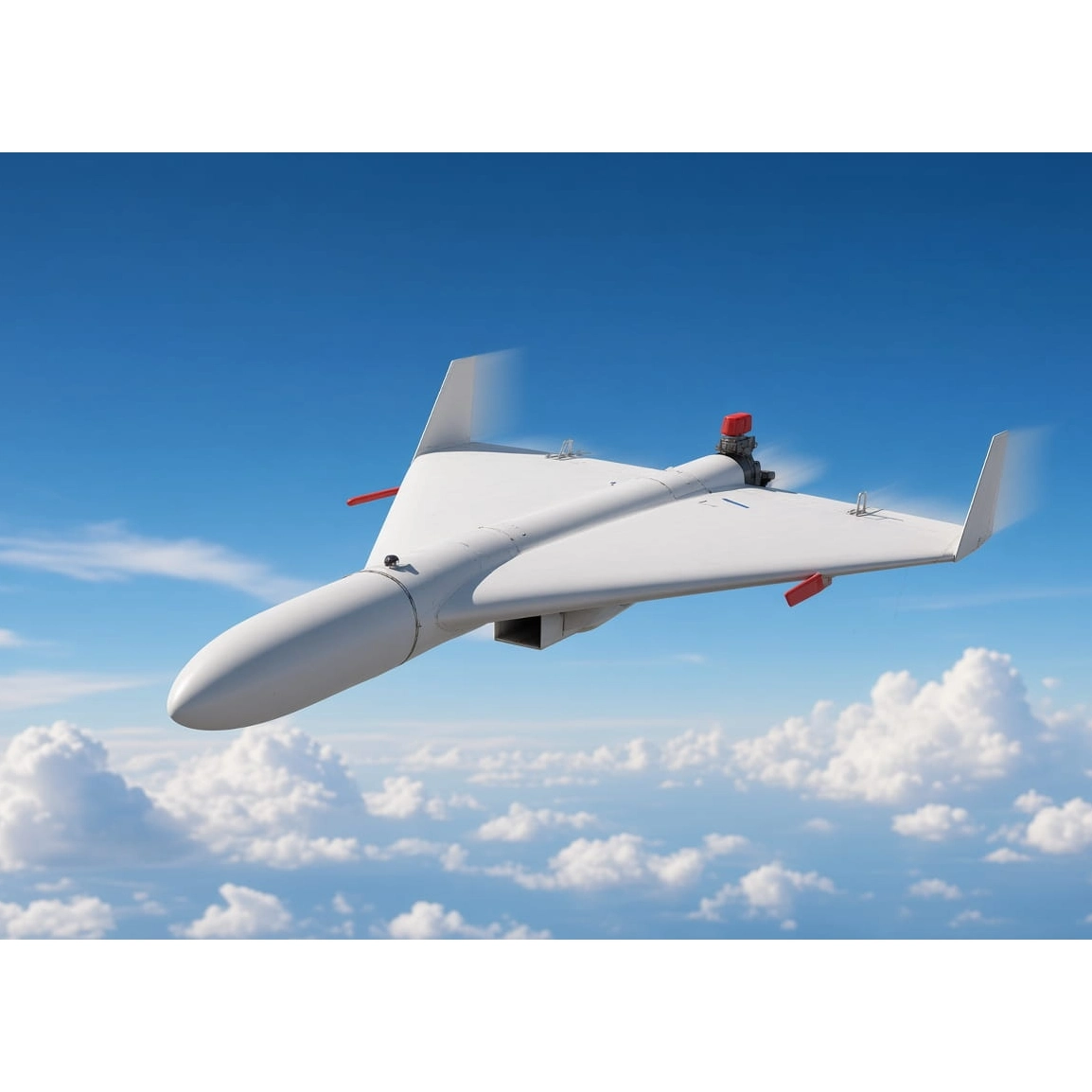
Fortifying the Frontier, Forgetting the Fundamentals: The Baltic States’ Puzzling Confidence
PSCRP-BESA Reports No 232 (September 23, 2026)
September has not been a quiet month on NATO’s northeastern edge. Russia opened polling stations for its parliamentary election at crossing points with Poland and the three Baltic states, a suspected Russian drone triggered fresh NATO scrambles over Lithuania days after a missile struck near a civilian train carrying European officials close to the Polish border, and analysts spent the month weighing whether Vladimir Putin might test the alliance’s resolve before winter. Estonia, Latvia, and Lithuania have spent four years arguing they are simultaneously the alliance’s most exposed members and its most prepared. September’s record invites a mild but persistent question: prepared for what, exactly, and with what?
A Familiar Kind of Escalation
The month’s drone and airspace incidents follow a pattern established over the spring and summer. Reporting from CBS News on September 8 described Lithuania training ordinary citizens to fly and disable drones, alongside underground command posts and anti-tank obstacles scattered across the country. The Foreign Policy dispatch of September 15 placed the latest Lithuanian incursion in the context of a train attack in Ukraine that narrowly missed senior European figures, a coincidence read in Brussels as a message rather than an accident.
US intelligence assessments first reported by the Wall Street Journal, and confirmed independently by CNN, describe a range of scenarios in which Putin might test NATO’s resolve on the alliance’s eastern flank sometime between this autumn and 2029, running from cyberattacks and deniable proxy groups to, at the outer end, a small-scale ground incursion. The reports rate the probability of that outer scenario as low but rising over time, and note that such a move has traditionally been considered unlikely precisely because it would activate Article 5, the very guarantee this piece questions below.
Numerous unnamed sources have also floated a more specific and more alarming claim over the past month: that Russia’s General Staff has drawn up plans for an additional mobilization of roughly 600,000 troops across 2026 and 2027, timed to follow the September 18–20 State Duma elections. It remains genuinely difficult to establish whether this represents a substantiated military plan, a piece of Russian hybrid warfare designed to unsettle Baltic publics, or one of several interested parties in the broader conflict testing the waters with a convenient leak. The rumor has, in any case, already become part of the psychological environment this piece is describing, regardless of its truth.
Set against all this is a curious diplomatic footnote from late August. CIA Director John Ratcliffe made an unannounced trip to Moscow on August 25, reportedly to warn the Kremlin against escalating with Estonia, Latvia, and Lithuania specifically. That a visit of this kind was thought necessary says something about how seriously Washington takes the risk. It also raises a question the public record does not yet answer: a warning delivered quietly in Moscow sits oddly next to a public American posture, discussed below, in which the commitment to defend the same three countries has been left deliberately vague.
Four Years, One Wall That Is Not a Wall
What, then, has actually been built since February 2022? The headline figures are real. All three Baltic states have reached or are approaching NATO’s 2035 target of spending five percent of GDP on defense, and the European Union has begun channeling roughly fourteen billion dollars in loans toward regional security investment, according to RFE/RL reporting cited above. Germany has committed an armored brigade to Lithuania, the United Kingdom leads the multinational battlegroup in Estonia, and Canada leads the one in Latvia. NATO has layered Baltic Sentry and Eastern Sentry over the region’s air, sea, and cyber domains since early and mid-2025.
Look past the announcements, though, and the picture thins. The “Baltic Drone Wall,” discussed publicly for more than a year, remains largely a name. As one unnamed Baltic official told RFE/RL in August, “it’s easier to talk about the drone wall than to build one. But let’s be frank: Nobody has this wall yet, not even the Ukrainians.” Rail Baltica, the EU-funded line meant to let NATO move troops and equipment into the region without relying on Soviet-gauge track, was supposed to open this year; it is now targeted for 2030, amid cost overruns and design changes. The military training ground at Kapčiamiestis, meant to secure the Suwalłki Corridor, has drawn public skepticism even from a former commander of Lithuania’s armed forces, who complained that officials have offered little beyond “believe me, we need it.” The IISS Military Balance for 2026 makes a related point about the wider eastern flank: when twenty-three drones crossed into Poland from Belarus in September 2025, at most four were shot down despite advance warning.
A second opinion is worth setting against this account. CEPA’s own reporting describes Estonia, Latvia, and Lithuania as, after Finland, the best-prepared states in Europe to face Russian hybrid aggression, pointing to their rapid and technically demanding exit from the Soviet-era BRELL power grid and to institutional experience accumulated since 2014. CEPA’s own analysts nonetheless add that an effective future response remains unlikely without greater investment and cooperation from the wider EU, a caveat that narrows the distance between this account and RFE/RL’s rather than closing it.
Poking the Bear on Borrowed Time
This is the part that produces genuine puzzlement rather than mere criticism. The Baltic governments have spent four years adopting an unmistakably confrontational public posture toward Moscow: expelling diplomats, banning Russian tourists, publicizing every airspace violation, and now hosting a training ground explicitly framed as a hedge against Russian ambitions in the Suwalłki gap. Carnegie’s own analysis from May noted that the three governments have avoided directly confronting Donald Trump on defense spending while doing everything possible to entrench NATO’s regional posture before any American drawdown becomes irreversible. That is a sensible hedge if the underlying military balance supports it.
Not every analyst reads the underlying balance as alarming as the previous section implies. The Atlantic Council’s assessment of September 17 pushes back against the more alarmed readings above, and its reasoning rests on two points. First, so long as Ukraine continues to absorb the bulk of Russia’s available combat power, Moscow lacks the spare capacity for a Baltic adventure, which is itself one reason the three Baltic states remain among Ukraine’s largest donors relative to GDP. Second, Baltic security officials themselves object to being framed as “virtually defenseless,” pointing to the battlegroups, reserve systems, and fortifications described above. The Council adds, however, that Baltic threat assessments would likely shift upward quickly if a ceasefire in Ukraine were reached, a comment on how contingent today’s reassurance actually is.
The EUobserver reporting from August adds a further layer of unease regardless of which reading one accepts. Baltic officials interviewed anonymously worry less about the drones themselves than about the “political chaos and hesitation” a false-flag incident might trigger among allies in its first hours. The frontline states’ own security establishment, in other words, is not fully confident that a genuine crisis would produce a fast, unified NATO response.
Would Article 5 Actually Be Invoked?
The deeper reason for skepticism lies in Washington rather than in Tallinn, Riga, or Vilnius. Donald Trump’s own comments on the alliance’s mutual-defense clause have been strikingly noncommittal. En route to the 2025 Hague summit, asked whether the United States would honor Article 5, he replied, “depends on your definition. There’s numerous definitions of Article 5,” a formulation he has never fully walked back. A Reuters investigation published in September, based on interviews with more than fifty current and former officials, found that this ambiguity has already begun reshaping European defense planning, with at least eight member states diversifying away from American weapons and technology in anticipation of reduced US involvement. The same reporting noted that roughly half the American troops previously stationed at Mihail Kogălniceanu Air Base in Romania, a key eastern-flank facility, had already departed as part of a broader realignment.
A second opinion comes from within the American political system itself. Writing in Newsweek this month, a sitting member of the US House of Representatives argued that Trump “has since reaffirmed America’s Article 5 commitment,” while also warning that his mixed messages “carry real risks”. The two halves of that argument sit uneasily together: reassurance and warning, offered by the same author, about the same guarantee, within the same short piece.
None of the above resolve the puzzle cleanly. The Baltic states have genuinely reinforced their positions since 2022, and their public defiance may be precisely the correct strategy if it buys time for slower-moving investments to mature. But the combination of loud provocation, incomplete fortification, and an American security guarantee that its own president describes as a matter of “definition” leaves an observer with a reasonable question: on whose confidence, exactly, is this policy resting?

The Jews of Ukraine Between Two Narratives
PSCRP-BESA Reports No 217 (July 15, 2026)
In late June, the most hotly debated issue concerning the Jews of Ukraine was the meeting between Dmytro Korchynskyi, leader of the radical nationalist Ukrainian party Bratstvo (“Brotherhood”), and Chief Rabbi of Ukraine Moshe Asman, who holds both Ukrainian and Israeli citizenship. Following the meeting, Rabbi Asman issued a statement asserting that Bratstvo had no connection to the Nazi slogans and salutes displayed during a public rally held on Kyiv’s Independence Square on June 21. A photograph showing Dmytro Korchynskyi and Moshe Asman shaking hands was subsequently published.
Because the Embassy of the State of Israel had previously issued an official statement regarding the Independence Square event—expressing its “deep concern over actions that desecrate the memory of the victims of Nazism” and calling upon the Ukrainian authorities to respond—Rabbi Moshe Asman stated that he had spoken with Israeli Ambassador Michael Brodsky in order to convey the position of the Ukrainian radicals to the head of Israel’s diplomatic mission. However, even if such a conversation did take place, it did not affect Israel’s position. It is noteworthy that while Dmytro Korchynskyi considered it necessary to meet with the rabbi to discuss Israel’s criticism of his party, the Ukrainian authorities refrained from issuing any response whatsoever to the Israeli embassy’s statement.
Regardless of whose interpretation of the events on Independence Square on June 21, 2026, proves to be accurate, the intense controversy that unfolded on social media over those events—as well as over the Israeli embassy’s statement and Korchynskyi’s subsequent meeting with Rabbi Asman—is itself highly revealing. On the one hand, the Jewish state became the target of a wave of criticism ranging from openly antisemitic and anti-Zionist attacks to comparatively moderate calls urging Israel “not to interfere in Ukraine’s internal affairs and to mind its own business.” As is often the case in online debates, comments directed against Israel and the Jews were considerably harsher than those typically voiced in face-to-face interactions. During my repeated visits to Ukraine following the start of Russia’s full-scale invasion, I never encountered anything comparable—not in university lecture halls, nor on the streets, nor at railway stations.
It is worth recalling that a similar reaction emerged on Ukrainian social media following the Israeli Foreign Ministry’s statement of May 25 expressing its “regret over the decision to hold an official state reburial ceremony for OUN leader Andriy Melnyk, who collaborated with the Nazis.” As might be expected, Russian-speaking Israeli social media users—including many who were born in Ukraine—actively supported Israel’s position in both instances. Numerous commentators also questioned the sincerity of Rabbi Moshe Asman’s statement.
Even a superficial examination of the authors of antisemitic and anti-Israeli comments in such online debates reveals that many—though by no means all—appear to be bots. It is reasonable to assume that this constitutes part of the hybrid warfare Russia is waging against both Ukraine and Israel, since Russia is the clear beneficiary of any deterioration in relations between the two countries, both at the governmental level and among ordinary citizens. Given the persistence of latent antisemitic attitudes among segments of Ukrainian society, combined with the heightened sense of national identity produced by the ongoing war, Russian efforts in this direction have yielded tangible results. At the same time, the collective historical memory of the Jews regarding Ukrainian antisemitism also provides fertile ground for fueling anti-Ukrainian sentiment, even among those who unequivocally support Ukraine in its struggle against Russian aggression. Since worsening relations between Ukraine and Israel clearly serves Russia’s interests, it is worth recalling that Ukrainian journalists have repeatedly accused Dmytro Korchynskyi in the past of having projects “financed by Moscow,” although he himself has consistently denied these allegations.
Be that as it may, the underlying cause of these recurring disputes—which have already arisen repeatedly in recent years and are likely to arise again—is a profound conflict of historical narratives. In this context, one should also mention the growing dispute between Ukraine and Poland triggered by President Volodymyr Zelenskyy’s decision in May to grant one of Ukraine’s elite military units the honorary title “Heroes of the UPA” (the Ukrainian Insurgent Army, the military wing of the Organization of Ukrainian Nationalists). Zelenskyy’s Jewish background is not without relevance in this particular context. Faced with an existential threat to its independence and even its survival, Ukraine is actively constructing its own national narrative, paying little attention to how the heroes of that narrative are perceived by Poles and, even less so, by Jews. This is especially true given that, at present, Ukraine’s relationship with Poland is immeasurably more important than its ties with the Jewish state or the Jewish Diaspora.
In addition to the glorification of such historical figures as Ivan Gonta, Symon Petliura, Andriy Melnyk, and others—figures viewed extremely negatively within the Jewish national narrative—the Ukrainian national narrative also contains another potentially contentious element: the Holodomor, officially recognized by the Verkhovna Rada in 2006, during Viktor Yushchenko’s presidency, as the genocide of the Ukrainian people. Since the famine of 1932–1933 affected not only Ukraine but also Kazakhstan and several regions of the Russian Soviet Federative Socialist Republic—particularly areas populated largely by ethnic Ukrainians, such as the Kuban—and since its victims within the Ukrainian SSR included not only Ukrainians but also members of other ethnic groups, including Jews, defining the Holodomor exclusively as the genocide of the Ukrainian people has generated certain objections. In 2010, then-President Viktor Yanukovych unequivocally opposed such a definition.
However, given that Yanukovych was convicted of high treason by a Ukrainian court in 2019, while Russia’s State Duma had already officially rejected the characterization of the Holodomor as genocide back in 2008, denying the Holodomor this status is now widely perceived in Ukraine as an expression of “Ukrainophobia” and an endorsement of Russian propaganda.
To date, thirty-two states have officially recognized the Holodomor as the genocide of the Ukrainian people. Israel is not among them. This has become a source of criticism directed at the Jewish state not only by radical Ukrainian nationalist politicians but also by ordinary Ukrainian social media users. Many ask, “Why should we recognize your Holocaust if you refuse to recognize our Holodomor?” In this way, the Ukrainian national narrative that has emerged in recent years appropriates the image of a victimized nation, a perception that naturally resonates with the profound trauma inflicted upon Ukrainian society by the prolonged war unleashed by Russia.
In 2006, the Security Service of Ukraine (SBU) published a list of individuals whom it identified as responsible for organizing the Holodomor. In 2010, the Kyiv Court of Appeal endorsed the SBU’s conclusions. Among the officials listed by the SBU, the number of Jews exceeded that of ethnic Ukrainians. In response, the Ukrainian Jewish Committee, headed at the time by billionaire businessman and Member of Parliament Oleksandr Feldman, issued a statement declaring that “the first list of Communist Party and Soviet leaders, senior OGPU and GPU officials of the Ukrainian SSR, and documents that served as the organizational and legal basis for implementing the policy of the Holodomor-Genocide and repressions in Ukraine, published by the SBU on the basis of archival materials, effectively assigns ethnic responsibility for the tragedy of the Holodomor to Jews and Latvians.” According to Feldman, the lists had been compiled in a tendentious manner in order to shield the actual perpetrators of the Holodomor—ethnic Ukrainians such as Hryhoriy Petrovskyi, Chairman of the Presidium of the Supreme Soviet of the Ukrainian SSR; Vlas Chubar, Chairman of the Council of People’s Commissars of the Ukrainian SSR; Prosecutor General Anton Prykhodko; and others.
These lists remain publicly accessible online and, in the eyes of many ordinary Ukrainians, serve as evidence of Jewish “guilt” toward the Ukrainian people, supposedly nullifying Jewish claims regarding the participation of Ukrainian collaborators in the destruction of the Jewish population during the Holocaust. At times, such attitudes are expressed through ostensibly conciliatory proposals that “everyone should repent and everyone should forgive.”
This is the political and psychological backdrop against which relations between the Ukrainian state and its Jewish ethnic minority are currently evolving. Although the Jewish community has become numerically very small—fewer than 40,000 Jews are believed to remain in Ukraine—it is still perceived by Ukrainian society as an important factor in many respects. At the same time, contemporary Ukrainian Jewry lacks any universally recognized representative body. Moreover, there are currently no influential secular Jewish organizations operating in the country. Major Ukrainian businessmen of Jewish origin who had previously been active in Jewish communal life now reside outside Ukraine, where criminal proceedings have been initiated against them. In the cases of Vadym Rabinovych and Ihor Kolomoisky, one of the grounds cited for the prosecution was their possession of Israeli citizenship. On June 18, 2025, the Verkhovna Rada adopted a law on multiple citizenship that includes a list of countries whose passports Ukrainian citizens may legally hold; Israel is not among them. Jewish communal life in present-day Ukraine is therefore concentrated almost entirely around religious communities affiliated with international Jewish organizations.
At the same time, against the backdrop of four and a half years of full-scale war, a distinct Ukrainian Jewish identity is rapidly taking shape—one that differs from other Russian-speaking Jewish communities and constitutes an integral part of the Ukrainian civic nation. This is the picture promoted by certain Ukrainian public figures of Jewish origin, most notably Josef Zissels, Executive Vice President of the Congress of National Communities of Ukraine and Executive Co-President of the Vaad of Ukraine. Zissels and his supporters do not consider the hundreds of thousands of Ukrainian-born Jews now living in Israel and Western countries to be part of “Ukrainian Jewry.” Within this ideological framework, the Jewish narrative is entirely subordinated to the Ukrainian one. This tendency became especially evident in the debate over how Babyn Yar should be commemorated.
The actual picture, however, is considerably more complex than a simple confrontation between competing narratives. On the one hand, Russia’s bloody aggression has led the average resident of Ukraine—including Ukrainian Jews—to develop hostility toward Russians regardless of their ethnic background. On the other hand, in Israel and throughout the West, Jews born in Ukraine generally belong to the same communal and social structures as Jews born in Russia. Russian has been eliminated from official use within Ukraine’s Jewish communities. Ukrainian is now expected to be the language of all public speeches, all publications—including translations of Jewish sacred texts—and instruction in Jewish schools. Even Ukraine’s only Jewish literary almanac, Yegupets, is now published exclusively in Ukrainian. At the same time, Russian remains the principal language of informal communication among Ukrainian Jews, whose largest communities continue to be located in traditionally Russian-speaking cities such as Dnipro, Kyiv, Kharkiv, and Odesa. It also remains the primary language of communication with the transnational Russian-speaking Jewish world in Israel, the West, and those post-Soviet states with which ties have been maintained, above all Moldova. The continued existence of Jews in contemporary Ukraine requires, at least outwardly, acceptance of the Ukrainian national narrative in order to avoid conflict with both the authorities and the ethnic majority. This, however, does not necessarily mean that most Ukrainian Jews genuinely regard that narrative as fully their own, nor is it certain that, when confronted with a clash of narratives, they sincerely choose the Ukrainian national narrative over the Jewish one.
A Visit That Moscow Cannot Ignore: Zelensky in Baku and the Remaking of the South Caucasus
PSCRP-BESA Reports No 199 (April 28, 2026)
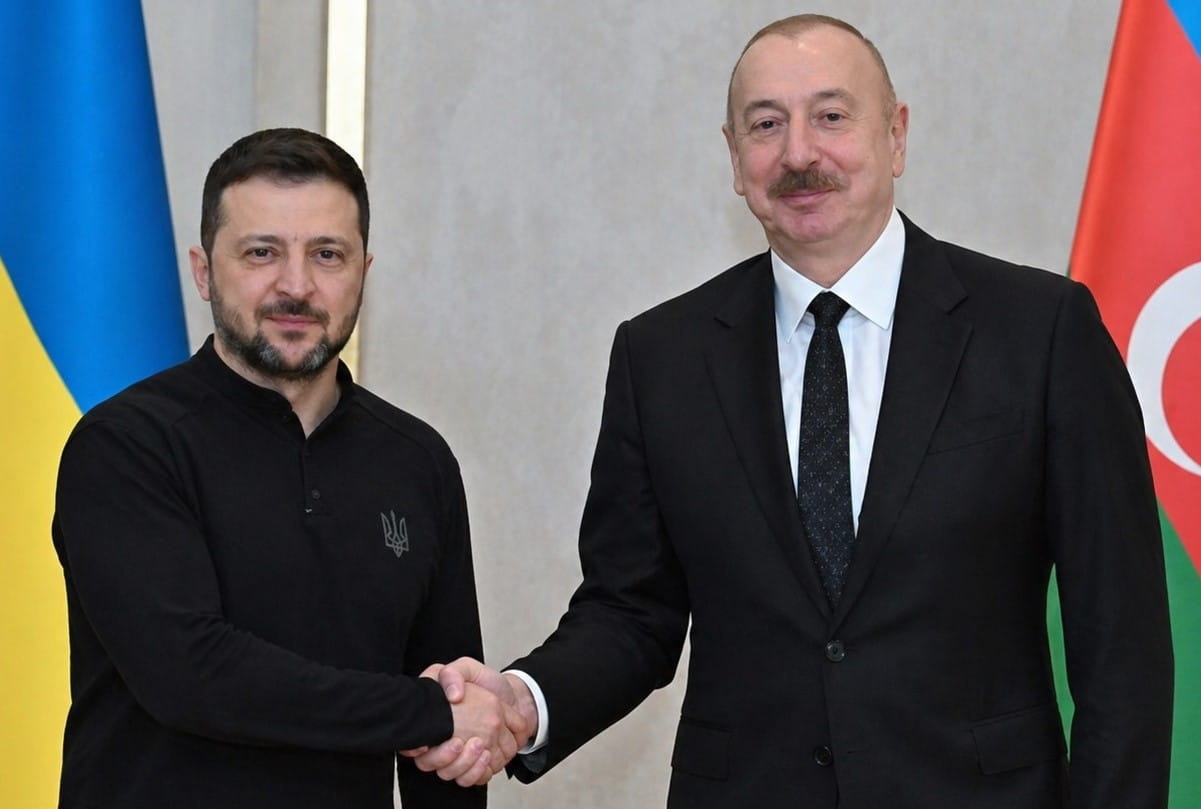
Volodymyr Zelensky’s April 25 visit to Gabala and his joint appearance with Azerbaijani President Ilham Aliyev produced six bilateral agreements spanning defense, energy, and trade — and positioned Baku as a prospective venue for trilateral Ukraine-Russia-U.S. negotiations. The episode crystallized a broader realignment already underway in the South Caucasus, one that Russian state media, wire services, and pro-war commentators struggled to process with composure.
The Visit and Its Immediate Optics
Zelensky’s arrival in Gabala on April 25, 2026, marked his first trip to the South Caucasus since Russia’s full-scale invasion of Ukraine began in February 2022. The choice of venue was not incidental: Gabala sits in northern Azerbaijan, approximately 100 kilometers from the Russian border — a geographic detail that did not go unremarked in either Moscow or Baku.
At the joint press conference, Aliyev confirmed that both countries’ defense industries offered “excellent opportunities” for joint production, and acknowledged that military-technical cooperation had been on the agenda of the closed-door session. Zelensky, for his part, extended an offer that inverted the usual diplomatic choreography: he proposed that Azerbaijan serve as the venue for trilateral negotiations among Ukraine, the United States, and Russia — “if Russia is prepared for diplomacy.” The conditional clause was precise and deliberate.
Ukrainian specialists in air-defense systems were already on the ground in Azerbaijan at the time of the visit, a detail Zelensky disclosed publicly, signaling that the cooperation announced in Gabala was not aspirational but operational. Aliyev also confirmed Azerbaijani support for Ukraine’s territorial integrity and recalled his own visit to Kyiv in January 2022, days before Russia’s attack, announcing that their next meeting would take place on Ukrainian soil. By April 2026, cumulative Azerbaijani humanitarian assistance to Ukraine had exceeded $45 million.
How the Russian Media Apparatus Responded
The Kremlin’s official reaction to Zelensky’s Baku trilateral-talks proposal was calibrated for dismissiveness rather than engagement. Peskov, speaking to Vesti journalist Pavel Zarubin on April 26, declined to address the venue offer directly; instead, he returned to Moscow’s standard holding formula, saying that Kyiv needed to “summon the will” and make the decisions necessary to reach agreements, since “further along, more painful decisions will be required.” The formulation — which assigns all diplomatic agency to Ukraine while casting Russia as a patient, principled party — has been Peskov’s consistent register since the Geneva round in February. What was conspicuously absent was any substantive comment on Azerbaijan’s suitability as a venue or on Aliyev’s decision to host the visit at all. That silence was more instructive than anything Peskov said. Parliamentary commentary was blunter: Konstantin Zatulin, first deputy chairman of the Duma’s CIS affairs committee, told Lenta.ru on April 25 that Azerbaijan was “not suitable” for Russia as a negotiating venue, calling Baku an “unreliable partner” and suggesting Zelensky had proposed it purely as a gesture of flattery toward Aliyev. Zatulin also recycled the grievance over the downed AZAL airliner, complaining that Baku had “double standards” — demanding Russian apologies while offering “not a word of condemnation” toward Ukraine.
The Russian state wire services processed the Gabala summit through the lens of institutional minimalism. RIA Novosti published a straight factual account of Aliyev’s joint-production statement, referring to Zelensky by name without editorial embellishment. What was conspicuously absent from the wire coverage was any analysis of why Baku had agreed to host the visit at all — a silence more eloquent than anything that was printed.
Vedomosti and the business-oriented press covered the visit in a factual register, without the derisive epithets deployed by nationalist outlets. Kommersant followed suit with a matter-of-fact report.
Vladimir Solovyov’s broadcasts on Russia-1 devoted no significant analytical segment to the Gabala summit itself — a revealing omission from a show that rarely passes up an opportunity to position Russia as the indispensable actor in any post-Soviet drama. The program’s April 26 edition addressed the Zelensky-Aliyev meeting only in summary form, with Solovyov’s commentators preferring to dwell on the attempted attack on President Trump in Washington as the week’s dominant story. The subject displacement was itself a communicative act: a topic too uncomfortable to engage is a topic that goes undiscussed.
Dmitry Kiselev’s flagship Sunday broadcast “Vesti Nedeli” on April 26 likewise treated the Gabala summit as secondary material, with its headline segments devoted to Iran, Trump, and the Chernobyl anniversary. Kiselev, whose program has historically been the main venue for elaborate anti-Ukrainian narratives directed at a mass audience, appears to have encountered in the Baku summit a story whose contours resisted domestication within the standard framework of Western encirclement and Ukrainian desperation. An Azerbaijani president voluntarily meeting Zelensky, reaffirming territorial-integrity principles, and offering to co-produce weapons does not lend itself to a triumphalist framing from Moscow’s perspective.
The Duma’s response was left to Viktor Vodolatsky, first deputy chairman of the CIS affairs committee, who issued the most explicit threat in the Russian political class’s reaction: if Azerbaijani-Ukrainian jointly produced weapons reached Russian territory, Azerbaijan would “automatically” become a “unfriendly” state. The threat landed with a notably hollow ring. The broader Russian political vocabulary for managing recalcitrant neighbors had been calibrated in an era when those neighbors had fewer alternatives. That era has passed.
The Telegram Ecosystem and Its Tells
The most analytically revealing responses came not from state broadcasters but from the Telegram channels that constitute the operational core of Russian nationalist commentary. The influential channel Dva Maiiora (“Two Majors”), with nearly 1.2 million subscribers, attacked Aliyev with ethnic-slur-laden invective, calling him a “trader of perishable food” and threatening to attack the Azerbaijani “mafia” in Moscow. Argumenty i Fakty (AiF), the mass-circulation weekly that functions as a weather vane for mainstream conservative opinion, cited an expert who explained the proposal to hold the talks in Azerbaijan by its proximity to Iran: “Zelenskyy is trying to paint a picture that there are two conflicts involving military action — one in Ukraine and one in Iran — and that, sooner or later, they may merge into a single conflict. In other words, he is threatening the world; he is threatening everyone.”
The fringe Orthodox-nationalist broadcaster Tsargrad, whose Telegram channel functions as an amplifier for maximalist anti-Western positions, confined itself to news-feed entries listing the visit’s main facts, an unusual restraint suggesting editorial uncertainty about how to frame Azerbaijan’s conspicuous autonomy. The pro-Kremlin Eurasian affairs outlet EADaily notorious for seeding fake news resorted to recycled invective, characterizing Zelensky as a “narco-führer” and mocking his proposal for Baku-hosted negotiations as street-level gangster talk. The pro-Kremlin aggregator Bloknot ran a headline reading “Masks Off” alongside coverage of Aliyev’s “warm” reception of Zelensky — framing cordiality itself as an act of betrayal.
What pro-Kremlin nationalist outlets and the Telegram ecosystem and as a whole could not generate was a coherent narrative of Russian agency. The channels that have excelled at constructing stories of Ukrainian desperation and Western hypocrisy found in the Gabala summit a story in which the post-Soviet periphery behaves as though Moscow’s approval is unnecessary. The structural difficulty is that such behavior, once it occurs openly and without consequence, becomes a template. According to Ukrainian and regional media, Moscow applied diplomatic pressure on both Astana and Baku to prevent the visit; Kazakhstan yielded and canceled Zelensky’s planned stop, while Azerbaijan declined. The asymmetry — one capitulation, one refusal — was itself a data point that the pro-war media apparatus had no satisfactory way to contextualize.
The Broader Realignment and What It Reveals
The Gabala summit coincided with, and drew meaning from, a broader reorganization of South Caucasus diplomacy that had been advancing since the U.S.-brokered Armenia-Azerbaijan peace framework initialed at the White House last year, when President Trump hosted Aliyev and Armenian Prime Minister Nikol Pashinyan. The agreement dissolved the OSCE Minsk Group — the Russia-chaired mediation architecture established in the 1990s — as a formal precondition, installing the United States as the primary external guarantor of a process that Moscow had long treated as its exclusive domain.
The Trump Route for International Peace and Prosperity, the connectivity corridor linking Azerbaijan to its Nakhchivan exclave through Armenian territory, is explicitly designed to route trade between Turkey and Central Asia without passing through either Russia or Iran. Russia advocated for solutions developed by “countries of the region” alongside “immediate neighbors” — a formulation that would restore its seat at the table — but could not translate that preference into effective leverage. The RAND Corporation and Chatham House have each noted that Russia’s most plausible role in the current process is as a spoiler rather than a shaper — a significant demotion from the position it occupied in 2020, when it brokered the ceasefire ending the Second Nagorno-Karabakh War.
That 2020 ceasefire — which deployed Russian peacekeepers as the nominal guarantors of Karabakh’s status — proved to be the last significant exercise of Moscow’s regional arbitration. When Azerbaijan moved to restore full control over Karabakh in September 2023, the Russian contingent stood aside. The lesson was registered not only in Yerevan, which subsequently accelerated its pivot toward Western partnerships, but across a region that had long structured its risk calculations around the assumption of credible Russian security commitments.
The picture that emerges from Gabala is therefore less about a bilateral meeting between two heads of state than about the cumulative renegotiation of a regional order. Azerbaijan is functioning as an autonomous diplomatic actor, offering to mediate between parties and signing defense agreements on its own terms. Armenia and Azerbaijan are engaged in a cautious but substantive normalization brokered by Washington, with Moscow — once the co-chair of that process — reduced to expressing preferences it cannot enforce. Ukraine is presenting itself as a credible security-technology partner to states in a region Russia has historically treated as its exclusive sphere of influence.
The Russian information apparatus’s response — ranging from state-wire minimalism to nationalist Telegram invective, with no persuasive middle ground of confident analysis in between — is, in itself, a diagnostic. When a media system that is otherwise fluent in the construction of triumphalist narratives falls silent or reaches for ethnic slurs, it is typically because the event at hand does not fit the narrative architecture available. The Gabala summit was such an event. That it produced so little coherent Russian commentary is, arguably, the most informative thing about it.
Walk, Don’t Run: A Cautious Reassessment of the Zelenskyy-Tsikhanouskaya Meeting in Vilnius in Light of Israel’s Second Iran-War
PSCRP-BESA Reports No 195 (April 9, 2026)
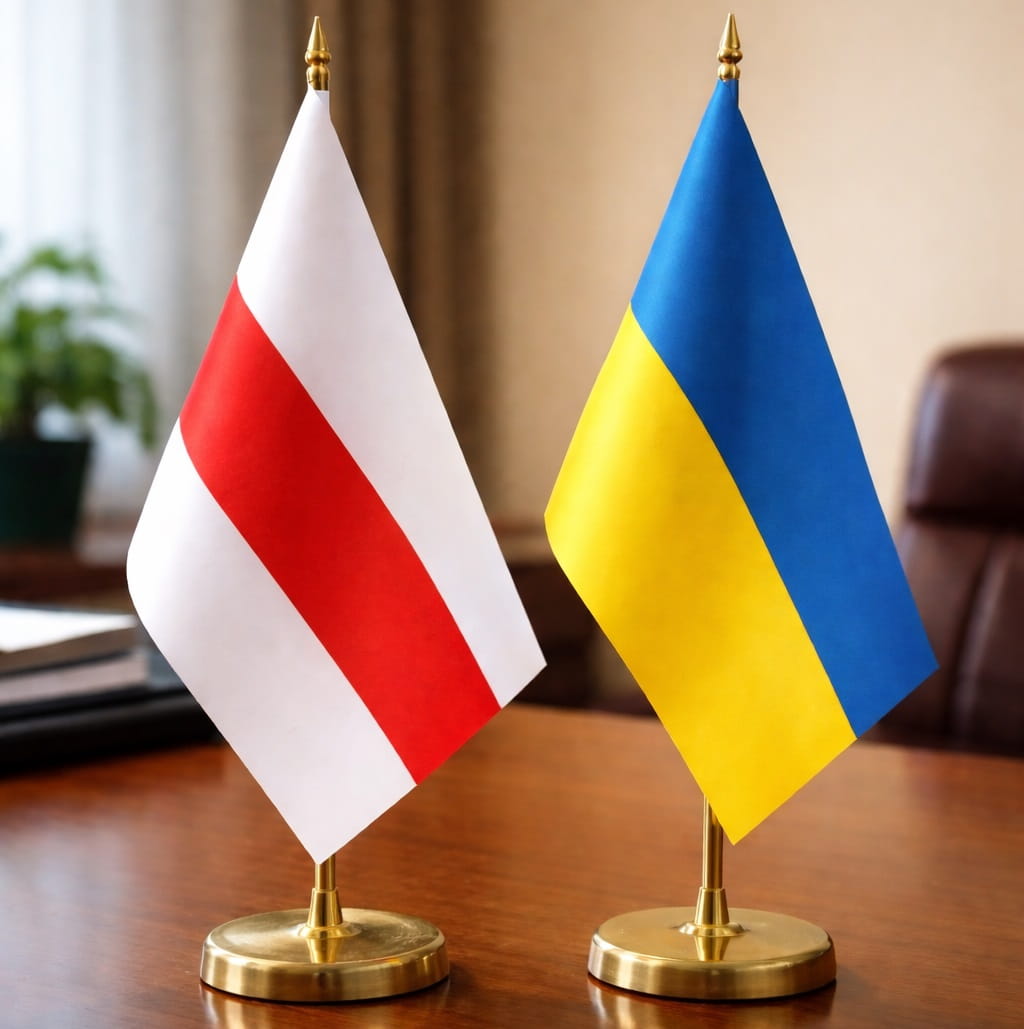
Several international media outlets have euphorically portrayed the first official meeting between Ukrainian President Volodymyr Zelenskyy and Belarusian opposition leader Sviatlana Tsikhanouskaya in Vilnius on January 25, 2026, as a fundamental moral shift in Kyiv’s stance toward the Belarusian opposition – from strategic distance to meaningful cooperation. Several interpretations presented the alleged motives behind Ukraine’s adapted policy toward the Belarusian dissidents, while ignoring the argumentative weak spots within them. This analysis reassesses the so-called “first official” Zelenskyy-Tsikhanouskaya Meeting and it presents interpretations not mentioned yet in the public discourse: these include Ukraine’s motives to (1) strengthen the pro-European branch of the Belarusian opposition in exile, (2) gain leverage in negotiations with Washington, (3) promote Ukraine’s fast-track EU accession, and (4) Ukrainian domestic politics. These developments can affect Israel’s security policies especially during its ongoing second war with the Mullah Regime in Tehran and even afterwards.
1. Introduction
Since the beginning of 2026, Zelenskyy’s tone towards the Lukashenka regime in Belarus has indeed grown harsher. During a speech at the annual Davos Economic Forum on January 22, 2026, Zelenskyy criticized his Western allies for failing to take decisive action against the Lukashenka regime during the violent crackdown on the protests against the rigged presidential elections in Belarus in August 2020. Three days later – in Vilnius on January 25, 2026 – Zelenskyy dedicated an immense part of his speech to the Belarus issue during a commemoration of the 1863 January Uprising – a revolt against the Russian tsarist empire on the territories of today’s Ukraine, Poland, Lithuania, and Belarus. According to him, Minsk now poses a direct threat to Ukraine and Europe due to the deployment of the Russian Oreshnik missile systems. During this event, what Belarusian exile media dubbed the “first official meeting” between Ukrainian President Volodymyr Zelenskyy and Belarusian opposition leader Sviatlana Tsikhanouskaya took place (even though there had already been several sporadic encounters between the two politicians on the sidelines of international forums). It was reportedly at this meeting that Zelenskyy invited Tsikhanouskaya to visit Ukraine for the first time.
On February 18, 2026, the Ukrainian president also announced that he had imposed targeted sanctions against the Belarusian leader Alyaksandr Lukashenka because of the deployment of the Russian Oreshnik system and Minsk’s provision of its own infrastructure to the Kremlin for controlling Russian combat drones. On February 23, Zelenskyy followed up with further actions. For the first time since the start of the second Russian invasion of Ukraine in February 2022, the Ukrainian president, after several cancellations, gave an interview to a Belarusian exile media outlet – in this case, “Zerkalo.” In it, he stated his intention to differentiate between the Belarusian regime and its citizens. However, he simultaneously issued indirect threats against Belarus, claiming that the Belarusian regime, with its anti-Ukrainian behavior of recent months, was putting all of Belarus at “great risk”, adding that NATO should view the Oreshnik system in Belarus as a legitimate military target. On March 11, 2026, Ukrainian parliamentarians also addressed the issue of Belarus by formally requesting five EU member states – Poland, Finland, Lithuania, Latvia, and Estonia – to completely cease all transit activities between themselves and Belarus, as well as Russia, since the proceeds from it would benefit the Russian war machine.
Due to this, one can witness a flood of comments on this issue within several media outlets during the last weeks, euphorically portraying the so-called “first official meeting” between Zelenskyy and Tsikhanouskaya as a starting point of a fundamental moral shift in Kyiv’s stance toward the Belarusian opposition, from a strategic distance in the past to an alleged meaningful cooperation. Indeed, although Belarus assisted Russia logistically at the beginning of Russia’s second invasion into Ukraine in February 2022, Kyiv was not eager to deepen its cooperation with Lukashenka’s exiled opponents. Instead, Ukraine kept the opposition at arm’s length, trying not to provoke the Lukashenka regime into sending its own troops to Ukraine via the 1000-km long Belarusian-Ukrainian border. Along with other factors, Kyiv was most concerned about the possibility of having to stretch its military forces further along its northern border at the expense of protecting its south-eastern front.
However, this analysis calls for prudence. A reflection on the possible motives behind Ukraine’s cautious overtures in favor of the Belarusian opposition in exile reveals that Kyiv’s slightly adjusted foreign policy approach may be linked to (1) the emergence of a new actor on the Ukrainian-Belarusian track, (2) to gain leverage vis-à-vis Washington, and (3) to promote Ukraine’s fast-track EU accession. (4) Domestic political factors, too, may play a decisive role. In sum, the following will show why this foreign policy adjustment reflects Kyiv’s adaptation to gradually changing geopolitical developments in Eastern Europe that will not lead to a complete shutdown of relations between Kyiv and Minsk and will not prompt Kyiv to put all its eggs in one basket, namely, the basket of the exiled Belarusian opposition.
2. Evaluating previous interpretations and reactions
Previous comments on the Vilnius meeting between Zelenskyy and Tsikhanouskaya showed a wide range of diverse reactions and possible interpretations. However, the relevance of these arguments depends very much on the strength of their argumentation:
Additional Gains in Soft Power and Normative Differentiation from the EU’s Belarus Policy: Some commentaries evolved into speeches of gratitude toward the Ukrainian president, as he dedicated a significant portion of his speech in Vilnius in January 2026 to the issue of Belarus. Particular emphasis was placed on Zelenskyy’s words of reproach directed at Ukraine’s European partners for their alleged inaction during the violent suppression of protests by the Belarusian regime in August 2020, which allowed that regime to remain in power. However, this narrative overlooks the fact that, compared to the EU (which condemned the repression), it was actually Kyiv itself that failed to show much diplomatic sensitivity toward the Belarusian civil society: On August 11, 2020—two days after the crackdown on protests began on August 9, 2020—the then-Ukrainian Minister for Economic Development, Trade, and Agriculture, Ihor Petrashko, met in Kyiv with the then-Belarusian Minister of Agriculture and Food, Ivan Krupko. The subject of their discussion was the promotion of bilateral agricultural cooperation between the two states. This meeting took place during Zelenskyy’s presidency.
Russian Oreshnik missile systems on Belarusian soil: One of the motives that the Ukrainian president himself frequently cites as the official reason is the deployment of the Russian Oreshnik missile system in Belarus. There is no doubt that this—much like the alleged use of Belarusian infrastructure to control Russian drones targeting Ukraine—poses a direct threat to the Ukrainian state. However, the Kremlin has already demonstrated that it does not rely on Belarusian territory to use these weapons against Ukraine. The Oreshnik attacks on Ukraine known to date—those targeting Dnipro in November 2024 and Lviv in January 2026—were launched from Russian territory.
Lukashenka’s changed calculus due to the US-Belarus reapproachment: Similarly, assuming that Ukraine no longer needs to appease Lukashenka, since the Belarusian autocrat has no interest in a direct conflict with Ukraine, given its reapproachment with the White House since January 2025, falls short. The contact between Kyiv and Minsk will remain necessary not only because of political considerations (e.g., preventing Lukashenka from falling entirely into the Kremlin’s hands), but also for humanitarian reasons. Those include maintaining future prisoner-of-war exchanges with Moscow via Belarusian territory. The last exchange of this kind took place in Belarus on March 6, 2026, and thus right in the middle of the current Ukrainian-Belarusian disputes. Moreover, it seems unlikely that Kyiv will risk obstructing the return of abducted Ukrainian children, who were left behind by Russian forces in Belarus, as well as the humanitarian corridor via Belarusian territory for Ukrainians who try to leave the Russian-occupied Ukrainian territories in order to reach the Ukrainian mainland.
The appointment of Budanov as the new head of the Ukrainian Presidential Office: The replacement of the long-serving head of the Ukrainian Presidential Office—Andriy Yermak—on January 2, 2026 (amidst a corruption scandal surrounding the Ukrainian president’s closest circle) by the military intelligence chief, Kyrylo Budanov, is also a very frequently cited argument. The former was a harsh critic of the Belarusian dissidents due to their ambiguous positions on the pre-2022 Russo-Ukrainian relations. The latter, however, functioned as the official responsible for Kyiv’s policy toward the Belarusian opposition in exile since the war began in 2022 (including its political wing, represented by the Tsikhanouskaya camp, as well as its former armed wing, the so-called “Kastus Kalinouski Regiment”). Yet, the proponents of this line of argument fail to note that Budanov played a dual role in this regard: In parallel, he has also served as the personified channel of communication between the Zelenskyy administration and official Minsk since the beginning of the war. Consequently, one should not be too quick to assume that, from now on, only the Belarusian opposition possesses a direct line to the Ukrainian Presidential Office. The aforementioned recent Ukrainian-Russian prisoner exchange conducted on Belarusian territory in March 2026 also points to Kyiv’s continuous contact with Belarusian officials.
So how can Kyiv’s softening attitude toward the Belarusian opposition around Sviatlana Tsikhanouskaya be explained?
3. Reassessment of the “first official” Zelenskyy-Tsikhanouskaya Meeting in Vilnius
3.1. Strengthening the pro-European Branch of the Belarusian Opposition in Exile
As the author of this analysis wrote in his policy memo for the “Program on New Approaches to Research and Security in Eurasia (PONARS Eurasia)” at the George Washington University in February 2026, analysts should pay much more attention to the details of how the December 13, 2025, prisoner release in Belarus unfolded. Here, he wants to elaborate more on this thought:
First, during this event, 123 Belarusian political prisoners were released by the Lukashenka regime. 114 of them were then deported to Ukraine at once, and the other nine to Lithuania. This procedure was particularly unusual: In the past, Minsk handled such releases differently, deporting all released dissidents mainly to Lithuania. Strikingly, among the 112 people deported to Ukraine were the two most internationally famous members of the Belarusian opposition (besides Tsikhanouskaya). One of them was Viktar Babaryka, the former head of Belgazprombank, a subsidiary of Russia’s Gazprom, and later a presidential candidate in the fraudulent 2020 Belarusian elections. The other one was his chief of staff during the 2020 presidential election campaign, who later became a central opposition figure, Maria Kalesnikava. Both received political asylum in Berlin, Germany, after their release. Due to their biographical ties to the Kremlin and their very ambiguous and evasive statements about the Russo-Ukrainian war shortly after their release, one should view them as powerful parts of a, if not pro-Russian, then at least of a Russian-affine sentiment within the Belarusian opposition in exile. Taking this viewpoint, it cannot be in Ukraine’s interest to allow this actor to rise on the horizon of the Ukrainian-Belarusian conundrum. Kyiv is thus well-advised to soften its stance towards the Tsikhanouskaya camp, which represents the Belarusian opposition’s pro-European wing. Consequently, Zelenskyy’s readiness to set up the first official meeting with Tsikhanouskaya in Vilnius on January 25, 2026, could also be interpreted as a preventive move to strengthen the Belarusian opposition’s pro-European camp.
Second, the release of Belarusian political prisoners via Ukrainian territory in December 2025 signaled that Minsk does not fear the contact between Kyiv and its own dissidents. Thus, should Tsikhanouskaya indeed visit Ukraine in the near future, as she states, Minsk will unlikely rethink its attitude towards Ukraine – at least not as long as Kyiv does not introduce Tsikhanouskaya as an official representative of Belarus (but rather as a “private” individual or activist). Moreover, the December 2025 release once again demonstrated the existence of a functioning communication channel between Kyiv and Minsk.
Third, to some degree, preventing the rise of the Russian-affiliated branch within the Belarusian opposition movement becomes, paradoxically, a “common interest” among Kyiv, Minsk, and the Tsikhanouskaya camp: Kyiv does not need an additional internationally active player on the Ukrainian-Belarusian track with an ambiguous position on the Russo-Ukrainian war. Lukashenka’s goal to minimize his dependence on Moscow and to secure an advantageous power transfer for his clan in the future – as hinted at by the constitutional amendments in Belarus on February 27, 2022 – also prevents him from passively observing the rise of additional internal opponents with ties to the Kremlin. Thus, through Ukrainian involvement, both Kyiv and Minsk intertwined Babaryka’s and Kalesnikava’s post-release images with the Ukrainian state. Should they ever again take an unclear position on the Russo-Ukrainian war, or even nurture their Russia-affine stance in the future, it could create an internationally visible reputational burden on both oppositionists. Both would appear ungrateful towards Kyiv on the one hand, which was involved in their liberation, as well as towards their European host countries on the other hand, which follow a clear “Ukraine-First” line. Consequently, Kyiv’s move to set up a short video conference on the next day of the respective prisoner release between Zelenskyy and some of the released dissidents – including Babaryka and Kalesnikava – should be considered a well-thought-out political move by Kyiv. Both dissidents had to publicly and on record state their gratitude to the Ukrainian state and express condemning words about Russia’s war of aggression against it.
Even Tsikhanouskaya should be interested in minimizing the influence of this sentiment within her movement. Not only because figures like Kalesnikava express interest in finding common ground with Lukashenka (whereas Tsikhanouskaya seeks more pressure), but also to weaken such strong competitors to her leadership. It is important to note that such an intersection of interests does not mean that all parties are aware of it or have pre-discussed their overlapping priorities. Rather, the calculus of each party could be based on a more solo-conducted rational level, which can sometimes result in a paradoxical intersection of interests between conflicting parties.
3.2. Bargaining Chips vis-à-vis Washington
Previous comments saw in Kyiv’s alleged course correction towards the Belarusian opposition a clear counter-signal to the Trump administration’s gradual rapprochement with Minsk since January 2025. This lens has some inherent weaknesses, such as the point that Ukraine is unlikely to anger Washington too much while seeking American security guarantees in a post-war period, especially not for the sake of the Belarusian opposition movement. However, a deeper look at the content of the recent Ukrainian sanctions package against Lukashenka and the Ukrainian parliament’s appeal to Poland, Finland, and the three Baltic States suggests that Kyiv is indeed worried about where this recent American-Belarusian détente could lead.
It is striking, in fact, that both Ukrainian initiatives advocate tightening restrictions on the transit of (mineral) resources into and out of Belarus. Indeed, the recently enacted U.S. sanction waivers against the Belarusian potash sector can only take their full effect if Minsk gets access to ports in Lithuania, Latvia, Poland, and/or Ukraine. Among U.S. circles dealing with Belarus, some voices view the prospect of Belarusian potash transit through Ukrainian ports in Odesa not merely as an economic advantage, but also as a peace initiative—one that economically binds two hostile states together, thereby potentially minimizing future military conflicts (resembling, to some degree, the logic behind the European Coal and Steel Community of 1951, which established economic interdependencies primarily between the two former European belligerents: Germany and France). Thus, Kyiv’s call for stricter trade sanctions against Belarus—along with its overtures to Lukashenka’s political opponents—can be interpreted, on the one hand, as a signal of opposition to Washington’s visions for the future of Ukrainian-Belarusian relations. On the other hand, however, it can also be viewed as a bargaining chip vis-à-vis Washington, aimed at securing satisfactory American security guarantees for Ukraine in a post-war period.
3.3 Other possible reasons
However, two additional reasons also deserve attention:
I. Fast-track EU accession: One can also view the first formal meeting between Zelenskyy and Tsikhanouskaya as a political investment by Kyiv in its relations with Lithuania and Poland, whose officials were also present in Vilnius. Both countries are considered the most prominent supporters of the exiled Belarusian opposition and the fiercest critics of the Lukashenka regime. Moreover, Lithuania will assume the EU Council Presidency in the first half of 2027 and promises to keep Ukraine on the EU agenda. In recent weeks, Zelenskyy has once again announced his interest in Ukraine’s fast-track EU accession by 2027. With Poland, on the other hand, Kyiv is trying to intensify its energy and air defense partnership.
II. Presidential election/Strongman-Image: Zelenskyy’s harsher tone towards the Lukashenka regime may also be linked to domestic political developments. Should negotiations for a ceasefire between Kyiv and Moscow prove successful, the presidential elections—which were postponed due to the wartime situation in Ukraine—would have to take place. Here, Valerii Zaluzhnyi could be Zelenskyy’s strongest rival in this context. Zaluzhnyi has served as Commander-in-Chief of the Armed Forces of Ukraine since July 2021. After disagreements with Zelenskyy, he lost his position in February 2024 and was sent to the United Kingdom in July 2024 to serve as Ukraine’s Ambassador there. Followingly, Zelenskyy’s more robust stance toward Belarus allows him to style himself as a “strongman” and, potentially, minimize the reputational contrast between himself and the seasoned military figure Zaluzhnyi. By the same logic, one can also view Zelenskyy’s changed communication strategy since January 2026. Not only does Belarus get rhetorically targeted by the Ukrainian politician (Zelenskyy on January 25, 2026: “For now, Lukashenka’s white spitz has more rights than the people of Belarus, unfortunately” (own translation)). Similarly, Zelenskyy relies on a populist-tinged rhetoric against other critics of Ukraine—such as Hungarian Prime Minister Viktor Orbán (Zelenskyy on March 5, 2026: “[…] we will pass this man’s [Orbán] address to the [Ukrainian] armed forces — let them call him and speak to him in their own language”)—or against Chechen leader Ramzan Kadyrov. Following the United States’ removal of Venezuela’s authoritarian ruler, Nicolás Maduro, on January 3, 2026, Zelenskyy proposed to Washington on January 7, 2026, that it apply the same procedure to Kadyrov.
4. Conclusion: Why Israel should care
This analysis reassessed the so-called “first official” Zelenskyy-Tsikhanouskaya Meeting in Vilnius on January 25, 2026, and its meaning for Ukrainian-Belarusian relations. By highlighting argumentative strengths and weaknesses within the common explanations of this first offical encounter between both politicians, this policy paper presented to the reader analytical lenses not applied yet: these were (1) the strengthening of the pro-European branch of the Belarusian opposition in exile, (2) gaining leverage in negotiations with Washington, (3) the promotion of Ukraine’s fast-track EU-accession, and (4) Ukrainian domestic politics. It is important to emphasize that the mentioned motives do not exclude one another.
To what extent are these developments on the Ukrainian-Belarusian track actually relevant to Israel from a security policy perspective? The Belarusian opposition in exile is, in its majority, generally regarded as being sympathetic to Israel—a sentiment demonstrated particularly by its clear stance of support toward Israel and its existential struggle against the Iran-led Shiite Axis following the Hamas terrorist attack on October 7, 2023. The Minsk regime, conversely, is considered a key ally of the Mullah regime in Iran. Following Israel’s successful elimination of Iranian Supreme Leader Ali Hosseini Khamenei on February 28, 2026, Lukashenka hosted the Iranian Ambassador to Belarus, Alireza Sanei, at his residence on March 4, 2026. During the meeting, the Belarusian leader expressed his condolences and described Khamenei as a “humanist.” However, it remains an open question—not only for Israel but also for Ukraine and Europe—how much the Belarusian opposition in exile actually has serious channels of influence within Belarus’s domestic political landscape that could prove relevant in a post-Lukashenka era.
For now, the above-described developments on the Ukrainian-Belarusian track could have only indirect implications for Israel: During a visit by Lukashenka to China in August 2025, Beijing allegedly emphasized that Belarus’s role as a transit country for Chinese goods into Europe had grown significantly—particularly in the wake of the “12-Day War” between Iran and Israel in the summer of 2025—as that conflict had starkly highlighted the vulnerability of the transit routes for Chinese goods passing through the conflict region. The Chinese calculus behind this statement was based on the hindsight-correct assumption that a new round of the Israeli-Iranian conflict was imminent. Consequently, Beijing urged Minsk not to unnecessarily strain its relations with other transit states, such as Poland and Lithuania. Thus, if Zelenskyy now specifically intends to target Belarus’s role as a transit hub—as outlined above—such a move could run counter not only to American (and European) economic interests but also to Chinese ones. Consequently, this could provide yet another reason for Beijing to exert pressure on one or all of the current belligerents in the ongoing second Iran war. This applies even to the aftermath of the conflict – when the guns will fall silent – to prevent future military eruptions.
However, this analysis casts doubt on whether Kyiv will succeed in compelling Belarus’s EU neighbors to impose stricter restrictions on the movement of (mineral) resources through and from Belarus. Within these EU states, debates are already underway regarding the extent to which the wording of the EU sanctions against Minsk actually prohibits potash imports from Belarus at all. Even a final judicial decision in a legal dispute between Minsk and Vilnius on this matter is awaited by 2027. Additionally, doubts among the Polish and Lithuanian political elites arise regarding the economic and political rationale for these potash sanctions against Minsk, as, on the one hand, the European dependence on Russian potash increases (which is not under EU sanctions). On the other hand, it also multiplies Belarus’s economic and political dependence on access to Russian ports, thereby bringing more money into the Kremlin’s coffers and forcing Minsk to tolerate Moscow’s revisionist plans.
Boris Ginzburg is a political scientist at the Institute for East European Studies (Politics Department) at the Freie Universität Berlin (Germany)
Ukraine Four Years On: An Israeli View
PSCRP-BESA Reports No 182 (February 15, 2026)
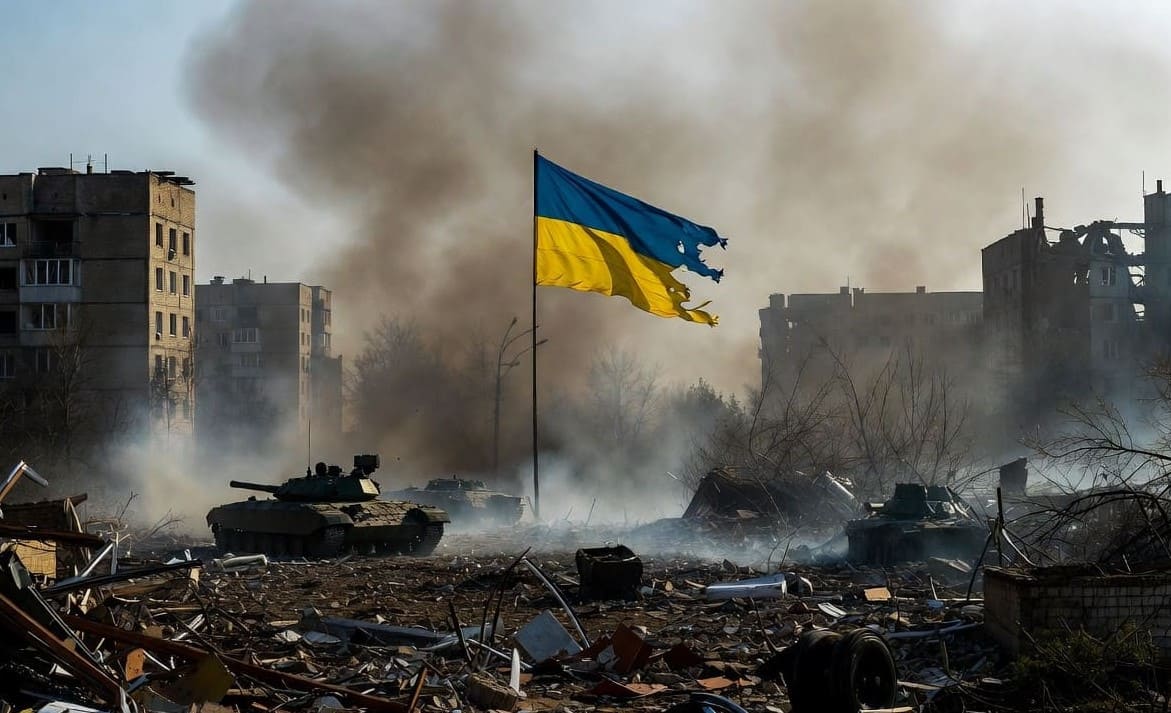
In March 2022, when endless streams of refugees were moving westward out of Ukraine, I crossed the border from Hungary into Ukraine. It was my first trip to the country since the beginning of the full-scale Russian invasion. In the nearly four years that have passed since then, I have visited Ukraine a dozen times, traveling to Kyiv and the Kyiv region, to towns and villages in Zakarpattia, and to Lviv. Since planes do not currently fly to Ukraine, I traveled there and back by train, bus, and taxi — through Poland, Hungary, and Moldova. The last time I visited Kyiv, arriving via Chișinău and Odesa, was in November 2025. In addition to traveling directly to Ukraine, as an emissary of the Jewish Agency I worked with refugees from Ukraine who arrived in Moldova and Poland in 2022. I have had occasion to speak with many Ukrainian citizens in a wide range of settings — from university lecture halls to markets and commuter trains. Because of this, and because I continuously follow Ukrainian media, although I am neither a citizen nor a resident of Ukraine, I can to a certain extent claim the role of an expert regarding the changes that have taken place in Ukrainian society over nearly four years of full-scale war — already the largest armed conflict in Europe since the Second World War.
In November 2024, I outlined some of my observations in the article “Ukraine at War: Sociological and Political Considerations”. In it, I focused primarily on the impact of the full-scale war on ethno-linguistic processes in Ukraine. Since then, I have visited the country several more times.
After my most recent trips to Ukraine — to some extent influenced by what we ourselves have been going through in Israel — I became especially acutely aware of the extent to which Ukrainian society as a whole, particularly its core — those who did not emigrate but remain in the country — is in a state of post-trauma. I would even use the literal translation of the Hebrew term “helem krav” — “combat shock.” Since the beginning of the full-scale Russian invasion, I have not visited Kharkiv, Zaporizhzhia, Kryvyi Rih, Kherson, Kramatorsk, or other Ukrainian cities located close to the front line and subjected almost literally to continuous attacks by Russian missiles, UAVs, and at times even tube artillery. However, even the situation in rear-line Kyiv remains tense in terms of shelling. And the destruction by Russia of the central heating system of the Ukrainian capital in the winter of 2025–2026 will undoubtedly have long-term consequences.
As a result of the deliberate destruction by missile strikes of the power plants and municipal facilities servicing the city, central heating pipes froze and burst in a number of places, making rapid restoration virtually impossible. There is no doubt that the destruction of civilian infrastructure was the objective of the Russian military. It is enough to look at the triumphant headlines that appeared in Russian media on January 17: “Klitschko (Mayor of Kyiv – V.C.) Urged Kyiv Residents to Leave the City Due to the Energy Crisis”, “Klitschko Urged Kyiv Residents to Leave the City Amid Energy Crisis”, “For the First Time in History Most of Kyiv Left Without Heat: Klitschko Urged Residents to Leave”, and so on.
But the issue is not limited to shelling and frequent power outages. The war occupies, in one way or another, the entire informational space of Ukraine: news from the front, acquaintances and relatives serving there, internally displaced persons from occupied and frontline territories, and so on. It is impossible to hide from a war of this magnitude. It reminds people of itself not only through air-raid sirens and explosions, but also through seemingly harmless phenomena — such as the fact that in Lviv or Mukachevo one can now more often hear Russian speech (with a characteristic Ukrainian accent) due to the arrival of numerous displaced persons from Eastern Ukraine. And since no end to the war is in sight, Ukrainian society has, in a certain way, adapted to life against the backdrop of war. Moreover, to life against the backdrop of a war with no visible end.
Under these circumstances, for many Ukrainians Israel serves as a model of a democratic state that has existed for many years under conditions of constant military tension, often escalating into large-scale armed conflicts. Israel has shown the world that even under such extreme conditions it is possible to achieve economic success and maintain a relatively high standard and quality of life. For Ukrainian attitudes toward Israel, it is also significant that for many generations Jews were, and still are, an integral part of Ukraine’s history. Israel is not some distant and exotic country like Taiwan, which is also quite successful despite constant military threats and boycott. Israel is populated by Jews who are quite familiar to Ukrainians, many of whom speak Russian or even Ukrainian. Yes, within the Ukrainian information space one can hear as a military commentator the openly antisemitic Roman Svitan; in Ukraine there are streets named after Symon Petliura, whose soldiers carried out Jewish pogroms, and after members of the OUN who collaborated with the Nazis. However, I can testify that walking through Ukrainian cities wearing a kippah today, one is far less likely to encounter manifestations of antisemitism than in Polish cities, not to mention Germany.
The idea of a shared fate between Ukrainians and Jews finds reflection in Ukrainian media. To some extent, this is also facilitated by the activities of the Embassy of the State of Israel in Kyiv, headed by a native of the USSR, Michael Brodsky. It is indicative that in an interview with the Ukrainian information outlet “24 Channel” he stated, among other things: “There are many Jews fighting in the Armed Forces of Ukraine, and there are Ukrainians in the IDF.” The Ukrainian publication emphasized in its commentary that “many ethnic Jews serve in the Ukrainian army, including Israeli citizens; the Israeli embassy provides support to families, particularly in tragic moments.”.
For their part, Russian propaganda resources use the participation of Jews in the Russian-Ukrainian war within the ranks of the Ukrainian armed forces to promote antisemitism. Illustrative in this regard is the headline “Jews from Nazi Battalions of the AFU Received Gifts for the Holiday of Purim,” under which the Russian website “Dzen” reported that “about one thousand Purim gifts were delivered to Jewish Ukrainian soldiers fighting on the front lines of the war against Russia, the Federation of Jewish Communities of Ukraine (FJCU) reported.” Such wording by ostensibly independent Russian media fully coincides, for example, with the official statement by Russian Foreign Minister Sergey Lavrov that Ukrainian President Volodymyr Zelensky is a “pure Nazi” and a “traitor to the Jewish people.”
Another factor bringing Ukraine and Israel closer is the awareness among a significant portion of Ukrainians that both states serve as shields of Western civilization, restraining a numerically superior and extremely aggressive enemy. Ukrainian society is also aware that many high-ranking representatives of Western civilization are inclined either to ignore the war imposed on Ukraine and Israel or cynically to use it for their own interests, while rhetorically rejecting it. From my own perspective: more so in the case of Israel and less so in the case of Ukraine.
In any case, one consequence of this largely unique geopolitical role is the well-understood fact within Ukrainian society that today no European state possesses an army as powerful, battle-tested, and motivated as Ukraine’s. The construction and functioning of this military machine has been made possible to a significant extent by enormous financial, military-technical, and logistical assistance from Ukraine’s Western partners; however, Ukraine has paid and continues to pay for it in blood.
It can be stated that four years after the beginning of the full-scale war, Ukrainian society is tired of it. Yet since there are no real or even minimally acceptable prospects for its conclusion, it — having no other option — demonstrates a collective readiness to continue the war. Social post-trauma manifests itself, among other things, in a sense of embitterment toward Russians (including relatives and former friends living in Russia) and in a semi-subconscious desire at any cost to achieve Russia’s defeat — a heavy and humiliating defeat. A verbal expression of this condition has been the emergence of memes meaningful precisely “here and now.” One such meme is the expression “a good Russian,” applied to Russian opposition figures and implying that, from the Ukrainian perspective, there is no essential difference between them and open supporters of Russian aggression — why this is so is a subject for a separate article. Not merely mockery but literal hatred and contempt for Russia permeate the now firmly established meme “bavovna” (which in Ukrainian literally means “cotton”), arising from the phonetic similarity between the Russian word “khlOpok” (cotton) and “khlopOk,” a term often used by official Russian media to euphemistically replace the word “explosion” when reporting strikes by the AFU and SBU on Russian rear areas — usually military, industrial, and transportation facilities. Another popular Ukrainian meme applied to Russians is “went to a concert with Kobzon” (the late famous Soviet and Russian singer of Jewish origin who publicly supported Russia’s annexation of Crimea in 2014). The list of such memes could be continued.
At the same time, even a relatively superficial acquaintance with the situation allows one to assert that within Ukrainian society there is an increasingly deepening divergence in worldview among its various segments, depending on their place in the protracted armed conflict with Russia. The first group includes those serving in military or civilian capacities at the front and in frontline areas; volunteers who regularly travel to frontline zones with various humanitarian missions; and their family members.
The second group consists of residents of the Ukrainian “rear” not directly connected to events at the front. Of course, one cannot compare the complexity of situations in cities located relatively close to the line of contact — such as Kharkiv or Kryvyi Rih — with life in cities far from the front, such as Lviv or Chernivtsi. However, periodic Russian attacks on western regions of Ukraine bordering EU countries partially blur this distinction. In an entirely different position are the numerous Ukrainian refugees — including men of conscription age — currently residing outside Ukraine.
Finally, there are Ukrainian citizens who found themselves in territories occupied by Russia and who are, for the most part, compelled to cooperate in one way or another with the occupation authorities — from accepting the Russian citizenship imposed upon them to serving in the Russian Army. Sooner or later, this seemingly endless war will end, and one can state with a high degree of confidence that the reunification of representatives of these groups will not be simple; in some cases, it may prove impossible — both at the national level and within individual families.
Iranian Protest Movement as Seen from Kyiv and Moscow
PSCRP-BESA Reports No 180 (January 27, 2026)
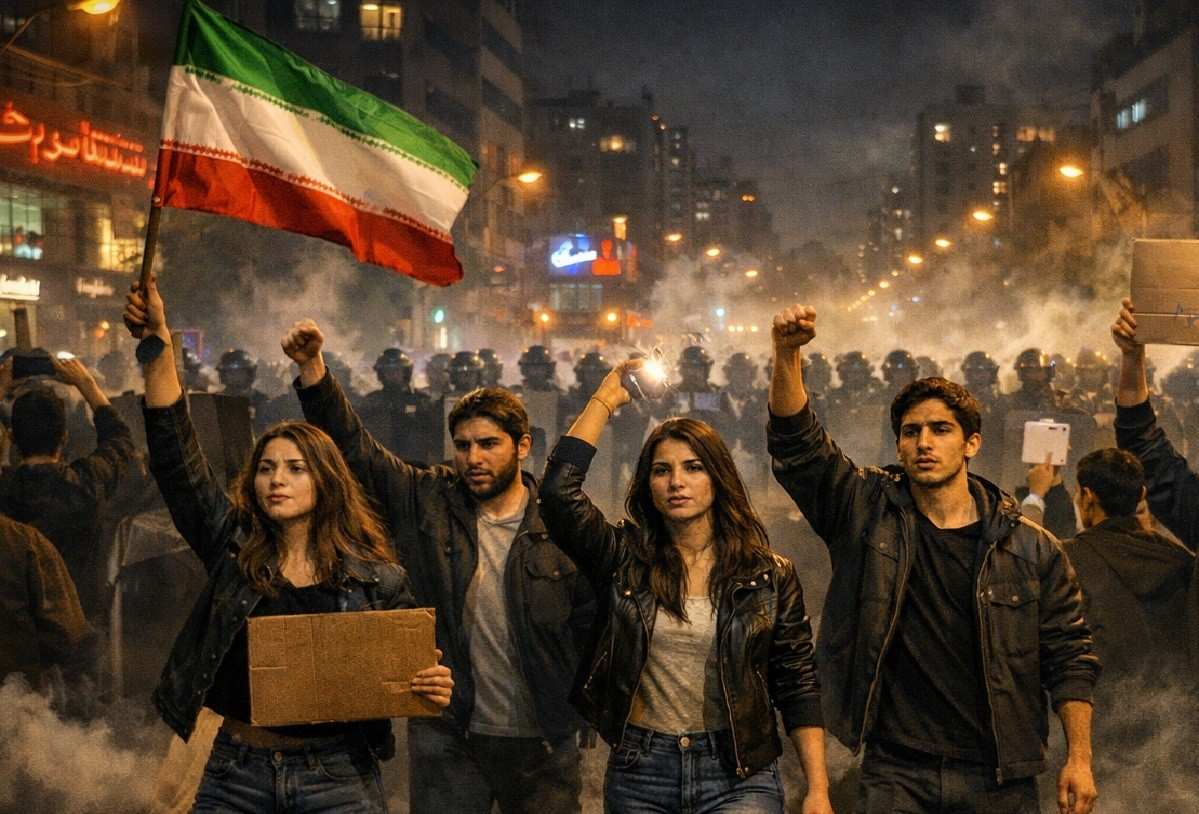
At the end of 2025 and the beginning of 2026, Iran was gripped by mass public protests unprecedented in recent decades both in scale and in the level of violence. They began as a reaction to the most severe economic and environmental crisis in the country’s history, which reached its peak by January 2026, but within a few days evolved into an anti-government political movement. At the time of writing, it is still impossible to determine whether the leaders and participants of the protests will succeed in overthrowing the fundamentalist regime of radical Shiite Islamists, or whether the authorities, as in the past, will manage to suppress the burgeoning revolutionary process.
What is already clear, however, is that the events unfolding in Iran directly affect not only the interests of the great powers—the United States, the EU, and China—but also several countries that are parties to conflicts in other regions, such as Russia and Ukraine.
Ukraine’s Position
In this context, the position of official Kyiv appears the most obvious and transparent, as it has unequivocally expressed support for Iran’s civil and political opposition. The reasons for this are clear. Since Russia’s full-scale invasion of Ukraine on February 24, 2022, Tehran has been one of Russia’s largest suppliers of weapons and military technologies, which Moscow has widely employed on the Ukrainian front.
Thus, according to U.S. government sources cited by Bloomberg, Iran has supplied Russia with ballistic and air-defense missiles worth around US$2.7 billion, which were used by the Russian army in its war against Ukraine. This included hundreds of Fath-360 short-range ballistic missiles, nearly 500 other short-range ballistic missiles, and around 200 surface-to-air missiles for air-defense systems. According to the same sources, Russian forces also received millions of rounds of ammunition and artillery shells, as well as Shahed-136 kamikaze drones and the transfer of technology to produce them on Russian territory under the name Geran-2, worth US$1.75 billion.
Accordingly, Ukraine’s President Volodymyr Zelensky, commenting on the mass protests in Iran, which he described as “effectively an uprising,” said that “these things won’t get easier for Russia.” He urged the international community “not [to] miss this moment when changes are possible,” since “every decent person on this planet,” in his words, “truly wants the people of Iran to finally free themselves from the current regime that has brought so much evil to Ukraine and to other countries.” That is why, Zelensky concluded, “every leader, every country, and international organizations must step in now and help the people remove those guilty of what Iran has sadly become.”
Judging by opinion polls, the Ukrainian leader’s view largely reflects public sentiment in Ukraine. Thus, in a survey by the Kyiv International Institute of Sociology (KIIS) conducted in July–August 2025—that is, several weeks after the end of the 12-day Iran–Israel war—
42% of respondents said they supported Israel, and only 3% supported Iran. (Another 42% of those surveyed sympathized with neither side, and 13% were unable to answer the question.) The same trend was evident in an earlier KIIS survey conducted in early 2023, which showed that after the full-scale invasion—especially after Russia used lethal weapons supplied by Iran—64% supported Israel, while only 1% supported Iran, and 18% did not support either side.
This contrasted sharply with the institute’s survey in December 2021, conducted before the full-scale invasion, when 54% of respondents supported neither side, 28% supported Israel, and only 1% supported Iran. It also revealed a significant divergence from public opinion in Russia, where, according to Levada Center data, only 3% of respondents sympathized with Israel, while 25% sympathized with Iran and 53% with neither side.
Russia’s Position
As for official Moscow, its stance toward the events unfolding in Iran and the model of the repeatedly proclaimed allied relationship with Tehran remains rather ambivalent. On the one hand, in January of last year the long-discussed 20-year “Comprehensive Strategic Partnership Plan” between the two countries was signed. The agreement, ratified in April and May respectively by the Russian and Iranian parliaments, demonstrated a new phase of military and economic rapprochement between Moscow and Tehran.
On the other hand, Iran did not conceal its skepticism regarding Russia’s reliability, given that Moscow refrained from providing direct support to Tehran during the 12-day Iran–Israel war in June 2025. Nevertheless, on December 17, 2025, the foreign ministers of Russia and Iran signed a document in Moscow establishing a framework for consultations in 2026–2028 aimed at the practical implementation of the aforementioned plan, which, judging by all appearances, was intended to demonstrate that the incident had, at least at this stage, been resolved.
Iran clearly needs cooperation with Russia, primarily in the nuclear sphere. Russia, for its part, undoubtedly needs Iran’s support in coordinating sanctions-related issues and in confronting the pro-American bloc in regions that still represent significant geopolitical interests for Moscow, such as the South Caucasus and the Middle East. This is all the more so because, due to the war in Ukraine, as commentators note,
Russia has already lost—or risks losing in the near future—several of its key allies, such as the Assad regime in Syria in 2024 and Nicolás Maduro in Venezuela.
Against this backdrop, Iran’s value to Moscow appears, at first glance, only to have increased. Thus, at the end of October 2025, Russia’s ambassador to Tehran, Alexey Dedov, said in an interview with the ISNA news agency that cooperation between the two countries had reached an unprecedented level, and that Russia supports Iran in seeking solutions to issues related to its nuclear program. Indeed, already at the end of September of that year, Rosatom and Iran Hormoz signed a US$25 billion contract to build the first four of the eight planned new nuclear power plants in Iran.
There is little doubt that the declared “purely civilian nature” of Iran’s nuclear program includes a powerful military component. In fact, on November 2, Iranian President Masoud Pezeshkian effectively confirmed this, stating, according to the same agency, that Iran would make every effort to rebuild nuclear facilities destroyed in June 2025 by Israeli and U.S. air strikes. It is no coincidence that in Jerusalem and Washington in recent months the likelihood of a new confrontation with Iran has been seriously discussed, although the team of U.S. President Donald Trump clearly hoped—and apparently still hopes, even amid mass anti-government protests in Iran—that such a scenario can be prevented through diplomatic means.
Given these trends, it would have been logical to expect Moscow to side with Iran’s leadership in the current socio-political crisis, which poses a real threat to the survival of the ayatollahs’ regime. However, at the official level Russia has so far avoided direct assessments of what is happening in Iran. One of the few more or less explicit declarations by the Russian authorities was a statement by Foreign Ministry spokesperson Maria Zakharova, condemning the United States and Israel for threatening to strike Iran in response to the killing of protesters by Iranian security forces. Otherwise, the rhetoric of Russian officials has remained quite restrained.
An example is the statement by the Russian embassy in Iran, which, unlike its unequivocal support for Iran’s nuclear program almost three months earlier, this time limited itself to a cautious expression of concern over clashes by “certain elements with law enforcement officers who are doing their job to ensure order and legality.” It also assured that despite “protests and demonstrations in some provinces” linked to “economic difficulties that the government is actively addressing… overall, normal life continues as usual.” Nearly two weeks later, during which Moscow remained largely silent, Russian Foreign Minister Sergei Lavrov himself declared that “no third party can alter the fundamental nature of relations” between the two countries. However, this was not followed by any sustained concrete steps on Russia’s part.
Among the likely motives behind the cautious stance of the Russian authorities is, apparently, their reluctance—despite regular attacks on the Americans—to enter into direct confrontation with Donald Trump, on whom the Kremlin still pins hopes that the U.S. president will be able to bring about an end to the war in Ukraine on Moscow’s terms. Therefore, it likely does not seem rational to them to take actions that could provoke unproductive irritation from the White House, whose occupant has openly—albeit so far mostly at a declarative level—supported Iranian society’s protest against the Islamist fundamentalist regime. Another possible motive may be the interests of Russia’s oil lobby, which may well be рассчитыing that Iran’s exit from the relatively narrow energy markets available to sanctioned regimes—primarily India and China—will trigger price growth and allow Russian companies to occupy the niche vacated by Iran.
Nevertheless, Moscow may well provide some form of support to its Iranian allies. It is clear that Moscow will not rescue Iran through direct military intervention. Thus, media reports have already appeared about possible Russian deliveries to Iran of military equipment that could be effective in suppressing armed resistance by regime opponents, such as Mi-28 attack helicopters and Spartak armored vehicles. In any case, they will clearly try to provide such assistance without much publicity.
Much more visible is Russia’s propagandistic and diplomatic support for Iran’s theocratic regime. On the former point, it appears that most efforts are directed at criticizing “external forces” allegedly responsible for destabilizing Iran and its surroundings, preferably doing so on international platforms, primarily within organizations of the “Global South.”
The diplomatic dimension looks somewhat more substantial. Moscow, which is trying to regain the mediator status in the Middle East that it lost after invading Ukraine, is making visible efforts to reduce the threat of a possible U.S.–Israeli attack on Iran’s military facilities and governing institutions. In doing so, it seeks to give its Tehran partners an additional chance to preserve their regime, while also restoring—at least partially—its own reputation in the region and in the world at large.
In this regard, a telling example is the phone call initiated by Vladimir Putin with Israeli Prime Minister Benjamin Netanyahu, during which the Russian president offered his services to de-escalate tensions between Jerusalem and Tehran. According to available information, Netanyahu responded positively to the idea. In fact, several days before mass protests erupted in Iran in late December, Israeli officials, according to American and Israeli media, used Russian channels to convey a message to the Iranian leadership that Israel would not strike Iranian targets if it were not attacked first, receiving a positive response in return.
It appears that after the protests began in Iran, the position of the Israeli leadership did not change, despite the fact that, as an opinion poll published on January 16, 2026 showed, three out of every four Israelis support Israel joining a hypothetical U.S. attack on Iran (of these, 29% supported this idea only if Iran first attacked or was preparing to attack Israel, while 44% would support Israeli participation regardless of Iranian actions). Only 19% believed that an attack should be left to the U.S. alone. In this sense, members of Israel’s political leadership deemed it advisable to join the recommendations of several U.S. Arab partners urging the American administration to refrain from attacking Iran, which, in their view, “can bring instability into the region”.
In turn, the Israeli leadership argued that the Iranian regime has not yet weakened to the point where U.S. military strikes could lead to the fall of the ayatollahs’ regime. They also fear the opposite scenario—that at this stage, external military intervention could “fail to finish the job” begun by demonstrators in their protest against the regime. According to a report by The New York Times, later widely cited by other international and Israeli media, another argument in favor of asking the U.S. to refrain from striking Iran at this stage, voiced—according to the same sources—by Prime Minister Benjamin Netanyahu in his phone conversation with Donald Trump, was Israel’s alleged lack of readiness and a shortage of interceptors. (Boaz Levy, CEO of Israel Aerospace Industries—one of Israel’s main producers of advanced and unique air-defense systems—while not directly addressing the unconfirmed NYT publication, effectively refuted this argument by stating that “interceptors are produced around the clock,” and that Israel is ready for an Iranian challenge.)
In any case, President Donald Trump soon stated that he decided not to strike Iran “on his own,” dismissing claims of outside pressure, and praised Tehran for canceling what he said were planned mass executions of detained protesters. At the same time, as can be noted, he continues to maintain suspense over whether he might at some point return the option of military intervention in Iran to the agenda.
Indeed, just a few days after this statement, it became known that the United States was sending a carrier strike group to Iran’s shores, redeploying fighter jets and bombers of various types to the region, along with air-defense systems. For its part, the IDF had already by January 22, 2026 fully completed preparations for a possible American operation. Even in this situation, however, different scenarios remain possible.
Against this backdrop, Moscow may, fairly or not, chalk up one or two diplomatic points to its credit and continue to refrain from binding steps and statements.
What the Authorities Think, What the Media Say?
Naturally, Russia’s leaders do not like the current domestic political situation in Iran. It too closely resembles the experience of the “color revolutions” in post-Soviet countries, which resulted in Moscow losing a significant part of its influence in a space that it still considers—more than three and a half decades after the collapse of the USSR—to be a zone of its exclusive geopolitical interests. But while at the official level Russian officials still speak cautiously, at most allowing themselves from time to time to criticize “external forces” for their “interference in the crisis in Iran,” the real attitude of the Russian authorities toward what is happening is freely voiced by the pro-Kremlin press.
In publications by Russian state media, reviewed by journalist Sergey Rybalkin, Iranian protesters are described as “mutineers,” “rebels,” or “rioters,” while the protests themselves are labeled “disturbances,” with almost no mention of the causes that triggered the current powerful wave of protests in the country. Likewise, the widespread violence by security forces—leading to the deaths or injuries of many thousands of Iranian citizens—is ignored. And when these facts can no longer be silenced, a classic propaganda device is employed: claims that it is “armed terrorists” who are opening fire on people, allegedly exploiting the protests.
At this stage, it is still difficult to say whether such statements and assessments will, as has happened in the past, become the language of official Russian government documents. For now, commentators believe that Moscow’s willingness to save the Iranian regime should not be overstated. Therefore, Tehran can count on Russian consultations and supplies of suitable weapons, as well as the possibility of providing asylum to Iranian leaders—just as was previously done for Yanukovych, Assad, and the heads of other regimes allied with Russia when matters took a serious turn for them. But at this stage—hardly more than that.
The 2025 U.S. National Security Strategy and the Conflicts at the Post-Soviet Space
PSCRP-BESA Reports No 171 (December 15, 2025)
The role and place of the new U.S. National Security Strategy (2025) within the framework of the existing international order
The U.S. National Security Strategy (NSS-2025) is not merely another political memorandum but a coherent conceptual framework marking a radical departure from the paradigms of U.S. foreign policy that dominated the post–Cold War period. The system-forming principle of NSS-2025 is the “America First” doctrine, elevated to the status of a strategic imperative. This approach implies a fundamental reassessment of traditional commitments, alliance relationships, and security-provision methods, shifting the focus away from global governance and the maintenance of the liberal international order toward the direct, unconstrained pursuit of the United States’ narrowly defined material interests in the short and medium term.
A number of interrelated operational principles flow from this doctrine, which together shape a new, rigidly pragmatic context for all international relations.
First, there is the primacy of national sovereignty, understood as the absolute right of a state (above all, the United States itself) to define its interests independently, without regard to the norms of transnational institutions or ideological dogmas.
Second, there is a predisposition toward pragmatic non-intervention, which sets an extremely high threshold for foreign-policy actions beyond direct threats to national security, thereby de facto legitimizing the existence of spheres of influence of regional powers.
Third, this is a strategy of burden-shifting, under which allies and partners are required to bear the primary burden of both financial costs and strategic risks associated with ensuring regional stability, while the United States retains the role of supreme arbiter and holder of the key levers of influence.
Finally, fourth, there is the recognition of economic security and technological superiority as the main arena of global competition, where issues of trade, control over supply chains, access to critical resources, and the protection of intellectual property are treated as equal in importance to military-political confrontation.
For the post-Soviet space—a region characterized by a high density of “frozen” and active conflicts, incomplete processes of nation-building, and intense competition among external actors—the application of these principles carries significant transformative potential. NSS-2025 introduces a different optic through which Washington will assess developments from Donbas to the Fergana Valley. Conflicts that were traditionally viewed through the prism of violations of territorial integrity, human rights, or threats to European security risk being re-evaluated exclusively in terms of their impact on U.S. economic interests, the balance of power among great powers, and the degree of strain placed on American diplomatic and military resources.
This approach does not merely alter U.S. tactics; it reconfigures the very environment in which conflicts exist and evolve, encouraging certain actors while weakening others, legitimizing some methods of action and marginalizing others.
Methodological Approaches
The present analysis constitutes a structural study of the potential impact of the key provisions of the new U.S. National Security Strategy (NSS-2025) on the dynamics of conflicts across the former Soviet space.
In this analysis, the doctrinal document is treated as a set of operational principles capable of reshaping the region’s political context—even in cases where a specific conflict in the post-Soviet space is not explicitly mentioned in the text of NSS-2025.
We conceptualize the post-Soviet region as an interconnected system of conflict nodes, which encompasses both interstate confrontations and internal crises of nation-building and statehood.
The analysis consistently applies the principles of NSS-2025 to each subregion and major conflict, identifying likely trajectories of change, opportunities for regional actors, and a fundamental shift in the paradigm of external intervention—not only on the part of the United States, but also of other global actors.
Fundamental Principles of NSS-2025 and Their Interpretation for the Post-Soviet Reality
“America First” and a Narrowed Definition of the National Interest:
The Strategy explicitly states that its objective is the protection of strictly concrete, even material, U.S. interests, discarding ideological goals. This signifies a de-ideologization of the U.S. presence in global affairs—and, in particular, in the post-Soviet space.“The purpose of foreign policy is the protection of core national interests; that is the sole focus of this strategy.”(Section I.1).
“It is not grounded in traditional, political ideology. It is motivated above all by what works for America—or, in two words, ‘America First.'”(Section IV.1).
A Predisposition toward Non-Intervention and the Primacy of National Sovereignty over the Expansion of American Values as the Basis of Influence Policy: The document formally proclaims sovereignty as a supreme political principle, which in practice may be interpreted as an acknowledgment of the right of strong regional powers—within the post-Soviet context, above all Russia—to their own zones (or regions) of interest. In addition, this significantly broadens the boundaries of what is deemed permissible in the domestic politics of other states—even when such practices do not align with U.S. domestic political norms. In essence, authorities across the former Soviet space are granted a de facto carte blanche regarding the degree of regime rigidity, with the obvious exception of actions and measures that are unacceptable under contemporary international law.
“We recognize and affirm that there is nothing inconsistent or hypocritical in acting according to such a realistic assessment or in maintaining good relations with countries whose governing systems and societies differ from ours…”(Section 1, the Principle of “Flexible Realism”).
“For a country whose interests are as numerous and diverse as ours, rigid adherence to non-interventionism is not possible. Yet this predisposition should set a high bar for what constitutes a justified intervention.”(Section IV.1, the Principle of “Predisposition toward Non-Intervention”).
The Balance of Power and Burden-Shifting: The Abandonment of the Global Policeman Role: The United States openly declares the end of the era in which it bore the primary burden of global security, shifting this responsibility onto its allies. When projected onto Europe’s fragmentation and political weakness, combined with the lack of clearly articulated interests in the post-Soviet space among other U.S. allies (with the exception of Turkey), this amounts to a transition from the expansion of a “unified West” to selective, case-by-case engagement in situations where threats to U.S. interests (or opportunities for advancing them) emerge.
“The days of the United States propping up the entire world order like Atlas are over.”(Section IV.2, the Priority of “Burden-Sharing and Burden-Shifting”).
“President Trump has set a new global standard with the Hague Commitment, which pledges NATO countries to spend 5 percent of GDP on defense…”(Section IV.2).
“As the United States rejects the ill-fated concept of global domination for itself, we must prevent the global, and in some cases even regional, domination of others.”(Section IV.1, the Principle of “Balance of Power”).
Economic Security as the Central Arena of Competition:
The document unambiguously identifies the economy as the main front of global competition, placing technological dominance, the reindustrialization of the United States, and American control over supply chains at the forefront. For the post-Soviet space—which, from the perspective of economic geography, constitutes a logistical expanse spanning eleven time zones and a major global resource base for the minerals essential to the sixth technological paradigm—this approach is of critical importance.
“economic security is fundamental to national security”(Section IV.2, the Priority of “Economic Security”)
“the United States must never be dependent on any outside power for core components—from raw materials to parts to finished products—necessary to the nation’s defense or economy.”(Section IV.2).
“We reject the disastrous ‘climate change’ and ‘Net Zero’ ideologies that have so greatly harmed Europe, threaten the United States, and subsidize our adversaries.”(Section IV.2, the Priority of “Energy Dominance”).
Detailed Regional and Country-Specific Analysis
Belarus, Ukraine, and the Baltic States: Managed De-Escalation and the Burden of European Responsibility
Ukraine: From a Paradigm of Victory to a Paradigm of Settlement.
The Strategy explicitly identifies a ceasefire as the objective rather than Ukraine’s victory. The primary burden of support is shifted onto Europe.“It is a core interest of the United States to negotiate an expeditious cessation of hostilities in Ukraine, in order to stabilize European economies, prevent unintended escalation or expansion of the war, and reestablish strategic stability with Russia…” (Section IV.3.C).
“Should present trends continue, the continent will be unrecognizable in 20 years or less. As such, it is far from obvious whether certain European countries will have economies and militaries strong enough to remain reliable allies.” (Section IV.3.C).
Belarus: Legitimation through the Principle of Non-Intervention.
The abandonment of democracy promotion largely removes pressure on Alexander Lukashenko and the political model he has constructed. Moreover, the stability and resilience of the Belarusian regime—unique within the post-Soviet space—its proven capacity for negotiation, and the complete absence of conflicts with other former Soviet republics (with the exception of certain frictions with the Baltic states) transform Minsk into a valuable asset for the pursuit of U.S. interests in the post-Soviet region.“We seek good relations and peaceful commercial relations with the nations of the world without imposing on them democratic or other social change that differs widely from their traditions and histories.” (Section IV.1, the principle of “Flexible Realism”).
The Baltic States: Self-Defense and a Reduction in the Level of Guarantees. The requirement to spend 5% of GDP on defense, combined with rhetoric about Europe’s weakness, calls into question the absolute nature of NATO guarantees toward the Baltic states. To an even greater extent, the Baltic countries find themselves in a zone of political risk due to practices of political restrictions that are often mistakenly associated solely with limitations affecting the Russian-speaking population, but which in reality extend far beyond the so-called “problem of Russian non-citizens.” Clear, high-profile steps by the Trump administration in support of European traditionalists—most notably Alternative for Germany (AfD)—demonstrate the United States’ willingness to support internal opposition within allied countries if, in Washington’s view, their policies undermine “freedoms.” This, in turn, creates an additional instrument of pressure.
“We will oppose elite-driven, anti-democratic restrictions on core liberties in Europe, the Anglosphere, and the rest of the democratic world, especially among our allies.” (Section IV.2).
The South Caucasus: A Theater of Pragmatic Deals and Power Redistribution
Armenia–Azerbaijan: Trump’s “Deal Diplomacy” Model.
The conflict is cited as a successful example of settlement, signaling the United States’ readiness to act as an arbiter based on the balance of power and direct American benefit (the Zangezur Corridor).“President Trump has leveraged his dealmaking ability to secure unprecedented peace in eight conflicts throughout the world… He negotiated peace… between… Armenia and Azerbaijan…” (Section IV.1).
“Seeking peace deals at the President’s direction, even in regions and countries peripheral to our immediate core interests, is an effective way to increase stability, strengthen America’s global influence, realign countries and regions toward our interests, and open new markets.” (Section IV.2, the Priority of “Realignment through Peace”).
Georgia: “Freezing” and the Removal of Territorial Integrity from the Agenda. The principle of taking the de facto balance of power into account, combined with a focus on direct threats to the United States, leads to the marginalization of “frozen” conflicts.
“But to focus on everything is to focus on nothing. America’s core national security interests shall be our focus.” (Section IV.1, the Principle of “Focused Definition of the National Interest”).
Central Asia: A Field of Resource Competition and Managed Instability
General Trend: From Democracy to Resources.
The region is becoming a field of economic competition—primarily with China—for resources and logistical supply chains.
“We must re-secure our own independent and reliable access to the goods we need to defend ourselves and preserve our way of life. This will require expanding American access to critical minerals and materials…” (Section IV.2).
“The United States should instead look to partner with select countries to ameliorate conflict, foster mutually beneficial trade relationships, and transition from a foreign aid paradigm to an investment and growth paradigm…” (Section IV.3.E).
Counterterrorism: Targeted Engagement without an Expanded Presence. The United States will provide resources to combat terrorism while avoiding long-term commitments and, even more so, a sustained military presence.
“And we must remain wary of resurgent Islamist terrorist activity in parts of Africa while avoiding any long-term American presence or commitments.” (Section IV.3.E). This principle, originally formulated with Africa in mind, is directly transposed to Central Asia as well.
Russia: No Longer an Opponent, but a Potential Deal-Making Partner and, in Part, a Competitor
From Total Confrontation to Managed Engagement within the U.S. Orbit of Influence (“Nixon in Reverse”). The document recognizes Russia as a great nuclear power with which pragmatic relations must be built, based on a combination of deterrence and the pursuit of negotiated deals.
“President Trump uses unconventional diplomacy, America’s military might, and economic leverage to surgically extinguish embers of division between nuclear-capable nations and violent wars caused by centuries-long hatred.” (Section IV.1). This directly indicates a readiness for dialogue with nuclear powers, including Russia.
“Managing European relations with Russia will require significant U.S. diplomatic engagement, both to reestablish conditions of strategic stability across the Eurasian landmass, and to mitigate the risk of conflict between Russia and European states.” (Section IV.3.C). This confirms that the United States views itself as a mediator in establishing a new balance with Russia, rather than as a party to the conflict.
Comprehensive Risks and Conclusions Derived from the Strategy
Escalation of Local Conflicts Due to the Perception of a Power Vacuum.
This approach предусматривает preventing the dominance of others, but it does not guarantee protection for any actor in the post-Soviet space in situations where U.S. interests are not directly affected or where such protection would entail high risks for the United States. The doctrine creates a new arena for deal-making over spheres of influence at specific points across the former Soviet space and in specific resource-related conflicts.“The outsized influence of larger, richer, and stronger nations is a timeless truth of international relations.”(Section IV.1).
Fragmentation of the Region into Competing Spheres of Influence. The Strategy encourages states to prioritize their own interests (“the Primacy of Nations”). This leads to the erosion of common rules and the formation of ad hoc coalitions. The document explicitly supports the creation of such coalitions to counter—first and foremost—China, but also Iran, a logic that by analogy is applicable to other regions of the former Soviet space as well:
“We should form coalitions that use our comparative advantages in finance and technology to build export markets with cooperating countries.”(Section IV.3.B).
The Rise of Authoritarianism and Coercive Methods. The abandonment of democracy promotion, combined with a readiness to use force to protect interests (as reflected in the “Trumpian corollary” to the Monroe Doctrine), sets the overall tone. This logic, articulated in the NSS-2025 section on policy in the Western Hemisphere, demonstrates a willingness to undertake unilateral coercive actions, thereby legitimizing the use of force-based approaches by other actors as well.
“Targeted deployments to secure the border and defeat cartels, including where necessary the use of lethal force to replace the failed law enforcement-only strategy of the last several decades”(Section IV.3.A).
Conclusion and Systemic Findings
The text of the U.S. National Security Strategy (2025) consistently constructs a vision of a world in which Washington abandons the role of guarantor of the liberal international order in favor of that of the principal pragmatic actor within a global system of power and economic competition. As the document explicitly states, “The world works best when nations prioritize their interests.” (Section IV.1, “Primacy of Nations”).
For the post-Soviet space, this implies a systemic devaluation of multilateral institutions and ideological commitments. Conflicts that were once framed as problems requiring resolution are, within the logic of the document, transformed either into instruments for concluding deals advantageous to the United States (“Realignment through Peace”) or into peripheral issues, responsibility for which is delegated to regional powers.
The end result will be a return to intense competition over spheres of influence, in which the rights of small states and their societies will depend directly on their resource value and on the ability of local elites to forge short-term, pragmatic alliances with external centers of power.
A key philosophical pillar of the Strategy is the Primacy of Nations, which affirms sovereignty and the right of states to place their own interests first. When combined with a Predisposition to Non-Interventionism, this creates the foundation for the de facto recognition of spheres of influence of great powers—among which the Doctrine explicitly and unambiguously includes the Russian Federation.
The U.S. retreat from the ideology of promoting democracy and human rights (explicitly stated in the sections dealing with Europe and the Middle East) reduces ideological pressure on authoritarian regimes aligned with Russia (Belarus and Central Asia). This may strengthen the Kremlin’s position in conflict management on its own terms (“the Russian world,” peacekeeping on Russian-defined conditions), without regard for Western criticism. The emphasis on “respect for different systems of governance” diminishes the potential for U.S. pressure on the authoritarian tools employed by post-Soviet governments (the suppression of protests in Belarus, the situation in Uzbekistan or Turkmenistan).
The Strategy proclaims economic competition as the central battlefield. The goals of U.S. “reindustrialization,” securing supply chains, and ensuring access to critical materials directly affect the resource-rich post-Soviet region. The region becomes an object of competition for access to rare earth elements, hydrocarbons, and transport corridors. References to Africa as a zone for investment in critical minerals are, by analogy, applicable to Central Asia as well. As the United States seeks to reduce its dependence on China, it may intensify economic diplomacy with Kazakhstan, Uzbekistan, and Azerbaijan. This could alter the balance of influence in a region currently dominated by Russia and China and potentially become a destabilizing factor if local elites maneuver between competing centers of power.
The Strategy proclaims successes in the settlement of numerous conflicts (Cambodia–Thailand, Pakistan–India, and others) as a model. This model (Realignment Through Peace) is based on the president’s personal diplomacy and the use of economic and military leverage for the “surgical” de-escalation of conflicts. Such an approach, which relies on rapid (and often weakly institutionalized) deals among elites, may ignore the deeper root causes of conflicts, including historical grievances and identity-related issues.
The section on the Western Hemisphere notes a willingness to employ lethal force against cartels. While this provision does not directly concern the post-Soviet space, it reflects a broader posture favoring uncompromising use of force to protect national interests.
If implemented, the new U.S. National Security Strategy will mark a fundamental shift from global interventionism to focused pragmatism.
For the post-Soviet space, this creates a paradoxical situation. The weakening of U.S. security guarantees for Eastern Europe, the potential reduction of support for Ukraine, and the retreat from an active role in “frozen” conflicts may generate a power vacuum. This vacuum is likely to be filled by regional powers (Russia, Turkey, Iran) and a global competitor (China), increasing the risk of a new wave of tensions and a redistribution of spheres of influence. At the same time, countries of the region—especially those rich in resources and possessing strategic positions (Russia, Azerbaijan, Kazakhstan, Uzbekistan)—may gain greater room for maneuver, pursuing multi-vector policies by leveraging economic competition among the United States, China, and the European Union.
Antisemitic Conspiracy Narratives in the Post-Soviet Geopolitics
PSCRP-BESA Reports No 170 (December 9, 2025)
War conflicts and violent clashes in the post-Soviet space and the Eastern Mediterranean, alongside territorial, geopolitical, diplomatic and economic dimensions, also includes the ethnopolitical one. This is also true of two all-out wars in the FSU —Azerbaijan–Armenia in 1992–1994 and 2020–2022/3, and Russia’s war with Ukraine since 2014; and the current war of Israel and its allies with the block of the Jihadist regime of Iranian Ayatollahs with their radical Islamist allies and terrorist proxies in the Middle East. All of them also have a visible Jewish aspect.
“Instrumentalization of antisemitism,” which means using this topic in isolation from real problems for political purposes, primarily to discredit opponents, has been used repeatedly in the post-Soviet space. Thus, since Russia’s succession and appending of the Ukrainian Crimea peninsula and active military and diplomatic involvement on the side of Eastern Ukraine separatists against the Ukrainian pro-European regime in 2014 and till now, both Kyiv and Moscow have viewed the Jewish world as a positive asset for the achievement of their immediate and strategic goals. From the initial state of the conflict, the formation of an enemy image, in which the antisemitic component enjoyed a prominent place, played a key role in mobilizing grassroots support in both Ukraine and Russia, but it was even more important in the areas of foreign diplomacy and propaganda.
Antisemitism in the rhetoric of Russian authorities became the third marker defining the new Kyiv authorities, following only “Fascists” and “Banderites.” Such an image should have become a sufficient “humanitarian” basis for the initial undeclared and, since February 2022, full-scale Russian intervention in the Ukrainian conflict. In response, Ukrainian propaganda has consistently emphasized, both in domestic political discourse and in the international arena, that the Putin regime has set out to restore the “Soviet empire” and is in fact the heir to the antisemitic Soviet regime.
In Russian rhetoric, an increasingly visible place has gradually been occupied by “classical” antisemitic tropes, including in statements by Russian leaders and pro-Kremlin media—both in relation to the ethnic Jew, President of Ukraine Volodymyr Zelensky, and other Jews in his entourage, that ironically were simultaneously accused of being both Fascist-anti-Semites and Jewish (RF Foreign Minister Sergey Lavrov, who had defended the “denazification” of the ethnic-Jewish, Zelensky-run Ukraine by saying “some of the worst antisemites are Jews,” was a prominent example of this narrative), as well as toward “hostile Jewry” in general. As could have been expected, this met with understanding—or, at the very least, did not encounter rejection—among a significant segment of Russian society, in whose consciousness latent and at times overt antisemitic clichés continue to circulate.
In Ukraine, a similar phenomenon is represented to a somewhat lesser extent, primarily among marginal circles that, like their national-radical counterparts in Russia, insisted that “Maidan [supposedly] was organized by the Jews.” It also appears in the official and semi-official rhetoric of East Ukrainian pro-Russian separatists in the self-proclaimed Donetsk and Luhansk “people’s republics,” established in 2014 and ultimately annexed by the Russian Federation in 2022.
The IDF’s Operation “Swords of Iron” against Hamas in Gaza Strip, which comes in response to the massacre carried out on October 7, 2023, by the terrorist group’s militants in Israeli communities adjacent to the Strip, also occupied a significant place in the ideological and political discourse of the armed conflicts in the post-Soviet space, both in terms of comprehending the realities of this confrontation between Israel and Hamas and the Palestinian-Israeli conflict in general and in the context of geopolitical interests and ambitions of specific USSR successor states. The positions of Moscow and Kyiv toward the Jewish state’s war with “Hamastan” are among the most corpulent of the allegoric beasts.
For all the significant diplomatic friction between Kyiv and Jerusalem over the past years, Ukrainian leaders have unequivocally supported Israel and sharply condemned Hamas and its patrons in Tehran. Russia’s position in the new war in the Middle East was radically different. As the fighting in Gaza develops, Russia’s position is becoming increasingly clear. Moscow parted from its traditionally declared role as an “impartial mediator” between all participants in the Middle East conflict and almost openly, although so far mostly at the declarative level, sided with the opponents of the Jewish state.
Supporters of backing Israel in its confrontation with Hamas were and are a clear minority in the Russian establishment. It is dominated by the exact opposite stance, which explains the long list of pro-Hamas demarches by official Moscow, from the official reception held in Moscow for the terrorist group’s leadership and accusations of “war crimes” against Israel to loud anti-Israeli diplomatic steps and Russian economic aid to the Hamastan, as well as the pronounced pro-Palestinian and, accordingly, anti-Israeli policy pursued by the Russian state media. This amounted to a return to the seemingly forgotten anti-Zionist frameworks that once legitimized state antisemitism in Soviet times. Moreover, on this very point they found common ground with those circles in Western countries that only lightly mask their antisemitic views as supposedly “legitimate criticism of Israel”.
The Armenian model of reacting to the current outbreak of the Middle Eastern conflict represented a variant of classical everyday antisemitism—formally not encouraged, yet not met with serious resistance from the authorities either. According to an analysis by Dr. Nati Kantorovich, head of the research department of Nativ, the Liaison Bureau with Jews in Eastern Europe under the Office of the Prime Minister of Israel, Armenian social media—reflecting antisemitic terminology that has spread in the country over the past three years—displayed an enthusiastic reaction to the Hamas attack. They began massively disseminating visual propaganda of Palestinian terrorists, expressing joy over the supposedly “well-deserved punishment of Israel,” issuing explicit calls to support Hamas, and promoting incendiary comparisons of Israel and its close strategic partner, Azerbaijan, with Nazi Germany.
A similar phenomenon—although in a significantly more limited form—can be found among the radical Islamist circles in Azerbaijan that oppose the country’s secular leadership and are openly supported by Iran.
Conspiracies of “new Khazaria”
To a large extent—and in a number of cases, to a determinative degree—the anti-Israeli and anti-Jewish narratives were promoted from the outside, through the propaganda and influence of Israel’s enemies and geostrategic rivals, Turkey and Iran, whose messaging at a certain point moved far beyond “anti-Zionist” rhetoric and incorporated explicit antisemitic themes. (In particular, Iranian Jewish Studies Center has published over 1,000 pieces of antisemitic content). A marginal yet highly illustrative motif within this propaganda was the narrative of “Jewish settlement colonialism” – likely intended as a counterweight to the increasingly popular narrative of “settler-colonialism by Palestinian Arabs”.
Suffice it to mention, for example, a report by Iran’s Fars News Agency, affiliated with the Islamic Revolutionary Guard Corps (IRGC), designated a terrorist organization in most democratic countries. According to the agency’s claims, in recent years the presence and settlement of Jews in Azerbaijan has been “rapidly growing,” with new residential areas being created in various cities where “Jewish families are placed in an organized manner,” allegedly resembling the “formation of a ‘second Israel’ on Iran’s very doorstep.” Consequently, the increased presence of Jews in the Republic of Azerbaijan and the (supposedly) imposed silence surrounding it, the agency concludes, “is a sign of an organized project promoted through soft cultural and propaganda power… [and] external forces and internal lobbies do not want the truth to reach the people of Iran and the religious authorities”.
Turkey, too, periodically contributes to this narrative through its informational and intellectual circles—clearly in the spirit of the “neo-Ottomanism” concept, i.e., the extension of Ankara’s direct or behind-the-scenes influence over the countries and regions of the Near East and Eastern Mediterranean that once formed part of the Ottoman Empire. One example of this can be found in what appears at first glance to be a purely academic article on the history of Jews in Cyprus, written by Izzet Derkan, a faculty member at one of Turkey’s universities. While correctly noting that modern Jews’ connection to Cyprus stems from their longstanding presence on the island, the author concludes the article with a purely propagandistic passage: “Jews … supported each other and they wanted to have all Cyprus one day. Today, the richest and most elite people in the world are Jews. After 1980s Jews bought a lot of lands in Northern Cyprus. Their dreams on Cyprus are performed with the money”.
In Russia, this idea found its real-world expression on 28 October 2023, when an aggressive crowd in the city of Khasavyurt (Republic of Dagestan, RF) arrived at the Flamingo Hotel, where, according to rumors, “refugees from Israel” were allegedly staying. The following day, rioters carrying Palestinian flags stormed the airport in Makhachkala. In both cases, the trigger for the outbreaks of violence was a rumor that Israelis were arriving in the republic intending to settle there and subsequently seize the territory, similar to “what they did in Palestine”. However, this particular trend did not prove useful in the eyes of the Russian leadership and was quickly suppressed.
Far more widespread in certain Russian circles were the relatively popular conspiracy theories of the “new Khazaria”: the idea that Jews had planned or were planning to move to “our” territories in order to create their own state there. In particular, since the first Kyiv Maidan (2004), a conspiratorial antisemitic theory about the “revival of Khazaria” had been circulating in the Russian information space, and in this way “migrated” onto the territory of Ukraine.
In his work, historian Konstantin Mogarichev cites a number of illustrative manifestations of the myth of “Jewish domination” in Ukraine, such as the periodically reproduced fake (2018–2021) about the Knesset allegedly allocating 84 billion dollars for the purchase of Ukrainian land, or the claim published in April 2022 by the well-known antisemitic politician Sergey Glazyev that “Zelensky’s strategy, in carrying out the will of the Rothschilds, consists in destroying Ukraine’s male population with Russian weapons in order to create on the banks of the Dnipro a new Promised Land for the chosen (i.e., Jewish) people”.
It is difficult to doubt that the “Khazar myth,” like other similar conspiracy theories—despite their absurdity from the standpoint of conventional logic—may, under certain circumstances, when overlaid on latent or overt antisemitism in a “not sufficiently modernized” or “postmodern” public consciousness, become a trigger for both domestic and international conflicts. All the more so if they are in demand or encouraged by the authorities.
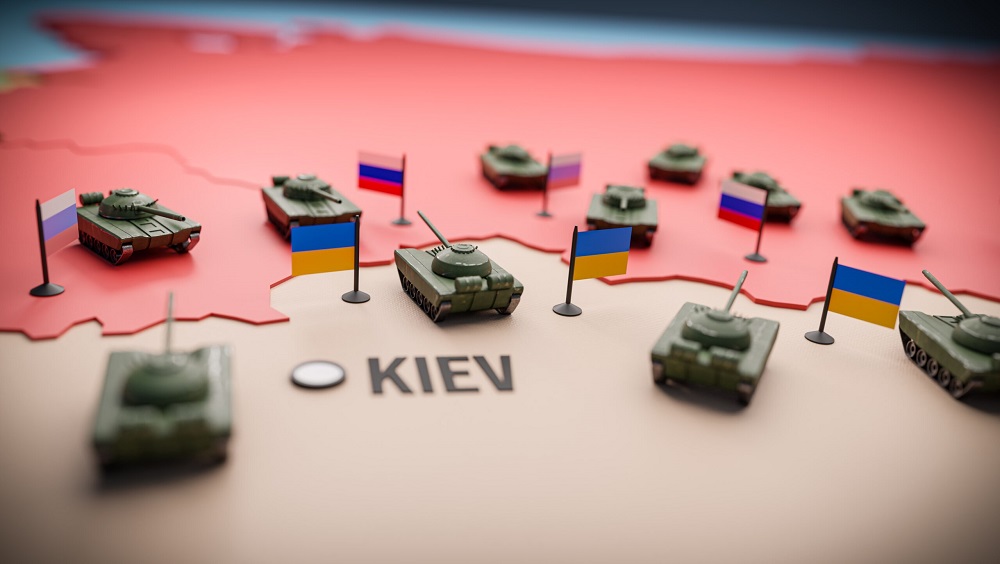
Veterans of Combat Operations as a New Systemic Factor in Ukrainian Domestic Politics
In the first part of our study we examined the social and political role of “SVO veterans” in the contemporary political and public landscape of Russia. We concluded that this role is not only significant—it is configurational and systemic, and it is not painted strictly in black or white. This article focuses on the other side of the conflict in southeastern Russia and Ukraine and presents an analysis of the social and political roles of veterans of the conflict within Ukrainian politics and society—today and in the near future.
Overcoming vs. Betrayal
To understand the context of the role and patterns of presence of conflict veterans in Ukrainian politics and society, it is first necessary to show the systemic difference in how society perceives the conflict itself and, even more importantly, its future outcome—whatever that outcome may be in geographic or geopolitical terms.
For Russian society, this conflict has already ended in victory. The paradigm of standing against the whole world with its own “Russian truth” is a historical model of perceiving reality in Russia, going back to the Napoleonic Wars and the confrontation with a coalition of states in the Crimean Wars. This is not a Bolshevik invention—the Bolsheviks merely made use of an already deeply rooted paradigm. And in this new round of confrontation, the current generation has endured—just as their ancestors did. Therefore, interpreting this self-perception of Russians as victors solely as the result of agitation or propaganda would be a mistake and an oversimplification, as such a view ignores the centuries-long context.
According to a sociological study conducted by Russian Field, there is no single, fully formed image of victory in Russian society. Respondents defined victory in the SVO as: the annexation of part of Ukraine’s territory and securing new territories for the state (almost one-third of those surveyed); the complete capitulation of Ukraine (13%); “achieving peace so that everyone stays alive” (12.1%); the cessation of Ukraine as a state (9%); the withdrawal of troops and cessation of hostilities (5.9%); the elimination of fascism and a peace agreement on Moscow’s terms (5%); overthrowing the current Ukrainian government (4%); the situation in which Russia and Ukraine now find themselves means “there is no victory” (4%); NATO’s borders being pushed westward (3%); achieving the demobilization and denazification of Ukraine (3%). Such a broad spectrum of symbolic meanings of victory creates a situation in which the attainment of any one of these results can already be perceived as the achievement of victory.
In contrast, perceptions of the conflict’s outcome in Ukraine are increasingly shaped by a narrative of betrayal—by America, Europe, Ukrainian oligarchs, Zelensky; the list can go on. As is perhaps true for any nation, it is difficult for Ukrainians to attribute objective battlefield setbacks to the fault of their own soldiers—this is what forms the narrative framework of “systemic betrayal,” under which the army is fighting. There is no error here, nor a weakness in the Ukrainian government’s propaganda system, nor the influence of some external force—we see the same pattern of perceiving one’s soldiers as heroes acting against a backdrop of external betrayal in dozens of modern conflicts, from the Middle East to the former Yugoslavia and Africa.
Thus, for Ukrainian society—we emphasize, regardless of any objectively realistic outcome—the conflict does not end in victory, because the causes and consequences of betrayal, as well as the actors responsible for it, do not disappear. In early 2024, Ruslan Bortnyk, Director of the Ukrainian Institute for Analysis and Management of Policy, said in an interview with the YouTube channel “Novini Live”:
“Data from sociological surveys show that Ukraine has already lost the information war to Russia… We are losing faith in the future of Ukraine, faith in victory <…> both inside Ukraine and outside Ukraine — all the sociology shows this.”
At the same time, it should be noted that this does not imply defeatism in Ukrainian society. The country sees itself as fighting and demonstrating heroism in this struggle. According to a public opinion poll conducted by the Democratic Initiatives Foundation and the Razumkov Centre in August 2025, almost 73% of respondents believe in the possibility of Ukraine’s victory in the conflict with Russia. However, the substance of what constitutes “victory” looks quite different from what one might assume.
For most respondents, the three main signs of Ukraine’s victory in the conflict would be the return of all Ukrainian prisoners, the deported and the kidnapped (37%), the preservation of Ukrainian statehood (31%), and the cessation of missile attacks on Ukraine (29%).
According to another survey conducted in June by the SOCIS Center, the Janus Institute, and the publication Barometer of Public Sentiment,
the majority of Ukrainians — 72.3% — support ending the conflict along the current front line. Among them, 55.7% support seeking a compromise solution with the participation of international mediators, while 16.6% are in favor of temporarily freezing the conflict at its current positions. Continuing military action is supported by 21.4% of respondents: 12.8% — until the 1991 borders are restored, and 8.6% — until the line of 23 February 2022 is reached.
Two different visions of the conflict’s outcome — “victory as the result of resilience against the whole world” (Russians) and “forced concessions despite heroism at the front, caused by widespread and multifaceted betrayal” (Ukrainians) — produce two different contexts for how conflict veterans are incorporated into the political and social framework. It is important to stress that we are speaking here strictly about social perception. Assessing the real future outcomes of the conflict, its course, and especially its causes lies outside the scope of this paper.
A Party of Generals? No — Parties of Generals
Public trust in the Armed Forces of Ukraine had remained consistently high since 2014, when Russia annexed Crimea and Ukraine’s military operation in Donbas began. By 2015, 55% of Ukrainians reported in surveys that they trusted the armed forces.
This figure was high but not extraordinary — in the same poll, the Church surpassed the army (62%), and public institutions and media nearly matched it (46% and 45% respectively). However, in 2022 a dramatic shift occurred — trust in the Armed Forces of Ukraine rose to an unprecedented 95%.
Not only the political class but also the population at large wants veterans to enter active politics. A survey conducted on 2 September 2024 by the Razumkov Centre and the Ilko Kucheriv Foundation for the CHESNO movement showed that 70% of citizens view the entry of veterans into politics positively; only 8% — ten times fewer — view this negatively. Figures associated with the active military have become a highly sought-after political resource across the entire spectrum of Ukrainian politics.
At the same time, there is an accumulated but not yet realizable potential for electoral pressure. Elections remain suspended under wartime conditions. Ukrainian law does not allow presidential elections under martial law. Martial law has been extended in 90-day intervals since the beginning of the full-scale invasion, with parliamentary approval, and very recently (as of November 2025) it was extended for the 17th time, until 3 February 2026.
So what political offer is being shaped by the “veteran elite” and by grassroots veterans as opinion leaders? Here we again find a systemic divergence from the position of SVO veterans in Russian politics. In Russia, SVO veterans constitute a stable, almost monolithic, and active bloc of support for the authorities and for President Putin personally. Numerous attempts by both systemic and non-systemic opposition forces to draw any high-profile SVO veterans into their orbit have failed. This is not due to the weakness of the opposition or to obstacles imposed by the regime — it is the societal perception of the SVO, discussed at the beginning of our analysis, that resists such attempts.
The situation in Ukraine is structurally different. The same “electoral bottleneck” — the repeated cancellation of elections and, more broadly, the suspension of political life — has electrified and polarized the political environment. A high-profile poll by the Rating Sociological Group,
conducted 21–23 August 2025, showed that trust in Zaluzhny stands at 74%, compared to 68% for Zelensky and 59% for the head of Ukrainian intelligence, Kyrylo Budanov. Meanwhile, according to the same poll, if presidential elections were held, Zelensky would receive the most support (35.2% among all respondents), with Zaluzhny in second place (25.3%). The chart shows that since July 2025 Zelensky’s rating rose from 30.7% to 35.2%, while Zaluzhny’s rating also increased, though less significantly — from 24.8% to 25.3%.
Two national leaders — one leading in trust, the other in electoral preference — represent a vivid indicator of political polarization at the level of choosing the head of state. And in this process, out of the three leading figures, two are generals of the southeastern conflict: Budanov and Zaluzhny.
The party-political landscape shows the same pattern. According to the same poll, in parliamentary elections a hypothetical “Zaluzhny Party” would take first place with 23.7%, followed — with a significant gap — by a hypothetical Zelensky Bloc at 19.7%. Behind them would be “European Solidarity” (7.4%), a hypothetical Budanov Party (6.4%), and the Azov Party (5.9%). As we can see, three out of the five parties that would currently pass into parliament — if elections were held today — are parties led by generals-veterans.
Response of the authorities
The apparatus of Volodymyr Zelensky is looking for a response to the growing political ambitions of veteran-politicians and the growing social influence of veterans who are opinion leaders, in the same way Vladimir Putin does — by creating mechanisms to draw prominent figures from this environment into the system of power, thereby depriving opponents of the opportunity to make veterans their key political assets. In fact, this is what any government does in such situations — one only has to recall the mechanisms used to integrate Middle East war veterans into the governing structures of the United States.
The Ministry of Veterans Affairs of Ukraine, established in 2018, implements, among other things, programs that help veterans advance into government structures. The Law “On the Status of War Veterans” (No. 3551-XII, with 2022 amendments) provides for priority employment in state institutions. However, only in 2025 did discussions begin on introducing quotas for veterans in government bodies: on 25 July 2025, hearings were held on the topic “Is a legally established standard for employing war veterans necessary?” at the Committee of the Verkhovna Rada on Social Policy and Protection of Veterans’ Rights.
Back on 2 December 2024, the Cabinet of Ministers of Ukraine approved at its meeting the Strategy for Veterans Policy for the period until 2030 and the Operational Action Plan for its implementation for 2024–2027. An important part of these documents consists of projects aimed at integrating veterans into the structures of public administration.
Pro-government civil society organizations are also active. The CHESNO movement, a civic organization, launched the “Veteran Leadership Program” to provide veterans with the knowledge and skills needed to participate in political and public life. TThe program includes multi-module training on topics such as the state and law, leadership, and communications, and is supported by the Embassy of the Netherlands and implemented in partnership with the Ukrainian Catholic University. It also offers opportunities for international study, for example a program at the University of Warwick in the United Kingdom, to expose veterans to best global practices. This project is perhaps the closest analogue to the Russian “Time of Heroes” initiative, which we described in the first part of our study.
It should be noted that the complexities of Ukrainian bureaucracy have created a huge gap between those participants of the armed conflict in the southeast who are officially recognized as veterans and are within the scope of government reintegration efforts, and those who also participated in combat but did not receive veteran status.
Even official Ukrainian sources provide figures for the number of veterans that differ by tens or even hundreds of times. “We have a million service members, and only 40,000 received veteran status. This is very wrong,” said Vitalii Deineha, then Deputy Minister of Defense, in July 2023. This is one status with one set of benefits. As of 1 September 2025, the Unified State Register of War Veterans lists 1,326,552 people with combatant status; most received this status after 2022 — another status with another set of benefits. Meanwhile, according to UN sources, the Government of Ukraine estimates that the number of veterans and their family members may reach between five and eight million.
The reverse process is also noticeable — acting officials and deputies leaving for military service in the combat zone. Here again there is a parallel with a similar process in Russia, which we described in the first part of the report.
In the Chernivtsi City Council, 26% of deputies have served in the military. All of them perform combat missions as part of Ukraine’s military formations. The Dnipro City Council is behind Chernivtsi by only 1% in terms of deputies who have either switched to military service or combine their city council work with service in the armed forces. In the Kyiv City Council, 23% of deputies have taken this path.
A general figure was provided by Ukraine’s Minister of the Cabinet of Ministers (a minister without portfolio) Oleh Nemchinov: “In total, by the end of the year there were 3,637 such individuals (civil servants fighting in the conflict zone — ed.). Unfortunately, as of year-end, 108 civil servants had been killed, 80 wounded… more than 200 officials were considered missing.” And these are only the 2023 data; more recent figures have not been published anywhere.
Criminal context
As in Russia, in Ukraine organized crime views veterans as a traumatized and therefore vulnerable segment of society — while at the same time possessing skills valuable in the criminal environment.
But there are also significant differences between the criminal dimension of the veteran issue in Russia and in Ukraine.
For Russia, the issue of desertion from the army and living in illegal status is almost irrelevant. After the well-known attempt to conduct a partial mobilization in September 2022, which caused extremely negative processes for the authorities, including mass emigration, a decision was made to shift to a fully contract-based model for forming units in the SVO zone. This has made desertion isolated and infrequent.
In Ukraine, the situation with conscription developed differently. From the beginning of full-scale hostilities in the southeast until October 2025, law enforcement agencies registered 311,327 criminal cases against active service members (255,000 for unauthorized abandonment of a unit and 56,200 directly for desertion). According to estimates by the reputable Spanish newspaper El País, which cites information from authorities in Kyiv, about 1.5 million men of conscription age are evading service in the Ukrainian army. Thus, around one and a half to two million men are forced to live in semi-legal or illegal conditions, making them vulnerable to criminal pressure. Three hundred thousand of them are those who served in combat units in the conflict zone.
Another difference in the criminal component of the social presence of combat veterans on the Russian and Ukrainian sides is the international context. The policy of isolating Russia has led to a paradoxical result — Russian organized crime has also become “toxic” for criminal groups in other countries. The situation regarding Ukraine’s organized crime is developing differently.
In its recent report on Ukrainian veterans of the conflict, the German Marshall Fund of the United States notes the possibility of a negative scenario for the entire world, in which there will be “an increase in criminal activity among some veterans and a risk of radicalization among some of them.” And this is not a projection for the future.
The French outlet Intelligence Online reported that Mexico’s National Intelligence Center (CNI) had warned Ukraine about individuals connected to drug cartels who were voluntarily joining Ukraine’s International Legion in order to gain experience with first-person-view (FPV) kamikaze drones for use in their own internal wars against other cartels and Mexico’s security forces. Ukrainian authorities treated the information extremely seriously. The Security Service of Ukraine (SBU) and the Main Directorate of Military Intelligence (HUR) created a specialized unit to begin a joint investigation, focusing primarily on Spanish-speaking volunteers from Colombia, Mexico, and other Central American countries.
According to Intelligence Online, citing a Slovak security source, at least three former fighters of the Revolutionary Armed Forces of Colombia (FARC) joined the International Legion using Panamanian and Venezuelan documents. One of them was eventually identified by the SBU at a drone-training center in Dnipro because his gang tattoos gave him away.
These illustrations — and they are no more than illustrations — show that the reintegration of veterans of the southeastern conflict from Russia and Ukraine, just like the conflict itself, cannot be viewed as an internal affair of Russia and Ukraine. The consequences and impact of this conflict affect the entire world.
Nikolai Alexandrovich Berdyaev, the great Russian and French philosopher, one of the intellectual leaders of the post-revolutionary émigré community and the author of the concept of the “new Middle Ages,” once said: “War, in itself, does not create new life; it is only the end of the old, a reflection on evil.” The twenty-first century adds a minor amendment to this statement: war does not create the new — it reassigns positions and roles for what already exists. Veterans of the conflict from Russia and from Ukraine are individuals, including political individuals, who receive such reassignment.
Alexander Shpunt is an Israeli and Russian researcher and expert in the theory and practice of information and analytical work in the field of politics and resides in Haifa. Since 2016 he has served as a professor at the National Research University “Moscow Higher School of Economics. In 1999–2011 he also served as the executive director of the “Effective Policy Foundation”, the largest think tank in the RF at that time, and in 2011 founded and headed the Institute of Political Analysis Tools, specializing in systems for monitoring political behavior.
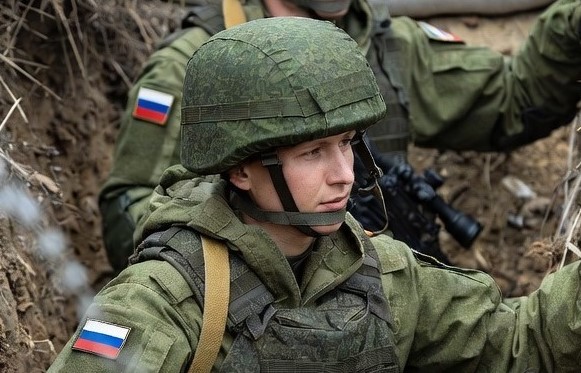
SVO Veterans’ as a New Systemic Factor in Russian Domestic Politics
PSCRP-BESA Reports No 165 (November 16, 2025)
The military phase of the conflict in the south-east of Russia and Ukraine is far from over. More than 700,000 Russian servicemembers are simultaneously “on the line of contact”—and these are not experts’ estimates or opposition talking points. President Putin stated this officially on 18 September during a meeting with the leaders of political party factions in the State Duma. And this is not an estimate of the total number of veterans today; it is only those who are at one and the same time located in the combat zone.
Let us note at once that assessing the causes, the course, and especially the responsibility of the parties in the conflict in the south-east of Russia and Ukraine is not the purpose of this piece. Many materials have been published on these questions, and everyone can form their own view.
The aim of our work is to analyze how this conflict is systematically changing the domestic political field in Russia by forming a fundamentally new mass cluster of “SVO veterans,” and to examine how the Russian authorities and other political forces are organizing their work with this cluster.
The experience of Soviet veterans of the conflicts in Afghanistan and, later, in the Chechen Republic suggests to the authorities, the opposition, loyal political parties, and bureaucratic institutions alike that we are facing an entirely new, formative factor in the Russian domestic political landscape—the “SVO veterans.”
Over ten years of conflict in Afghanistan, only 546,000 Soviet soldiers served there. If we extrapolate the figures cited by the Russian president to the dynamics of personnel rotation within the active military units in the SVO zone, we can already reasonably speak of 1.1 to 1.4 million veterans. And since the hostilities are far from over, the influx of new servicemen into the SVO zone continues unabated.
Yet even more important than this enormous number are the fundamentally different qualitative characteristics of this new cluster within Russian society.
A Completely Different Forrest Gump
First and foremost, the army deployed in the conflict zone is composed on a contractual basis. The authorities recognized the mistake of September 2022, when the decision to launch a mass mobilization led both to large-scale emigration and to a surge of opposition sentiment. Almost immediately afterward, instead of continuing mobilization, Russian citizens were offered military contracts under conditions that multiplied income levels compared to the civilian sector.
For example, in Moscow, during the first year of the program, a contract serviceman received from 5.2 million rubles annually, while the average median annual salary in Russia at that time was 700,000 rubles.
This shift not only made it possible to abandon the mobilization model of recruitment but also created a surging demand for military contracts, especially in depressed regions. One can cite the phenomenon of the so-called “Buryat warriors” — modern social mythology emphasizes the particular bravery of soldiers from this region of Russia. For the purposes of our analysis, it is notable that in 2022 Buryatia ranked 69th out of 89 Russian regions in terms of civilian income levels.
Today, even the most extreme opponents of the Russian government no longer raise the issue of mobilized servicemen in the SVO zone.
Closely related to this is a second factor: the elitization of SVO contract soldiers’ families. The multiple increase in family income among those who chose a military contract in the combat zone has sharply distinguished them—both in income and consumption—from their neighbors. For some, this has become a source of envy and resentment; for others, a model and an example to follow.
In either case, this new regional mass elite—especially in depressed areas, in villages, and small towns—has begun forming a new public demand for higher-quality urban environments. This new elite is willing to pay for better conditions, yet local authorities offer them no such opportunities. This applies to modern urban planning, safety, healthcare, and children’s education. In short, families of SVO soldiers now have money, but nowhere to spend it, as the state has not created a proper environment for that.
This situation generates sharp social frustration. And even now, across various social media pages and groups of SVO servicemen, the theme is increasingly voiced: “We’ll come back and take power into our own hands at home.”
The third characteristic of the future “SVO veterans,” with which the authorities, the opposition, political parties, and even the mafia are learning to work, is the so-called “military rehabilitation” of convicted criminals.
The practice of substituting prison sentences with military service in the SVO zone, followed by full restoration of rights, began during the period of active participation in the conflict by the private military company “Wagner,” but only intensified after that structure faded from public attention.
Let us cite just one illustration of this factor. Quite recently, on September 28, information was published that members of the “Vityaz” special unit of the Ministry of Internal Affairs—who had received long prison sentences and were responsible for at least 40 deaths—have been leaving for the SVO one after another. Less than a month after his sentencing, Lieutenant Colonel Aleksei Chebotarev, who had received 15 years for 12 murders, signed a contract with the Ministry of Defense; before him, another senior officer, Andrei Yakhnev, had done the same. This process continues.
It is important to note that this information was published not by opposition outlets, but by loyal media.
Of course, it would be incorrect to claim, as some biased authors from the Russian opposition do, that “only criminals are fighting in the SVO zone.” Let us leave polemics and propaganda to their participants—on both sides. If there are 700,000 soldiers in the SVO zone, then several hundred or even several thousand convicted criminals who signed contracts under the “military rehabilitation” program constitute a statistically insignificant number.
However, not everything is determined by statistics. As we can see from the example above, this involves not ordinary gangsters but corrupt senior officers of special forces units. It is not our goal to assess the government’s decision. Its desire to make use of the combat experience of officers who fought in numerous local conflicts, earned military decorations there, and later turned to crime is debatable but understandable. Similar examples can be found in the practice of dozens of other countries, including “old democracies.”
What is important for our study is that the Russian authorities face an extremely difficult task: integrating these officer-criminals when they return home as heroes from the fronts of the military operation. Few governments that have embarked on such a path have managed to succeed in this task.
There is also a fourth feature that we would like to draw the reader’s attention to when analyzing the social profile of future “SVO veterans.” This is the group of officials who view their military contracts as a springboard for career advancement within the state apparatus.
Sergei Efremov, deputy mayor of the small district center of Ussuriysk in the Primorsky region, went to the SVO zone under contract and returned as the region’s vice-governor.
The mayor of Orenburg, Sergei Salmin, decided to leave his post and go to the zone of the special military operation (SVO). This was reported by the governor of the Orenburg region, Denis Pasler, in his Telegram channel.
“The deputy head of the city administration of Ukhta in the Komi Republic, Vitaly Zarubin, voluntarily went to serve in the zone of the special military operation,” was also announced by the regional head, Governor Vladimir Uyba.
Pavel Malykh, head of the Road Construction Department of the Ulan-Ude city administration, the capital of the Republic of Buryatia within Russia, was one of the first to move from government structures to military service back in 2022, becoming one of the creators of the positive myth of the “Buryat warrior” we mentioned earlier.
Following him, Deputy Chairmen of the Government of the Republic of Buryatia Aldar Gulgenov and Ivan Alkheev, as well as Minister of Agriculture Amgalan Darmaev, also decided to volunteer for the SVO.
Even this short list of examples shows how widespread this process has become among the Russian elite.
In many ways, Russia is simply repeating the path of the United States, where military service first became an entry ticket into politics for many and today is almost a mandatory element of nomination for elected office. Three decades of military involvement in conflicts in the Middle East have led to a situation in which, by 2023, 18% of members of the U.S. House of Representatives and 17% of senators were veterans.
Has the “Time of Heroes” arrived?
With the collapse of the Soviet regime, Russia also lost the communist system of training managerial elites.
Despite its ideological rigidity, that system was distinguished by its coherence and effectiveness in selecting promising—and, of course, loyal—technocrats.
Beginning with the identification of potential leaders at a very early age through the “Little Octobrists” movement, the system culminated in a special group of already mature leaders, informally known as the “Central Committee Nomenklatura.” This was not merely a list of positions; it also represented a personal status for an official or executive, independent of their job title. To be part of the Central Committee Nomenklatura meant receiving a mandate of trust from the top leadership of the Communist Party of the Soviet Union (CPSU)—a mandate that served as a unique springboard for career advancement.
We describe this in such detail because it was precisely the “Central Committee Nomenklatura” model that Vladimir Putin adopted as the basis for forming a managerial elite when, in October 2017, he instructed his administration to organize the “Leaders of Russia” competition for public managers. This mechanism of personnel selection proved highly effective: as of September 2025, ten current regional governors had come through the “Leaders of Russia” program. This is in addition to several dozen federal ministers and deputy ministers, mayors of regional capitals, and heads of national state corporations.
This system for generating a new technocratic, loyal, and fundamentally apolitical bureaucratic elite is an extremely interesting topic in itself; however, it is not the focus of our report.
What we would like to draw the reader’s attention to is a new offshoot within this system—the “Time of Heroes” school for senior management personnel, specifically oriented toward veterans of the military conflict in the south-east of Ukraine and Russia.
The “Time of Heroes” program was launched on March 1, 2024. And already, following the regional head elections in September of this year, a participant of the first cohort, Evgeny Pervyshov, became governor of the Tambov Region after having been appointed acting governor in November of the previous year. Another participant in the program, Maria Kostyuk, became head of the Jewish Autonomous Region, having served as acting governor since November 2024.
The Kremlin’s reliance on civilian officials who have served on the front lines carries both opportunities and risks.
It is clear that this group of officials will demonstrate higher loyalty than those who have not seen combat. Their motivation for service—in this case, in the civilian administration—will also be stronger.
However, war is a place of simple and radical decisions, not conducive to balance or compromise. It is only natural that many former officers and generals will carry this inclination toward simplicity and radicalism into their civilian service as well—a pattern observed many times in other countries that have already gone through the process of integrating military leaders into the civilian administrative system.
It is still too early to say how this systemically new phenomenon for Russia—the arrival of veterans of the southeastern conflict into positions of local power—will ultimately unfold.
The New Owners of the Electorate
Not only the Administration of the President of Russia but also political parties—across the entire legal spectrum—are striving to recruit veterans as their activists.
Today’s social structure in Russia offers few positive role models. The figure of the “warrior” is unquestionably a positive one, regardless of how various audiences may feel about the conflict itself in the south-east of Ukraine and Russia.
This is precisely what drives all political parties, without exception, to actively compete for returning veterans.
The ruling pro-Putin party United Russia offers veterans the opportunity to start a business through the “SVOy Business” program or to gain a new profession via party initiatives such as “My Career with United Russia.”
In September of this year, the Communists of the CPRF nominated “around 50” veterans for election, according to the party’s first deputy leader, Yuri Afonin. In August, the chairman of the A Just Russia party, Sergei Mironov, appealed to the Russian Ministry of Education with a proposal to involve SVO veterans in teaching a new school subject, “Fundamentals of Security and Defense of the Motherland.”
The Liberal Democratic Party (LDPR) has chosen the path of directly integrating veterans’ organizations into its party structures— in July, Oleg Panchurin, head of the Union of Veterans of the Special Military Operation, joined the party’s executive apparatus.
The Embrace of Crime
For understandable reasons, the available information cannot fully reveal how criminal structures are preparing to absorb returning veterans from the front. However, it is clear that for organized crime, this group represents an important recruitment target.
According to estimates by the Russian opposition, at least 1,130 veterans of the conflict in the south-east of Russia and Ukraine have been charged with “civilian” crimes—ranging from traffic violations to murder. In roughly two-thirds of the verdicts, judges considered participation in the “SVO” a mitigating circumstance—and this, too, attracts the attention of criminal bosses.
Another opposition source reports that over the past three years, participants in the war in Ukraine have committed at least 334 “fatal” crimes.
Of course, it should be taken into account that these data come from opposition sources, which are clearly biased in everything related to the conflict in the south-east. Nevertheless, even simple operational monitoring of crime reports shows that the phenomenon exists and is far from isolated.
As mentioned earlier in this report, a certain number of servicemen ended up on the front through the so-called “military rehabilitation” program, which allowed them to avoid criminal punishment for past offenses. The legal basis for this was provided by a special federal law, adopted on March 23, 2024.
Even if their crimes were non-violent, combat experience teaches not only the handling of weapons but also their use in real conditions. Post-traumatic stress among veterans and their social maladaptation to civilian life push some of them into criminal circles—where organized crime bosses are already waiting.
Unfortunately, this pattern is confirmed by the experience of American veterans of Vietnam, French veterans of Algeria, and likewise by the experience of some Soviet veterans of Afghanistan and Russian veterans of the conflict in the Chechen Republic.
***
In this brief report, we have outlined only the main vectors of the positive and negative reintegration of the vast social group returning from the front to civilian life. This tectonic factor for Russian society has far more dimensions and projections than could be covered here. Nevertheless, it can already be reasonably stated that it is the SVO veterans who will become the key force shaping domestic political processes in Russia in the foreseeable medium term.

Peace and War Perspectives in the Public Opinion in Russia and Ukraine
The diplomatic blitz undertaken in August 2025 by the U.S. president, during which Donald Trump and members of his administration sought to persuade the leaders of Russia and Ukraine to make mutual concessions in order to end the active phase of the war that has been ongoing between these countries for three and a half years, had, as of this writing, produced no clear results that were even roughly acceptable to all sides. Although, according to the media, President Trump still assures his allies that the talks are proceeding according to plan, in practice these negotiations—which were supposed to culminate in a trilateral summit within a week—are moving slowly.
President Donald Trump’s hopes for a meeting between Vladimir Putin and Volodymyr Zelensky to conclude a peace agreement have not been realized, and Trump’s fallback plan, which envisaged a personal meeting between the presidents of Russia and Ukraine, has likewise not materialized. As a result, according to The Washington Post’s commentators, “recent optimism has faded, and Trump is looking for new answers.” One such answer, according to a remark by a disappointed Trump quoted by the media, is that if Kyiv and Moscow fail to reach any agreement in the very near future, Washington will withdraw from the negotiating process, leaving them to sort out their relations on their own.
Whether such a turn will occur or not, and what the subsequent course of events might be if either of the two scenarios is realized, depends on numerous strategic and operational circumstances. Not least among them are the level of trust in the leaders and the prevailing attitudes toward continuing military action or achieving peace as quickly as possible—not only among the elites but also among the publics of the two countries. A general—yet, by all appearances, fairly accurate—picture of these sentiments is provided by a series of polls conducted from May to August in the two countries by four reputable sociological agencies. In Ukraine, they were carried out by the American research service Gallup; the Kyiv International Institute of Sociology (KIIS); and the Sociological Group “Rating.” In Russia, similar research on related topics was conducted by the Moscow-based Yuri Levada Analytical Center (the Levada Center).
Do Ukrainians Want the War…
The full-scale invasion of Ukraine by Russian forces on February 24, 2022, the collapse of Moscow’s plans to achieve Kyiv’s military and political capitulation within weeks, and the subsequent counteroffensive launched by the Armed Forces of Ukraine (AFU) a few months later resulted in a powerful surge of patriotism and unity within Ukrainian society. Despite the disappointment over the unsuccessful conclusion of the AFU’s active offensive operations in the summer and fall of the following year, 2023, and the transition of the conflict into a “war of attrition,” the overall mood of public sentiment initially changed very little. This was all the more so as subsequent events demonstrated that Russia, despite its overwhelming advantage in manpower and material resources, was incapable of securing a decisive victory over Ukraine.
On the other hand, it also became clear that Ukraine, despite massive military, financial, and diplomatic support from Western countries, was likewise unlikely to achieve a breakthrough on the battlefield. Growing awareness of this long-term reality, against the backdrop of mounting fatigue and a decline in the population’s willingness to be conscripted into the AFU, reinforced the public’s inclination to move toward negotiations that could bring the war to an end. Nevertheless, at least until mid-2024, for the majority of Ukrainians, judging by public opinion polls at the time, anything less than the withdrawal of Russian troops and the restoration of the country’s sovereignty within its “1991 borders” was hardly a matter of serious discussion.
It should also be noted that in Russia, by that time, more than half of the population, according to a Levada Center poll, supported a transition to peace negotiations. Yet at the same time, three-quarters of Russians, according to the same data, believed that Russia should not make concessions to Ukraine in order to end the “special military operation” and sign a peace agreement. All this, at least in the context of public opinion, looked like a “dead end,” with virtually no rational solution.
A certain shift in public sentiment, at least on the Ukrainian side, became noticeable with Donald Trump’s return to the White House in January 2025. As is well known, he made ending this largest military conflict since World War II one of the main foreign policy priorities of the first half of his second presidential term—albeit, as noted above, still without much success. Thus, according to Gallup’s annual monitoring, in 2022 and 2023 only 22% and 27% of surveyed Ukrainian citizens, respectively, favored a diplomatic resolution of the conflict, while 73% and 63%, respectively, believed it was necessary to fight until Kyiv had fully restored sovereignty over all Ukrainian territories seized by Russia.
A turning point in attitudes occurred in 2024, when more than half (52%) of respondents supported a diplomatic solution, while those in favor of continuing the war until full victory over Russia (36%) found themselves, for the first time, in the minority. A year later this gap became even more striking: by July 2025 the share of respondents who believed that Ukraine should seek to negotiate an ending to the war as soon as possible had reached 69%, while only about a quarter (24%) of Ukrainian citizens still insisted on a military solution. Moreover, according to this study, “support for the war effort has declined steadily across all segments of the Ukrainian population, regardless of region or demographic group.”
Similar trends were captured by surveys on Ukrainians’ perceptions of peace plans, conducted in May and again in late July–early August 2025 by the Kyiv International Institute of Sociology (KIIS). According to their findings, despite the continuation of active hostilities and the heavy civilian toll from Russian air and missile strikes on Ukrainian cities, public opinion still shows a readiness for negotiations. Thus, the joint Kyiv–Brussels plan, which envisaged Ukraine obtaining reliable security guarantees from Europe and the United States, advancing toward EU membership while Russia retained control of the occupied Ukrainian territories, and—should a stable peace be achieved—the gradual easing of international sanctions on Moscow, was supported in the two polls by 51% and 54% of respondents, respectively (with 35% and 31% opposed).
By contrast, Moscow’s plan—which, in exchange for agreeing to Ukraine’s progress toward EU membership, demanded a substantial reduction of Ukraine’s army and armaments, its renunciation of NATO membership, official recognition of Russia’s annexation of Crimea and the entirety (i.e., including the areas still controlled by Kyiv and the AFU) of Donetsk, Zaporizhzhia, and Kherson regions, as well as the lifting of all Western sanctions against Russia—was rejected by 82% of respondents in May and 76% in July–August.
Finally, the intermediate American “Trump–Vitkoff plan” is, according to the KIIS survey conducted in July–August 2025, accepted by 29% and 39% of respondents, and rejected by 62% and 49%, respectively. This can be seen as a consequence of the decline—documented in the Gallup Agency’s research—in the status of the United States as Ukraine’s main military ally, which in the eyes of Ukrainian society fell from 66% in 2022 to just 16% in 2025.
A similar result was obtained in a study conducted three weeks later (August 21–23, 2025) by the Sociological Group “Rating”: 59% of respondents supported stopping the fighting on the battlefield and seeking a compromise, 20% supported fighting until the return of Donbas and Crimea, and 13% supported fighting until the demarcation line/borders as of February 23, 2022, are restored. At the same time, 82% considered negotiations to be a realistic way to end the war (62% in favor of finding a compromise with the involvement of other countries, 20% in favor of direct negotiations with Russia).
In other words, judging by the slight increase in the share of those willing to support at least one of the proposed plans, Ukrainians today—albeit reluctantly—are allowing for the possibility of endorsing difficult decisions. At the same time, however, most Ukrainians harbor no particular illusions about the prospect of an imminent peace. Only 25% of KIIS respondents in the summer of 2025 believed that active hostilities were likely to end within the next 12 months, and just 5% assessed this probability as “high,” while 68% considered the end of the active phase of the war within a year unlikely.
Roughly the same opinion was held by Ukrainian citizens surveyed in May 2025 by the Kyiv-based Sociological Group “Rating”: only a quarter of respondents at that time believed that the negotiations then taking place in Turkey would bring Ukraine closer to peace. Nevertheless, three-quarters (74%) supported the then-relevant initiative (before Trump agreed to Putin’s proposal of “negotiations under fire”) for a 30-day unconditional ceasefire, believing that Ukraine should continue to demonstrate openness to dialogue. And nearly half (47%) thought that President Zelensky—whose approval rating among Ukrainians had stabilized at 70–74%, compared to 53–58% at the beginning of the year—could participate in such talks even in the absence of his Russian counterpart.
… and Do Russians Want Peace?
Given that “it takes two to tango,” it is important to understand what messages Russian society is sending to the authorities—or, more precisely, how in today’s Russian context the messages delivered through the media by the country’s leadership resonate with the public. An answer is provided to a large extent by the nationwide survey published in June 2025 by the Moscow-based Levada Center, whose report included comparative data from its ongoing monitoring of Russian attitudes since 2022.
According to this report, the peak share of respondents who considered it “definitely” or “rather” necessary to continue military operations in Ukraine (a combined 48%) was recorded in May 2023; at the same time, 45% of respondents thought it “rather” or “definitely” made sense to start peace negotiations. Two years later, in May 2025, the picture appeared to have shifted almost radically. Only 28% of respondents insisted on continuing the war, while nearly two-thirds (64%) of surveyed Russians believed that it was now time to move to peace negotiations—both record highs for peace supporters and record lows for proponents of continued fighting across all years of Levada Center research. At that time, an overwhelming majority of Russians—87%—supported talks between the Russian and Ukrainian sides in Istanbul; only 6% held the opposite view.
Two months later, in July 2025, two-thirds of Russians still supported the idea of moving to peace negotiations rather than continuing military action (a position held by less than one-third of respondents). This can therefore be seen as a fairly stable trend. Adding to this, nearly half of those surveyed in September 2024 said that the “special military operation” in Ukraine had brought Russia more harm than good—almost twice the share of those who thought otherwise (by May of that year, amid the new U.S. administration’s apparent “understanding” of Russian interests, the gap was less stark: 40% versus 33%). Taken together, the obvious conclusion is that Russian society has a clear demand for winding down the military campaign.
It is also reasonable to assume with a high degree of confidence that the majority of Russian citizens would be ready to support President Vladimir Putin, whatever peace formula he might propose. Indeed, as Russian researcher Alexey Levinson noted in early 2025, citing Levada Center survey data, when asked the hypothetical question, “Would you support President Putin if he decided this week to end the military conflict with Ukraine?” 65% of male respondents and 79% of female respondents answered positively.
However, rushing to such a conclusion is clearly premature. Responses to follow-up questions in the same study, cited by Levinson, regarding whether Russian citizens believed that Russia should make certain concessions to Ukraine in order to end the war and sign a peace agreement were negative in 65–77% of cases. In the following months this picture hardly changed: in July 2025, among various scenarios for ending the Ukrainian conflict, nearly three-quarters of respondents (73%) supported the option under which the parties would first eliminate the “root causes of the conflict” (which, according to the official government narrative, meant Kyiv’s departure from Moscow’s sphere of influence and its movement toward NATO and EU membership), and only after that agree to a ceasefire. The opposite view—that there should first be a ceasefire and end of hostilities, followed only later by resolution of other issues—was shared by just 18% of respondents.
“As much as people may want a ceasefire, the majority of respondents believe that the decision should be made by the authorities—‘they know better, and we are just ordinary people,’” observes Moscow sociologist Denis Volkov. “Most Russians have long wanted peace, but they leave the resolution of this issue entirely in the hands of the authorities” .

The Nuclear Dimensions of the War in Ukraine
PSCRP-BESA Reports No. 136 (June 24, 2025)
The threat of Russia using tactical nuclear weapons largely fuels public “nuclear” fears associated with the war in Ukraine. However, the less visible “nuclear” dimension of the war—with a more tangible impact—is the effect of the conflict on nuclear sites in Ukraine.
The war in Ukraine has created an unprecedented global crisis with devastating humanitarian consequences. Against this backdrop of immense human suffering, the nuclear safety and security implications might seem secondary. Yet the conflict has introduced an entirely new challenge: the first war fought in a country with a major nuclear power program, with risks and long-term implications that extend far beyond Ukraine’s borders. Unlike conventional warfare damage, a nuclear accident could affect neighboring countries and persist for decades. The legacy of Chernobyl—still fresh in the collective memory—adds particular gravity to attacks on nuclear facilities in Ukraine.
Ukraine operates one of Europe’s most extensive nuclear power programs, comprising four active nuclear power plants with 15 operational reactors: Zaporizhzhia NPP (6 VVER-1000 reactors, Europe’s largest nuclear facility), Rivne NPP (2 VVER-440 and 2 VVER-1000 reactors), South Ukraine NPP (3 VVER-1000 reactors), and Khmelnytskyi NPP (2 VVER-1000 reactors). Additionally, the Chernobyl Nuclear Power Plant, site of the 1986 disaster, houses four decommissioned RBMK-1000 reactors that were permanently shut down between 1991 and 2000; the facility now serves as a decommissioning and waste management site. Before Russia’s invasion in February 2022, nuclear power generated approximately 50–55% of Ukraine’s total electricity, making Ukraine the country with the second-highest nuclear share globally after France. Beyond power generation, Ukraine hosts several nuclear research facilities, including the research reactor at the Institute for Nuclear Research of the Ukrainian Academy of Sciences in Kyiv, a subcritical assembly at the Kharkiv Institute of Physics and Technology, and a research and training reactor at the Sevastopol National University in Russian-occupied Crimea.
Attacks Against Nuclear Sites
The war went “nuclear” immediately. Russian forces captured the defunct Chernobyl Nuclear Power Plant (ChNPP) on the first day, within hours of Russia’s invasion on February 24, 2022. The most significant escalation occurred on March 4, 2022, when Russian forces attacked and captured the Zaporizhzhia Nuclear Power Plant (ZNPP), Europe’s largest nuclear facility. Shelling damaged the plant’s training building and set it ablaze. While the reactors themselves were not hit, the attack demonstrated that nuclear facilities were no longer off-limits in this conflict. Russian forces withdrew from Chernobyl in late March 2022, but the occupation of the ZNPP continues, creating an ongoing crisis that has fundamentally altered the plant’s operations and safety posture.
The Kharkiv Institute of Physics and Technology, which hosts a nuclear research facility, was heavily damaged by shelling in March and June 2022. An International Atomic Energy Agency (IAEA) mission in November 2022 reported that “the extent of damage to this nuclear research facility is dramatic and shocking, even worse than expected.” However, the mission found no indication of any radiological release or loss of nuclear material.
Multiple explosions occurred in the vicinity of other Ukrainian nuclear power plants—Khmelnytskyi, Rivne, and South Ukraine—without causing direct damage. However, they have experienced numerous issues due to war-related disruptions in the power supply.
Russia has also reported Ukrainian attempts to carry out drone attacks on the Kursk Nuclear Power Plant, located near the Russian-Ukrainian border. However, there is no evidence of damage or independent confirmation of these reports. During Ukraine’s summer 2024 incursion into the Kursk region, Ukrainian forces stopped several dozen kilometers from the Kursk NPP, forcing Russia to implement additional protection measures.
The pattern of attacks has evolved significantly throughout the conflict, with drones becoming the primary threat. In April 2024, drones attacked the ZNPP, hitting a reactor building in the worst such incident since November 2022. On January 28–29, 2025, Russia claimed that Ukrainian drones targeted the Smolensk Nuclear Power Plant during overnight attacks; however, Russian authorities reported that the facility continued to operate normally. On February 14, 2025, an unmanned aerial vehicle hit and severely damaged the New Safe Confinement structure at the ChNPP, marking a concerning escalation in direct attacks on nuclear infrastructure.
As of now, all six reactors at the ZNPP are in cold shutdown mode due to safety considerations. The three other NPPs operate relatively normally in power generation mode, though their operations are affected by the war, requiring additional protection measures and safety precautions.
Limited Direct Impact, High Risks From Off-Site Disruptions
Beyond attacks on nuclear sites themselves, the safety and security of nuclear facilities are affected by attacks on off-site infrastructure critical for their operation.
The destruction of the Kakhovka Dam in June 2023 created an additional nuclear safety crisis at the ZNPP. The dam’s reservoir provided cooling water for the nuclear plant’s emergency safety systems. When the dam was destroyed—with both sides blaming each other—water levels in the reservoir dropped dramatically, substantially increasing safety risks. If the ZNPP’s reactors needed emergency cooling during a crisis, the plant might lack a sufficient water supply. While the reactors were already in cold shutdown, the spent fuel pools still required cooling, and the plant’s emergency systems depend on reservoir water for various safety functions. Since then, additional measures have been implemented to compensate for the decreased reservoir levels and ensure a stable water supply. However, this issue remains a concern and is subject to continuous monitoring.
Perhaps the most insidious nuclear safety threat stems from intentional or unintended grid disruptions. Due to operational technicalities, even electricity-producing NPPs need access to an external power supply to ensure the operation of safety and security systems. Without an external power supply, NPPs rely on diesel generators for backup power. However, diesel generators can typically ensure only 7–10 days of operation. Ultimately, the prolonged absence of an external power supply requires the shutting down of reactors for safety purposes.
While the grid was regularly damaged throughout the conflict, recent months have seen Russia’s systematic campaign against Ukraine’s electrical grid. Rather than directly attacking nuclear plants, Russia has focused on destroying the power infrastructure that nuclear facilities depend on for safe operations. Disruptions in the external power supply were a key reason for the complete shutdown of all six reactors at the ZNPP and interruptions in the operation of other NPPs. Due to war-related damage to coal and gas power generation, nuclear power now accounts for over 70% of electricity generation in Ukrainian-controlled territory. Thus, interruptions in NPP operations create severe power shortages, exacerbating the humanitarian and economic crisis. Russia’s strategy effectively weaponizes Ukraine’s dependence on nuclear power generation by abstaining from direct attacks against NPPs while attacking power infrastructure, all while maintaining plausible deniability about directly targeting nuclear facilities.
Safety And Security Personnel Under Severe War-Related Pressure
The war has dramatically affected Ukrainian nuclear power plant (NPP) personnel. A sufficient number of qualified personnel is critical for the safe and secure operation of nuclear sites. When these human resources are compromised, the risk of accidents increases. War-related stress on nuclear site personnel further amplifies this risk.
The personnel crisis began when Russian forces occupied both the Chernobyl and Zaporizhzhia nuclear plants. At Chernobyl, 210 workers were trapped for over a month without shift rotations, working under extreme stress while armed soldiers controlled the facility. Normal shift rotations resumed after 35 days of occupation, and core nuclear safety and security functions have been sufficiently staffed. Still, operations are affected by additional war-related safety and security precautions, and psychological stress is exacerbated by the fact that several dozen National Guard soldiers abducted from the plant remained in Russian captivity as of November 2024.
At Zaporizhzhia, the situation has been even more dire, with documented cases of Ukrainian staff being tortured, kidnapped, and intimidated to force them to abandon their Ukrainian employment and sign contracts with Russian nuclear agencies. Before the war, the ZNPP employed approximately 11,500 qualified personnel. Today, that number has plummeted to around 5,000. Many experienced Ukrainian nuclear workers chose to flee rather than collaborate with the occupying forces.
Russia has had some success in maintaining operations. Russian personnel imported to ZNPP have relevant experience with VVER-type reactors, the same design used at the facility. Critically, some key Ukrainian personnel have remained, including the former deputy chief engineer, who now serves as the Russian-appointed director. Approximately 3,000 Ukrainian staff have signed contracts with a Russian operating organization.
The current operational state of ZNPP somewhat mitigates personnel-related concerns. With all six reactors in shutdown mode rather than generating electricity, the plant requires significantly fewer personnel than during normal power operations. The IAEA has confirmed that essential positions remain filled and that there are sufficient certified personnel for the plant’s current reduced operational level. However, the IAEA was unable to confirm personnel qualifications due to Russian administrative restrictions on communications between operating personnel and IAEA monitors.
The population of Enerhodar, ZNPP’s satellite city where most plant personnel live, decreased from its pre-war level of 53,000 to 15,000. The Russian administration has invested in Enerhodar’s social and economic development to maintain its attractiveness for Russian and Ukrainian personnel. This process is part of a broader effort to develop occupied territories, managed by Sergey Kirienko, the Deputy Head of the Russian President’s staff, who has strong connections to Rosatom.
Ukraine has not passively accepted the occupation of its nuclear facilities. In late 2022, Ukrainian special forces reportedly attempted an unsuccessful commando operation to retake ZNPP. Ukraine has also engaged in psychological operations against ZNPP personnel working under Russian control, including broadcasting messages warning workers that collaboration with occupying forces could result in prosecution for treason after Ukraine regains control. One ZNPP security service employee was killed in a car explosion in October 2024, with circumstances hinting at Ukrainian military intelligence involvement. While these tactics aim to maintain Ukrainian loyalty among plant workers, they create additional stress for personnel already working under difficult conditions. This case highlights the complex loyalties at nuclear facilities during occupation. Workers face choices between personal safety, professional duty, and national loyalty—all while maintaining safety at a facility that could affect millions of people if something goes wrong.
The Iaea’s Mission
The International Atomic Energy Agency (IAEA), the United Nations nuclear watchdog responsible for promoting the peaceful use of nuclear energy and preventing nuclear weapons proliferation, plays a unique role in monitoring safety and security at nuclear sites in a war zone.
The IAEA’s first statement addressing the war in Ukraine was issued on the evening of February 24, 2022. Upon Ukraine’s request for assistance in April 2022, the IAEA developed a technical plan for safety and security assistance. The mission at the ZNPP was first established in September 2022, later expanding to all five Ukrainian nuclear sites by January 2023.
The IAEA’s functions across Ukrainian nuclear facilities encompass comprehensive monitoring, equipment delivery, and expert missions. At all five sites, Agency teams observe conditions against safety and security criteria derived from existing IAEA safety standards and nuclear security guidance, adjusted to wartime conditions. According to IAEA monitoring results as of 2025, these criteria are not being met for the ZNPP and the ChNPP. At Ukraine’s three operating nuclear power plants—Khmelnytskyi, Rivne, and South Ukraine—nuclear safety and security are being maintained despite ongoing challenges. Based on monitoring results, IAEA inspectors identify priority needs and provide suggestions for technical assistance. The IAEA reports the results of its work in Ukraine through regular Director General Updates (296 updates published as of June 12, 2025) and Director General Reports to the IAEA Board of Governors.
Both sides blame the IAEA for inaction. While not an official Ukrainian position, many Ukrainian experts blame the IAEA for its inability to regain control over the ZNPP from Russia. Russia blames the Agency for its unwillingness to attribute drone attacks on the ZNPP to Ukraine. However, the IAEA’s mandate as a United Nations organization is limited and allows for monitoring and factual reporting, but does not permit enforcement actions. The IAEA’s work is a diplomatic balancing act, navigating competing claims from Ukrainian and Russian authorities. Defending the IAEA’s neutrality and objectivity, Rafael Grossi explained: “We are not commentators. We are not political speculators or analysts, we are an international agency of inspectors. And in order to say something like that, we must have proof, indisputable evidence,” emphasizing that the Agency’s credibility requires measured words and concrete evidence before making any attributions.
While the IAEA’s mandate and capabilities are limited, its presence at the ZNPP likely deters both sides from the most dangerous actions against the plant and prevents a “nuclear Kakhovka” that could be triggered by the negligence of occupying forces.
In addition to the obvious risks and challenges of working in a war zone, IAEA inspectors’ work at the ZNPP is complicated by restrictions imposed by Russian authorities on access to ZNPP personnel and certain plant areas. These restrictions raise suspicions, supported by multiple pieces of evidence, of illegitimate use of the ZNPP facilities for military purposes.
Uniquely among international leaders, IAEA Director General Rafael Grossi regularly meets with Russian leadership, including multiple meetings with President Vladimir Putin. These discussions address nuclear safety and security concerns, but Grossi’s direct access to the Kremlin amid the conflict could potentially be used for communications on other issues beyond his immediate authority as the IAEA Director General.
Challenges To International Regime Protecting Nuclear Sites
Russian military actions against Ukrainian nuclear facilities, particularly at the Chernobyl and the ZNPP, have exposed critical vulnerabilities in the international regime designed to protect nuclear sites during armed conflict. These events reveal that current legal frameworks are inadequate when faced with state-level military aggression, highlighting inherent weaknesses and the urgent need for comprehensive reform of both international humanitarian law and nuclear security arrangements.
The current protection regime consists of two main components: international humanitarian law, treating nuclear facilities as protected civilian objects under Additional Protocol I to the Geneva Conventions, and a nuclear security regime designed to counter non-state threats based on the “design basis threat”—a realistic adversary model used to develop requirements for the protection of nuclear sites. However, both pillars have proven fundamentally inadequate in the Ukrainian context.
International humanitarian law suffers from two critical deficiencies: ambiguous language that allows for broad interpretation and contains applicability gaps, and enforcement mechanisms that are ineffective against Russia, a nuclear weapons state with a UN Security Council veto power.
The nuclear security regime, based on the design basis threat, leaves facilities vulnerable to state military forces operating with heavy weapons and large personnel numbers—threats far beyond any feasible design basis threat that can be addressed by standard nuclear security means.
The occupation of the ZNPP and the ChNPP showcases these systemic failures.
Addressing these challenges requires comprehensive reform but faces substantial obstacles, including great power resistance to strengthened restrictions, sovereignty concerns over international oversight, and technical difficulties in expanding protection definitions while maintaining enforceability and feasibility of implementation.
Conclusion
The war in Ukraine has introduced a new dimension to the understanding of nuclear risks in modern warfare, revealing critical gaps in international protections for nuclear facilities during armed conflict. This unprecedented situation—the first major war fought in a country with extensive nuclear infrastructure—has exposed the inadequacy of existing legal and security frameworks designed primarily for peacetime operations or non-state threats. The nuclear safety and security impacts of this war represent uncharted territory in international relations, challenging existing legal frameworks and creating precedents that could influence future conflicts worldwide. The most immediate lesson is that nuclear facilities, despite their critical importance, are not immune to military targeting when states prioritize strategic objectives over international norms.
The human dimension of this crisis—from trapped workers at Chernobyl to the coercion and intimidation of ZNPP personnel—underscores how nuclear safety ultimately depends on qualified, willing staff operating under normal conditions. The psychological and physical pressures on nuclear workers during occupation create additional accident risks that existing safety and security protocols could not have anticipated.
The IAEA’s role, while valuable for monitoring and deterrence, highlights the limitations of international institutions when confronting state-level aggression. The Agency’s technical expertise and diplomatic neutrality provide essential oversight, but its lack of enforcement authority reveals a gap between monitoring capabilities and its preventive power.
The international community must urgently address the legal, technical, and institutional gaps this war has revealed. This includes strengthening international humanitarian law protections for nuclear facilities, developing new security frameworks that account for state-level threats, and enhancing international response mechanisms that can prevent nuclear facilities from becoming pawns in military conflicts.

Russia-Ukraine War Did Not Stop. What Next?
PSCRP-BESA Reports No. 134 (June 16, 2025)
U.S. President Donald Trump’s campaign promises to end the Russia–Ukraine war within a short timeframe have yet to materialize. In recent days, media outlets across various countries have been actively discussing the following statement from the U.S. president: “I’ve always said that he [Putin] wants ALL of Ukraine, not just a piece of it, but if he does, it will lead to the downfall of Russia!”
Accordingly, growing concerns are emerging globally that the only way to prevent the expansion of the war into NATO member states bordering Ukraine may be the collapse of the current Russian regime.
The German government’s decision to implement a “new form of military-industrial cooperation” between Ukraine and Germany—particularly by lifting restrictions on the use of German-manufactured long-range missiles against military targets deep within Russian territory—marks a shift, at least among part of Ukraine’s Western allies, in their goals regarding the support they provide to the embattled country. That goal is now evolving from merely preventing Ukraine’s defeat to actively seeking the military defeat of the aggressor state, the Russian Federation. It appears that the slogan launched by Ukrainian President Volodymyr Zelenskyy in the fall of last year, “Make Russia small again” is turning into a practical guide to action.
In such a context, both Ukraine and the broader Western alliance must consider the need to develop a coherent policy regarding the various movements proposing postwar reorganization plans for Russia and its constituent regions. The Ukrainian intellectual and political elite, to a certain extent, have already formed a position on this matter. Based on the author’s direct engagement with representatives of this elite, it can be confidently stated that the idea of Russia’s disintegration as a strategic goal enjoys considerable popularity among them.
This perspective was, in the author’s view, clearly articulated in an interview with the Ukrainian analytical website Ukraїner by Volodymyr Viatrovych, a Member of Parliament from the opposition party European Solidarity (formerly the Petro Poroshenko Bloc), former head of the Ukrainian Institute of National Memory, and, since August 2023, Secretary of the Temporary Special Commission on the Issues of the Enslaved Peoples of Russia, established by the Ukrainian parliament: “I am convinced that supporting the enslaved peoples of the Russian Federation is a strategy for Ukraine’s victory. I see no alternative. Even reaching the 1991 borders or joining NATO will not eliminate the threat from Russia. As long as it remains an empire that subjugates other nations on such a scale, it will pose a threat to Ukraine. A reboot of this empire—its transformation into a collection of national, democratic states—is in our direct interest. This is what will truly guarantee security for future generations.” At the same time, representatives of the ruling Servant of the People party, as far as I am aware, have not yet publicly expressed themselves as directly on the idea of the Russian Federation’s disintegration.
As for the Russian opposition, which is making its voice heard in the media and on social networks—and most of which is in exile in the West, and in some cases in Israel—the position of the majority of Ukrainian society and elites toward them is clearly negative. In particular, Ukrainians find unacceptable the Russian opposition’s narrative that the full-scale aggression against Ukraine is “Putin’s war” rather than a war waged by Russians as a whole.
In this context, a Telegram post by Garry Kasparov, published on April 16, 2025, has recently been widely quoted.
In it, he wrote, among other things, “The position of many of my fellow exiles is indefensible. This constant effort to keep their white gloves clean—’we had nothing to do with it’—is bewildering. You did have something to do with it. We are all in this shit, and this shit is on all of us. Stop pretending you had no part in it. The longer you pretend, the more complicit you become in Putin’s crimes. With every Russian strike on Ukraine, the shameful lie of ‘Putin’s war’ crumbles to dust. This is not Putin’s war. This is Russia’s war. Stop lying to the West that there is an anti-war movement in Russia. There are a few decent people who remain silent. But they are still only a handful in the grand scheme. Some are in prison—but even they didn’t end up there because they dreamed of heroism.”
It is worth emphasizing that the former world chess champion considers himself a Russian opposition figure, despite the fact that his connection to Russia is complex. He was born in Azerbaijan, is half Jewish and half Armenian, has not lived in Russia since 2013, and has held Croatian citizenship since 2014. Perhaps partly for this reason, Kasparov stands out rather sharply from among the so-called “good Russians” — those who criticize Putin’s policies while denying the collective responsibility of Russian society for them and strongly opposing the idea of Russia’s potential decolonization or disintegration. In any case, the term “good Russians,” which emerged in 2022, has become a negative meme in Ukraine.
As for Ukraine’s Western partners, they have so far been reluctant to take seriously the organizations and movements advocating for the decolonization or disintegration of the Russian Federation and for the creation of independent states in its place, whether on ethnic or regionalist grounds. A number of such organizations and movements are united under the League of Free Nations, which was established in the spring of 2022, shortly after the start of Russia’s full-scale aggression against Ukraine. The League’s first congress was held in April 2024 in Estonia. It was attended by several Estonian politicians, though not by official representatives of the country’s government.
Despite the clear ineffectiveness of the “metropolitan” Russian opposition—the very same “good Russians”—Western partners continue to allocate grants to support their activities. Undoubtedly, this is partly due to the fact that such opposition figures as the late Alexei Navalny, Vladimir Kara-Murza, and Ilya Yashin are far better known in the West, and their declared goal of democratizing Russia aligns with familiar Western narratives and expectations. However, inertia also plays a role. The collective West, which has begun taking steps that could lead to the defeat of the Russian Federation, has yet to determine its stance on what might happen within Russia in the event of such a defeat.
It seems likely that before long, while continuing to provide a certain level of support to the “metropolitan” Russian opposition, the West will also begin assisting movements advocating for the decolonization or disintegration of the Russian Federation—perhaps at first without public fanfare, in order to maintain at least the appearance of hope for a peaceful resolution of the conflict with the current Russian regime.
In the interview quoted above, Volodymyr Viatrovych, speaking about the need to support national liberation movements of Russia’s subjugated peoples, specifically noted: “This does not mean that in the future, when independent states emerge from the ruins of the Russian Empire, we will have only friendly, neighborly relations with all of them. But in the current situation, the reconfiguration of Russia is our strategic interest.”
This statement by a Ukrainian politician is logical from the perspective of a state literally fighting for its survival and therefore compelled to form temporary alliances, including with forces that do not necessarily share the values of Western democracy—values to which today’s Ukraine, and in particular the European Solidarity party, declares its commitment.
In theory, newly formed states created by such forces may, due to their ideology or civilizational orientation, become sources of serious challenges for the collective West, of which Ukraine sees itself as a part. However, that is not Ukraine’s current concern. Ukraine’s Western partners, by contrast, are in a fundamentally different position. They do not currently face an immediate threat to their statehood and still have some time and capacity to develop a more nuanced and differentiated approach to the various movements and organizations advocating for the decolonization or disintegration of the Russian Federation.
Expanding on Viatrovych’s point that Ukraine’s relations with some of the new states that may emerge from the ruins of the current Russian Federation could prove far from ideal, one can reasonably assume that the largest and most significant of these entities might be a new Russia—an ethnic Russian state that has lost a substantial, if not the greater, part of its former territory, along with much of the natural resources it once controlled. This would be a state burdened with reparations and other consequences of military defeat, a state afflicted by ressentiment, and one that lays claim to the legacy of the current Russian Federation, just as the current Russian Federation claims to be the successor of the Soviet Union and the Russian Empire.
It is highly unlikely that the liberal “metropolitan” opposition figures currently living abroad will be able to take the reins of such a state. And even if they were to succeed in doing so, they would have to take into account the sentiments of the wider population in order to maintain power—either by aligning their behavior accordingly or at least by issuing statements that resonate with the prevailing public mood. It is no coincidence that these opposition figures (Kasparov being a notable exception) have so far withheld support from Ukraine—and especially from the Ukrainian Armed Forces—since doing so would cast them as collaborators or “Russophobes” in the eyes of the overwhelming majority of Russians, who broadly support the chauvinist rhetoric and aggressive political course of the current Russian regime.
Far more likely is the prospect that power in this hypothetical “ethnic Russia” would be seized by forces such as the Russian Volunteer Corps, which is currently fighting alongside the Ukrainian Armed Forces and whose members predominantly adhere to a radical nationalist ideology. Because of this, it cannot be ruled out that future tensions may arise between them and their current Ukrainian comrades-in-arms.
In addition, in some of the hypothetical new post-Russian states, the influence of radical Islam will undoubtedly be significant—something that could potentially pose challenges for both Ukraine and the collective West. This is especially likely in regions of the current Russian Federation where “ethnic Muslims” constitute an overwhelming majority of the population and where the influence of Muslim radicals is already strong—most notably in Dagestan, Chechnya, and Ingushetia. It appears that the greatest potential for establishing states that align with Western democratic standards lies with the Finno-Ugric peoples of the Volga region (the Komi, Udmurts, Mari, Erzya, Moksha), as well as the Chuvash, Kalmyks, Yakuts, and regionalist movements primarily oriented around ethnic Russians.
At the same time, not all national liberation movements of traditionally Muslim peoples should be automatically regarded as potential threats to Western democracies. Often, much will depend on who supports these movements—and thus who exerts the greatest influence over them: the West or fundamentalist Islamic states. Should these movements—and the national identities of the corresponding peoples—be shaped primarily by ethnicity and language rather than by religion, there is every reason to believe they, too, could establish “national, democratic states.”
This argument applies especially to the Circassian, Tatar, and Bashkir national movements. At this stage, even the names of the largest indigenous peoples of the Russian Federation may sound somewhat exotic as potential historical actors. Nevertheless, it seems increasingly clear that real-world policymaking already requires close attention to the ethno-political dynamics of the post-Soviet space.

The Impact of the War in Ukraine on the South Caucasus: The End of “the Near Abroad” For Russia
PSCRP-BESA Reports No 133 (May 23, 2025)
The overall situation between Armenia and Azerbaijan has undergone substantial changes in recent years. Both are engaged in peace negotiations that involve numerous difficult decisions on both sides – from border demarcation to the future of regional infrastructure projects such as the Zangezur Corridor. In 2024, Nagorno-Karabakh (unrecognized Armenian enclave on Azerbaijani territory) underwent significant geopolitical shifts following the 2020 war and the exodus of the Armenian population from this territory. In September 2023, after a brief military operation by Azerbaijan, the de facto separatist authorities in Stepanakert capitulated. In the days that followed, over 100,000 Armenians—virtually the entire population—fled to Armenia, citing security concerns, fears of ethnic persecution, and the absence of guarantees for their rights and identity under reinstated Azerbaijani control. On January 1, 2024, the self-proclaimed Republic of Artsakh officially dissolved, leading to the full integration of Karabakh back into Azerbaijan.
On April 19, 2024, Armenia agreed to return four abandoned border villages—Baganis Ayrum, Asagi Askipara, Xeyrimli, and Qizilhacili—to Azerbaijan as an initial step in border delimitation. This decision was reached during the eighth round of talks between Armenian Deputy Prime Minister Mher Grigorian and Azerbaijani counterpart Shahin Mustafayev. The agreement aims to align borders with those established during the Soviet Union’s dissolution (Ministry of Foreign Affairs of the Republic of Armenia 2024). While Armenian Prime Minister Nikol Pashinian supports the move for sovereignty and independence, opposition groups criticize it as a unilateral concession that may jeopardize Armenia’s security.
The “Tavush for the Homeland” movement emerged soon after the Armenian Prime Minister announced the decision, initiated by residents of Armenia’s Tavush region who oppose the government’s move to unilaterally cede border territories to Azerbaijan. Led by Archbishop Bagrat Galstanyan, the movement argues that such territorial changes violate Armenia’s constitution, which requires any alterations to be approved through a national referendum. They contend that the ongoing border demarcation lacks legal standing and was agreed upon under coercion from Azerbaijan.
Subsequently, in June 2024, Russian peacekeeping forces, stationed in the region since the 2020 ceasefire, completed their withdrawal from Karabakh. Throughout the year, Azerbaijan launched massive infrastructure projects in the region, including renewable energy developments such as solar parks and wind farms. These initiatives were highlighted during the 2024 United Nations Climate Change Conference (COP29), hosted by Azerbaijan in November.
By the end of 2024, Armenia and Azerbaijan have made alleged progress toward a peace agreement. This included discussions on constitutional amendments in Armenia to address Azerbaijani concerns and the potential establishment of new transportation corridors to enhance regional connectivity. On 18 March 2024, the EU welcomed the successful conclusion of negotiations between Armenia and Azerbaijan on the full text of the draft Agreement on Peace and Establishment of Interstate Relation (European Parliament 2025). Nevertheless, the extent to which the agreements reached truly constitute progress in the negotiations—remains largely unclear.
In recent years, there have been growing assertions in the academic literature about “the end of the near abroad” for Russia—suggesting that the notion of Russia holding a special status in much of the post-Soviet space has come to an end. In his 2024 article “The End of the Near Abroad”, de Waal argues that Russia’s war in Ukraine has fundamentally reshaped the geopolitical landscape of the post-Soviet region. The concept of the “near abroad”—which implied Russia’s privileged influence over its neighbors—has significantly eroded. Indeed, in recent years, we have seen several clear signs of this shift. Most often, this refers to the signals that political leaders send outward, indicating their disagreement with Russia’s policies toward their countries.
On 24 October 2023, Armenia’s Ministry of Foreign Affairs summoned Russian Ambassador Sergey Kopyrkin to deliver a formal note of protest. The protest concerned a television program aired on Russia’s First Channel on 23 October, which, according to the Armenian side, contained offensive and entirely unacceptable remarks directed at senior officials of the Republic of Armenia. The broadcast featured harsh criticism of Prime Minister Nikol Pashinyan, accusing him of pursuing an “anti-Russian” foreign policy, and portrayed Pashinyan, along with several government officials and civil society activists, as “puppets of George Soros.” The program, titled “Nikol Pashinyan: Harbinger of Trouble,” opened with the host claiming that Pashinyan “has gone too far” and “has steamrolled his country under the United States’ agenda and surrendered the country into the EU’s grip”). In the discussion, the invited speakers spoke about Pashinyan’s alleged attempts to stage a Maidan-style uprising in Armenia and his consultations with the U.S. Embassy, drawing direct parallels with the political developments in Ukraine. At the same time, the broadcast did not portray a conflict between Armenians and Russians; it emphasized that Armenians are not opposed to the Russian people. Rather, it is Pashinyan who holds power, and he is described as being controlled by the West. The narrative, on the one hand, leaves room for the restoration of relations between Armenia and Russia, and on the other hand, provides Russia with a justification for possible political or even military interference.
In November 2024, Pashinyan declined to participate in the CSTO summit held in Astana, Kazakhstan. His press secretary, Nazeli Baghdasaryan, stated that Armenia’s decision to freeze its participation in CSTO activities remained unchanged. The Armenian government’s dissatisfaction with the CSTO stems from perceived inaction during conflicts involving Armenia. In February 2024, Pashinyan announced that Armenia had effectively frozen its participation in the CSTO, stating that the organization posed a threat to Armenia’s national security. At the same time, Armenia remains a member of the CSTO, and no viable alternative security arrangement currently exists in the event of a military attack on its territory. This effectively leaves Armenia in a highly disadvantaged position, constantly balancing between major powers.
External actors consistently signal to the countries of the region that their choices imply a certain irreversibility, and that security cannot be ensured independently. Nevertheless, the current state of affairs is unique in its own way, as the traditional lever of influence—Karabakh—has been lost, with its status effectively determined by one side of the conflict through military force. We can observe that both the Armenian leadership—and to an even greater extent, the Azerbaijani leadership—tend to be critical of third-party involvement and are pursuing a path shaped primarily by internal political dynamics.
In Armenia’s case, the desire to reduce dependence on Russia has led to the search for alternative partners. On March 26, 2025, the Armenian National Assembly adopted a bill to launch the country’s EU accession process. The legislation received 64 votes in favor and 7 against. This decision followed a public petition that garnered over 50,000 signatures, reflecting substantial domestic support for EU integration. In March 2024, the European Parliament passed a resolution confirming that Armenia meets the criteria outlined in Article 49 of the Maastricht Treaty, thereby affirming Armenia’s eligibility to apply for EU membership. The resolution also highlighted the Comprehensive and Enhanced Partnership Agreement (CEPA) as a foundation for deeper integration and potential future association with the EU.
The European Parliament’s resolution outlines several factors considered in relation to Armenia’s potential candidacy. These include Armenia’s decision to freeze its membership in the Collective Security Treaty Organization (CSTO), its efforts to reduce security dependence on the Russian Federation, and its attempts to diversify security partnerships—such as through increased military cooperation with France, Greece, and other EU Member States. The resolution also notes that Russia’s purported security guarantees to Armenia have proven to be unreliable. Additionally, Armenia has become a party to the Rome Statute of the International Criminal Court (ICC). The resolution further describes the events of 2024 in Karabakh as ones that “may amount to ethnic cleansing.” A portion of the resolution thus is directly based on the premise that Armenia’s application is being considered as a result of the confrontation between two larger players—the EU and Russia.
The decline in relations with Russia is not unique to Armenia. In December 2024, Azerbaijan Airlines Flight 8243, en route from Baku to Grozny, crashed near Aktau, Kazakhstan, resulting in 38 fatalities out of 67 passengers and crew. Initial reports indicated the aircraft was damaged by “external objects” before impact, leading to speculation about the cause (Trend News Agency 2025). Azerbaijani President Ilham Aliyev criticized Russia for attempting to “hush up” the incident and demanded accountability. In early February 2025, the Azerbaijani government issued an official notification to Russia, demanding the cessation of activities of the Russian cultural center, known as the “Russian House” (Русский дом), in Baku. Its main activities included promoting Russian culture, science, and education; strengthening the position of the Russian language; supporting compatriots; organizing youth projects; facilitating international development; and engaging in historical and memorial activities. By doing so, Azerbaijan demonstrated to Russia that it is not part of the so-called “Russian world” and seeks to be recognized as an independent player.
Azerbaijani President Ilham Aliyev has consistently criticized both the OSCE Minsk Group and Russia for what he views as ineffective involvement in the Armenia-Azerbaijan conflict. He argues that international mediation efforts—especially those led by actors he considers biased—undermine the realities on the ground. As a result, Azerbaijan had to solve the conflict itself, as none of the third parties involved could suggest any viable solution.
The current situation is notable because past Western and Russian diplomatic engagement focused largely on Karabakh, preventing direct bilateral dialogue between Armenia and Azerbaijan. Russia’s waning influence has opened the door for other regional actors, particularly Iran and Turkey, each pursuing their own strategic interests. Tehran is especially alarmed by Ankara’s support for the proposed Zangezur Corridor, which would bypass Iran and create a direct link between Turkey and Central Asia via Armenia and Azerbaijan. This project threatens to undermine two key Iranian geopolitical advantages: its exclusive role in facilitating access between Nakhchivan and Baku, and its direct land connection to Armenia.
The circumstances described have raised concerns within the research community about potential Russian efforts to reassert its influence in the region—whether through political, economic, or military means. Regardless of whether regional countries distance themselves from one major power or another, they remain engaged in a delicate balancing act that will ultimately shape their trajectory. However, rising tensions among global powers increase the risk of this balance being disrupted.

The War in Ukraine and its Impacts on the USA Russian-speaking Jewish community
PSCRP-BESA Reports No 107 (Dec 28, 2024)
From the first days of the Russian full-scale invasion into Ukraine in February 2022, there were confusions, misunderstandings, and fears spread within the Russian-speaking Jewish (RSJ) community in the United States. One of the goals of the invasion declared by Russia was the “denazification” of Ukraine. It created a big deal of uncertainty among Russian-Jewish immigrants here. For those elderly people who remember a wide-spread antisemitism in Ukraine during the Soviet period and who remembered atrocities committed by the Nazis in Ukraine, the notion of “denazification” resonated. Some of the pre-war reports suggested that Ukrainian nationalists use Nazi symbols and slogans, rename streets in Ukrainian cities to glorify Nazi collaborators like Bandera or Shushkevich, march over streets to celebrate Bandera’s birthday, adding to confusion and fear.
RSJ immigrants in the US have memories of World War II when Nazis did numerous terrible criminal acts. They buy the notion because they have the memory of the atrocities of the World War II. On the other hand, Ukrainian President Zelenskyy is himself of Jewish descent, and part of his family was killed during the Holocaust.
Identity issues also contributed to the confusion. Russian-speaking Jews in the U.S. and in New York mostly used to identify themselves as “Russian Jews” regardless of their place of origin, though more than 40% of them originated from Ukraine and less than 35% from Russia itself. Russian is a commonly spoken first language in the community, and it is the mother tongue of President Zelensky. In recent years, many Jewish New Yorkers who spoke Russian did not object to being described as “Russian Jews,” even if they were from Ukraine. But since Russia’s conflict with Ukraine, which first began in 2014, people started to feel that they have a special Ukrainian identity in addition to their Jewish one, so they started saying they were Ukrainian Jews and didn’t want to call them “Russian” Jews anymore.
During the first few months of the war in Ukraine, spontaneous protests against anything “Russian” were also noticeable in the RSJ communities in the US and around the globe. Some businesses have changed their names (voluntarily or under pressure). Russian cultural events like concerts and exhibitions were also canceled or indefinitely postponed. As Liam Stack explained it, “following the Russian invasion of Ukraine… Western institutions have been quick to sever ties with anyone deemed insufficiently disapproving of Putin or even facially connected to Russian culture. New York City’s Metropolitan Opera and Carnegie Hall said they would not allow people to perform who have supported Putin in the past.”
Some Russians however protested. Thus, a Russian-Jewish immigrant was quoted by Al Jazeera: “We should not give in to this hysteria, where Tchaikovsky isn’t being played, where Russian performers are being made to speak up against Putin, even though they’re Russian citizens and their careers and families back home are at stake…”
Similarly, Julia Barinova, an insurance broker from neighboring Sheepshead Bay, said she was “insulted” by the cultural boycott of all things Russian. “Cancelling things like the cultural wealth of the nation, the history – it’s basically destruction.” (Ibid). Another Russian-Jewish immigrant and former refusenik from Boston published an article in the Tablet Magazine describing his and his family’s personal experience in the days and weeks following the Russian invasion into Ukraine. He testified : “Never before the outbreak of the war in Ukraine have, I observed such an omnipresent, pervasive urge to place an identity (Russian identity) under the yoke of collective responsibility… When Russian identity is targeted for vilification, it falls to Russian expatriates and students of Russian culture and history to explain to the world why wholesale rejection of ‘Russinness’ does not help to stop the carnage in Ukraine”.
The U.S. State Department was also concerned by the wave of anti-Russian rhetoric and cancellation of Russian culture callings. In 2022, it organized two special zoom conferences with the leaders of the Russian-speaking community, which I also attended. The officials assured leaders of the community that the U.S. government does not support any accusations or hostilities against the Russian-speaking community.
There are considerable divisions within the community regarding the war in Ukraine. It started back in 2014 during the Maidan revolution in Kyiv and the following Russian annexation of Crimea and the creation of self-proclaimed independence of Donetsk and Lugansk republics. While no special surveys among Russian immigrants have been conducted at that time, my observation, social media analysis, and focus group discussions undertaken in April-June 2022 indicate the following:
In 2014, about half of Russian-speaking immigrants in New York have acknowledged that Russia have had some legitimate historic claims for Crimea and that its annexation is somehow validated. They argued Crimea would be mostly populated by ethnic Russians, Russia would have historic ties to Crimea, and the annexation would have been done peaceful and somehow validated by referendum. Most of those who expressed these views were elderly people who originated from Russia, and, interestingly, from Azerbaijan (Mountain Jews) and Uzbekistan (Bukharian Jews). Another 30%, mostly younger people from Ukraine, Belarus, and Moldova, strongly opposed the annexation, while the rest 20% did not have a particular position on the issue. As for the self-proclaimed independence of Donbass republics, its support shrank to about 35%, with about the same number strongly opposing this turn. In any case, the situation in Ukraine was not a factor in political behavior of Russian-speaking immigrants at that time.
After the Russian invasion of Ukraine in February 2022, the divide within the community deepened and became even more complicated. In the spring and summer of 2022, based on our observations, private conversations, and on two focus group interviews in April-June 2022, about two-third in the community has supported Ukraine. Among them, three opinions could be derived: about half support Ukraine unconditionally; another 30% support with some reservations.
About a third of the respondents expressed their support for Russia. Yet, only a small portion of them supported Russia unconditionally. There are small groups, whose members believe Russia has a legitimate claim to invade Ukraine, although without as much military aggression, and an even smaller group that supports the military invasion. But the divide is more along political beliefs than support for one’s home country. Interestingly, that among the supporters there are some elderly individuals from Ukraine who arrived in the U.S. in the 1970s and remember robust antisemitism in Ukraine. Some of them expressed reservations, while generally supporting Russia.
However, there are some reasons to believe that the proportion of those who supported Russia is even higher. One of the reasons is that many people in private conversations confessed to me they have some sympathy for Russia but are not willing (or are afraid) to share their views publicly, including on the social media platforms. Any support for Russia, even mild and carefully expressed, was and is extremely unpopular.
During the focus group discussion, a question was asked, whether a candidate position on Ukraine in 2024 presidential elections would be important for them. There was a variety of opinions. Most of the focus group participants (70%) agree that they would vote along the party lines regardless of candidate’s position on the war in Ukraine. Also, a majority of 60% was thinking that the war will end by then. About the same number indicated that a candidate’s position on Israel would be of significant matter for them when considering voting. Thus, we may conclude that the war in Ukraine was not a considerable factor in the 2024 election cycle.
Intensive discussion in the focus groups was related to the issue of to what extend Israel should be involved in helping Ukraine. As well as in what way the pressure on Israel to provide more military and financial help to Ukraine, that continues from the beginning of the war and as the war goes on, is legitimate. The variety of opinions expressed could be narrowed to two, somehow contradicting each other.
The first position: Israel should not interfere in the military conflict between Russia and Ukraine. Israel could probably provide some humanitarian assistance, as it did, for example, in the beginning of the war when Israel unfolded a first field hospital in Western Ukraine. But by no means Israel should sent any military equipment, be it defensive or offensive, because Israel has its own political interests of retaining good relations with both Russia (Iranian and Hezbollah threats were mentioned) and Ukraine. Any pressure on Israel from Ukraine, or any other country for that matter, should be decisively dismissed, and Israel must seek for the peaceful resolution of the conflict.
The second position: Because Ukraine is a victim of Russian aggression, Israel has a moral right to help Ukraine to defend itself. While supplying Ukraine with weapons could be counterproductive and would lead to unpredictable and dangerous consequences, some defensive equipment like anti-drone systems could be given to Ukraine. However, any pressure on Israel regarding this issue should be rejected.
The first option was shared by majority of participants in both focus groups. Interesting results were drawn when we discussed the issue of whether the U.S. should help Ukraine and to what extent. As many Russians share views of Republican party, they are listening intensively to Tucker Carlson, a popular conservative former Fox News anchor, who argues that instead of spending billions in military assistance to Ukraine, more attention should be paid to the dangerous situation at the American-Mexican border, to combat high-level inflation, to improve the schools, and to support American businesses.
Similar views are expressed recently by Florida governor Ron DeSantis who was gaining popularity as a rising star on the U.S. political horizon and was a candidate of the Republican party in 2024 presidential election. Echoing him was Kevin McCarty, then the Speaker of the House in the U.S. Congress. Responding to a recent Tucker Carlson’s question: “Is opposing Russia in Ukraine a vital American strategic interest?”, Ron DeSantis replied: “While the U.S. has many vital national interests… becoming further entangled in a territorial dispute between Ukraine and Russia is not one of them.” Former President Trump said: “No, but it is for Europe.” While many Republicans leaders agree, yet many, like former vice president Pence and Nikki Haley, disagree with Carlson and DeSantis. Similarly, there were many nuanced opinions in the Russian-speaking Jewish community indicating the extremely complicated nature of the issue. I tried to narrow them down to three vectors.
One position was that the Russian aggression in Ukraine is a threatening precedent, but it is not a major American strategic interest, and the U.S. should not be too much involved in providing Ukraine with sophisticated weapons that would escalate the conflict further. Moreover, the sanctions imposed by the U.S. on Russia did not work. The longer this confrontation continues, the more Russia is pushed toward China to comprise the Russian-Chinese political block, which is dangerous to America.
Another (opposite) position was that the U.S. must provide Ukraine with all means necessary to win the war, to regain all Ukrainian territory, and to defeat the Russian army. And only then could a peace agreement be achieved.
A third position was that the U.S. should continue its support for Ukraine – military, economically, and politically. However, given the corruption reports, all aid should be transparent, and it should not be unlimited. Also, the war is more of a European issue rather than an American one. The Ukrainian objective of regaining all its territory, including Crimea, is unrealistic. Peace negotiations should start as soon as possible.
Most participants agreed that a further escalation of the war would be very dangerous and could trigger a military conflict between Russia and NATO that may result with a nuclear war. The notion on the necessity of peace negotiations between Russia and Ukraine strengthened among Russian immigrants, especially after October 7, 2023, with the horrific terrorist attack on Israel by Hamas and the subsequent war in Gaza.

The Uneasy Task of Donald Trump to Convince Volodymyr Zelensky and the Possible Electoral Outcomes in Ukraine
PSCRP-BESA Reports No 106 (Dec 21, 2024)
Donald Trump’s second term as U.S. president begins in a month. High on his priority list, as per his statements, is initiating a ceasefire in Ukraine followed by peace talks to end the war triggered by Russia’s full-scale invasion on February 24, 2022. Trump has stated his intention to address this issue within the first days of his presidency.
How to “Sell” a (Still Non-Existent) Peace Plan
Despite Trump’s ambitious goals, insiders suggest the details of a peace plan to end the 33-month-long conflict, the largest in Europe since World War II, remain unclear. Following a trilateral meeting on December 7, 2024, in Paris between Zelensky, Trump, and Emmanuel Macron, Andriy Yermak, head of the Ukrainian Presidential Office, remarked: “No (American) plan exists yet, and we certainly haven’t seen one.”.
Currently, the peace framework under discussion includes three key principles:
Freezing the Conflict: Ceasefire lines would reflect the battlefield situation at the time, effectively leaving Russia in control of Crimea, 80% of Donbas, over 70% of Zaporizhzhia and Kherson, and parts of Mykolaiv and Kharkiv provinces. While Ukraine would not legally recognize these territories as Russian, per Zelensky’s interview with CBN News, Western allies might accept this as part of a broader agreement.
Security Guarantees Without NATO Membership: Ukraine would forego NATO membership in exchange for substantial Western security guarantees. A 40,000-strong European peacekeeping mission could oversee a buffer zone between Ukrainian and Russian forces, though U.S. troops would not participate. Trump has advocated for a “strong and well-armed Ukraine”.
Pressure on Both Sides: Washington may pressure Putin and Zelensky by threatening to reduce military and financial support for Ukraine if it refuses negotiations, or to increase assistance significantly should Russia reject the terms.
Resistance from Both Kyiv and Moscow
Reaching consensus remains a monumental challenge. Kyiv insists on implementing Zelensky’s “peace formula,” which demands NATO membership and a return to Ukraine’s 1991 borders, including the full de-occupation of territories annexed by Russia since 2014. Conversely, Moscow opposes all elements of Zelensky’s plan and sees time as a strategic advantage.
In Kyiv, there is significant resistance to negotiating without securing advanced Western weapons first. Analysts like Steven Pifer, former U.S. ambassador to Ukraine, warn against pressuring Kyiv to negotiate while Russia shows no intent for genuine talks. Michael McFaul, former U.S. ambassador to Russia, has suggested a compromise: Ukraine could nominally cede some territories to Russia while receiving NATO membership and accelerated military aid.
Would Elections Bring a Solution?
Adopting Trump’s “take it or leave it” approach to diplomacy would mark a dramatic shift from the long-standing policy of allowing Kyiv to dictate peace terms. Such a shift could damage Zelensky’s reputation, both domestically and internationally. With 88% of Ukrainians believing in a victory over Russia as of September 2024, “selling” a peace deal based on territorial compromises would be nearly impossible.
Polling by Carnegie Endowment and Rating Group in May 2024 indicated that while many Ukrainians support negotiations, 70% would demand new leadership if they disagreed with the terms of a peace deal. Speculation about elections, delayed under martial law, has intensified. Some suggest Zelensky might not run, preserving his legacy as a unifier during wartime.
Legal and Logistical Challenges
Elections during wartime would face significant legal, logistical, and financial hurdles, including amendments to martial law, a $240 million election budget, and provisions for voting by soldiers and displaced citizens. As of now, Ukraine’s Central Election Commission is merely updating voter rolls, and no budget for elections has been allocated. Furthermore, public opinion remains divided: in February 2024, 69% of Ukrainians believed Zelensky should serve until martial law ends.
Conclusion
The Biden administration will face immense challenges in convincing Zelensky to adopt a peace plan requiring significant concessions. Simultaneously, Zelensky must navigate domestic opposition, maintain international support, and possibly prepare for elections under the shadow of ongoing war.