
Theme - Estonia
Baltic States Depopulation: The Effect of the “EU Periphery” or Soviet Legacy?
PSCRP-BESA Reports No 148 (August 25, 2025)
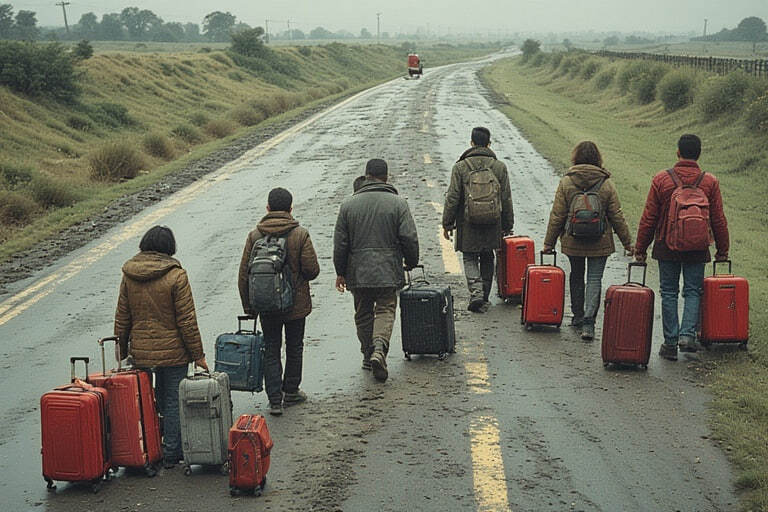
Depopulation—especially in the form of the departure of able-bodied families—is considered today a key socio-economic trend in the Baltic countries. Many researchers – not just journalists in mass media—call this depopulation a “national catastrophe.”
According to the 2024 World Factbook, Latvia ranked first among European countries in terms of depopulation, Lithuania ranked second, and Estonia ranked fifth, behind Poland and Romania. The numbers really do look like a demographic catastrophe.
Estonia, the most demographically prosperous of the Baltic countries, showed 9,691 births and 15,756 deaths last year, in 2024. In Latvia the situation is the same: 12,571 births last year (-13.2% compared to 2023) and 26,341 deaths (-6%); natural decline –13,770. The same happens in Lithuania: 22,068 births, 42,884 deaths; total fertility rate 1.27.
It would seem that the similar economic parameters of these five countries—Estonia, Poland, Romania, Latvia, and Lithuania—point to the underlying reason for depopulation. All of them serve as donors of labor resources to “old Europe.” For their citizens, the status of being EU members makes relocation and employment in more developed countries with higher wages significantly easier. Since it is primarily young and working-age families who move, they tend to postpone having children until after resettling; in Latvia, Lithuania, and Estonia, it is mainly the grandparents who remain, while their grandchildren are raised abroad as “Europeans.”
According to the Ministry of Foreign Affairs and the Migration Department, about 461,000 Lithuanians live abroad, with Germany and Ireland being the largest host countries. The figure is a huge number for a nation with fewer than 2.5 million inhabitants. Moreover, we are seeing migration motivated specifically by employment: Lithuania is among the countries with the fastest growth in the issuance of PD A1 certificates for those working in two or more countries (the category of multi-country employment).
Extremely low pensions deter elderly residents of the Baltics from emigrating. In January 2024, Latvia’s Ministry of Welfare reported that, including supplements, the average pension stood at €563. In Estonia, the figure was somewhat higher at €680, while in Lithuania, in March 2024, it was €596.19. At such pension levels, even €500 in remittances from adult children working in “old” Europe becomes a decisive factor for economic well-being. According to the Bank of Lithuania, private remittances to Lithuania in 2023 amounted to €903.26 million (1.4% of GDP).
At first glance, the reasons for depopulation are obvious. The reasoning outlined above appears correct but somewhat superficial. The economic, mercantile motive for population outflow accurately describes the present situation, but it does not explain why things turned out this way. It does not address why, after the collapse of the USSR and the rapid integration into the European Union, the Baltic states were left without socio-economic stabilizers—factors that would have kept their populations rooted in their traditional places of residence.
Had such stabilizers existed, the economic model might have developed in the opposite direction. One could reasonably assume that European entrepreneurs, recognizing the availability of large groups of well-educated, disciplined, and relatively inexpensive workers, would have started developing production facilities directly in the Baltics—as we see happening today, for example, in Vietnam. But this did not occur, and in the Baltics labor migration grew into full-fledged depopulation. So, what caused this particular demographic trajectory?
The Legacy of Stalinism: The Death of the Baltic Village
A key factor behind the rapid outflow of the Baltic states’ qualified and inexpensive labor force to “old Europe,” before Western European investors arrived in their own countries, lies in the destruction of the social roots of Baltic society—specifically, the rural way of life in these territories.
Before the Second World War, the Baltics were an agrarian region, with the majority of the population living in rural areas. The settlement system consisted mainly of small villages and farmsteads. In Latvia, some eastern districts (Latgale) were dominated by villages, while in other regions the population mostly lived on individual farmsteads. These farmsteads functioned as self-contained economic units with land ownership. The distance between homesteads ranged from 100–150 meters to 1–3 kilometers.
The situation in Estonia differed somewhat, as the land reform of 1919 nationalized noble estates and divided them into smaller plots, which were transferred to local landless peasants for farming in the homestead style. From the expropriated lands, the state created about 56,000 small new farms, whose owners were primarily landless Estonian peasants. Similarly, Lithuania carried out a comparable land reform aimed at forming a prosperous peasant class by creating a homestead-based farming system. By 1938, homestead landownership accounted for 84% of all peasant land in Lithuania.
Thus, the social foundation was not only individual farming (which in the West would be called a farm) but also individual settlement, outside of large villages—the homestead model of land use.
This settlement pattern did not fit the needs of the Soviet regime established in 1940. Despite attempts to establish a Soviet agricultural system in 1940–1941, it wasn’t until around 1949 that they began to implement it in earnest. Under threat of deportation, peasants were forced to “join” collective farms. Stalin’s regime adopted a tactic of forced resettlement. At the end of March 1949, mass deportations of the Baltic republics’ inhabitants to Siberia and the Far North began. During the major March deportation (Operation “Priboi”) alone, 94,779 people were deported. Official figures show that 33,496 were deported from Lithuania, 41,445 from Latvia, and 20,660 from Estonia.
As a result, the remaining rural population was stripped of its traditional way of life. Collectivization was directly tied to the transformation of rural settlements. The goal was to remove people from their homesteads and resettle them into collective farm villages—sometimes larger than small towns. By the mid-1980s, agricultural enterprises (kolkhozes and sovkhozes) covered about 70% of Lithuania’s territory, and large rural settlements accounted for 70–75% of all Lithuanian villages. This arrangement sharply contrasted with the traditional homestead-based settlement structure that had existed just half a century earlier.
Even those born in these new large, artificial “main estates” of collective and state farms felt no emotional attachment to their homes. These places carried no family history or ancestral ties. And even if, by Soviet standards, such settlements offered decent living conditions, their residents often perceived them as prison camps—without guards, but with the right to leave. They had not chosen this place or way of life. The Soviet urban planning strategy promoted the construction of urban-type apartment buildings in these “main estates” as part of a broader ideology of “merging city and countryside.” Moving from one’s own house into an apartment in a multi-story building further severed historical ties with the land. Importantly, this was not ethnic in character: such a “break with the homeland” affected all rural inhabitants of the Baltics—Russians, Estonians, Latvians, and Lithuanians alike.
The collapse of the Soviet system and the subsequent shift in economic structures also radically altered settlement trajectories. The inherited network of settlements, adapted to collective farming, no longer matched the new economic realities. In the former “main estates” of kolkhozes and sovkhozes, the dissolution of collective farms and the rapid decline in agricultural employment became decisive factors of transformation.
In 2023, employment in agriculture in Latvia accounted for 6.75% of total employment. This figure had been falling for four consecutive years and was 3.4 times lower than in 1991. According to the World Bank, agricultural employment in Estonia in this period was only 2.6% of the workforce. In Lithuania in 2023, 5.06% of total employment was in agriculture, a 4.76-fold decrease since 1991. In 1991, agricultural employment reached its peak, accounting for 24.10% of the total workforce.
This dramatic decline in agricultural employment, combined with the earlier destruction of the homestead-based farming system during the Soviet period, produced a population free of local ties and traditions—ready to leave their homeland easily and without deep hesitation in search of any available work in “old Europe,” even in jobs unattractive to Western Europeans themselves.
No factors or circumstances kept these families in the Baltics. They had no access to the traditional rural work of the past. They had no ancestral homesteads. They had no tradition of working independently on their own small plots. What they did have was a good education, a tradition of diligence, a European identity, and EU passports. This rapid relocation of young families from both rural and urban regions of the Baltics occurred so quickly that it outpaced business interest in the region’s cheap labor force.
The project of a “European Vietnam”—a manufacturing hub for EU countries—simply could not keep up with the Baltic youth, who were already rapidly leaving for work in “old Europe.”
Changes in Non-EU Suffrage in Estonia: Reasons and Potential Consequences
PSCRP-BESA Reports No 128 (April 26, 2025)
On 26 March 2025, the Estonian parliament (Riigikogu) voted on changing the country’s constitution in the part defining who is eligible to vote in local (municipal, in the case of cities) elections. Namely, Article 156 of Estonia’s Constitution was changed, and all citizens of non-EU countries can no longer vote at the local level. (Now, before the amendment is enforced, this Article is formulated as follows: “In elections to local authority councils, the right to vote is held, under conditions established by law, by persons who reside permanently in the territory of the local authority and have attained at least sixteen years of age.”) Those Estonian residents who do not hold any other citizenship (“non-citizens of Estonia”) might vote for the last time at the local elections in 2025, and after that, they will be equal in their rights (or their absence) to other non-EU citizens residing in the country. An alternative amendment, proposed by the right-wing Estonian Conservative People’s Party, to strip non-citizens of voting rights in 2025 immediately was rejected by the parliamentary majority. The voting took place in two steps: first, the MPs approved the very procedure of the urgent change of the country’s Constitution, and then they voted on the two alternative amendments (differing regarding the non-citizens’ voting rights). Only the parliamentary fraction of the Center Party (Keskerakond) voted against the very change of the Constitution; the initial bill was drafted by the center-liberal Reform Party, Social Democrats, and the left-liberal “Estonia 200.”
On the surface, this measure does not look extraordinary: even across the European Union, the practices differ regarding the municipal suffrage of non-EU residents and the Union’s citizens. Most EU countries do not grant non-EU foreigners any voting rights, including at the local level; the non-EU residents might vote, if meeting certain residential criteria, in the local elections only in Belgium, the Netherlands, Ireland, Slovenia, Denmark, Lithuania, Finland, and Sweden. In other countries, nobody (or almost nobody) protests against the “discrimination” of non-EU citizens, and their non-participation in local politics is considered something natural. However, if we take into account the context of the Estonian sociodemographic situation, it becomes clear why the issue of municipal suffrage turned into one of the most discussed Estonian news topics in recent months.
The Russophone minority currently comprises 21.6 percent of Estonia’s population; 20 percent of the local Russians have the so-called “aliens’ passports” (välismaalase pass). (“Non-citizens” constitute roughly 62,000 persons, which makes up 4.5 percent of the population, although not all of them are Russian or Russophone; close to 80,000 of the country’s residents hold Russia’s citizenship). This means that they are permanent residents of Estonia who cannot acquire Estonian citizenship by birthright and have not undergone the naturalization procedure; at the same time, they do not hold any other citizenship, which effectively turns this populational group into de jure apatrides. Despite this status, the differences in political and other rights with the full-fledged Estonian citizens are not that drastic – or they have not been before 26 March. For instance, in neighboring Latvia, the similar category of non-citizens (nepilsoņi) has never enjoyed any voting rights at all. Nevertheless, in Estonia there is a certain (although not that huge as often portrayed by Russian state media) portion of people who, being (for a certain, long enough period) tied to the country and the community they live in, do not have the country’s (and the EU’s) citizenship and would feel disenfranchised because of the potential inability to elect future local authorities. The issue thus acquires a strong political air and rises in significance not only in domestic but also in international political processes.
The effects and problems of the decision might be grouped in the following way.
First of all, if the declared goal was to diminish the potential malicious influence of Russia and Belarus on Estonia’s domestic affairs, the decision to exclude the citizens of all other non-EU countries (like, for instance, Moldova, Ukraine, Canada, or Norway) from local suffrage does not look justified. Also, it is not clear how the disenfranchisement of the local “non-citizens” (who do not have any other citizenship, including the passports of Russia or Belarus) might, at least de jure, diminish foreign influence – if one does not assume that these people are “pro-Russian” only because they are Russophone, regardless of their actual citizenship (or lack thereof). No less important is the fact that Estonian Russophone non-citizens have largely voted, in recent years, for either the Center Party, which has, apart from some most radical MPs, abandoned pro-Russian rhetoric of any kind in recent years, or for the party “KOOS,” which does not seem to have the potential of bridging the electoral threshold. Thus, the danger seems to be smaller than it is presented by the media and the ruling coalition.
Secondly, the measure, especially in the format it was presented to the general public, leaves no doubts regarding its main target, i.e., the local Russophone population. The share of those “Russians” that live in Estonia with Russian/Belarusian passports or with the grey “alien’s” passports is rather small, and the potential positive effect for the country’s security does not seem impressive. The political parties that supported the initiative might hope that disenfranchisement of non-EU citizens at the local level would, if not boost their popularity, then at least reduce the electoral gains of the Center Party. This may be true, but only in the local elections – indeed, the earlier loss of power by the Center Party in Tallinn, the country’s capital, might be further consolidated. However, those Russophone residents who have acquired Estonian citizenship and are eligible to vote nationally might, on the contrary, express their greater support, as a form of protest voting, for Centrists, the only parliamentary fraction that voted against the constitutional change. Or they may even lend more support to the extra-parliamentary and more radical, pro-Russian populist party “KOOS.” The above-mentioned parties, presenting themselves as the voices of the local Russians, have, for sure, already taken the opportunity to criticize the Estonian establishment for the estrangement of the Russophones. This critique is echoed by the Russian state-controlled media, read by many local Russians and negatively preoccupied with the Baltic countries’ domestic politics, which were quick to label the constitutional change as “Russophobic.” The effect on the national political landscape might thus prove to be contrary to what the legislators initially expected.
For Israel, this experience demonstrates once more the importance of developing a stable and coherent ethnic politics aimed at integration and non-estrangement of minorities, and the eternal necessity to strike a balance between the urge for securitization and the need for national coherence, resilience, and political stability.
Public discourse in Estonia concerning the Academy of Arts’ anti-Israeli decision
PSCRP-BESA Reports No 109 (Jan 13, 2025)
In December 2024, Mart Kalm, the rector of the Estonian Academy of Arts (Eesti Kunstiakadeemia, EKA), announced that this university would not continue its cooperation with Dr. Jonathan Ventura from Shenkar College in Ramat Gan (Israel), whose course had been in the EKA curriculum since 2019 and was scheduled to take place again in February 2025. Prof. Kalm added that EKA was “no longer open” to cooperation with Israeli universities. There was no clear reasoning behind this: the rector said that the move was in line with what other European universities were doing, and that Israeli colleagues (without names or institutions mentioned) understood his decision.
The situation was not uncommon among European universities in recent years, with several institutions in Spain, Belgium, the Netherlands, and others having severed ties with Israeli higher education. However, in Estonia, the art academy decision became the “biggest academic scandal” in 2024, as I may quote Priit Hõbemägi, one of the most renowned Estonian journalists. After the refusal to work with Israeli academics was made public, many Estonian politicians openly disagreed with this controversial move. Among them were Riina Solman (ex-Minister of Public Administration) and Urmas Paet (ex-Minister of Foreign Affairs and current Member of the European Parliament). Eerik-Niiles Kross (chair of the Estonian-Israeli parliament group, Reform Party) called Kalm’s decision “dim-witted antisemitism” and asked rhetorically if Estonian public universities should instead cooperate with universities led by Hamas. Marti Aavik, a prominent journalist, stated that it was a result of a “left-radical and Islamist alliance.” The country’s Prime Minister, Kristen Michal, along with Ministers of Foreign Affairs, Margus Tsahkna, and Education, Kristiina Kallas, asked Kalm to reconsider the decision’s utility and necessity. That recommendation was echoed by Maria Mägi-Rohtmets, the EKA’s Council chair, who reported that the Council had recommended Prof. Kalm reconsider the earlier move (which demonstrates, inter alia, that the rector’s demarche was rather spontaneous and uncoordinated). Sass Henno, a famous writer, demonstratively left his professorial position at EKA, and the Estonian Jewish Community unequivocally condemned Mart Kalm’s initiative.
It seems that the opponents of EKA’s anti-Israeli move numerically and influentially outweigh its supporters. Namely, the latter include some journalists from Eesti Päevaleht, one of the country’s leading newspapers (while another major newspaper, Postimees, seems to assume a more moderate, and sometimes even pro-Israeli, position), and some academic activists, mainly from Tallinn University. Two other big public universities, Tartu and TalTech, did not support the refusal to cooperate with Israel: the rector of Tartu University said that, if there were any institutionalized cooperation with Israeli institutions, TU wouldn’t cancel it, and the rector of TalTech stated that Kalm’s initiative “had a political air.” Tallinn University’s officials remained silent, and three lecturers from this institution, who self-represent as active members of “BDS in International Studies” (BDS – Boycott, Divestment, Sanctions, an international anti-Israeli influence group), published an open letter in support of an even broader anti-Israeli academic boycott. This had been their long-held and consistent position, judging by previous publications in the same Eesti Päevaleht newspaper; the latter’s opinion editor, Krister Paris, made his point of view crystal clear by stating that “first – Netanyahu to the Hague, then – normal relationships [with Israel].” The contrast with the attitude of some leading Postimees journalists is striking.
The division between the media structures seems to be more evident than the divide between the political parties on the issue of the Arab-Israeli conflict. However, the latter is also present, as in most other European democracies. While Isamaa (“Fatherland”), the Christian democratic party of national conservative orientation, criticizes all anti-Israeli demarches, the position of the center-left “Estonia 200” is more ambiguous. The conservative parties try to use the scandal to their advantage, criticizing the liberals for an “anti-Israeli turn”: in 2024, the Estonian MFA, controlled by “Estonia 200,” supported two anti-Israeli votes in the UN, which caused harsh critique from nearly all major parties in the country. In November, Margus Tsahkna (Minister for Foreign Affairs) said that Estonia would “take into account” the ICC arrest warrant against Benjamin Netanyahu. However, at least on the surface (and if we put aside the UN votes), the position of Tsahkna seems quite moderate, and he condemned the EKA decision as a “move in the wrong direction.”
Naturally, since Russia, as a neighbor of Estonia, remains a significant Other in public discourse, the issue of parallels with the war in Ukraine arises. Is Estonian policy consistent enough? The anti-Zionist critics compare Israel to Russia (and Gaza – to Ukraine) and ask rhetorically if the strict standards of international law should be applied differently to Moscow and Jerusalem. “If Estonia wanted Russia to be sanctioned for its crimes, it would be utmost hypocritical for us to think differently now in the case of Israel,” claims Kristi Ockba, an Estonian Middle East expert educated in Yemen, in her Eesti Päevaleht column. At the same time, the pro-Israeli public compares Israel to Ukraine, and Russia – to Hamas (as does, for instance, journalist Olga Štraube). Interestingly, the linguistic divide between Estonian-speaking and Russian-speaking communities has not affected the debate: the discussions are equally vivid in both language “camps,” with Russian-speaking journalists, academics, and artists actively participating.
After the unexpected (to him) public outrage, Prof. Kalm tried to explain the decision to cease any collaboration with Israeli institutions (actually, Shenkar College was the only one with which EKA still cooperated, as some other bilateral agreements peacefully “died” during the COVID pandemic). He said that the decision was “purely technical and not political” (ironically, the technical aspect is extremely unclear; for instance, some commentators cannot understand if the move affects cooperation in the Erasmus+ framework or just the bilateral ties). According to Kalm, the demarche was meant to “retain a secure working climate” at the Academy (Does the presence of Israeli professors or students make the working climate insecure?). He claims to be sorry for his “unclear wording that led to false interpretations.” However, the Estonian Academy of Arts has been known for its support of the Palestinian cause even before the scandal, in the format of public discussions, movie screenings, and a student-led Instagram account “EKA community for Palestine”; in the spring of 2024, Gaspar Šabad (Tallinn city assembly member) noticed a Palestinian flag waving on the Academy’s campus. The uncoordinated and unfounded (with any previous discussions and declarations) demarche of Mart Kalm makes it even more complicated for his potential successors in the rectoral position: he leaves his chair in April 2025, either to Kirke Kangro or to Hilkka Hiiop, and now there is no way for them to avoid tackling the Palestinian issue. Notably, both of them have by now refused to comment on the scandal.
As scholars of antisemitism and other types of biased hate, we should remind countries and institutions that double standards, demonization, and delegitimization of the State of Israel may easily turn a legitimate critique of a country’s government into manifestations of antisemitism (the famous 3D formula by Nathan Sharansky). Also, “holding Jews collectively responsible for actions of the State of Israel” is an inherent part of IHRA’s Working Definition of Antisemitism, which was adopted, in various forms, by many European institutions and countries (including Estonia in 2021). At the same time, we should not forget the immense support that Estonian politicians and the broader public have expressed towards Israel after October 7th. With Estonia remaining one of the most “non-anti-Zionist” countries in the European Union (judging by the parliamentary declarations and statements by the government officials), one should view the Estonian Academy of Arts’ decision as nothing more than an isolated and uncoordinated action that goes contrary to public opinion and official discourse. Nevertheless, the EKA scandal has finally turned the Middle Eastern conflict into a fully-fledged and widely discussed issue in Estonian society, and it is now not only (and not so much) about Israel but also about the intra-party divisions and media struggles, with the ghosts of Russia (as the – still – significant Other) and left-wing divide wandering over the debate.